









Six sintering processes for carboneto de silício ceramics
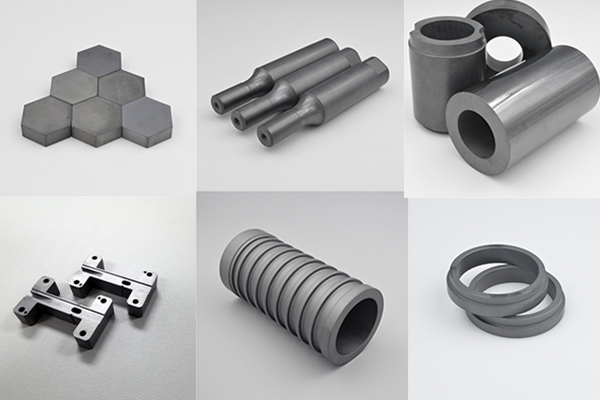
Sobre a sinterização de cerâmica de carboneto de silício (SiC)
A cerâmica de carboneto de silício com elevada dureza, elevado ponto de fusão, elevada resistência ao desgaste e à corrosão, bem como excelente resistência à oxidação, resistência a altas temperaturas, estabilidade química, resistência ao choque térmico, condutividade térmica e estanquidade ao ar, tem uma vasta gama de aplicações.
Atualmente, os métodos de sinterização das cerâmicas de carboneto de silício incluem principalmente a sinterização por prensagem a quente, a sinterização sem prensagem, a sinterização por reação, a sinterização por recristalização, a sinterização por micro-ondas e a sinterização por descarga de plasma.
Sinterização por prensagem a quente
Hot pressing sintering is to place the silicon carbide powder in the mold and apply an axial pressure of 20~50MPa at the same time of heating. This is helpful to increase the contact, diffusion and flow between particles and accelerate the rearrangement and densification in the sintering process.
Hot pressing sintering process is simple, the product density is high, can reach more than 99% of the theoretical density. Because the temperature of hot pressing sintering is low, the growth of grain is inhibited. And the resulting sintered grain is fine and strong. However, the hot pressing sintering equipment is complex, the mold material requirements are high, the production process requirements are strict, only suitable for the preparation of simple shape parts. And the energy consumption is large, low production efficiency, high production cost.
Sinterização sem pressão
O processo de sinterização sem pressão do carboneto de silício pode ser dividido em sinterização em fase sólida e sinterização em fase líquida.
The main disadvantages of solid phase sintering are as follows: high sintering temperature (> 2000℃) is required, high purity of raw materials is required. And the sintered body has low fracture toughness and strong crack strength sensitivity. This is manifested as coarse grain and poor uniformity in structure. And the fracture mode is typical transgranular fracture. In recent years, the research on silicon carbide ceramics at home and abroad focuses on liquid phase sintering.
A realização da sinterização em fase líquida baseia-se num certo número de aditivos de sinterização de óxidos eutécticos multivariados, como o Y2O3 binário, o aditivo ternário pode fazer com que o SiC e os seus materiais compósitos apresentem a sinterização em fase líquida, a densificação a uma temperatura mais baixa para realizar o material, ao mesmo tempo, devido à introdução da fase líquida nos limites do grão e ao enfraquecimento da força de ligação da interface única, o material cerâmico entra no modo de fratura intergranular, de modo que a resistência à fratura dos materiais cerâmicos pode ser significativamente melhorada.
Sinterização por reação
O processo de preparação de carboneto de silício por sinterização por reação consiste em pré-misturar uma quantidade adequada de material contendo carbono no pó de carboneto de silício e sintetizar novo carboneto de silício utilizando a reação a alta temperatura entre o carbono e o silício residual no pó de carboneto de silício, de modo a formar cerâmica de carboneto de silício com estrutura compacta.
Reactive sintering process has the advantages of low sintering temperature, short sintering time and near net size forming, etc. It is the most effective method to prepare large size and complex shape silicon carbide ceramics. However, reaction sintering is prone to some problems, such as uneven density of sintered products, easy cracking of sintered products. And insufficient silicon penetration in the sintering process. Moreover, this sintering process has high requirements on raw materials, high energy consumption and high production cost.
Recristalização sinterização
Recrystallization SiC ceramic material is different size of SiC particles in a column of grading than after molding for billet, grain in the slab of fine particles can be evenly distributed between the coarse particle pore. And then in the high temperature of 2100 ℃ above and some flow under the protection of the atmosphere, SiC fine particles gradually after evaporation condensation of coarse particle contact point precipitation, until the fine particle completely disappear. As a result of this evaporation-condensation mechanism, new grain boundaries are formed at the neck of the particles, resulting in the migration of fine particles and the formation of bridge structures between large particles and sintered bodies with a certain porosity.
This ceramic material does not contract despite the obvious neck growth process. Results The density of the product does not change in the sintering process, so its strength is relatively low. However, its advantage is that the ceramic material does not need any sintering assistant during the sintering process. And the sintered body is a single SiC crystal phase, so the material has excellent anti-oxidation performance. Meanwhile, the sintering process can produce large products with high precision size and no deformation.
Sinterização por micro-ondas
Em comparação com o processo de sinterização tradicional, a sinterização por micro-ondas tira partido da perda dieléctrica do material no campo eletromagnético de micro-ondas para aquecer todo o material até à temperatura de sinterização e realizar a sinterização e a densificação. Em comparação com o método de sinterização convencional, a sinterização por micro-ondas tem muitas vantagens, como a baixa temperatura de sinterização, a velocidade de aquecimento rápida, a boa densidade do material, etc. Ao mesmo tempo, a sinterização por micro-ondas acelera o processo de transferência de massa dos materiais, de modo a obter materiais de grão fino.
Sinterização por plasma de descarga
Discharge plasma sintering technology is a new powder metallurgy technology for the preparation of block materials. It USES high energy electric spark to complete the sample sintering process at low temperature and in a short time. It can be used for the preparation of metal materials, ceramic materials and composite materials. In the sintering process, instantaneous discharge between particles and high-temperature plasma can break or remove impurities (such as oxidation film) and adsorbed gas on the surface of powder particles, activate the surface of powder particles. And improve the sintering quality and efficiency.
By means of discharge plasma sintering technology, the SiC powder with Al2O3 and Y2O3 accelerators was sintered rapidly. And the dense SiC ceramics could be obtained.
Peças cerâmicas estruturais de carboneto de silício
Due to its various excellent properties, high-temperature bearings, bulletproof plates, nozzles, high-temperature corrosion-resistant parts. And electronic equipment parts in the high-temperature and high-frequency range made of SiC ceramics are widely used in petroleum, chemical, microelectronics and other fields, automobiles, It is widely used in industrial fields such as aerospace, aviation, papermaking, laser, mining and atomic energy.
Silicon carbide sintering is widely used in advanced ceramic applications.
Saiba mais sobre Silicon Carbide Sintering and our maquinagem de precisão em cerâmica services.
Perguntas mais frequentes
What is Silicon carbide sintering?
Silicon Carbide Sintering is an advanced technical ceramic material known for its exceptional properties including high thermal conductivity, excellent electrical insulation, and superior mechanical strength. Great Ceramic specializes in precision manufacturing of Silicon carbide sintering components.
What are the main applications of Silicon carbide sintering?
Silicon Carbide Sintering is widely used in semiconductor manufacturing, aerospace components, electronic substrates, medical implants, and high-temperature industrial applications. Its unique properties make it ideal for demanding environments.
How is Silicon carbide sintering machined?
Silicon Carbide Sintering requires specialized machining techniques including diamond grinding, ultrasonic machining, and laser cutting to achieve precision tolerances. Great Ceramic provides custom Silicon carbide sintering machining services with tight tolerances.