








Six sintering processes for carbure de silicium céramique
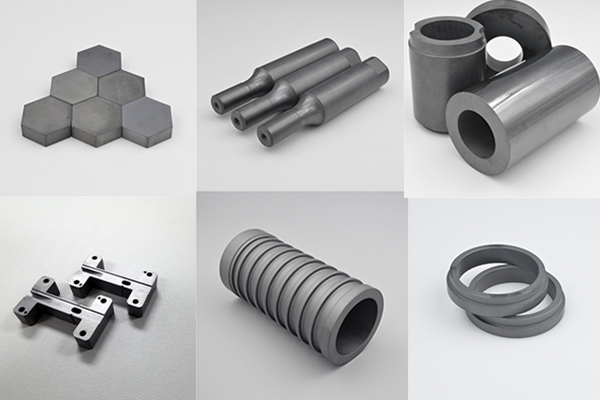
À propos du frittage de céramique de carbure de silicium (SiC)
Les céramiques de carbure de silicium ont une dureté élevée, un point de fusion élevé, une grande résistance à l'usure et à la corrosion, ainsi qu'une excellente résistance à l'oxydation, une résistance aux températures élevées, une stabilité chimique, une résistance aux chocs thermiques, une conductivité thermique et une étanchéité à l'air, ce qui leur confère un large éventail d'applications.
Actuellement, les méthodes de frittage des céramiques de carbure de silicium comprennent principalement le frittage par pressage à chaud, le frittage sans pressage, le frittage par réaction, le frittage par recristallisation, le frittage par micro-ondes et le frittage par plasma à décharge.
Pressage à chaud frittage
Hot pressing sintering is to place the silicon carbide powder in the mold and apply an axial pressure of 20~50MPa at the same time of heating. This is helpful to increase the contact, diffusion and flow between particles and accelerate the rearrangement and densification in the sintering process.
Hot pressing sintering process is simple, the product density is high, can reach more than 99% of the theoretical density. Because the temperature of hot pressing sintering is low, the growth of grain is inhibited. And the resulting sintered grain is fine and strong. However, the hot pressing sintering equipment is complex, the mold material requirements are high, the production process requirements are strict, only suitable for the preparation of simple shape parts. And the energy consumption is large, low production efficiency, high production cost.
Frittage sans pression
Le processus de frittage sans pression du carbure de silicium peut être divisé en frittage en phase solide et frittage en phase liquide.
The main disadvantages of solid phase sintering are as follows: high sintering temperature (> 2000℃) is required, high purity of raw materials is required. And the sintered body has low fracture toughness and strong crack strength sensitivity. This is manifested as coarse grain and poor uniformity in structure. And the fracture mode is typical transgranular fracture. In recent years, the research on silicon carbide ceramics at home and abroad focuses on liquid phase sintering.
La réalisation du frittage en phase liquide est basée sur un certain nombre d'additifs de frittage d'oxydes eutectiques multivariés, tels que l'additif binaire ou ternaire Y2O3, qui peuvent permettre au SiC et à ses matériaux composites de présenter le frittage en phase liquide, la densification à une température plus basse pour réaliser le matériau, En même temps, en raison de l'introduction de la phase liquide aux joints de grains et de l'affaiblissement de la force de liaison de l'interface unique, le matériau céramique passe au mode de fracture intergranulaire, de sorte que la résistance à la rupture des matériaux céramiques peut être améliorée de manière significative.
Frittage par réaction
Le procédé de préparation du carbure de silicium par frittage par réaction consiste à prémélanger une quantité appropriée de matériau contenant du carbone dans la poudre de carbure de silicium et à synthétiser un nouveau carbure de silicium en utilisant une réaction à haute température entre le carbone et le silicium résiduel dans la poudre de carbure de silicium de manière à former des céramiques de carbure de silicium avec une structure compacte.
Reactive sintering process has the advantages of low sintering temperature, short sintering time and near net size forming, etc. It is the most effective method to prepare large size and complex shape silicon carbide ceramics. However, reaction sintering is prone to some problems, such as uneven density of sintered products, easy cracking of sintered products. And insufficient silicon penetration in the sintering process. Moreover, this sintering process has high requirements on raw materials, high energy consumption and high production cost.
Recristallisation frittage
Recrystallization SiC ceramic material is different size of SiC particles in a column of grading than after molding for billet, grain in the slab of fine particles can be evenly distributed between the coarse particle pore. And then in the high temperature of 2100 ℃ above and some flow under the protection of the atmosphere, SiC fine particles gradually after evaporation condensation of coarse particle contact point precipitation, until the fine particle completely disappear. As a result of this evaporation-condensation mechanism, new grain boundaries are formed at the neck of the particles, resulting in the migration of fine particles and the formation of bridge structures between large particles and sintered bodies with a certain porosity.
This ceramic material does not contract despite the obvious neck growth process. Results The density of the product does not change in the sintering process, so its strength is relatively low. However, its advantage is that the ceramic material does not need any sintering assistant during the sintering process. And the sintered body is a single SiC crystal phase, so the material has excellent anti-oxidation performance. Meanwhile, the sintering process can produce large products with high precision size and no deformation.
Frittage par micro-ondes
Par rapport au processus de frittage traditionnel, le frittage par micro-ondes tire parti de la perte diélectrique du matériau dans le champ électromagnétique des micro-ondes pour chauffer l'ensemble du matériau à la température de frittage afin de réaliser le frittage et la densification. Comparé à la méthode de frittage conventionnelle, le frittage par micro-ondes présente de nombreux avantages, tels qu'une température de frittage basse, une vitesse de chauffage rapide, une bonne densité du matériau, etc. En outre, le frittage par micro-ondes accélère le processus de transfert de masse des matériaux, ce qui permet d'obtenir des matériaux à grain fin.
Frittage par plasma à décharge
Discharge plasma sintering technology is a new powder metallurgy technology for the preparation of block materials. It USES high energy electric spark to complete the sample sintering process at low temperature and in a short time. It can be used for the preparation of metal materials, ceramic materials and composite materials. In the sintering process, instantaneous discharge between particles and high-temperature plasma can break or remove impurities (such as oxidation film) and adsorbed gas on the surface of powder particles, activate the surface of powder particles. And improve the sintering quality and efficiency.
By means of discharge plasma sintering technology, the SiC powder with Al2O3 and Y2O3 accelerators was sintered rapidly. And the dense SiC ceramics could be obtained.
Pièces céramiques structurelles en carbure de silicium
Due to its various excellent properties, high-temperature bearings, bulletproof plates, nozzles, high-temperature corrosion-resistant parts. And electronic equipment parts in the high-temperature and high-frequency range made of SiC ceramics are widely used in petroleum, chemical, microelectronics and other fields, automobiles, It is widely used in industrial fields such as aerospace, aviation, papermaking, laser, mining and atomic energy.
Silicon carbide sintering is widely used in advanced ceramic applications.
En savoir plus sur Silicon Carbide Sintering et notre usinage de précision de la céramique services.
Questions fréquentes
What is Silicon carbide sintering?
Silicon Carbide Sintering is an advanced technical ceramic material known for its exceptional properties including high thermal conductivity, excellent electrical insulation, and superior mechanical strength. Great Ceramic specializes in precision manufacturing of Silicon carbide sintering components.
What are the main applications of Silicon carbide sintering?
Silicon Carbide Sintering is widely used in semiconductor manufacturing, aerospace components, electronic substrates, medical implants, and high-temperature industrial applications. Its unique properties make it ideal for demanding environments.
How is Silicon carbide sintering machined?
Le frittage du carbure de silicium nécessite des techniques d’usinage spécialisées, notamment la rectification diamant, l’usinage ultrasonique et la découpe laser, afin d’obtenir des tolérances de précision. Great Ceramic fournit des services d’usinage sur mesure du carbure de silicium fritté avec des tolérances serrées.