









Six sintering processes for węglik krzemu ceramics
O spiekaniu ceramicznym węglika krzemu (SiC)
Ceramika z węglika krzemu o wysokiej twardości, wysokiej temperaturze topnienia, wysokiej odporności na zużycie i odporności na korozję, a także doskonałej odporności na utlenianie, wytrzymałości na wysokie temperatury, stabilności chemicznej, odporności na szok termiczny, przewodności cieplnej i szczelności, ma szeroki zakres zastosowań.
Obecnie metody spiekania ceramiki z węglika krzemu obejmują głównie spiekanie z prasowaniem na gorąco, spiekanie bez prasowania, spiekanie reakcyjne, spiekanie rekrystalizacyjne, spiekanie mikrofalowe i spiekanie plazmowe.
Spiekanie metodą prasowania na gorąco
Hot pressing sintering is to place the silicon carbide powder in the mold and apply an axial pressure of 20~50MPa at the same time of heating. This is helpful to increase the contact, diffusion and flow between particles and accelerate the rearrangement and densification in the sintering process.
Hot pressing sintering process is simple, the product density is high, can reach more than 99% of the theoretical density. Because the temperature of hot pressing sintering is low, the growth of grain is inhibited. And the resulting sintered grain is fine and strong. However, the hot pressing sintering equipment is complex, the mold material requirements are high, the production process requirements are strict, only suitable for the preparation of simple shape parts. And the energy consumption is large, low production efficiency, high production cost.
Spiekanie bezciśnieniowe
Bezciśnieniowy proces spiekania węglika krzemu można podzielić na spiekanie w fazie stałej i spiekanie w fazie ciekłej.
The main disadvantages of solid phase sintering are as follows: high sintering temperature (> 2000℃) is required, high purity of raw materials is required. And the sintered body has low fracture toughness and strong crack strength sensitivity. This is manifested as coarse grain and poor uniformity in structure. And the fracture mode is typical transgranular fracture. In recent years, the research on silicon carbide ceramics at home and abroad focuses on liquid phase sintering.
Realizacja spiekania w fazie ciekłej opiera się na pewnej liczbie wielowariantowych eutektycznych dodatków do spiekania tlenków, takich jak dwuskładnikowy Y2O3, trójskładnikowy dodatek może sprawić, że SiC i jego materiały kompozytowe przedstawiają spiekanie w fazie ciekłej, zagęszczanie w niższej temperaturze w celu uzyskania materiału, Jednocześnie ze względu na wprowadzenie fazy ciekłej na granicach ziaren i unikalne osłabienie siły wiązania interfejsu, materiał ceramiczny może włamać się do trybu pękania międzykrystalicznego, dzięki czemu można znacznie poprawić odporność na pękanie materiałów ceramicznych.
Spiekanie reakcyjne
Proces wytwarzania węglika krzemu metodą spiekania reakcyjnego polega na wstępnym zmieszaniu odpowiedniej ilości materiału zawierającego węgiel w proszku węglika krzemu i syntezie nowego węglika krzemu przy użyciu reakcji wysokotemperaturowej między węglem a resztkowym krzemem w proszku węglika krzemu, tak aby utworzyć ceramikę z węglika krzemu o zwartej strukturze.
Reactive sintering process has the advantages of low sintering temperature, short sintering time and near net size forming, etc. It is the most effective method to prepare large size and complex shape silicon carbide ceramics. However, reaction sintering is prone to some problems, such as uneven density of sintered products, easy cracking of sintered products. And insufficient silicon penetration in the sintering process. Moreover, this sintering process has high requirements on raw materials, high energy consumption and high production cost.
Spiekanie rekrystalizacyjne
Recrystallization SiC ceramic material is different size of SiC particles in a column of grading than after molding for billet, grain in the slab of fine particles can be evenly distributed between the coarse particle pore. And then in the high temperature of 2100 ℃ above and some flow under the protection of the atmosphere, SiC fine particles gradually after evaporation condensation of coarse particle contact point precipitation, until the fine particle completely disappear. As a result of this evaporation-condensation mechanism, new grain boundaries are formed at the neck of the particles, resulting in the migration of fine particles and the formation of bridge structures between large particles and sintered bodies with a certain porosity.
This ceramic material does not contract despite the obvious neck growth process. Results The density of the product does not change in the sintering process, so its strength is relatively low. However, its advantage is that the ceramic material does not need any sintering assistant during the sintering process. And the sintered body is a single SiC crystal phase, so the material has excellent anti-oxidation performance. Meanwhile, the sintering process can produce large products with high precision size and no deformation.
Spiekanie mikrofalowe
W porównaniu z tradycyjnym procesem spiekania, spiekanie mikrofalowe wykorzystuje straty dielektryczne materiału w mikrofalowym polu elektromagnetycznym do podgrzania całego materiału do temperatury spiekania w celu spiekania i zagęszczania. W porównaniu z konwencjonalną metodą spiekania, spiekanie mikrofalowe ma wiele zalet, takich jak niska temperatura spiekania, duża prędkość nagrzewania, dobra gęstość materiału itp. Jednocześnie spiekanie mikrofalowe przyspiesza proces przenoszenia masy materiałów, co pozwala uzyskać materiały drobnoziarniste.
Wyładowcze spiekanie plazmowe
Discharge plasma sintering technology is a new powder metallurgy technology for the preparation of block materials. It USES high energy electric spark to complete the sample sintering process at low temperature and in a short time. It can be used for the preparation of metal materials, ceramic materials and composite materials. In the sintering process, instantaneous discharge between particles and high-temperature plasma can break or remove impurities (such as oxidation film) and adsorbed gas on the surface of powder particles, activate the surface of powder particles. And improve the sintering quality and efficiency.
By means of discharge plasma sintering technology, the SiC powder with Al2O3 and Y2O3 accelerators was sintered rapidly. And the dense SiC ceramics could be obtained.
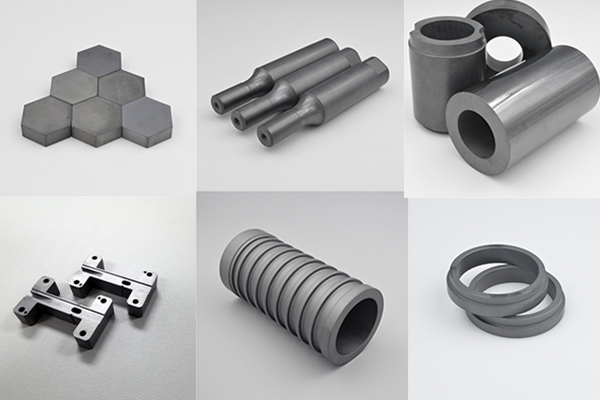
Części ceramiki strukturalnej z węglika krzemu
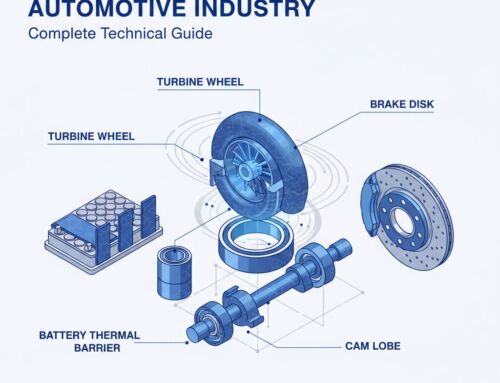
Due to its various excellent properties, high-temperature bearings, bulletproof plates, nozzles, high-temperature corrosion-resistant parts. And electronic equipment parts in the high-temperature and high-frequency range made of SiC ceramics are widely used in petroleum, chemical, microelectronics and other fields, automobiles, It is widely used in industrial fields such as aerospace, aviation, papermaking, laser, mining and atomic energy.
Silicon carbide sintering is widely used in advanced ceramic applications.
Dowiedz się więcej o Silicon Carbide Sintering and our precyzyjna obróbka ceramiki usługi.
Często zadawane pytania
What is Silicon carbide sintering?
Silicon Carbide Sintering is an advanced technical ceramic material known for its exceptional properties including high thermal conductivity, excellent electrical insulation, and superior mechanical strength. Great Ceramic specializes in precision manufacturing of Silicon carbide sintering components.
What are the main applications of Silicon carbide sintering?
Silicon Carbide Sintering is widely used in semiconductor manufacturing, aerospace components, electronic substrates, medical implants, and high-temperature industrial applications. Its unique properties make it ideal for demanding environments.
How is Silicon carbide sintering machined?
Silicon Carbide Sintering requires specialized machining techniques including diamond grinding, ultrasonic machining, and laser cutting to achieve precision tolerances. Great Ceramic provides custom Silicon carbide sintering machining services with tight tolerances.