








Six sintering processes for silisyum karbür SERAMİK
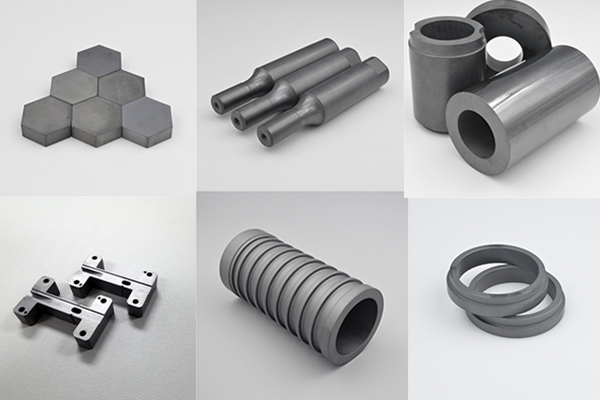
Silisyum Karbür (SiC) Seramik Sinterleme Hakkında
Yüksek sertlik, yüksek erime noktası, yüksek aşınma direnci ve korozyon direncinin yanı sıra mükemmel oksidasyon direnci, yüksek sıcaklık dayanımı, kimyasal stabilite, termal şok direnci, termal iletkenlik ve hava sızdırmazlığına sahip silisyum karbür seramikler geniş bir uygulama alanına sahiptir.
Şu anda, silisyum karbür seramiklerin sinterleme yöntemleri temel olarak sıcak presleme sinterleme, preslemesiz sinterleme, reaksiyon sinterleme, yeniden kristalleştirme sinterleme, mikrodalga sinterleme ve deşarj plazma sinterlemeyi içerir.
Sıcak presleme sinterleme
Hot pressing sintering is to place the silicon carbide powder in the mold and apply an axial pressure of 20~50MPa at the same time of heating. This is helpful to increase the contact, diffusion and flow between particles and accelerate the rearrangement and densification in the sintering process.
Hot pressing sintering process is simple, the product density is high, can reach more than 99% of the theoretical density. Because the temperature of hot pressing sintering is low, the growth of grain is inhibited. And the resulting sintered grain is fine and strong. However, the hot pressing sintering equipment is complex, the mold material requirements are high, the production process requirements are strict, only suitable for the preparation of simple shape parts. And the energy consumption is large, low production efficiency, high production cost.
Basınçsız sinterleme
Silisyum karbürün basınçsız sinterleme işlemi katı faz sinterleme ve sıvı faz sinterleme olarak ikiye ayrılabilir.
The main disadvantages of solid phase sintering are as follows: high sintering temperature (> 2000℃) is required, high purity of raw materials is required. And the sintered body has low fracture toughness and strong crack strength sensitivity. This is manifested as coarse grain and poor uniformity in structure. And the fracture mode is typical transgranular fracture. In recent years, the research on silicon carbide ceramics at home and abroad focuses on liquid phase sintering.
Sıvı faz sinterlemesinin gerçekleştirilmesi, Y2O3 ikili, üçlü katkı maddesi gibi belirli sayıda çok değişkenli ötektik oksit sinterleme katkı maddelerine dayanır, SiC ve kompozit malzemelerinin sıvı faz sinterlemesini, malzemeyi gerçekleştirmek için daha düşük bir sıcaklıkta yoğunlaştırmayı sunmasını sağlayabilir, Aynı zamanda, sıvı fazın tane sınırlarına girmesi ve benzersiz arayüz bağlanma mukavemetinin zayıflaması nedeniyle, seramik malzemenin taneler arası kırılma moduna girme yolu, böylece seramik malzemelerin kırılma tokluğu önemli ölçüde iyileştirilebilir.
Reaksiyon sinterleme
Reaksiyon sinterleme ile silisyum karbür hazırlama işlemi, silisyum karbür tozuna uygun miktarda karbon içeren malzemeyi önceden karıştırmak ve kompakt yapıya sahip silisyum karbür seramikler oluşturmak için silisyum karbür tozundaki karbon ve artık silikon arasında yüksek sıcaklık reaksiyonu kullanarak yeni silisyum karbür sentezlemektir.
Reactive sintering process has the advantages of low sintering temperature, short sintering time and near net size forming, etc. It is the most effective method to prepare large size and complex shape silicon carbide ceramics. However, reaction sintering is prone to some problems, such as uneven density of sintered products, easy cracking of sintered products. And insufficient silicon penetration in the sintering process. Moreover, this sintering process has high requirements on raw materials, high energy consumption and high production cost.
Yeniden kristalleşme sinterlemesi
Recrystallization SiC ceramic material is different size of SiC particles in a column of grading than after molding for billet, grain in the slab of fine particles can be evenly distributed between the coarse particle pore. And then in the high temperature of 2100 ℃ above and some flow under the protection of the atmosphere, SiC fine particles gradually after evaporation condensation of coarse particle contact point precipitation, until the fine particle completely disappear. As a result of this evaporation-condensation mechanism, new grain boundaries are formed at the neck of the particles, resulting in the migration of fine particles and the formation of bridge structures between large particles and sintered bodies with a certain porosity.
This ceramic material does not contract despite the obvious neck growth process. Results The density of the product does not change in the sintering process, so its strength is relatively low. However, its advantage is that the ceramic material does not need any sintering assistant during the sintering process. And the sintered body is a single SiC crystal phase, so the material has excellent anti-oxidation performance. Meanwhile, the sintering process can produce large products with high precision size and no deformation.
Mikrodalga sinterleme
Geleneksel sinterleme işlemi ile karşılaştırıldığında, mikrodalga sinterleme, sinterleme ve yoğunlaştırmayı gerçekleştirmek için tüm malzemeyi sinterleme sıcaklığına ısıtmak için mikrodalga elektromanyetik alanındaki malzemenin dielektrik kaybından yararlanır. Geleneksel sinterleme yöntemiyle karşılaştırıldığında, mikrodalga sinterlemenin düşük sinterleme sıcaklığı, hızlı ısıtma hızı, iyi malzeme yoğunluğu vb. gibi birçok avantajı vardır. Aynı zamanda, mikrodalga sinterleme, ince taneli malzemeler elde etmek için malzemelerin kütle transfer sürecini hızlandırır.
Deşarj plazma sinterleme
Discharge plasma sintering technology is a new powder metallurgy technology for the preparation of block materials. It USES high energy electric spark to complete the sample sintering process at low temperature and in a short time. It can be used for the preparation of metal materials, ceramic materials and composite materials. In the sintering process, instantaneous discharge between particles and high-temperature plasma can break or remove impurities (such as oxidation film) and adsorbed gas on the surface of powder particles, activate the surface of powder particles. And improve the sintering quality and efficiency.
By means of discharge plasma sintering technology, the SiC powder with Al2O3 and Y2O3 accelerators was sintered rapidly. And the dense SiC ceramics could be obtained.
Silisyum Karbür Yapısal Seramik Parçalar
Due to its various excellent properties, high-temperature bearings, bulletproof plates, nozzles, high-temperature corrosion-resistant parts. And electronic equipment parts in the high-temperature and high-frequency range made of SiC ceramics are widely used in petroleum, chemical, microelectronics and other fields, automobiles, It is widely used in industrial fields such as aerospace, aviation, papermaking, laser, mining and atomic energy.
Silicon carbide sintering is widely used in advanced ceramic applications.
Hakkında daha fazla bilgi edinin Silicon Carbide Sintering ve bizim hassas serami̇k i̇şleme hizmetler.
Sıkça Sorulan Sorular
What is Silicon carbide sintering?
Silicon Carbide Sintering is an advanced technical ceramic material known for its exceptional properties including high thermal conductivity, excellent electrical insulation, and superior mechanical strength. Great Ceramic specializes in precision manufacturing of Silicon carbide sintering components.
What are the main applications of Silicon carbide sintering?
Silicon Carbide Sintering is widely used in semiconductor manufacturing, aerospace components, electronic substrates, medical implants, and high-temperature industrial applications. Its unique properties make it ideal for demanding environments.
How is Silicon carbide sintering machined?
Silicon Carbide Sintering requires specialized machining techniques including diamond grinding, ultrasonic machining, and laser cutting to achieve precision tolerances. Great Ceramic provides custom Silicon carbide sintering machining services with tight tolerances.