








Silicon Nitride Ceramic for Automotive Industry: Complete Technical Guide
The transition toward high-efficiency internal combustion engines (ICE) and high-voltage electric vehicles (EVs) has fundamentally altered the material requirements for critical drivetrain and powertrain components. Standard metallic alloys often fail under extreme thermal stress, rapid thermal cycling. And high-velocity friction. Enter silisyum nitrür ceramic for automotive industry applications—a state-of-the-art non-oxide structural material engineered to withstand temperatures exceeding 1,000°C while maintaining exceptional fracture toughness and mechanical fatigue resistance. With a unique interlocking microstructure, silicon nitride mitigates premature component failure, prevents electrical arcing in EV motor bearings. And reduces rotational mass by up to 60% compared to bearing steels. However, the true bottleneck lies in manufacturing these components to exact geometric specifications. Great Ceramic bridges this gap by leveraging advanced diamond grinding technologies to deliver custom silisyum nitrür parts with ultra-tight ±0.005mm tolerances. If your automotive project demands uncompromising precision, contact Great Ceramic today to secure reliable, performance-critical components.
Malzeme Özellikleri
The extraordinary performance of silicon nitride in vehicular applications stems directly from its unique thermodynamic and mechanical properties. Unlike traditional oxide ceramics that suffer from inherent brittleness, the beta-phase ($\beta$-Si3N4) crystalline structure features elongated, needle-like grains. When subjected to severe mechanical stress—such as the 2,500+ bar pressure found in modern diesel fuel injection systems—these interlocking grains create a tortuous crack propagation path, effectively absorbing the fracture energy and preventing catastrophic failure. The material’s inherently low coefficient of thermal expansion (3.2 x 10⁻⁶ /°C) combined with moderate thermal conductivity ensures superior thermal shock resistance, allowing automotive components to survive rapid temperature fluctuations (ΔT > 600°C) without micro-cracking.
| Mülkiyet | Değer | Birim |
|---|---|---|
| Yoğunluk | 3.20 – 3.30 | g/cm³ |
| Sertlik | 1,500 – 1,700 | HV |
| Eğilme Dayanımı | 800 – 1,100 | MPa |
| Kırılma Tokluğu | 6,5 – 8,0 | MPa-m½ |
| Termal İletkenlik | 25 - 35 | W/m-K |
| Elektriksel Dirençlilik | > 10¹⁴ | Ω-cm |
| Maksimum Çalışma Sıcaklığı | 1,200 | °C |
Diğer Seramiklerle Karşılaştırma
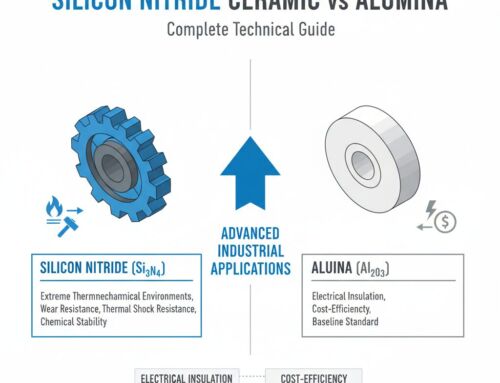
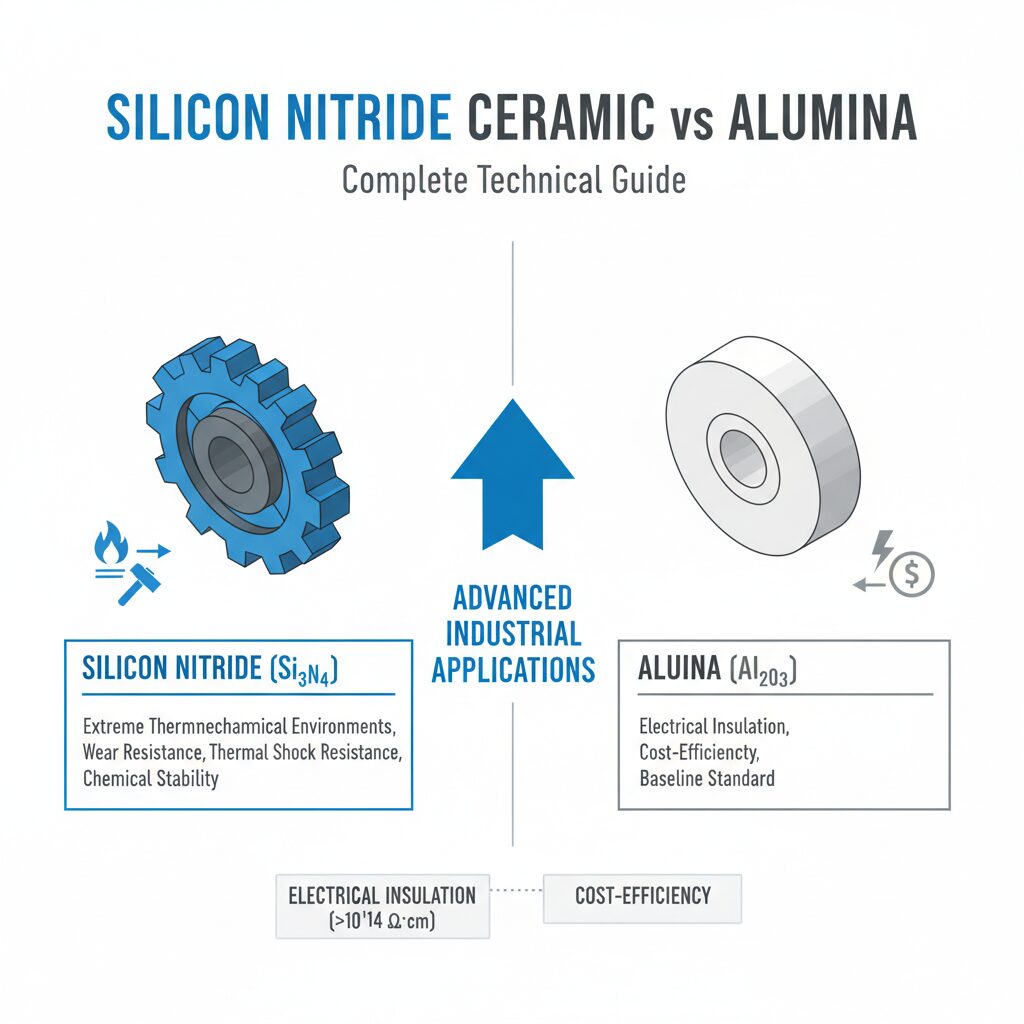
Selecting the optimal technical ceramic for automotive engineering requires a strict comparative analysis of mechanical degradation under operational loads. While standard metallic alloys max out their operational utility at roughly 600°C, technical ceramics push thermal envelopes far beyond standard engineering limits. When evaluating tribological performance, high-speed rotational mass. And thermal dissipation, silicon nitride frequently emerges as the optimal choice over alternative materials like alümina/”>alümina (aluminum oxide), Zirkonya (zirconium dioxide). And silisyum karbür. For instance, while silicon carbide offers superior hardness and thermal conductivity, its low fracture toughness makes it highly susceptible to impact damage in dynamic engine environments. Conversely, zirconia provides high fracture toughness but suffers from rapid thermal degradation and phase transformation at temperatures exceeding 500°C. Silicon nitride occupies the critical middle ground: it provides enough toughness to survive shock loads, enough hardness to resist abrasive wear. And thermal stability to operate continuously at 1,000°C.
| Mülkiyet | Silisyum Karbür | Alümina | Zirkonya | Silisyum Nitrür |
|---|---|---|---|---|
| Termal İletkenlik (W/m-K) | 120 – 150 | 25 - 35 | 2.0 - 3.0 | 25 - 35 |
| Sertlik (HV) | 2,400 – 2,800 | 1,400 – 1,600 | 1,200 – 1,300 | 1,500 – 1,700 |
| Kırılma Tokluğu (MPa-m½) | 3.5 – 4.5 | 3.5 – 4.5 | 8.0 - 10.0 | 6,5 – 8,0 |
| Maliyet | Yüksek | Düşük | Orta | Yüksek |
Uygulamalar
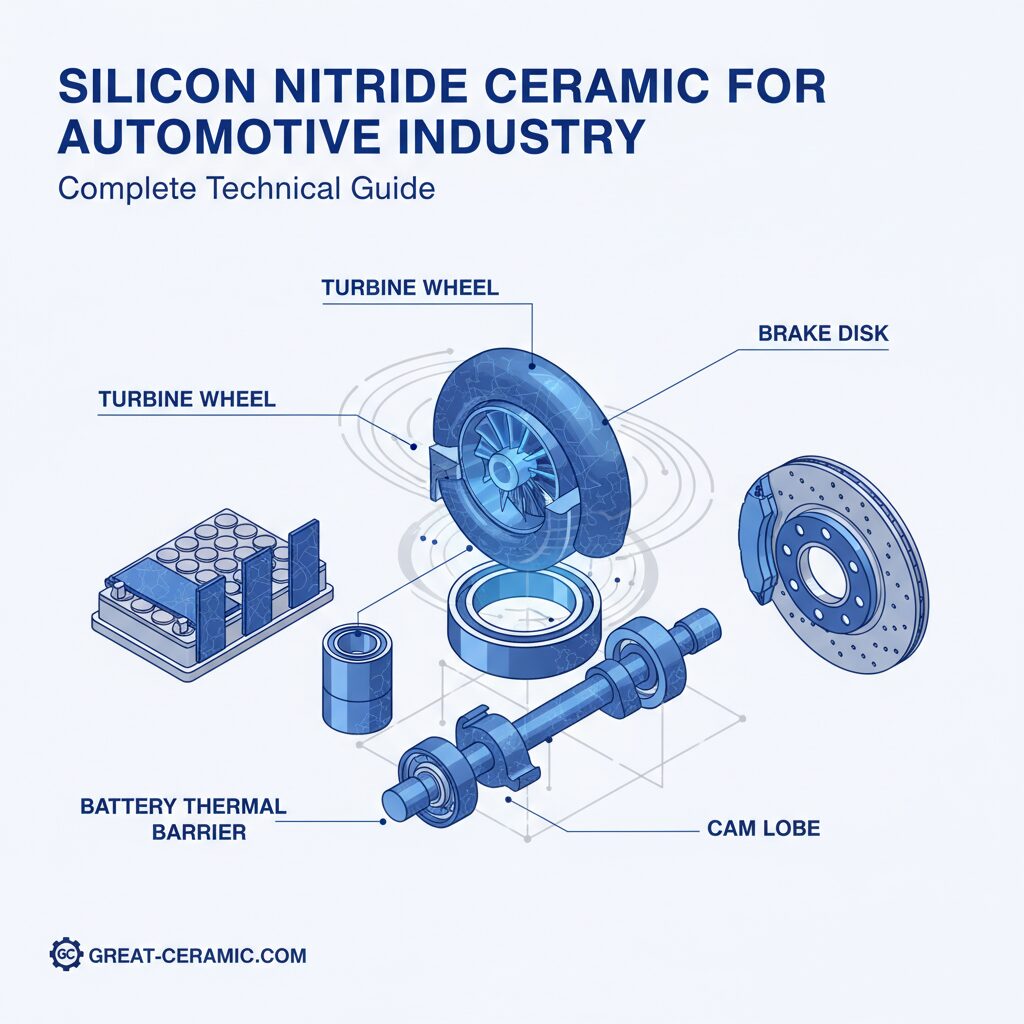
The integration of silicon nitride components spans across both legacy internal combustion ecosystems and next-generation battery electric vehicle (BEV) platforms. The material’s unique combination of dielectric strength, low mass. And high contact-fatigue resistance dictates its use in environments where failure is not an option.
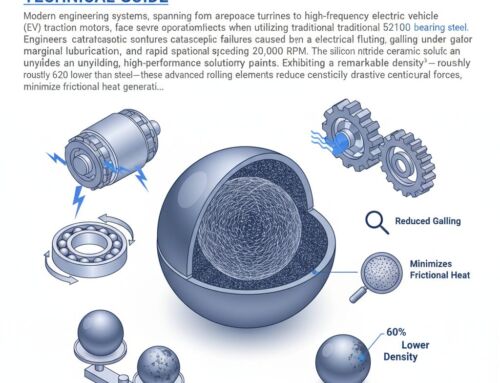
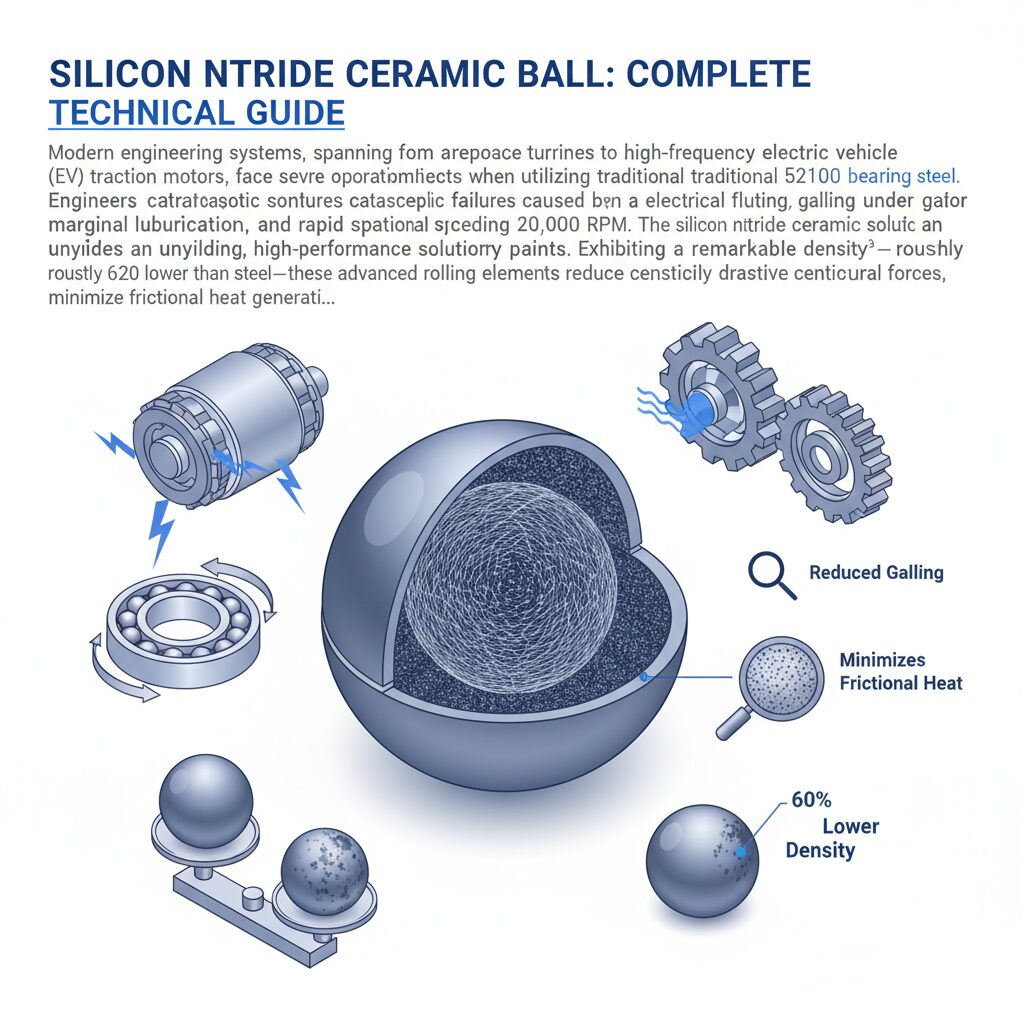
- Electric Vehicle (EV) Motor Bearings: In high-performance electric motors spinning at 20,000+ RPM, stray electrical currents generate electrical discharge machining (EDM) effects, causing severe micro-pitting in standard steel bearings. Silicon nitride rolling elements provide absolute electrical isolation (>10¹⁴ Ω·cm resistivity), eliminating electrical arcing completely. Additionally, their lower density (3.2 g/cm³) reduces centrifugal forces on the outer bearing race by 40%, drastically lowering heat generation and extending battery range.
- Turbocharger Rotors: Internal combustion engines require immediate forced induction to minimize “turbo lag.” Silicon nitride turbocharger rotors weigh nearly 50% less than their Inconel or nickel-alloy counterparts. This dramatic reduction in rotational inertia allows the turbo to spool up up to 30% faster. Furthermore, the material maintains its yield strength at exhaust gas temperatures of 1,050°C, eliminating the creep deformation commonly seen in metallic turbines.
- High-Pressure Fuel Injection Systems: Modern common-rail diesel engines inject fuel at extreme pressures exceeding 2,500 bar to optimize atomization and reduce particulate emissions. Plungers, control valves. And roller tappets manufactured from silicon nitride easily endure these severe Hertzian contact stresses. The ceramic’s ultra-hard surface prevents the abrasive wear caused by low-lubricity fuels, ensuring exact injection timing over a lifespan of 500,000+ miles.
- Glow Plugs for Diesel Engines: Cold-start emissions are heavily regulated in modern automotive standards. Silicon nitride ceramic glow plugs feature an integrated tungsten heating element encased in the ceramic body. They can heat from ambient temperature to 1,200°C in under 2 seconds. The exceptional thermal shock resistance of silicon nitride ensures the plug does not shatter during rapid heating, while its chemical inertness resists the highly corrosive combustion gases.
- Valve Train Components: Cam rollers, tappets. And engine valves machined from silicon nitride reduce parasitic mechanical friction in the valve train by up to 30%. Because silicon nitride requires virtually no lubrication to prevent galling against steel camshafts, engine designers can utilize lower viscosity motor oils. This directly translates to improved fuel economy and reduced CO2 emissions, critical for meeting stringent Euro 7 and EPA tier standards.
Üretim Süreci
Transforming raw silicon and nitrogen into a fully dense, dimensionally accurate automotive component requires a tightly controlled metallurgical and ceramic engineering process. The process requires navigating shrinkage rates of up to 20% during consolidation, followed by rigorous diamond-abrasive machining to hit automotive OEM tolerance requirements.
Şekillendirme Yöntemleri
- Soğuk İzostatik Presleme (CIP): High-purity silicon nitride powder, mixed with specific sintering aids (such as yttria and alumina), is encapsulated in a flexible mold and subjected to uniform hydrostatic pressure (typically 200-300 MPa). This method ensures consistent density gradients, critical for large or cylindrical automotive parts like fuel pump plungers.
- Seramik Enjeksiyon Kalıplama (CIM): For high-volume, complex-geometry automotive parts like turbocharger rotors, CIM is utilized. The ceramic powder is mixed with a thermoplastic binder, injected into a precisely machined mold cavity. And subsequently debinded. This near-net-shape manufacturing significantly reduces downstream machining costs.
Sinterleme
The densification of silicon nitride requires high-temperature processing to trigger liquid-phase sintering. Because silicon nitride sublimates (decomposes into silicon and nitrogen gas) at atmospheric pressure around 1,850°C, specialized sintering environments are mandatory. Gas Pressure Sintering (GPS) is the industry standard for automotive components. The process occurs in a nitrogen atmosphere pressurized to 1-10 MPa at temperatures ranging from 1,750°C to 1,900°C. The pressure suppresses the decomposition of $Si_3N_4$, allowing the sintering aids to melt and form a glassy secondary phase that densifies the ceramic to >99% theoretical density. During this stage, the alpha-phase powder transforms into the robust, interlocking beta-phase microstructure that gives the material its signature fracture toughness.
Son İşleme
Post-sintering, the silicon nitride blank is exceptionally hard (up to 1,700 HV) and requires highly specialized subtractive manufacturing. Final machining is strictly performed using resin-bonded and metal-bonded diamond abrasive wheels. Operations include cylindrical grinding, centerless grinding, honing. And lapping to achieve required surface finishes (Ra < 0.1 µm) and dimensional tolerances. Through advanced hassas serami̇k i̇şleme techniques, Great Ceramic routinely achieves ultra-tight tolerances of ±0.005mm, ensuring exact fitment for critical automotive assemblies.
Avantajlar ve Sınırlamalar
Avantajlar
- Superior Thermal Shock Resistance: Capable of withstanding instantaneous temperature drops of over 600°C without initiating micro-fractures, far exceeding the capabilities of alumina.
- High Strength at Elevated Temperatures: Retains its flexural strength (up to 1,000 MPa) even when operating continuously at 1,000°C, outperforming nearly all structural metallic superalloys.
- Extremely Low Density: At 3.2 g/cm³, it is less than half the weight of steel (7.8 g/cm³), drastically reducing rotational inertia in dynamic automotive applications.
- Exceptional Wear Resistance and Galling Prevention: The high hardness prevents abrasive wear. And unlike metals, silicon nitride will not cold-weld or gall when running against steel under high pressure with marginal lubrication.
Sınırlamalar
- High Manufacturing Cost: The requirement for expensive raw powders, specialized pressurized sintering furnaces. And diamond-tool machining makes the initial unit cost higher than metallic equivalents.
- Difficult to Machine: Its extreme hardness makes standard CNC tooling (carbide, high-speed steel) completely useless. Strict reliance on diamond grinding significantly increases processing times.
İşleme ile İlgili Hususlar
Machining silicon nitride to automotive specifications is fraught with technical engineering challenges. The material’s extreme hardness combined with its brittle nature (relative to metals) means that standard turning and milling operations are impossible on fully sintered blanks. The primary material removal mechanism is brittle fracture via abrasive grinding. If the grinding parameters are not meticulously optimized, the process will induce sub-surface micro-cracking, residual tensile stresses. And edge chipping. This drastically reduce the component’s fatigue life.
To overcome these challenges, Great Ceramic utilizes highly rigid, vibration-dampened CNC grinding centers equipped with continuous dressing mechanisms. Spindle speeds exceeding 10,000 RPM are paired with meticulously calculated feed rates—often as low as 0.01 mm/min for finishing passes—to ensure the diamond grit removes material in the “ductile regime” rather than causing brittle fracture. Flood cooling with specialized synthetic cutting fluids is heavily utilized to dissipate the intense localized heat generated at the grinding interface, preventing thermal damage to both the ceramic surface and the diamond wheel.
| İşleme Parametresi | Rough Grinding | Finish Grinding | Lapping/Polishing |
|---|---|---|---|
| Diamond Grit Size (Mesh) | 100 – 150 | 300 – 400 | Sub-micron paste |
| Spindle Speed (RPM) | 5,000 – 8,000 | 8,000 – 12,000 | 100 – 500 (Platen) |
| Depth of Cut (mm) | 0.02 – 0.05 | 0.002 - 0.005 | N/A |
| Target Surface Finish (Ra) | > 0.8 µm | 0.2 – 0.4 µm | < 0.05 µm |
Achieving geometric perfection in automotive bearings and fuel pump components dictates rigid quality control. Great Ceramic implements in-process metrology to measure concentricity, cylindricity. And runout down to single-digit microns. Our expertise in managing grinding kinematics ensures that we consistently deliver silicon nitride components that meet exact ±0.005mm tolerances. If you are struggling with component wear, thermal failure, or high parasitic mass in your automotive systems, contact Great Ceramic to request an engineering consultation and precision machining quotation.
FAQ
What is silicon nitride ceramic for automotive industry?
Silicon nitride ($Si_3N_4$) is an advanced non-oxide technical ceramic known for its unparalleled combination of high fracture toughness, thermal shock resistance. And low density. In the automotive industry, it is utilized as a high-performance substitute for metallic alloys in environments subjected to extreme heat, high friction. And rapid rotational speeds, such as EV motor bearings, turbochargers. And high-pressure fuel injection systems.
What are the main applications of silicon nitride ceramic for automotive industry?
The material is primarily deployed in highly stressed dynamic environments. Critical applications include high-speed rolling element bearings in electric vehicle (EV) traction motors to prevent electrical pitting, turbocharger rotors to reduce turbo lag, glow plugs for ultra-fast heating in diesel engines. And common-rail fuel pump plungers designed to withstand injection pressures exceeding 2,500 bar without abrasive wear.
How does silicon nitride compare to other ceramics?
Compared to alumina, silicon nitride possesses double the fracture toughness and exponentially greater thermal shock resistance, allowing it to survive extreme temperature fluctuations. While zirconia offers higher fracture toughness at room temperature, silicon nitride maintains its mechanical strength and phase stability well past 1,000°C, whereas zirconia severely degrades above 500°C. Compared to silicon carbide, silicon nitride provides superior impact resistance and is far less prone to catastrophic shattering under dynamic loads.
What are the advantages of silicon nitride ceramic for automotive industry?
The definitive advantages include a massive 60% reduction in mass compared to steel (drastically lowering rotational inertia), total electrical insulation to eliminate EV bearing arcing, absolute resistance to thermal shock up to a ΔT of 600°C. And a low coefficient of friction. These characteristics collectively improve engine thermal efficiency, increase EV battery range. And extend the mean time between failures (MTBF) for critical drivetrain components.
How is silicon nitride machined?
Due to its high hardness (up to 1,700 HV), fully sintered silicon nitride cannot be machined using standard cutting tools. It requires specialized, high-RPM precision CNC grinding, lapping. And honing utilizing diamond-bonded abrasives under strict coolant protocols. Great Ceramic specializes in the complex precision machining of silicon nitride, leveraging multi-axis CNC grinding technology to deliver complex automotive geometries with ultra-tight tolerances down to ±0.005mm and mirror-like surface finishes (Ra < 0.1 µm).
Need custom silicon nitride ceramic for automotive industry parts? Great Ceramic ile iletişime geçin dar toleranslara sahip hassas işleme hizmetleri için veya e-posta [email protected].
silicon nitride ceramic for automotive industry is widely used in advanced ceramic applications.
Hakkında daha fazla bilgi edinin Otomotiv Endüstrisi için Silisyum Nitrür Seramik ve hassas seramik işleme hizmetlerimiz.