







Machinable Glass Ceramic vs Steel: Complete Technical Guide
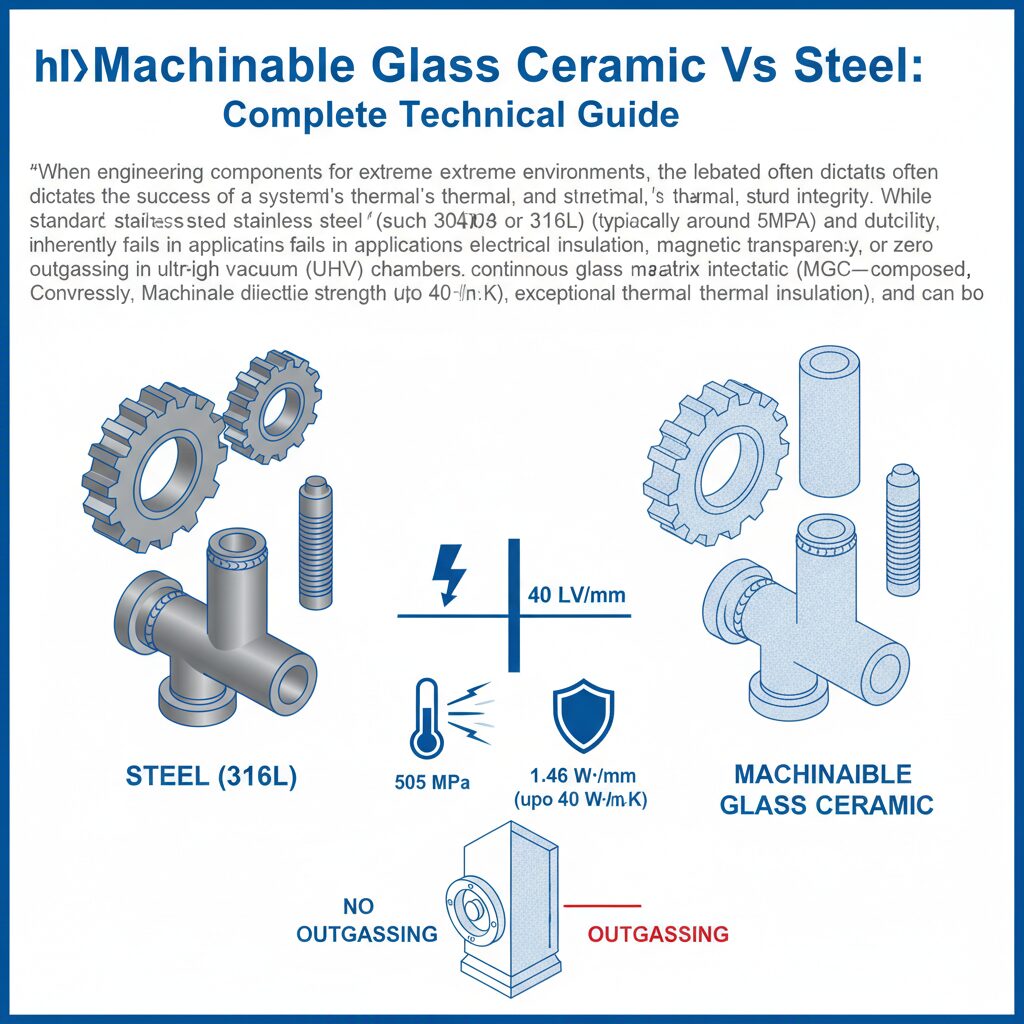
When engineering components for extreme environments, the debate between machinable glass ceramic vs steel often dictates the success of a system’s thermal, electrical. And structural integrity. While standard stainless steel (such as 304 or 316L) provides excellent tensile strength (typically around 505 MPa) and ductility, it inherently fails in applications requiring electrical insulation, magnetic transparency, or zero outgassing in ultra-high vacuum (UHV) chambers. Conversely, Machinable Glass Ceramic (MGC)—composed of a continuous borosilicate glass matrix interlaced with fluorphlogopite mica crystals—delivers outstanding dielectric strength (up to 40 kV/mm), exceptional thermal insulation (1.46 W/m·K). And can be machined using standard metalworking tools without post-sintering shrinkage. This guide provides a definitive, data-driven comparison of these materials to help engineers and procurement teams optimize their R&D and production lines. For engineered components requiring ±0.005mm tolerances in advanced materials, partner with Great Ceramic for industry-leading precision.
Malzeme Özellikleri
Understanding the fundamental material properties is critical when transitioning a design from traditional metals to advanced ceramics. Below is the baseline data for high-grade Machinable Glass Ceramic (MGC). For comparison, standard 304 Stainless Steel exhibits a density of 8.00 g/cm³, a thermal conductivity of 16.2 W/m·K. And an electrical resistivity of just 7.2 x 10^-5 Ω·cm.
| Mülkiyet | Değer | Birim |
|---|---|---|
| Yoğunluk | 2.52 | g/cm³ |
| Sertlik | 250 | HV |
| Eğilme Dayanımı | 94 | MPa |
| Kırılma Tokluğu | 1.53 | MPa-m½ |
| Termal İletkenlik | 1.46 | W/m-K |
| Elektriksel Dirençlilik | > 10^16 | Ω-cm |
| Maksimum Çalışma Sıcaklığı | 800 | °C |
The starkest contrast in the machinable glass ceramic vs steel comparison lies in the density and thermal management profiles. MGC offers a 68.5% weight reduction compared to steel (2.52 g/cm³ versus 8.00 g/cm³), making it heavily favored in aerospace payloads and rotating analytical equipment where inertial mass must be minimized. Thermally, steel acts as a conductor, rapidly transferring heat (16.2 W/m·K) across assemblies. This can degrade sensitive nearby electronics. MGC, with its 1.46 W/m·K thermal conductivity, acts as a robust thermal break. Furthermore, MGC exhibits a Coefficient of Thermal Expansion (CTE) of 9.3 µm/m·°C (from 25°C to 300°C), while austenitic stainless steels expand at approximately 17.2 µm/m·°C. This lower CTE ensures MGC components maintain strict dimensional stability under thermal cycling, avoiding the binding or warping often experienced with metallic counterparts.
Diğer Seramiklerle Karşılaştırma
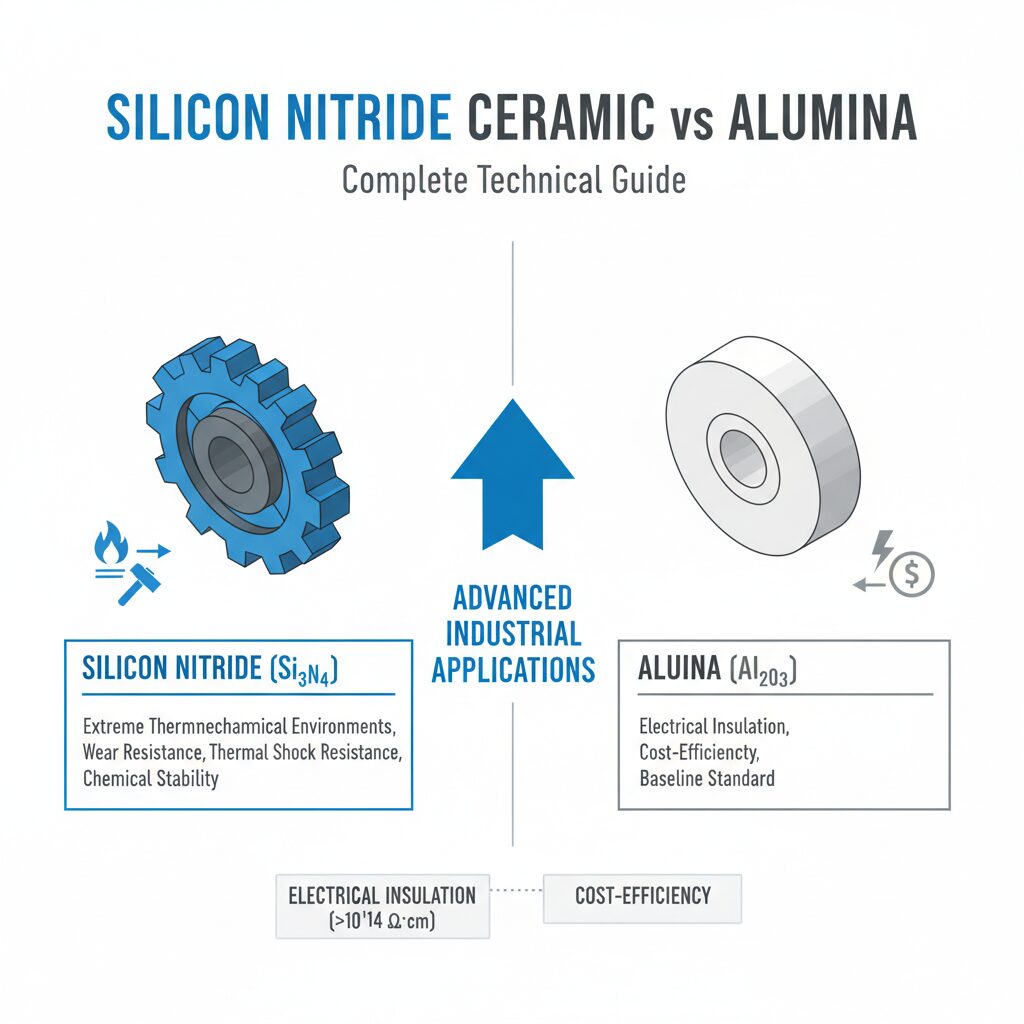
While MGC is uniquely machinable with standard tooling, applications subjected to extreme mechanical wear or temperatures exceeding 800°C often necessitate transitioning to traditional technical ceramics. Understanding when to specify MGC versus when to upgrade to alümina/”>Alümina, Zirkonyaveya Silisyum Nitrür is crucial for controlling project costs and lead times.
| Mülkiyet | İşlenebilir Cam Seramik | Alümina | Zirkonya | Silisyum Nitrür |
|---|---|---|---|---|
| Termal İletkenlik | 1.46 | 30.0 | 2.5 | 30.0 – 90.0 |
| Sertlik (HV) | 250 | 1500 | 1200 | 1500 |
| Kırılma Tokluğu | 1.53 | 4.5 | 9.5 | 7.0 |
| Maliyet | Orta düzeyde | Düşük | Orta düzeyde | Yüksek |
MGC trades extreme hardness for rapid machinability. Because it does not require diamond grinding like Alumina (1500 HV) or Silicon Nitride (1500 HV), prototyping iteration cycles are drastically reduced. However, if a component acts as a high-speed wear pad or structural bearing, the 1.53 MPa·m½ fracture toughness of MGC may lead to premature failure. In such scenarios, Zirconia provides the highest fracture toughness (up to 9.5 MPa·m½), closely mimicking the durability of steel while retaining ceramic benefits. For structural components requiring both high thermal shock resistance and extreme mechanical strength at elevated temperatures (up to 1200°C), Silicon Nitride remains the premier choice.
Uygulamalar
The decision to replace steel with machinable glass ceramic is typically driven by the need for multi-functional performance—where a single component must provide structural support, electrical isolation. And vacuum integrity simultaneously.
- Ultra-High Vacuum (UHV) Environments: MGC is heavily utilized for standoffs, insulating feedthroughs. And structural supports in UHV chambers. Unlike steel. This requires extensive bake-out at 250°C+ to mitigate hydrogen outgassing, MGC has zero porosity and virtually zero outgassing. It can achieve pressure environments of 10^-10 torr without the surface treatments required for metals.
- Medical Diagnostic Equipment (MRI/NMR): Metallic components, particularly ferromagnetic steels, create severe magnetic resonance interference and dangerous eddy currents in MRI machines. MGC is entirely non-magnetic and acts as an exceptional electrical insulator (Volume Resistivity > 10^16 Ω·cm at 25°C), making it ideal for coil supports, sensor housings. And RF targeting fixtures.
- Aerospace and Space Exploration: Aerospace engineering requires drastic weight optimization and thermal shielding. Steel’s specific gravity of 8.0 is a severe detriment. MGC reduces mass by nearly 70% while providing thermal shock resistance and structural rigidity for satellite communication arrays, sensor mounts. And avionics insulators that undergo rapid temperature fluctuations in low earth orbit.
- Yarı İletken Üretimi: Wafer handling components, plasma chamber liners. And deposition equipment require materials that will not contaminate the silicon wafer with metallic ions. Steel sputtering degrades wafer yields. MGC provides a high-purity, halogen-resistant alternative for chucks and retaining rings, offering excellent dimensional stability (±0.005mm tolerances) under operational thermal loads.
- High-Power Laser Systems: Optical bench supports and laser cavity reflectors require zero thermal drift to maintain beam alignment. Austenitic steel’s high CTE (17.2 µm/m·°C) causes focal misalignment as the system heats. MGC offers a much lower CTE (9.3 µm/m·°C) and acts as a robust electrical barrier for the high-voltage discharge tubes powering the laser.
Üretim Süreci
The manufacturing process of MGC fundamentally differs from both steel metallurgy and traditional technical ceramic processing. Steel is typically cast, forged. And heat-treated to manipulate its crystalline grain structure (austenite, ferrite, martensite). Traditional ceramics are pressed from powders and fired, resulting in 15-20% volumetric shrinkage. MGC is unique. it begins as a glass melt and undergoes a highly controlled thermal transformation.
Şekillendirme Yöntemleri
- Glass Melting and Casting: The raw materials—primarily silica, magnesia, alumina. And potassium fluorosilicate—are blended and melted in a continuous electric furnace at temperatures exceeding 1400°C. The molten glass is then continuously cast into large slabs, billets, or rods.
- Annealing: The cast glass is carefully cooled to room temperature to remove internal residual stresses. At this stage, the material is fully amorphous and transparent, lacking the required machinability and structural strength.
Sinterleme
Unlike standard technical ceramics that require powder compaction and traditional sintering, MGC achieves its properties through a specialized, two-stage heat treatment process known as “ceramming” or controlled crystallization. The glass billets are heated to approximately 600°C to 700°C, causing the spontaneous nucleation of fluorite (chondrodite) crystals. As the temperature is subsequently elevated to between 900°C and 1000°C, fluorphlogopite mica crystals grow from these nucleation sites. This ceramming process converts approximately 55% of the amorphous glass volume into a dense network of interlocking, sheet-like mica crystals. Because this crystallization occurs entirely within the solid phase of the glass, there is zero macro-shrinkage, ensuring the material retains perfect geometric stability. The final microstructure is completely non-porous.
Son İşleme
The defining characteristic of MGC is its post-ceramming machinability. The interlocking mica crystals act as microscopic crack arrestors. When a cutting tool shears the material, the fractures propagate along the cleavage planes of the mica, causing the material to chip off in microscopic, localized dust particles rather than propagating structural cracks. This allows MGC to be milled, turned, tapped. And threaded using conventional high-speed steel (HSS) or carbide metalworking tools. Specialized diamond abrasives are not strictly necessary, drastically reducing setup costs and turnaround times compared to standard hard ceramics. For complex geometries, precision CNC machining achieves surface finishes down to Ra 0.1 µm.
Avantajlar ve Sınırlamalar
Avantajlar
- Exceptional Machinability: MGC can be processed on standard CNC mills and lathes, drastically cutting prototype lead times compared to hard ceramics that require post-sintering diamond grinding. It allows for the integration of intricate geometries, such as internal M2 threads. This are notoriously difficult in traditional ceramics.
- Superior Electrical and Thermal Insulation: Unlike steel, MGC boasts a dielectric strength of 40 kV/mm and a low thermal conductivity of 1.46 W/m·K. It entirely prevents eddy currents, galvanic corrosion. And high-voltage arcing in critical electrical assemblies.
- Zero Porosity and Vacuum Integrity: The unique crystallization process ensures zero porosity. It does not outgas in vacuum environments, does not absorb moisture (zero water absorption). And has a helium leak rate of less than 1×10^-10 atm-cc/sec.
- Dimensional Stability: Free from the residual stress warping common in cold-rolled or heavily machined steels, MGC does not require post-machining heat treatments. Components hold exceptionally tight tolerances (±0.005mm) reliably over time.
Sınırlamalar
- Lower Mechanical Strength: With a flexural strength of 94 MPa, MGC cannot replace steel in load-bearing structural applications where high tensile or bending stresses are present. Steel’s yield strength easily exceeds 300-500 MPa.
- Brittle Failure Mechanism: Steel offers ductility and will plastically deform before failure. MGC, like all ceramics, exhibits a linear elastic response up to its breaking point. It will shatter under severe impact or shock loading due to its low fracture toughness (1.53 MPa·m½).
İşleme ile İlgili Hususlar
While MGC is advertised as being machinable with standard metalworking tools, achieving optimal surface finishes and tight tolerances (±0.005mm) requires strict adherence to specialized speeds, feeds. And tooling geometries. Treating MGC exactly like carbon steel or aluminum will result in edge chipping, tool wear. And catastrophic part failure.
Because MGC relies on controlled micro-fracturing along mica cleavage planes rather than the plastic shearing seen in metals, cutting forces must be carefully managed. When turning MGC on a CNC lathe, engineers must use highly sharp, uncoated tungsten carbide inserts with positive rake angles to minimize cutting pressure. Spindle speeds should be kept low—typically between 10 to 15 surface meters per minute (m/min)—while maintaining a relatively aggressive feed rate of 0.05 to 0.13 mm/rev. If the feed rate is too low, the tool will rub rather than cut, leading to localized frictional heating that can cause thermal cracking in the glass matrix.
Milling operations require similar care. Climb milling is strictly recommended over conventional milling to ensure the cutting force pushes the material into the bulk of the workpiece, reducing the risk of edge breakout. When drilling, standard HSS or carbide twist drills are effective, but “peck drilling” must be employed to clear the highly abrasive ceramic dust from the flutes. Furthermore, an exit backing plate (a sacrificial piece of material clamped tight to the back of the workpiece) is mandatory to prevent massive cone-shaped blowouts as the drill breaches the bottom surface.
Coolant application is another critical differentiator in the machinable glass ceramic vs steel debate. While steel can often be machined dry or with oil-based lubricants, MGC machining generates highly abrasive powder. Copious amounts of water-soluble coolant must be flooded directly at the cutting interface. This serves a dual purpose: it continuously flushes away the abrasive swarf (preventing rapid tool degradation) and maintains thermal equilibrium, preventing the glass matrix from fracturing under localized thermal shock. If your facility lacks the specialized filtration systems required to handle ceramic swarf, it is highly recommended to outsource production. Great Ceramic specializes in advanced hassas serami̇k i̇şleme, utilizing state-of-the-art multi-axis CNC equipment to guarantee pristine, chip-free edges and dimensional accuracy down to ±0.005mm.
FAQ
What is Machinable Glass Ceramic vs Steel?
Machinable glass ceramic (MGC) is a composite material consisting of a borosilicate glass matrix populated with interlocking synthetic mica crystals. Unlike steel. This is a metallic alloy of iron and carbon characterized by high tensile strength and electrical conductivity, MGC is a brittle, highly insulating material. The defining comparison is that MGC offers zero electrical conductivity, low thermal expansion. And non-magnetic properties, while still allowing for rapid CNC machining using standard metalworking tools—a capability unique among technical ceramics.
What are the main applications of Machinable Glass Ceramic?
MGC is primarily used in extreme engineering environments where standard metals fail. Its main applications include ultra-high vacuum (UHV) insulating feedthroughs, aerospace thermal insulators, semiconductor wafer chucks, medical diagnostic equipment (such as MRI coil supports due to its non-magnetic nature). And high-power laser cavity components. It is the material of choice when a design requires complex geometries combined with zero outgassing and high dielectric strength.
How does Machinable Glass Ceramic compare to other ceramics?
Compared to hard technical ceramics, MGC’s primary advantage is its machinability. While Alümina ve Zirkonya offer drastically higher hardness (1500 HV vs 250 HV) and superior flexural strength, they require expensive diamond grinding processes after sintering. MGC bridges the gap by offering robust ceramic properties—such as 800°C continuous operating temperatures and excellent chemical resistance—with the rapid, cost-effective prototyping speed typically associated with metals or plastics.
What are the advantages of Machinable Glass Ceramic?
The distinct advantages of MGC include rapid, high-precision machinability without the need for post-firing or diamond grinding, ensuring no dimensional shrinkage. It possesses extreme dielectric strength (up to 40 kV/mm), a low thermal conductivity (1.46 W/m·K). And zero porosity. Additionally, it does not outgas in UHV environments, resists radiation damage. And maintains strict dimensional stability under thermal loads, outperforming steel in any application requiring thermal or electrical isolation.
How is Machinable Glass Ceramic machined?
MGC is machined using standard high-speed steel (HSS) or tungsten carbide cutting tools. The process requires low cutting speeds (10-15 m/min), consistent feed rates. And copious amounts of water-soluble coolant to clear abrasive ceramic dust and prevent thermal shock. Specialized techniques like climb milling and the use of sacrificial backing plates during drilling are necessary to prevent brittle edge chipping. At Great Ceramic, our engineers utilize advanced multi-axis CNC technology and proprietary tooling strategies to provide exceptional hassas serami̇k i̇şleme, consistently achieving tight tolerances of ±0.005mm for complex MGC components.
Need custom machinable glass ceramic vs steel parts? Great Ceramic ile iletişime geçin dar toleranslara sahip hassas işleme hizmetleri için veya e-posta [email protected].
machinable glass ceramic vs steel is widely used in advanced ceramic applications.
Hakkında daha fazla bilgi edinin İşlenebilir Cam Seramik Vs Çelik ve hassas seramik işleme hizmetlerimiz.