






Silicon carbide ceramic seal ring for electronics: Complete Technical Guide
The electronics and semiconductor manufacturing industries operate under extremely unforgiving parameters, where component failure or microscopic contamination can ruin entire production batches, costing millions of dollars. Engineers constantly face the critical pain points of managing extreme thermal loads, aggressive chemical attacks from etching plasmas. And high-speed mechanical wear in wafer fabrication environments. The optimal solution to these compounding challenges is the carboneto de silício ceramic seal ring for electronics. With a hardness exceeding 2500 HV and thermal conductivity approaching 150 W/m·K, silicon carbide (SiC) outperforms traditional metals and standard ceramics in almost every metric relevant to electronic grade sealing. This comprehensive technical guide details the material properties, comparative advantages, manufacturing workflows. And precision machining considerations required to deploy SiC seal rings in advanced electronics infrastructure. If your R&D or procurement team requires ultra-precise components with tolerances down to ±0.005mm, partnering with an expert in advanced ceramics is the first step toward minimizing downtime and maximizing mean time between failures (MTBF). Contactar Great Ceramic to request an RFQ for your custom engineering needs.
Propriedades do material
The deployment of a silicon carbide ceramic seal ring for electronics is entirely predicated on its exceptional mechanical, thermal. And electrical properties. In semiconductor packaging and wafer processing equipment, seal rings are subjected to highly corrosive gases, rapid thermal cycling. And immense frictional forces. Silicon carbide maintains its structural integrity and dimensional stability where other materials undergo plastic deformation or catastrophic thermal shock. The table below outlines the critical quantitative metrics for sintered carboneto de silício utilized in electronics-grade sealing applications.
| Imóveis | Valor | Unidade |
|---|---|---|
| Densidade | 3.10 – 3.15 | g/cm³ |
| Dureza | 2500 – 2800 | HV |
| Resistência à flexão | 400 – 450 | MPa |
| Resistência à fratura | 4.0 – 4.5 | MPa-m½ |
| Condutividade térmica | 120 – 150 | W/m-K |
| Resistividade eléctrica | 10³ – 10⁶ (tunable) | Ω-cm |
| Temperatura máxima de funcionamento | 1600 | °C |
Analyzing these parameters reveals exactly why this material dominates the sector. A density of 3.10 g/cm³ ensures the component remains lightweight, reducing centrifugal forces in high-speed rotary seal applications operating at up to 10,000 RPM. The extraordinary hardness of 2500-2800 HV, second only to diamond and boron carbide, guarantees an extraordinarily low wear rate even under dry-running conditions. When a silicon carbide ceramic seal ring for electronics rotates against a mating surface, the friction generates localized heat. Thanks to its thermal conductivity of 120-150 W/m·K—which is nearly ten times higher than that of standard oxide ceramics—this heat is rapidly dissipated, preventing thermal degradation of adjacent polymer O-rings or housing components.
Furthermore, the electrical resistivity can be specifically tuned during the doping and sintering phases. While high-purity SiC acts as a semiconductor, adjustments can push its resistivity into ranges suitable for electrostatic discharge (ESD) safe applications, a mandatory requirement in microelectronics manufacturing where static buildup can instantly destroy a wafer containing 10-nanometer transistors. The maximum continuous working temperature of 1600°C means the seal ring will not warp, outgas, or lose mechanical strength during high-temperature chemical vapor deposition (CVD) processes.
Comparação com outras cerâmicas
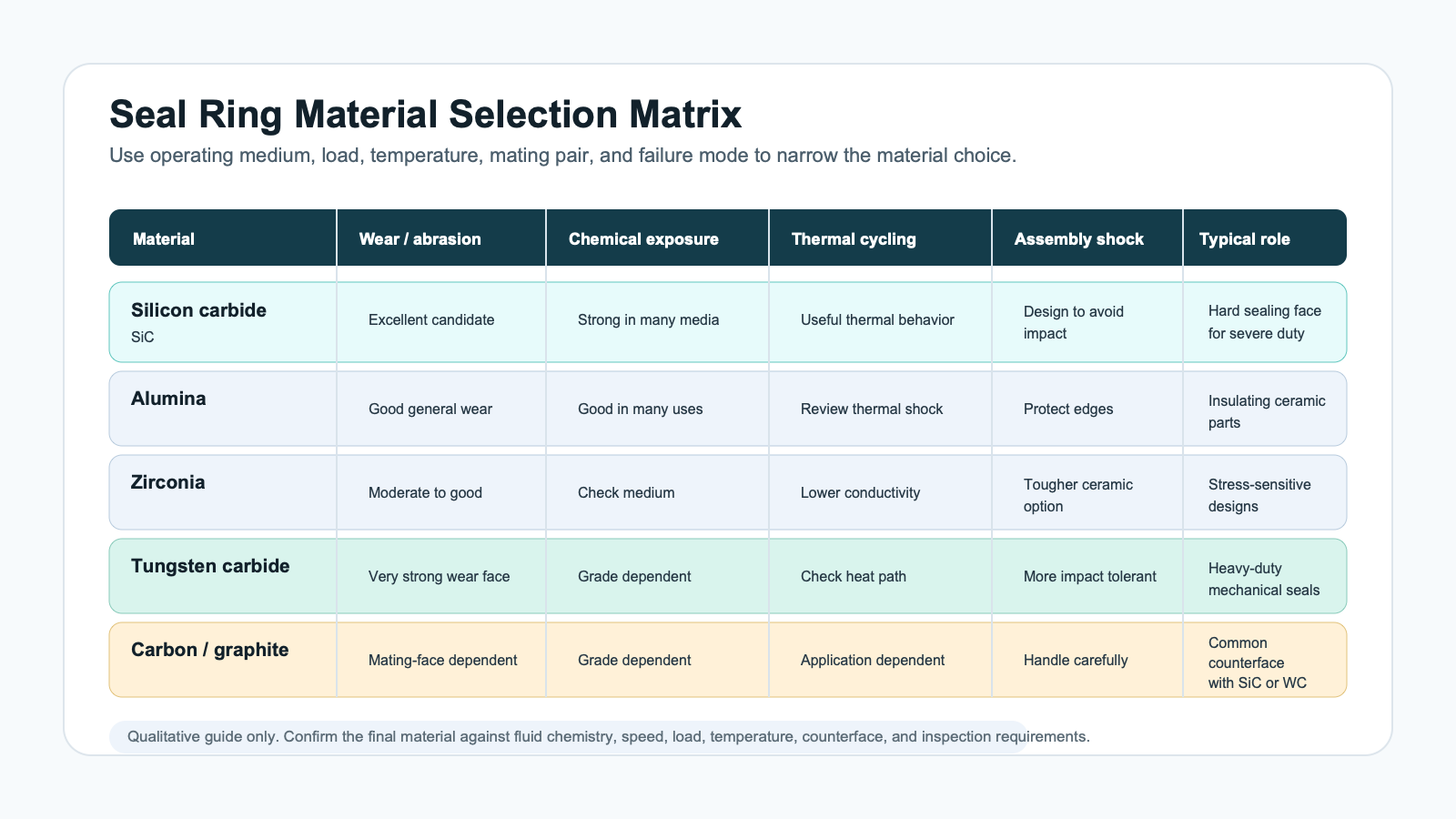
When engineering a sealing solution for electronics manufacturing, specifiers frequently evaluate several advanced ceramics. While each material has a specific niche, comparing them across critical physical properties highlights the operational superiority of silicon carbide for aggressive rotary and static sealing environments.
| Imóveis | Carbureto de silício | Alumina | Zircónia | Nitreto de silício |
|---|---|---|---|---|
| Condutividade térmica | 120 – 150 W/m·K | 25 – 35 W/m·K | 2 – 3 W/m·K | 20 – 30 W/m·K |
| Dureza | 2500 – 2800 HV | 1500 – 1650 HV | 1200 – 1300 HV | 1400 – 1600 HV |
| Resistência à fratura | 4.0 – 4.5 MPa·m½ | 3.5 – 4.0 MPa·m½ | 8.0 – 10.0 MPa·m½ | 6.0 – 7.0 MPa·m½ |
| Custo | Elevado | Baixa | Médio | Elevado |
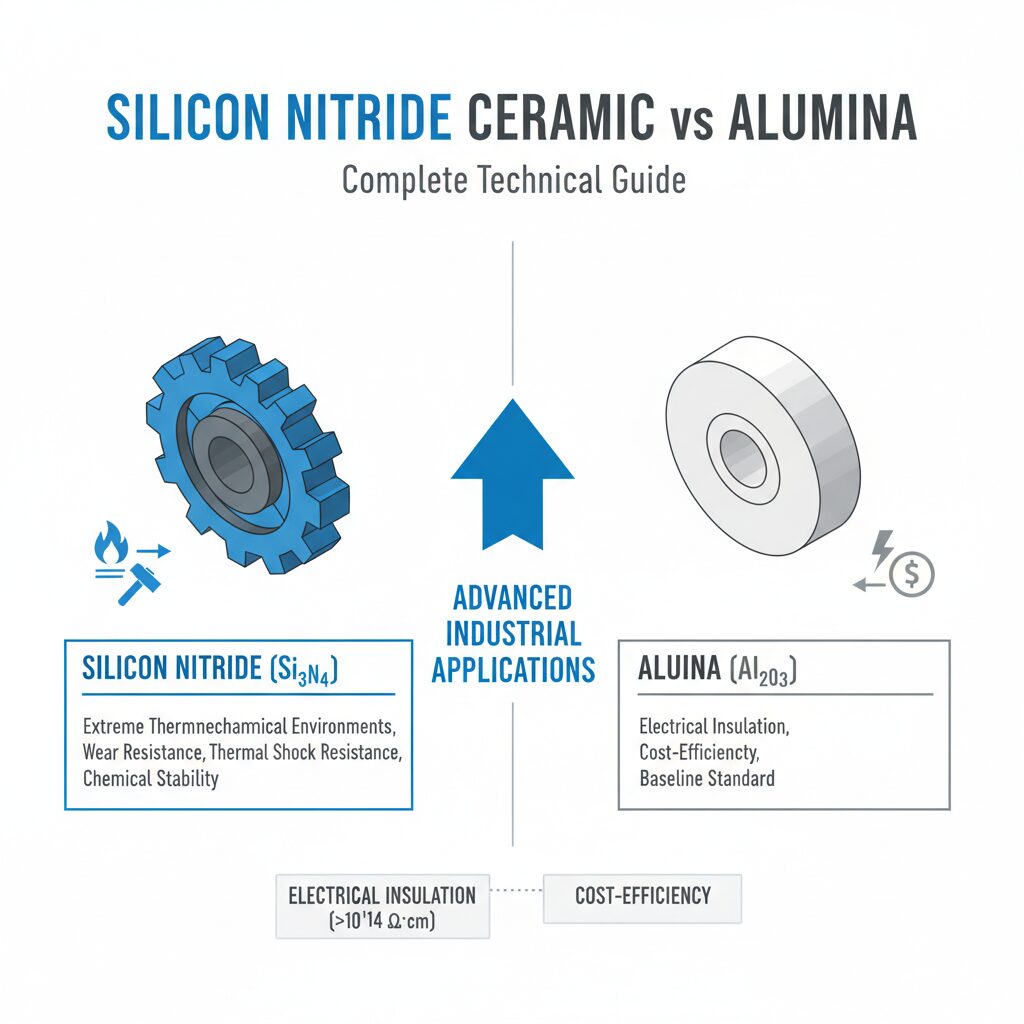
Compared to alumina/”>alumina, silicon carbide offers massively superior thermal conductivity and hardness. Alumina is highly cost-effective and serves well as an electrical insulator, but its lower thermal conductivity (25-35 W/m·K) makes it susceptible to thermal shock failure if frictional heat spikes at the seal interface. Alumina’s hardness of 1500 HV is also significantly lower, leading to faster wear rates in abrasive slurry environments, such as chemical-mechanical polishing (CMP) tools.
When evaluated against zircónia, the contrast is even starker regarding thermal management. Zirconia is renowned for its excellent fracture toughness (up to 10.0 MPa·m½), making it highly resistant to mechanical impact. However, zirconia acts as a thermal insulator with a conductivity of merely 2-3 W/m·K. In a high-speed mechanical seal application, utilizing zirconia would trap frictional heat precisely at the sealing face, causing fluid vaporization, thermal expansion. And catastrophic seal failure. Silicon carbide’s thermal conductivity actively pulls this heat away from the critical interface.
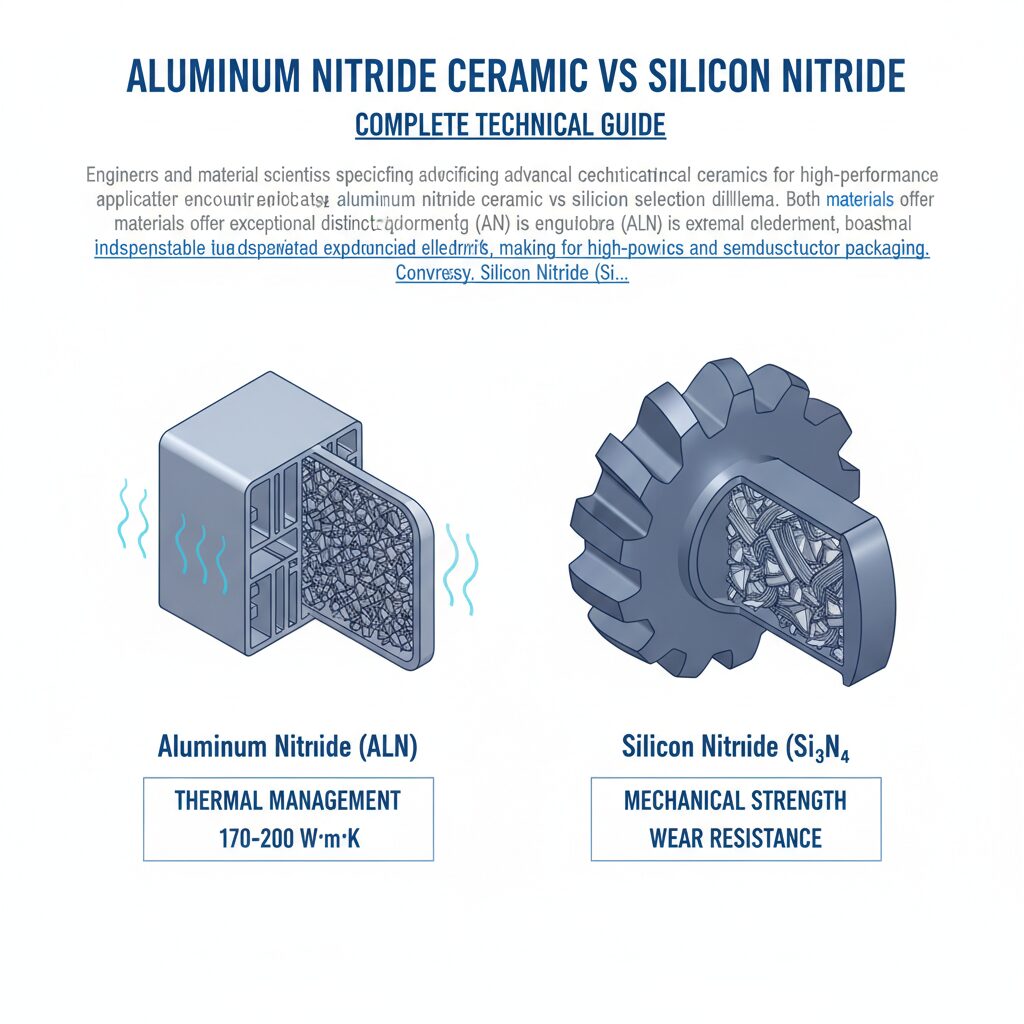
Finally, compared to nitreto de silício, SiC still retains the advantage in absolute hardness and thermal conductivity, though silicon nitride offers slightly better fracture toughness. Silicon nitride is an exceptional material for bearing balls and structural components subjected to high mechanical loads, but for the specific demands of a tribological sealing interface where maximum hardness and heat dissipation are the defining success factors, the silicon carbide ceramic seal ring for electronics remains the premier engineering choice.
Aplicações
The unique tribological, thermal. And chemical profile of a silicon carbide ceramic seal ring for electronics dictates its use in the most severe operating environments within semiconductor fabs and electronic component manufacturing plants. Engineers specify this exact material when metallic seals corrode, polymer seals melt. And standard oxide ceramics crack under thermal shock.
- Chemical Mechanical Polishing (CMP) Equipment Seals: In CMP processes, silicon wafers are planarized using highly abrasive, chemically reactive slurries containing silica or ceria nanoparticles. Metallic seals wear down rapidly, shedding particulate contaminants onto the wafer. Silicon carbide seal rings are chosen because their 2500+ HV hardness resists the abrasive slurry flawlessly, while their chemical inertness prevents any reaction with the polishing acids, ensuring zero-defect wafer processing and extending seal life from weeks to months.
- Plasma Etching Chamber Static Seals: Dry etching in semiconductor manufacturing uses aggressive halogen plasmas (such as fluorine or chlorine) operating under hard vacuum. Polymeric seals degrade and outgas under these conditions, ruining the vacuum and depositing organic contaminants. A silicon carbide ceramic seal ring for electronics is utilized because it is fundamentally impervious to halogen plasma erosion, does not outgas under 10⁻⁸ Torr vacuum. And maintains sub-micron dimensional stability despite the harsh chamber environment.
- Liquid Cooling System Pumps for High-Power Microelectronics: Data center servers and high-power IGBT modules require closed-loop liquid cooling using dielectric fluids. The mechanical pump seals driving these cooling loops must operate at 5000-8000 RPM continuously for years. SiC is selected for these rotary seals because its high thermal conductivity (150 W/m·K) dissipates friction heat instantly. And its low coefficient of friction minimizes power draw while preventing catastrophic leaks of dielectric coolant over server racks.
- MOCVD Susceptor Shaft Rotary Seals: Metal-Organic Chemical Vapor Deposition (MOCVD) systems—used to manufacture LEDs and advanced RF electronics—operate at temperatures exceeding 1000°C while injecting toxic precursor gases. The rotary shafts that spin the wafer susceptors require dynamic seals. Silicon carbide is chosen because it maintains its mechanical strength and perfect sealing geometry at 1200°C, a temperature where stainless steel would warp and PTFE would instantly vaporize.
- Ultra-Pure Water (UPW) System Seals: Semiconductor manufacturing requires millions of gallons of 18.2 MΩ·cm ultra-pure water. Standard metal seals leach iron, nickel, or chromium ions into the water, destroying its resistivity. Silicon carbide seal rings are utilized in UPW circulation pumps because they leach absolutely zero ions into the fluid stream. The material’s dense, non-porous microstructure ensures total containment without contributing trace metal contaminants to the fab’s water supply.
Processo de fabrico
Transforming raw chemical powders into a finished, tight-tolerance silicon carbide ceramic seal ring for electronics is a complex, multi-stage engineering endeavor. The process requires stringent environmental controls, precisely programmed thermal cycles. And advanced machining technologies to achieve the final dimensions. The difference between standard industrial ceramics and electronics-grade ceramics lies in the absolute control over purity and microscopic tolerances throughout the entire manufacturing lifecycle.
Métodos de moldagem
The manufacturing journey begins with ultra-high purity alpha-silicon carbide powder, typically synthesized via the Acheson process and subsequently refined to achieve a particle size distribution with a D50 of less than 0.5 micrometers. For electronics applications, trace metal impurities must be reduced to parts-per-billion (ppb) levels. This powder is homogeneously mixed with temporary organic binders and lubricants.
- Prensagem isostática a frio (CIP): For high-performance seal rings, CIP is the preferred forming method. The powder is encased in a flexible elastomeric mold and subjected to multi-directional hydrostatic pressure ranging from 200 to 300 MPa. This ensures completely uniform density distribution throughout the green body. This is critical to preventing anisotropic shrinkage and distortion during the firing phase.
- Dry Pressing: For thinner, high-volume sealing rings, automated uniaxial dry pressing is utilized. The powder is compacted in a precision rigid die at pressures between 100 and 150 MPa. While faster and more economical, careful die design is required to manage density gradients across the height of the seal ring.
Sinterização
Following forming, the green parts undergo a meticulous binder burnout phase at 400-600°C to remove all organic additives without inducing micro-cracks. The parts are then transferred to a high-vacuum or argon-atmosphere furnace for sintering. The sintering methodology profoundly affects the final properties of the silicon carbide ceramic seal ring for electronics.
For Sintered Silicon Carbide (SSiC), the furnace is ramped to extreme temperatures between 2100°C and 2200°C. Small additions of boron and carbon act as sintering aids. During this process, the material undergoes a volumetric shrinkage of 15% to 20%, densifying to over 98% of its theoretical maximum density. The resulting microstructure is entirely single-phase, containing no free silicon, granting it maximum chemical resistance to HF and HNO3 acids. Alternatively, Reaction Bonded Silicon Carbide (RBSiC) is sintered at lower temperatures (circa 1500°C) by infiltrating a porous SiC/carbon preform with molten silicon. While RBSiC exhibits near-zero shrinkage, the presence of free silicon makes it less suitable for ultra-aggressive electronics etching environments than pure SSiC.
Maquinação final
Because SSiC shrinks by up to 20% during sintering, the “as-fired” component cannot meet the strict dimensional requirements of the electronics industry. This often dictate geometric tolerances measured in micrometers. Final machining is the most critical and cost-intensive phase of production. Because the material hardness exceeds 2500 HV, traditional carbide or high-speed steel tools are completely ineffective. they will instantly dull or shatter upon contact.
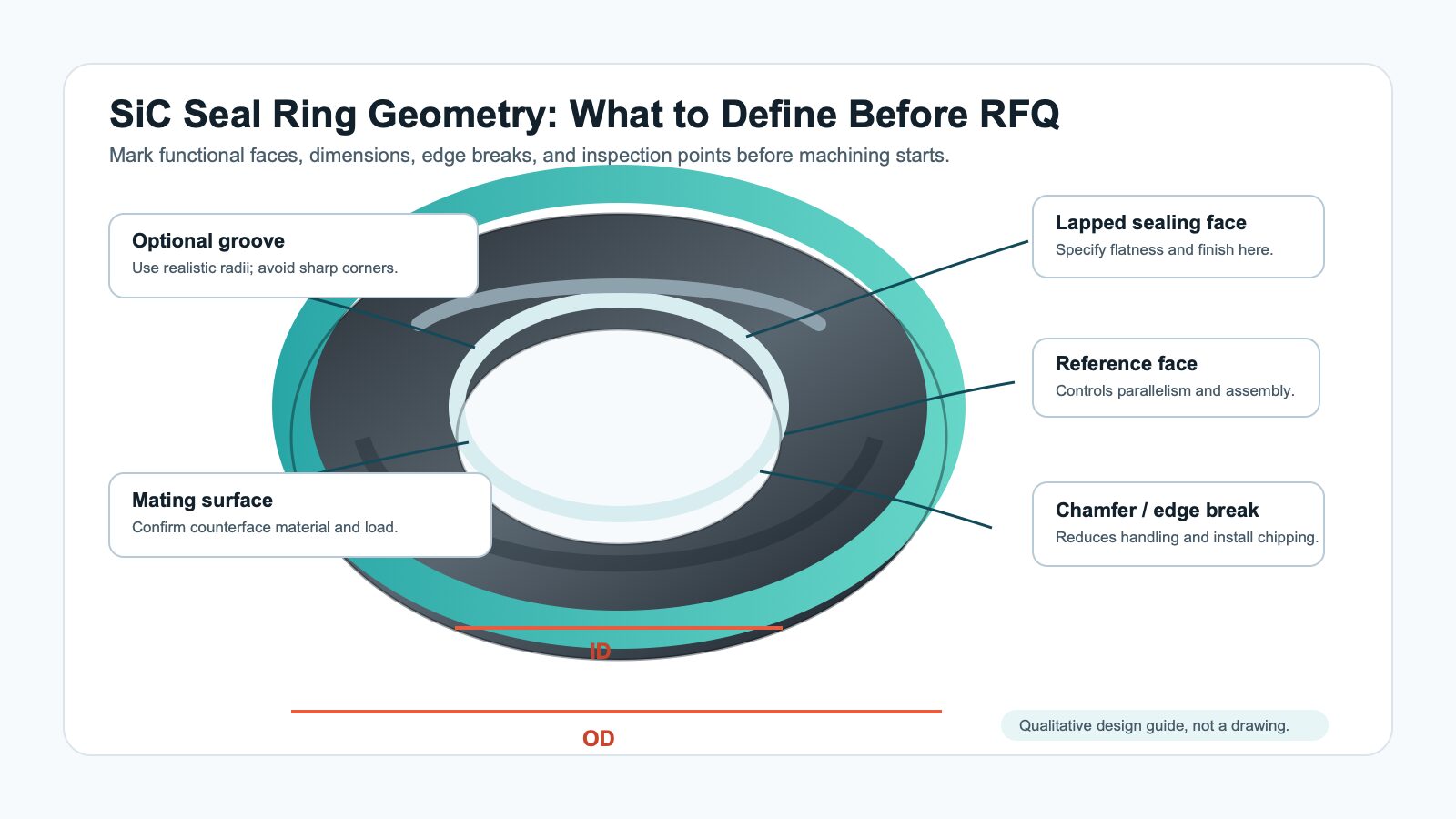
The seal rings must be shaped using state-of-the-art CNC grinding centers equipped with resin-bonded or metal-bonded diamond abrasive wheels. The process involves rough grinding to establish the outer and inner diameters, followed by precision face grinding. For a mechanical seal ring, the mating face must be extremely flat to prevent fluid leakage at the micro-level. This requires specialized lapping machines utilizing diamond slurries (typically 1 to 3-micron grit) on cast iron or composite plates, followed by a final polishing stage. Precision ceramic machining techniques are employed to achieve surface finishes of Ra < 0.1 µm and flatness levels better than 1 light band (0.29 µm). If you are looking for a reliable manufacturing partner capable of executing these exacting operations, ensure they possess comprehensive metrology laboratories to verify every single tolerance.
Vantagens e limitações
Selecting a silicon carbide ceramic seal ring for electronics requires a balanced understanding of its engineering profile. While it solves many catastrophic failure modes associated with metals and plastics, it introduces specific design constraints that mechanical engineers must accommodate.
Vantagens
- Resistência excecional ao desgaste: The 2500-2800 HV hardness rating ensures that the seal face undergoes practically zero wear over tens of thousands of operational hours, drastically increasing the MTBF of semiconductor processing equipment and reducing maintenance downtime.
- Superior Thermal Management: Operating at 120-150 W/m·K, the material acts as its own heat sink. In high-velocity rotary applications within electronics cooling loops, it pulls destructive frictional heat away from the dynamic sealing interface, preventing the thermal breakdown of adjoining elastomers.
- Absolute Chemical Inertness: In the harsh chemical environments of wafer fabrication—involving hydrofluoric acid, sulfuric acid. And fluorine plasmas—SSiC remains completely unreactive. It will not dissolve, pit, or release particulate contamination into the pure processing stream.
- Dimensional Stability under Thermal Stress: With a coefficient of thermal expansion (CTE) of approximately 4.0 x 10⁻⁶ /°C (less than half that of steel), SiC seal rings maintain precise interference fits and micron-level flatness profiles even when equipment rapidly cycles from room temperature to hundreds of degrees Celsius.
Limitações
- Inherent Brittleness: Like all advanced ceramics, silicon carbide has a relatively low fracture toughness (4.0 – 4.5 MPa·m½). It is highly susceptible to brittle fracture if subjected to sudden mechanical impact, high-stress concentrations from sharp corners, or improper assembly techniques. Engineering designs must avoid point loads and incorporate chamfers or radii.
- High Manufacturing and Machining Costs: The necessity of processing temperatures exceeding 2100°C and the absolute requirement for diamond-tooled precision grinding makes SiC components significantly more expensive to produce than metal or alumina equivalents. However, the total cost of ownership (TCO) is heavily offset by the exponential increase in component lifespan.
Considerações sobre maquinagem
Producing a silicon carbide ceramic seal ring for electronics that meets the uncompromising standards of the semiconductor industry presents severe machining challenges. The very property that makes SiC desirable—its immense hardness—makes it notoriously difficult to cut, drill, or grind. When machining a material this hard, engineers battle constantly against rapid tool wear, the introduction of sub-surface micro-cracks. And edge chipping. The cutting parameters must be aggressively controlled to prevent inducing thermal and mechanical stresses into the brittle ceramic matrix.
To demonstrate the level of precision and deterministic machining required, the table below outlines typical high-end machining tolerances that expert ceramic manufacturers must achieve for electronics-grade seal rings:
| Parâmetro de maquinagem | Standard Tolerance | Great Ceramic Precisão |
|---|---|---|
| Outer/Inner Diameter (OD/ID) | ±0.05 mm | ±0,005 mm |
| Concentricity | 0.02 mm | 0.005 mm |
| Surface Finish (Ra) | 0.4 µm | < 0.1 µm |
| Flatness (Sealing Face) | 3 Light Bands (~0.9 µm) | 1 Light Band (< 0.3 µm) |
At Great Ceramic, overcoming these challenges is our core competency. Achieving tight tolerances of ±0.005mm on a silicon carbide ceramic seal ring for electronics requires rigid, vibration-damped CNC machine tools and optimized kinematic programming. Spindle speeds, feed rates (often restricted to a few millimeters per minute). And depths of cut (frequently sub-millimeter) are meticulously calculated. High-pressure, temperature-controlled flood coolant is directed precisely at the grinding zone to flush away abrasive swarf and prevent localized thermal shock from the friction of the diamond wheel.
Furthermore, edge chipping is mitigated through specialized toolpath strategies, such as climb grinding and the implementation of sacrificial backing materials during through-hole generation. The lapping process, essential for achieving a flatness of less than 1 light band, requires continuous monitoring of the lapping plate’s curvature and precise dosing of the diamond slurry suspension. Our metrology department employs advanced Coordinate Measuring Machines (CMM), laser interferometers. And optical profilometers to validate that every single geometric callout on the engineering drawing is met to the exact micron.
FAQ
What is a silicon carbide ceramic seal ring for electronics?
A silicon carbide ceramic seal ring for electronics is a highly engineered mechanical component used to create a leak-proof barrier in dynamic (rotating) or static environments within semiconductor and microelectronics manufacturing equipment. Constructed from ultra-high purity alpha-silicon carbide powder sintered at extreme temperatures, this component exhibits extraordinary hardness, exceptional thermal conductivity. And absolute chemical inertness. It is specifically designed to operate in severe environments—such as high-speed pumps for dielectric coolants, aggressive CMP slurry dispensing. And vacuum plasma etching chambers—where traditional metal, polymer, or lower-grade ceramic seals would rapidly fail due to wear, thermal degradation, or corrosive attack. The component ensures zero contamination and maintains tight dimensional stability under stress.
What are the main applications of a silicon carbide ceramic seal ring for electronics?
The main applications revolve around semiconductor wafer fabrication and high-power electronic cooling infrastructure. They are predominantly utilized as dynamic mechanical seal faces in pumps that circulate ultra-pure water (UPW) or dielectric liquid coolants for data centers and IGBT modules, where rapid heat dissipation and low friction are mandatory. Additionally, they serve as retaining rings and seals in Chemical Mechanical Polishing (CMP) equipment, resisting the highly abrasive nanoparticle slurries. They are also deployed as static structural seals in plasma etching and Metal-Organic Chemical Vapor Deposition (MOCVD) reactors, where the material’s resistance to halogen gases, extreme vacuum stability. And ability to withstand temperatures over 1000°C without warping or outgassing are critical for defect-free microchip production.
How does a silicon carbide ceramic seal ring for electronics compare to other ceramics?
When compared to other industrial ceramics, a silicon carbide ceramic seal ring for electronics stands out primarily due to its superior thermal conductivity (120-150 W/m·K) and hardness (2500-2800 HV). For instance, while alumina is widely used due to its low cost and excellent electrical insulation, its low thermal conductivity (25-35 W/m·K) makes it prone to thermal shock and failure in high-speed mechanical seal applications. Zircónia offers unparalleled fracture toughness, making it highly impact-resistant, but its extremely low thermal conductivity (2-3 W/m·K) makes it entirely unsuitable for dissipating frictional heat in rotary seals. While nitreto de silício provides a good balance of strength and thermal shock resistance, silicon carbide remains the undisputed leader for tribological sealing faces requiring absolute maximum hardness, wear resistance. And heat dissipation.
What are the advantages of a silicon carbide ceramic seal ring for electronics?
The primary advantages are rooted in its ability to dramatically extend the Mean Time Between Failures (MTBF) in critical manufacturing equipment. Its hardness of over 2500 HV guarantees an exceptionally low wear rate, ensuring that the seal geometry remains perfectly flat over millions of rotational cycles. The material’s high thermal conductivity prevents localized heat buildup, safeguarding adjacent elastomer components from thermal degradation. Furthermore, Sintered Silicon Carbide (SSiC) is completely chemically inert to nearly all acids, alkalis. And etching plasmas used in electronics manufacturing, meaning it will not corrode or release trace metal contaminants (ions or particulates) into ultra-pure processing environments. Finally, its low coefficient of thermal expansion ensures micron-level dimensional stability despite severe temperature fluctuations.
How is a silicon carbide ceramic seal ring for electronics machined?
Machining a silicon carbide ceramic seal ring for electronics is a complex subtractive manufacturing process that occurs entirely after the material has been sintered to its full hardness. Because SiC is harder than tungsten carbide or tool steel, it cannot be turned or milled using traditional methods. Instead, it must be ground using precision CNC machining centers equipped with industrial diamond-impregnated abrasive wheels. The process requires highly rigid machines, optimized feed rates. And high-pressure coolant to prevent edge chipping and subsurface micro-cracking. To achieve the requisite sealing face flatness (often less than 0.3 micrometers or 1 light band) and ultra-smooth surface finishes (Ra < 0.1 µm), the rings undergo specialized multi-stage lapping and polishing processes using progressively finer diamond slurries. At Great Ceramic, our advanced maquinagem de precisão em cerâmica capabilities and strict metrology protocols ensure we reliably achieve tight tolerances of ±0.005mm on complex SiC geometries.
Need custom silicon carbide ceramic seal ring for electronics parts? Contactar Great Ceramic para serviços de maquinagem de precisão com tolerâncias apertadas, ou envie um e-mail para [email protected].
silicon carbide ceramic seal ring for electronics is widely used in advanced ceramic applications.
Saiba mais sobre Silicon Carbide Ceramic Seal Ring For Electronics e os nossos serviços de maquinagem de precisão em cerâmica.