








Silicon Carbide Seal Rings for Electronics Equipment
Use silicon carbide seal rings when a sealing face must resist wear, chemical exposure, thermal cycling, and cleanliness risk in electronics or semiconductor-adjacent equipment.
The key design decision is not simply “use SiC.” The working face, flatness, surface finish, edge condition, mating material, and inspection plan determine whether the part performs reliably. Review those points before sending a drawing for quote.
Abrasive media
Use SiC when slurry, particles, or hard counterfaces make wear control the main design risk.
Chemical exposure
Confirm the process fluid, cleaning chemistry, and grade before choosing the final material route.
Functional seal face
Mark flatness, surface finish, counterface, and inspection method on the drawing before production.
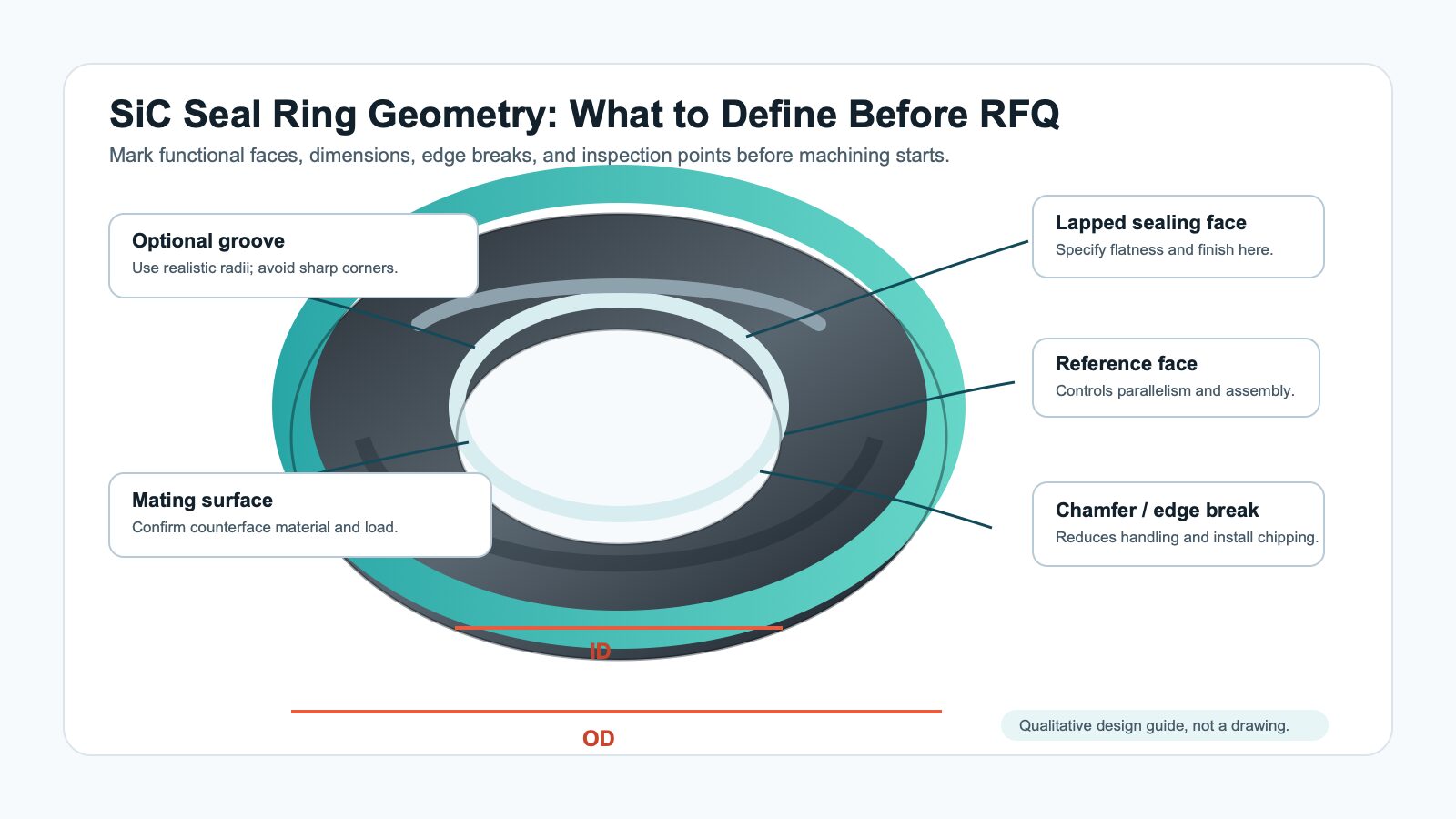
Define functional faces, dimensions, edge breaks, and inspection points before requesting a custom SiC seal ring quote.
Where SiC seal rings fit
In electronics manufacturing and related process equipment, silicon carbide seal rings may appear in vacuum systems, chemical delivery assemblies, wet process tools, coolant loops, dry pumps, CMP slurry-handling equipment, and high-duty rotating assemblies.
SiC is often considered when the application combines abrasive contact, chemical exposure, heat generation, and tight leakage control. Actual performance still depends on the selected grade, mating material, load, speed, temperature range, and installation conditions.
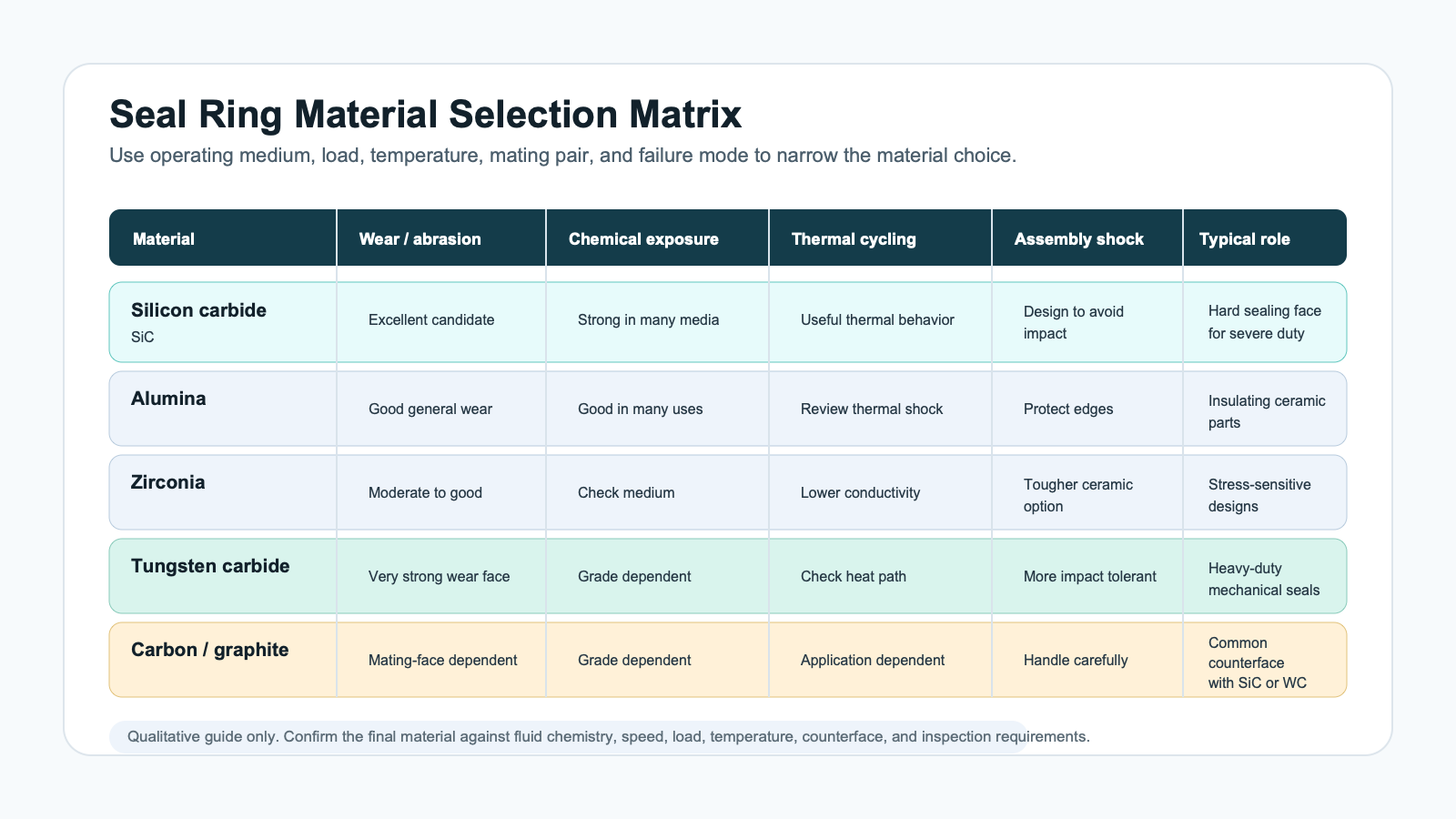
Use this qualitative matrix to narrow seal-ring materials before confirming grade, counterface, and operating conditions.
Material choice: what to compare
“Silicon carbide” is a material family, not a single universal grade. Sintered SiC is commonly evaluated when high hardness, wear resistance, chemical resistance, and high-temperature stability are priorities. Reaction-bonded SiC may be suitable for some geometries and cost targets, but the composition and service medium must be checked.
Other materials can still be the better choice. Alumina may fit insulation-focused designs. Zirconia can help where assembly stress matters. Tungsten carbide is common in heavy-duty mechanical seals. Carbon and graphite grades are often used as mating faces. The right selection starts with the failure mode, not with a catalog name.
Design details that change cost and reliability
Face flatness: define the sealing face and inspection method.
Surface finish: specify lapping or polishing only where it is functional.
OD / ID / thickness: separate functional tolerances from non-critical dimensions.
Chamfers: reduce chipping risk during handling and assembly.
Grooves and holes: use realistic radii and avoid sharp internal corners.
Counterface: confirm whether SiC runs against carbon, graphite, tungsten carbide, another SiC face, or another engineered material.
Typical manufacturing route for a custom SiC seal ring
1. Drawing review: confirm functional faces, edge breaks, tolerances, and inspection requirements.
2. Material route: select the SiC grade and forming route based on geometry and service conditions.
3. Near-net forming and firing: create the ceramic blank before final precision machining.
4. Diamond grinding: control OD, ID, thickness, parallelism, and critical features.
5. Lapping or polishing: finish the sealing face where leakage, friction, or mating behavior requires it.
6. Final inspection and packaging: verify dimensions, surface condition, and documentation requirements before shipment.
RFQ checklist
Prepare a 2D drawing with critical faces marked. Add a 3D model for grooves, holes, or non-round features. Include OD, ID, thickness, flatness, surface finish, operating medium, cleaning chemistry, temperature range, counterface material, sliding condition, quantity, inspection documentation, and packaging requirements.
When to involve Great Ceramic
Great Ceramic can review custom silicon carbide ceramic seal-ring drawings and help evaluate manufacturability, machining sequence, functional surfaces, and inspection requirements.
If the application is still in development, send the working drawing and operating conditions before freezing the design. Early review is usually the simplest way to reduce unnecessary grinding cost, avoid fragile features, and confirm which specifications are truly functional.
FAQ
Can silicon carbide seal rings be used in semiconductor equipment?
They can be suitable in semiconductor-adjacent equipment where wear resistance, chemical stability, thermal behavior, and cleanliness matter. Suitability depends on the process medium, mating material, grade, geometry, and inspection requirements.
Is sintered SiC always better than reaction-bonded SiC?
No. The better grade depends on the operating environment, geometry, cost target, and chemical exposure. Sintered SiC is often selected for demanding wear and chemical conditions, while reaction-bonded SiC may be suitable in some applications after composition and service conditions are reviewed.
What information is needed to quote a custom SiC seal ring?
A usable RFQ should include drawings, dimensions, tolerances, functional faces, surface finish, operating medium, temperature range, mating material, quantity, and inspection or packaging requirements.
What is the biggest design risk with ceramic seal rings?
The most common risk is treating a ceramic ring like a metal part. Sharp corners, thin unsupported sections, unclear flatness requirements, and installation shock can create problems even when the material itself is appropriate.