








Zirconia Ceramic Ball for Semiconductor: Complete Technical Guide
As semiconductor manufacturing advances toward sub-3nm nodes, the demand for ultra-pure, defect-free components has never been higher. Contamination, mechanical wear. And chemical degradation in critical fluid handling and wafer processing equipment directly impact wafer yield. A диоксид циркония ceramic ball for semiconductor applications presents an engineered solution to these pervasive industry pain points. By leveraging Yttria-Tetragonal Zirconia Polycrystal (Y-TZP), engineers can eliminate metallic particle generation, withstand aggressive planarization slurries. And operate seamlessly in ultra-high vacuum environments (10⁻⁸ Torr). This comprehensive technical guide explores the material physics, exact engineering specifications, comparative performance metrics. And rigorous manufacturing protocols required to produce semiconductor-grade zirconia spheres. Furthermore, we detail how Great Ceramic’s advanced capabilities achieve strict dimensional tolerances of ±0.005mm, ensuring frictionless operation and extended mean time between failures (MTBF) in next-generation fabrication equipment.
Свойства материала
Semiconductor-grade диоксид циркония is predominantly formulated as 3 mol% Yttria-Stabilized Zirconia (3Y-TZP). The addition of yttrium oxide (Y₂O₃) stabilizes the tetragonal crystalline phase down to room temperature, a critical structural mechanism that prevents the destructive volumetric expansion (typically 3% to 5%) associated with the monoclinic transition. This precise stabilization matrix yields unparalleled fracture toughness, measuring between 8.0 and 10.0 MPa·m½. This effectively arrests micro-crack propagation when subjected to high-cycle mechanical stress in fab equipment.
Furthermore, this material exhibits an exceptional density of 6.05 g/cm³, providing immense structural rigidity and compressive strength exceeding 2,000 MPa. In semiconductor environments where dielectric isolation is mandatory, 3Y-TZP delivers an electrical resistivity greater than 10¹⁰ Ω·cm at 20°C, completely mitigating static discharge risks near sensitive IC architectures. With a virtually zero porosity matrix (less than 0.1% water absorption), outgassing in high-vacuum deposition chambers is eradicated.
| Недвижимость | Значение | Единица |
|---|---|---|
| Плотность | 6.05 | г/см³ |
| Твердость | 1250 | HV |
| Прочность на изгиб | 1050 | МПа |
| Вязкость разрушения | 9.5 | МПа-м½ |
| Теплопроводность | 2.2 | Вт/м-К |
| Электрическое сопротивление | >10¹⁰ | Ω-см |
| Максимальная рабочая температура | 1000 | °C |
The specific heat capacity of this engineered ceramic remains stable at 400 J/kg·K. This combined with its notably low thermal conductivity (2.2 W/m·K), makes it an outstanding thermal insulator for hot-zone isolation in High-Temperature Chemical Vapor Deposition (HTCVD) systems. The coefficient of thermal expansion (CTE) registers at 10.5 × 10⁻⁶/°C (from 20 to 400°C), closely matching specific high-performance alloys to allow for precise interference fits in complex metallic assemblies.
Сравнение с другими видами керамики
When selecting a bearing or valve component for wafer processing, engineers must evaluate a highly specialized matrix of tribological, thermal. And mechanical data. While глинозем/”>глинозем provides a cost-effective solution for less demanding environments, its lower fracture toughness (4.5 MPa·m½) limits its viability under the high-impact shock loads encountered in rapid wafer handling robotics. A zirconia ceramic ball for semiconductor applications excels precisely where alumina fails, offering more than double the fracture toughness and significantly superior wear resistance against nano-silica CMP slurries.
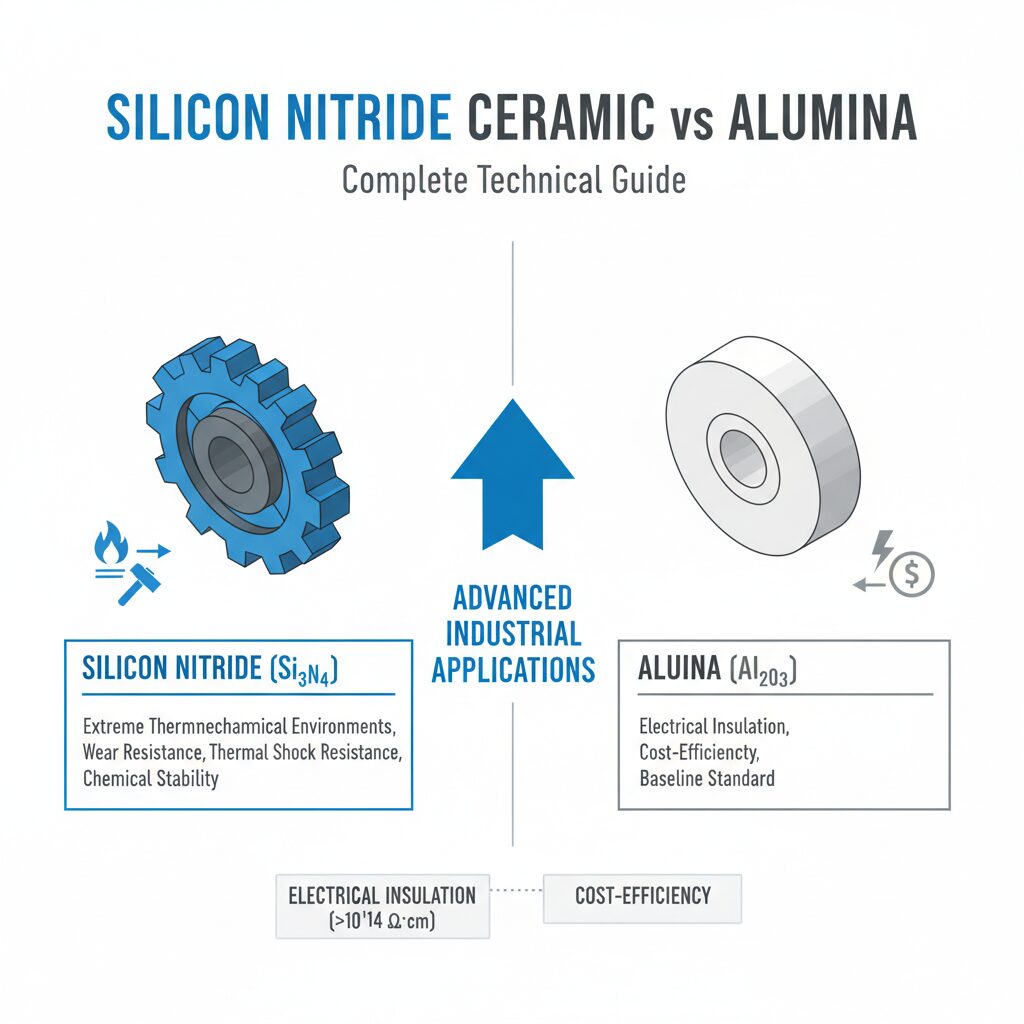
Conversely, нитрид кремния provides a lower density profile (3.20 g/cm³) and superior high-temperature operational thresholds (up to 1200°C continuous), making it the primary choice for ultra-high-speed spindle bearings. However, Y-TZP zirconia offers a uniquely superior surface finish potential (capable of Ra 0.005µm) and unmatched chemical inertness in highly basic environments (pH > 12). This is paramount for specific liquid chemical delivery systems. Additionally, zirconia outperforms карбид кремния in shock absorption, as SiC’s extreme rigidity (Young’s Modulus of 410 GPa) makes it brittle under dynamic mechanical loads.
| Недвижимость | Zirconia Ceramic Ball for Semiconductor | Глинозем | Цирконий | Нитрид кремния |
|---|---|---|---|---|
| Теплопроводность | 2.2 | 30.0 | 2.5 | 29.0 |
| Твердость | 1250 | 1600 | 1200 | 1500 |
| Вязкость разрушения | 9.5 | 4.5 | 8.0 | 6.5 |
| Стоимость | Высокий | Низкий | Средний | Очень высокий |
Optimize Your Semiconductor Equipment Performance: Do you need assistance selecting the exact ceramic material grade for your high-vacuum or corrosive fluid application? Contact our materials engineering team today for a comprehensive design consultation.
Приложения
- Chemical Mechanical Planarization (CMP) Slurry Control Valves: In advanced node CMP processes, slurries utilize highly abrasive nano-ceria or silica particles suspended in aggressive chemistries (pH ranges from 2.0 to 12.0). A zirconia ceramic ball for semiconductor valves acts as the primary fluid control check mechanism. Engineers select this material because its 1250 HV hardness prevents micro-abrasion from the slurry, ensuring zero particle shedding and maintaining leak rates below 1×10⁻⁶ atm·cc/sec over a lifecycle exceeding 5 million cycles.
- Wafer Processing Vacuum Bearings: Standard steel bearings suffer from severe galling and cold-welding in ultra-high vacuum (UHV) environments (10⁻⁸ Torr) found in PVD and ion implantation chambers. Zirconia balls operate entirely unlubricated, preventing hydrocarbon contamination. Their non-magnetic nature (magnetic permeability < 1.00001) ensures they do not distort the sensitive electromagnetic fields utilized to guide ion beams or plasma confinement arrays.
- Wet Bench Fluid Handling Pumps: Automated wet stations utilizing Piranha etch (H₂SO₄/H₂O₂ at 120°C) or RCA cleans require diaphragm and check pumps with absolute chemical resistance. Y-TZP zirconia check balls resist aggressive acidic and alkaline attacks, exhibiting a corrosion rate of less than 0.01 mm/year in 10% HF solutions. This prevents heavy metal leaching (such as Fe, Ni, or Cr) that would severely degrade carrier minority lifetime in silicon wafers.
- Lithography Equipment Metrology Spheres: Extreme Ultraviolet (EUV) lithography systems require highly calibrated spherical targets for multi-axis laser interferometry. Zirconia is chosen for its ability to be polished to a Grade 3 specification (sphericity < 0.08 µm, surface roughness Ra < 0.005 µm). Its high density (6.05 g/cm³) provides vibration damping properties, ensuring geometric stability even under micro-seismic disturbances within the fab environment.
- Plasma Etch Chamber Positioning Components: Reactive Ion Etching (RIE) utilizes aggressive halogen-based plasmas (such as CF₄, Cl₂, HBr). Zirconia balls are employed in the kinematic coupling mechanisms of wafer chucks due to their high plasma erosion resistance. They maintain their sub-micron geometric tolerances even after hundreds of hours of exposure to high-density plasma operating at 1,000 W RF power, where metallic components would rapidly vaporize.
Производственный процесс
The fabrication of a zirconia ceramic ball for semiconductor integration dictates absolute control over every phase of production, from raw powder synthesis to final nano-polishing. The process begins with ultra-high purity Y-TZP powders featuring an average particle size (D50) of precisely 0.3 to 0.5 µm. Powder morphology is strictly controlled to ensure homogeneous green-body density. Any agglomeration or impurity at the ppm level will result in catastrophic failure or contamination in the final semiconductor application. Great Ceramic employs a stringent, multi-stage manufacturing architecture designed to guarantee the ±0.005mm tight-tolerance required by Tier 1 equipment manufacturers.
Методы формовки
- Холодное изостатическое прессование (CIP): For larger spherical components (typically > 10.0 mm in diameter), the prepared zirconia powder is encapsulated in a flexible elastomer mold and submerged in a highly pressurized fluid vessel. Hydraulic pressures ranging from 200 to 300 MPa are applied uniformly across all 360 degrees. This hydrostatic forming method achieves an exceptional green density of roughly 60% theoretical maximum, eliminating internal voids and density gradients that would otherwise cause anisotropic shrinkage during sintering.
- Керамическое литье под давлением (CIM): For micro-spheres (ranging from 1.0 mm to 5.0 mm), powders are compounded with proprietary thermoplastic binders to create a specialized feedstock. This feedstock is injected into precision multi-cavity tungsten carbide molds at temperatures between 160°C and 200°C and pressures exceeding 100 MPa. CIM allows for rapid scale-up while maintaining net-shape geometric consistency, prior to advanced catalytic or thermal debinding processes.
Спекание
The transition from a fragile green body to a fully densified structural ceramic occurs via precisely profiled solid-state sintering. The spherical preforms are loaded onto refractory setter plates and processed in high-purity atmospheric kilns. The thermal profile is engineered to ramp up at exactly 1°C to 2°C per minute to prevent thermal shock, culminating in a soak temperature between 1450°C and 1550°C for 2 to 4 hours. During this phase, the material undergoes a massive volumetric shrinkage of 20% to 25%. Accurate thermodynamic control is paramount to achieve a final theoretical density of >99.9%, effectively sealing all interconnected porosity and achieving the required 6.05 g/cm³ physical density.
Окончательная обработка
Achieving semiconductor-grade dimensional accuracy requires advanced прецизионная обработка керамики and multi-axial lapping operations. Post-sintering, the blanks possess a rough tolerance of ±0.2 mm. They are loaded into specialized grooved cast iron lapping plates and rotated in a planetary motion under heavy continuous downward pressure (ranging from 10 to 50 N per sphere). Successive stages of diamond abrasive paste, stepping down from 15 µm to sub-micron 0.25 µm grit, slowly remove surface material. This prolonged, geometrically complex lapping process ensures roundness, achieving Grade 5 or even Grade 3 specifications (sphericity deviation less than 0.13 µm and 0.08 µm respectively). The final chemical-mechanical polishing (CMP) step guarantees an ultra-smooth, scratch-free surface (Ra < 0.01 µm), essential for frictionless rolling contact.
Преимущества и ограничения
Преимущества
- Zero Particle Shedding: Thanks to the 1250 HV hardness and high cohesive strength of the Y-TZP microstructure, a zirconia ceramic ball for semiconductor applications experiences negligible abrasive wear. This ensures class 10 cleanroom compliance, avoiding the generation of nanoscale particulate contaminants that would otherwise result in catastrophic yield losses in sub-10nm logic and memory nodes.
- Трансформационное упрочнение: When a micro-crack begins to propagate through the material under high mechanical stress, the stress field induces a phase transformation in the immediate vicinity of the crack tip. The crystal structure shifts from tetragonal to monoclinic, accompanied by a 3-5% localized volume expansion. This expansion actively compresses the crack, halting its progression and yielding a fracture toughness (9.5 MPa·m½) unmatched by other advanced technical ceramics.
- Supreme Chemical Inertness: Zirconia does not react with the vast majority of highly aggressive chemicals utilized in modern fab processes. It demonstrates total immunity to hydrofluoric acid (HF), hydrochloric acid (HCl). And heated sulfuric acid mixtures. Consequently, it maintains strict dimensional stability and prevents heavy metal ionic leaching into critical process fluids.
- High-Vacuum Compatibility: By achieving over 99.9% theoretical density and zero open porosity, these ceramic spheres prevent trapped gases from outgassing when subjected to ultra-high vacuum (UHV) pressures below 10⁻⁸ Torr. This ensures deposition integrity in Physical Vapor Deposition (PVD) and Atomic Layer Deposition (ALD) chambers.
Ограничения
- Hydrothermal Aging Vulnerability: Under prolonged exposure to high-temperature moisture or steam environments (specifically between 200°C and 300°C), Y-TZP can undergo Low-Temperature Degradation (LTD). This environmental condition triggers spontaneous surface phase transformation from tetragonal to monoclinic, resulting in micro-cracking and a subsequent decrease in mechanical strength.
- High Mass Inertia: With a density of 6.05 g/cm³, zirconia is significantly heavier than silicon nitride (3.20 g/cm³) and standard bearing steel (7.80 g/cm³). In ultra-high-speed centrifugal applications (exceeding 50,000 RPM), the resulting centrifugal forces create extreme kinetic loads on the outer bearing races. This can limit the maximum continuous operating speeds compared to lighter ceramic alternatives.
Особенности обработки
Transforming sintered Y-TZP blanks into flawless bearing components for the semiconductor sector poses profound engineering challenges. The very characteristic that makes a zirconia ceramic ball for semiconductor use so durable—its high fracture toughness and transformation toughening—renders it exceptionally difficult to machine. Conventional abrasive cutting mechanics often induce excessive subsurface damage due to localized frictional heating (exceeding 800°C at the tool-ceramic interface) and the subsequent stress-induced tetragonal-to-monoclinic phase shifts.
To overcome this, Great Ceramic utilizes rigid, high-damping machine architectures coupled with resin-bonded polycrystalline diamond (PCD) tooling. Grinding kinematics must be strictly controlled. feed rates are kept exceptionally low (e.g., 0.05 to 0.1 mm/min). And spindle speeds are optimized to maintain constant surface speed while heavily flooding the contact zone with highly lubricious, water-based synthetic coolants at 15-20 Bar pressure. This rapid heat evacuation prevents thermal shock micro-fractures.
For high-precision spherical lapping, achieving the required ±0.005mm dimensional tolerance and a sphericity of < 0.13 µm requires proprietary multi-directional planetary kinematics. The lapping loads must be meticulously distributed across hundreds of spheres simultaneously to prevent localized pressure spikes. Additionally, post-machining metrology is critical. every production batch is subjected to rigorous optical interferometry and laser scanning to verify that surface roughness (Ra) strictly adheres to the < 0.01 µm specification, guaranteeing zero asperity contact in high-vacuum mechanical integration.
Require Tight-Tolerance Ceramic Components? Great Ceramic’s advanced machining centers routinely deliver precision components with tolerances down to ±0.005mm. Submit your CAD drawings for a rapid RFQ.
FAQ
What is a zirconia ceramic ball for semiconductor?
A zirconia ceramic ball for semiconductor is an ultra-high precision, spherical component manufactured from Yttria-Stabilized Zirconia (Y-TZP). Engineered specifically for microelectronics manufacturing equipment, these spheres are utilized in environments requiring absolute chemical inertness, high mechanical toughness. And zero particle generation. Operating in conditions ranging from ultra-high vacuum deposition chambers (10⁻⁸ Torr) to aggressive chemical mechanical planarization (CMP) fluid lines, they are strictly manufactured to tight dimensional tolerances (often ±0.005mm) and high surface finish (Ra < 0.01 µm) to prevent any metallic or particulate contamination on silicon wafers.
What are the main applications of a zirconia ceramic ball for semiconductor?
These engineered spheres are deployed across critical sub-systems within the fab. Their primary applications include acting as high-cycle check valves in chemical mechanical planarization (CMP) slurry distribution pumps, where they resist the abrasive nature of nano-silica. They serve as unlubricated, non-magnetic bearing elements in high-vacuum robotic wafer handlers, preventing outgassing and cold-welding. Additionally, they are used in wet bench fluid handling systems for dosing highly corrosive acids (like HF and Piranha). And act as dimensionally stable, vibration-damping calibration targets in multi-axis extreme ultraviolet (EUV) lithography metrology systems.
How does a zirconia ceramic ball for semiconductor compare to other ceramics?
When evaluated against standard technical ceramics, zirconia holds a unique position. It offers more than double the fracture toughness of high-purity alumina (9.5 vs 4.5 MPa·m½), making it significantly more resistant to impact shock and mechanical fatigue in rapid automation cycles. While silicon nitride offers lower density and higher speed capabilities for spindle bearings, zirconia provides superior surface finish characteristics and enhanced chemical resistance against strong alkaline solutions (pH > 12). Furthermore, zirconia completely surpasses silicon carbide in terms of impact resistance, avoiding the brittle shattering risks associated with extreme modulus rigid materials.
What are the advantages of a zirconia ceramic ball for semiconductor?
The critical advantage lies in its “transformation toughening” mechanism. This halts micro-crack propagation under stress, granting it unparalleled mechanical durability (flexural strength of 1050 MPa). This durability ensures a zero-particle-shedding operation. This is mandatory for maintaining high wafer yields in sub-3nm logic nodes. Furthermore, its ultra-high density (6.05 g/cm³) and 0% open porosity eliminate outgassing risks in high-vacuum environments. Its absolute chemical inertness ensures it does not leach heavy metal ions into process fluids. And its high electrical resistivity (>10¹⁰ Ω·cm) prevents the accumulation and discharge of static electricity that could easily destroy sensitive microcircuits.
How is a zirconia ceramic ball for semiconductor machined?
Sintered zirconia is notoriously difficult to machine due to its extreme hardness and toughness. At Great Ceramic, achieving strict tolerances of ±0.005mm and a sphericity of less than 0.13 µm requires proprietary multi-axis precision lapping. We utilize rigid planetary lapping machines equipped with grooved cast iron or polyurethane plates, applying precise downward forces (10-50 N) while progressively stepping down diamond abrasive slurries from 15 µm to 0.25 µm grit. Copious coolant flow is mandated to prevent stress-induced phase transformations at the contact patch. Our advanced прецизионная обработка керамики capabilities ensure a flawless Grade 5 or Grade 3 specification with mirror-like surface finishes (Ra < 0.01 µm).
Need custom zirconia ceramic ball for semiconductor parts? Связаться с компанией Great Ceramic для получения услуг по прецизионной обработке с жесткими допусками, или отправьте сообщение по электронной почте [email protected].
zirconia ceramic ball for semiconductor is widely used in advanced ceramic applications.
Узнайте больше о Zirconia Ceramic Ball For Semiconductor и наши услуги по прецизионной обработке керамики.