








нитрид бора ceramic ceramic components for energy: Complete Technical Guide
The transition toward high-efficiency power generation, advanced nuclear systems. And next-generation energy storage requires materials capable of surviving extreme thermal and electrical environments. When engineers specify boron nitride ceramic ceramic components for energy applications, they are addressing critical industry pain points: catastrophic thermal shock, high-voltage dielectric breakdown. And the need for complex, highly machinable geometries. Hexagonal boron nitride (h-BN), often referred to as “white graphite,” delivers an unparalleled combination of thermal conductivity (up to 120 W/m·K in specific orientations), near-zero thermal expansion. And a dielectric strength exceeding 35 kV/mm. This complete technical guide breaks down the thermomechanical properties, application environments. And manufacturing protocols required for energy sector deployment. At Отличная керамика, we leverage state-of-the-art CNC technology to deliver these critical components, specializing in tight-tolerance precision machining up to ±0.005mm to ensure seamless integration into complex power systems.
Свойства материала
Hexagonal boron nitride exhibits a highly anisotropic crystal structure. The sp² covalently bonded boron and nitrogen atoms form planar hexagonal networks, while weak van der Waals forces bind the adjacent layers. This distinct structural morphology dictates its bulk macroscopic properties, resulting in exceptional lubricity, a low dielectric constant (approximately 4.0 at 1 MHz). And high thermal stability. In an oxidizing atmosphere, h-BN remains stable up to 900°C, whereas in inert or vacuum environments, it withstands continuous operation at 1900°C to 2000°C without significant outgassing or structural degradation. Below is the standard thermomechanical property profile for hot-pressed boron nitride used in energy applications.
| Недвижимость | Значение | Единица |
|---|---|---|
| Плотность | 2.10 – 2.25 | г/см³ |
| Твердость | 25 – 30 | HV |
| Прочность на изгиб | 30.0 – 45.0 | МПа |
| Вязкость разрушения | 1.0 – 1.2 | МПа-м½ |
| Теплопроводность | 60.0 (Average) | Вт/м-К |
| Электрическое сопротивление | > 10¹⁴ | Ω-см |
| Максимальная рабочая температура | 900 (Air) / 1900 (Vacuum) | °C |
*Note: Thermal conductivity and flexural strength values are highly dependent on the pressing direction (parallel vs. perpendicular to the pressing axis) due to the anisotropic nature of the h-BN crystal lattice.
Сравнение с другими видами керамики
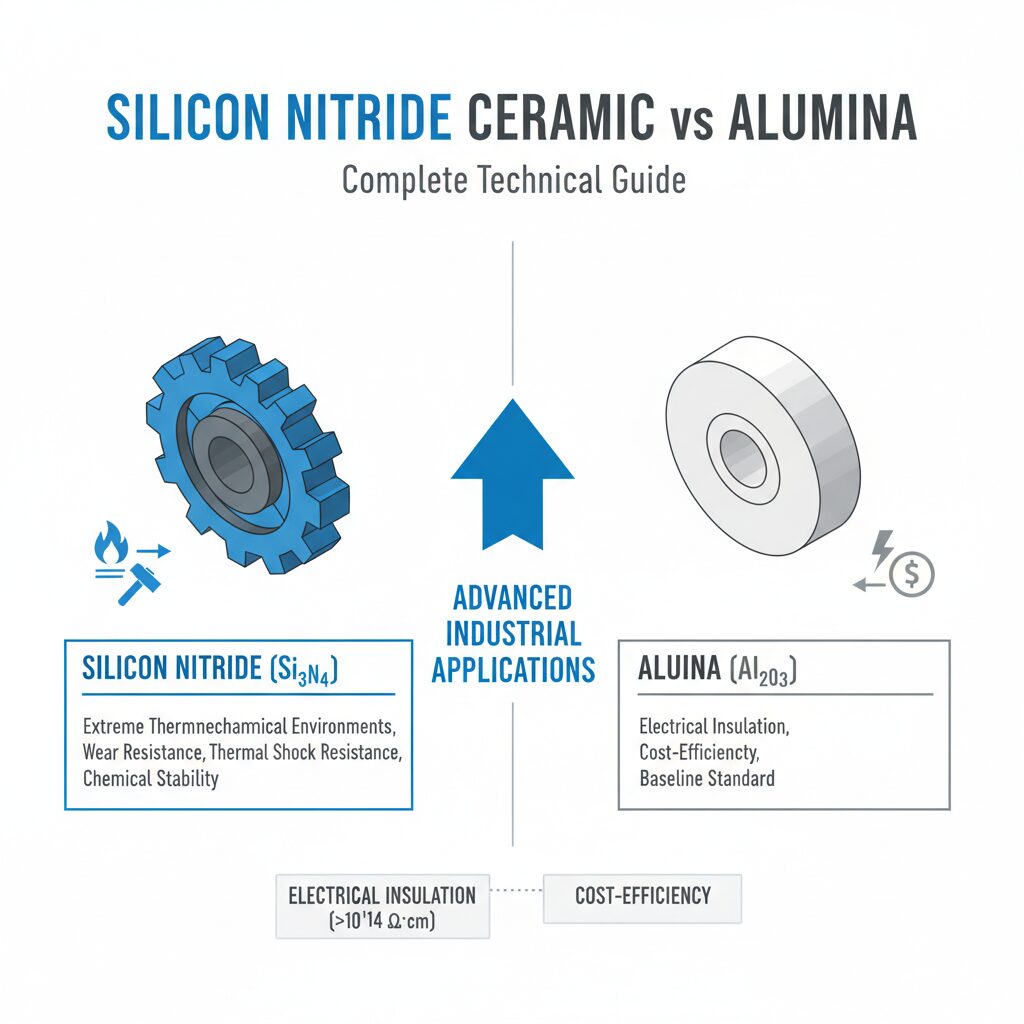
Selecting the correct technical ceramic for energy infrastructure requires balancing thermal performance, mechanical robustness. And manufacturing cost. While глинозем-ceramics/”>alumina (Al2O3) is the industry standard for general electrical insulation, its thermal shock resistance is vastly inferior to boron nitride. диоксид циркония-ceramics/”>Zirconia (ZrO2) offers fracture toughness up to 10.0 MPa·m½, making it ideal for high-stress mechanical parts, but its thermal conductivity is extremely low (2.5 W/m·K), acting as a thermal insulator rather than a conductor. Silicon nitride (Si3N4) bridges the gap with high strength and good thermal shock resistance, but it cannot match the machinability or the ultra-high-temperature inertness of boron nitride in specific molten metal or semiconductor applications.
| Недвижимость | boron nitride ceramic ceramic components for energy | Глинозем (99.5%) | Цирконий (Y-TZP) | Нитрид кремния (Si3N4) |
|---|---|---|---|---|
| Теплопроводность (Вт/м-К) | 60.0 | 30.0 | 2.5 | 30.0 – 90.0 |
| Твердость (HV) | 25 | 1500 | 1200 | 1600 |
| Вязкость разрушения (МПа-м½) | 1.0 | 4.0 | 10.0 | 6.5 |
| Диэлектрическая прочность (кВ/мм) | 35.0 – 40.0 | 15.0 – 18.0 | 10.0 | 15.0 – 20.0 |
| Обрабатываемость | Excellent (Standard Tools) | Poor (Diamond Grinding) | Poor (Diamond Grinding) | Poor (Diamond Grinding) |
| Стоимость | Высокий | Низкий | Средний | Высокий |
Приложения
The unique intersection of high thermal conductivity, electrical insulation. And chemical inertness positions boron nitride as a mission-critical material in the energy sector. Engineers routinely specify h-BN for environments where thermal cycling causes standard ceramics to catastrophically fracture.
- Solid Oxide Fuel Cells (SOFCs) and Electrolyzers: Boron nitride is utilized as high-temperature electrical insulators and gas-sealing gaskets. Operating continuously at temperatures between 700°C and 1000°C, SOFC components require materials that do not react with hydrogen, oxygen, or water vapor while maintaining absolute electrical isolation between adjacent cell interconnects.
- Nuclear Reactor Systems: In next-generation molten salt reactors (MSRs) and neutron shielding applications, h-BN is deployed because the boron-10 isotope possesses a massive neutron absorption cross-section (approximately 3840 barns). It acts as an effective neutron absorber and control rod material while surviving extreme radiation fluxes and temperatures exceeding 1500°C without significant volumetric swelling.
- Solar Photovoltaic (PV) Manufacturing: Boron nitride crucibles, nozzles. And PVD (Physical Vapor Deposition) fixtures are essential in the crystallization of polysilicon and the manufacturing of thin-film solar panels. BN is completely non-wetting to molten silicon, preventing contamination of the high-purity silicon melts (often maintaining purities of 99.9999% or 6N) and extending crucible lifespans significantly compared to quartz.
- Power Electronics and EV Inverters: Insulated Gate Bipolar Transistors (IGBTs) and карбид кремния (SiC) MOSFETs used in wind turbine converters and electric vehicle inverters generate massive localized heat densities (often exceeding 200 W/cm²). Boron nitride substrates and heat sinks provide rapid heat dissipation away from the semiconductor junctions while providing high-voltage isolation (up to 3000V DC) to prevent short circuits.
- High-Voltage Switchgear Insulation: In high-voltage power transmission grids, arc-extinguishing chambers require materials that can withstand sudden plasma arcs reaching thousands of degrees for milliseconds. Boron nitride’s superior thermal shock resistance (ΔT > 1500°C) allows it to absorb extreme, instantaneous thermal gradients without cracking, while its dielectric properties suppress arc propagation.
Производственный процесс
Producing energy-grade boron nitride requires tightly controlled synthesis and consolidation parameters to achieve the desired density, purity. And crystallographic orientation. Unlike conventional technical ceramics that rely on cold pressing and pressureless sintering, h-BN requires specialized thermomechanical processing to achieve structural integrity.
Методы формовки
- Горячее прессование (HP): The primary method for producing bulk h-BN blanks. High-purity boron nitride powder, often mixed with a calcium borate or yttria binding agent, is placed into graphite dies. The material is subjected to simultaneous uniaxial pressure (typically 20 to 40 MPa) and high temperatures (1800°C to 2000°C) in an induction-heated vacuum or nitrogen-atmosphere furnace. This process aligns the hexagonal platelets perpendicular to the pressing direction, resulting in anisotropic physical properties.
- Химическое осаждение из паровой фазы (CVD): For high-purity, binderless applications, Pyrolytic Boron Nitride (pBN) is produced via CVD. Boron trichloride (BCl3) and ammonia (NH3) gases are reacted in a high-temperature vacuum chamber (around 1900°C). The resultant pBN is deposited onto graphite mandrels layer by layer, achieving 99.99% purity and theoretical density, ideal for extreme high-vacuum energy systems.
Спекание
Because boron nitride covalently bonds, it exhibits extremely low solid-state diffusion rates. Pressureless sintering is nearly impossible without significant liquid-phase sintering aids (such as B2O3). Sintering during the hot-pressing phase requires strict atmospheric control—typically high-purity nitrogen gas—to prevent the dissociation of nitrogen from the boron lattice at temperatures above 1800°C. Cooling rates are closely monitored (typically 5°C to 10°C per minute) to prevent residual internal stresses.
Окончательная обработка
Unlike sintered alumina or silicon carbide. This require slow, expensive diamond grinding, hot-pressed boron nitride is highly machinable. Standard carbide end mills and turning tools can be utilized. However, achieving energy-sector tolerances requires specialized CNC equipment. Great Ceramic’s machining process utilizes multi-axis CNC milling and turning centers to produce complex threaded components, thin-walled insulators. And micro-holes, routinely achieving tolerances of ±0.005mm and surface finishes as fine as Ra 0.2 µm.
Need high-precision prototyping for your energy project? Reach out to our engineering team to discuss your drawings and specifications.
Преимущества и ограничения
Преимущества
- Extreme Thermal Shock Resistance: The low thermal expansion coefficient (1.5 – 2.5 x 10⁻⁶/°C) combined with high thermal conductivity allows h-BN parts to be quenched from 1200°C to room temperature without catastrophic crack propagation.
- Superior Machinability: Components can be machined to exacting tolerances (±0.005mm) significantly faster and at a lower tooling cost compared to other technical ceramics, making it ideal for rapid prototyping in R&D environments.
- Высокая диэлектрическая прочность: Capable of withstanding up to 40 kV/mm, providing exceptional electrical isolation in high-voltage grid infrastructure and EV battery management systems.
- Chemical Inertness and Non-Wetting: Highly resistant to molten metals (aluminum, magnesium, silicon, copper) and molten salts, making it the premier choice for metallurgy and advanced reactor coolants.
Ограничения
- Low Mechanical Strength: With flexural strengths rarely exceeding 50 MPa and a fracture toughness of ~1.0 MPa·m½, boron nitride is not suitable for high-stress load-bearing applications or environments subjected to severe mechanical impact.
- Moisture Sensitivity (Binder Dependent): Certain grades of hot-pressed boron nitride utilizing calcium borate binders (like Grade A or Grade HBN) are hygroscopic. If exposed to high humidity, the binder can absorb water, leading to volumetric swelling and a degradation of dielectric properties. Such parts must be baked out at 300°C to 400°C before use in vacuum applications.
Особенности обработки
While h-BN is renowned for its machinability, achieving the ±0.005mm precision required for advanced energy components presents distinct engineering challenges. Because the material is soft and friable, traditional machining approaches often lead to edge chipping, delamination (due to its anisotropic layer structure). And surface galling. At Great Ceramic, our engineers utilize highly optimized parameters to counteract these challenges.
Workholding and Fixturing: Boron nitride has a low compressive yield strength. Standard mechanical vises or 3-jaw chucks can easily crush or distort the blank. We utilize custom-profiled soft jaws and advanced vacuum chucks to distribute clamping forces evenly across the component’s surface area, preventing micro-fractures before the tool even touches the part.
Tooling Selection and Geometry: Although high-speed steel (HSS) can cut h-BN, it wears rapidly due to the abrasive nature of microscopic ceramic particles. We specify ultra-fine-grain solid carbide or Polycrystalline Diamond (PCD) tooling. Tools must have sharp, positive rake angles (typically 5° to 10°) to shear the material cleanly rather than pushing or rubbing it. This causes localized delamination.
Coolant Protocols: Because many standard h-BN grades absorb moisture, liquid water-based coolants are strictly prohibited as they destroy the material’s dielectric integrity. Great Ceramic utilizes specialized dry machining techniques, employing continuous high-velocity air blasts and vacuum extraction systems to clear abrasive swarf instantly. This prevents chip recutting and maintains thermal stability during the machining cycle.
| Операция обработки | Tool Material | Cutting Speed (Vc) | Feed Rate (f) | Coolant Method |
|---|---|---|---|---|
| CNC Turning (Roughing) | Carbide (Uncoated) | 150 – 250 m/min | 0.10 – 0.20 mm/rev | Dry / Air Blast |
| CNC Turning (Finishing) | PCD or Carbide | 250 – 400 m/min | 0.02 – 0.08 mm/rev | Dry / Air Blast |
| CNC Milling (Slotting) | Solid Carbide | 100 – 200 m/min | 0.05 – 0.12 mm/tooth | Dry / Air Blast |
| Drilling (Deep Hole) | Carbide (Polished Flutes) | 50 – 100 m/min | 0.02 – 0.05 mm/rev | Air Blast / Peck Cycle |
By tightly controlling these parameters, Great Ceramic eliminates the risk of edge chipping on critical features such as O-ring grooves and high-voltage feedthrough flanges, ensuring the final part meets rigorous energy industry standards.
FAQ
What is boron nitride ceramic ceramic components for energy?
These are highly specialized industrial parts machined from hexagonal boron nitride (h-BN), engineered specifically for power generation, distribution. And storage systems. They are utilized when an application requires simultaneous high thermal conductivity (to dissipate heat) and extreme electrical insulation, alongside the ability to survive thermal shocks up to 1500°C without fracturing. Common examples include solid oxide fuel cell insulators, EV inverter heat sinks. And nuclear reactor neutron absorbers.
What are the main applications of boron nitride ceramic ceramic components for energy?
Primary applications include electrical insulators in Solid Oxide Fuel Cells (SOFCs) operating at 1000°C, neutron absorbing shields in molten salt nuclear reactors, non-wetting crucibles for solar-grade silicon crystallization, high-voltage arc extinguishing chambers in electrical grids. And thermal management substrates for high-power density electronics (like SiC MOSFETs and IGBTs) where standard ceramics fail due to thermal stress.
How does boron nitride ceramic ceramic components for energy compare to other ceramics?
Compared to standard structural ceramics, boron nitride offers superior thermal shock resistance, unmatched machinability. And better high-temperature lubricity. While alumina (Al2O3) has higher mechanical strength, its thermal conductivity (30 W/m·K) is half that of BN (up to 120 W/m·K oriented). And it cracks easily under rapid temperature changes. Zirconia offers massive fracture toughness (10 MPa·m½) but acts as a thermal insulator (2.5 W/m·K). Boron nitride is chosen when thermal management, electrical insulation. And complex geometry outweigh the need for high tensile strength.
What are the advantages of boron nitride ceramic ceramic components for energy?
The core advantages include exceptional thermal shock resistance (ΔT > 1500°C), a very low coefficient of thermal expansion (averaging 2.0 x 10⁻⁶/°C), high dielectric breakdown strength (over 35 kV/mm). And continuous high-temperature stability (up to 1900°C in a vacuum or inert atmosphere). Furthermore, it is completely non-wetting to most molten metals and glass. And its exceptional machinability drastically reduces manufacturing lead times for complex geometries.
How is boron nitride ceramic ceramic components for energy machined?
Hexagonal boron nitride is machined using conventional CNC turning and milling centers, typically utilizing sharp, solid carbide or Polycrystalline Diamond (PCD) tools with positive rake angles. Because the material is fragile and some grades are moisture-sensitive, machining must be done dry using high-velocity air blasts instead of liquid coolants. And clamping requires custom vacuum fixturing to prevent crushing. Great Ceramic’s advanced machining capabilities allow us to routinely achieve ultra-tight tolerances of ±0.005mm and complex geometries without edge chipping or delamination.
Need custom boron nitride ceramic ceramic components for energy parts? Связаться с компанией Great Ceramic for precision machining services with tight tolerances. Our engineering team is ready to review your CAD files and deliver performance-critical solutions tailored to your high-temperature and high-voltage applications.
boron nitride ceramic ceramic components for energy is widely used in advanced ceramic applications.
boron nitride ceramic ceramic components for energy is widely used in advanced ceramic applications.