









Machinable Glass Ceramic: Complete Technical Guide
For engineers and R&D teams facing long lead times and high tooling costs associated with traditional fired ceramics, machinable glass ceramic represents a critical material solution. The primary industrial pain point in advanced technical ceramics is the necessity for post-sintering diamond grinding to achieve tight tolerances. This inherently increases both cost and prototyping turnaround times. Machinable glass ceramic eliminates this bottleneck entirely. Composed of approximately 55% fluorophlogopite mica embedded within a 45% borosilicate glass matrix, this highly specialized composite allows for direct CNC fabrication using standard metalworking tools without the need for post-machining firing or sintering. Great Ceramic leverages the unique microstructural properties of this material to deliver complex geometries with exceptional dimensional stability. By utilizing state-of-the-art multi-axis CNC centers, we routinely achieve ultra-tight manufacturing tolerances of ±0.005mm. Whether your application requires ultra-high vacuum (UHV) compatibility, zero porosity, or continuous thermal resistance up to 800°C, machinable glass ceramic offers unparalleled versatility. Submit your CAD files to Great Ceramic today to accelerate your prototyping cycle and drastically reduce your precision engineering costs.
Propriedades do material
The engineering value of machinable glass ceramic stems from its highly specialized thermomechanical and dielectric profile. Unlike traditional polycrystalline technical ceramics, the unique glass-mica matrix actively arrests crack propagation during mechanical stress, allowing the material to be cut rather than ground. The material exhibits a zero-porosity microstructure, ensuring absolute hermeticity and zero outgassing in environments dropping below 10^-10 torr. Thermally, it maintains structural integrity under continuous operating temperatures of 800°C, with peak transient exposures permissible up to 1000°C. With a coefficient of thermal expansion (CTE) of 9.3 × 10^-6 /°C (measured from 20°C to 300°C), it closely matches the CTE of many structural metals, including sealing glasses, titanium. And Kovar, making it ideal for matched hermetic feedthrough seals. Electrically, it is an outstanding insulator, boasting a dielectric constant of 6.03 at 1 kHz, a dissipation factor of just 0.004 at 1 MHz. And an impressive dielectric strength of 40 kV/mm under continuous direct current.
| Imóveis | Valor | Unidade |
|---|---|---|
| Densidade | 2.52 | g/cm³ |
| Dureza | 250 | HV |
| Resistência à flexão | 94 | MPa |
| Resistência à fratura | 1.53 | MPa-m½ |
| Condutividade térmica | 1.46 | W/m-K |
| Resistividade eléctrica | >10^16 | Ω-cm |
| Temperatura máxima de funcionamento | 800 | °C |
Mechanically, engineers must account for a Modulus of Elasticity of 66.9 GPa and a Shear Modulus of 25.5 GPa, alongside a Poisson’s ratio of 0.29. While its flexural strength (94 MPa) and compressive strength (345 MPa) are significantly lower than conventional sintered technical ceramics, its unique machinability off-sets these mechanical limitations in non-load-bearing applications. The material exhibits exceptional dimensional stability, meaning parts machined to ±0.005mm at ambient room temperature (25°C) will retain precise geometries without residual stress warping when subjected to high-temperature operational cycling.
Comparação com outras cerâmicas
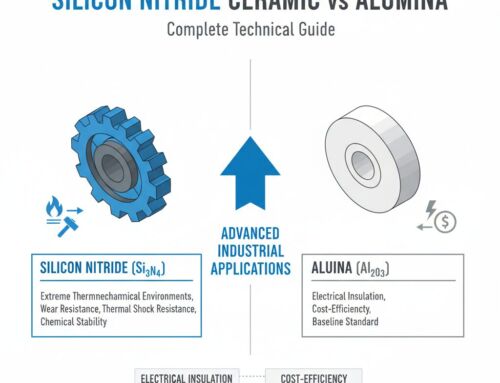
Selecting the optimal technical ceramic requires a rigorous analysis of application specific parameters, balancing thermal management, mechanical strength. And manufacturing cost. While machinable glass ceramic is unmatched for rapid prototyping and complex geometries, it possesses distinct physical limitations when contrasted with traditional technical ceramics. For instance, alumina/”>alumina provides superior mechanical strength and hardness, making it a better candidate for high-wear structural components, but it mandates expensive diamond tooling. When thermal shock resistance and high fracture toughness are required, nitreto de silício significantly outperforms glass ceramics, albeit at a drastically higher raw material and machining cost.
For applications heavily reliant on thermal dissipation, engineers should consider nitreto de alumínio. This offers a thermal conductivity of up to 170 W/m·K—over 100 times greater than the 1.46 W/m·K insulating profile of machinable glass ceramic. Conversely, if high fracture toughness (up to 10 MPa·m½) is the primary design requirement to prevent catastrophic mechanical failure, zircónia remains the superior choice. If you require another easily machined alternative specifically for ultra-high temperature applications in inert environments, nitreto de boro offers excellent lubricity and thermal stability, though it lacks the high mechanical rigidity and vacuum-tight hermeticity of glass ceramics. Finally, for extreme high-temperature structural rigidity and abrasion resistance, carboneto de silício provides unmatched hardness and thermal conductivity, though it represents one of the most difficult materials to machine.
| Imóveis | Vidro cerâmico maquinável | Alumina | Zircónia | Nitreto de silício |
|---|---|---|---|---|
| Condutividade térmica | 1.46 | 24 - 35 | 2.2 - 3.0 | 20 - 30 |
| Dureza | 250 | 1500 | 1200 | 1500 |
| Resistência à fratura | 1.53 | 4.0 - 5.0 | 8.0 - 10.0 | 6.0 - 7.0 |
| Custo | Baixo-Médio | Médio | Elevado | Muito elevado |
Aplicações
- Ultra-High Vacuum (UHV) Components: Utilized extensively as insulating standoffs, feedthroughs. And supports in mass spectrometers and electron microscopes. Machinable glass ceramic is selected because it features absolute zero porosity, exhibiting zero volumetric outgassing at pressures as low as 10^-10 torr. And can be baked out at temperatures exceeding 600°C without dimensional degradation.
- Aerospace and Defense Sensor Housings: Employed in structural mountings for sensitive guidance and telemetry systems. Engineers select this material because it is completely non-magnetic, radiation-resistant. And possesses a low density (2.52 g/cm³), contributing to critical weight reduction while maintaining stable telemetry signal transmission with a low dielectric constant (6.03).
- Semiconductor Wafer Processing Equipment: Used as thermal isolators, plasma-resistant nozzles. And retaining rings in deposition and etching chambers. The material is chosen because it produces absolutely no particulate shedding or ductile outgassing during high-heat plasma exposure, maintaining Class 100 cleanroom compliance while insulating sensitive electronic nodes.
- Medical and Analytical Instrumentation: Integrated as fluid handling manifolds, laser cavity reflectors. And RF insulators in MRI equipment. Selected due to its bio-inertness, absolute chemical stability against physiological fluids. And the ability to be internally threaded and machined to micro-fluidic tolerances (±0.005mm) without risking micro-crack bacterial harbor points.
- High-Power Laser Substrates: Utilized as insulating supports and optical mounts in gas and solid-state laser systems. Machinable glass ceramic is favored because its thermal expansion coefficient (9.3 x 10^-6 /°C) aligns well with internal metal chassis components, preventing optical misalignment caused by thermal cycling between 20°C and 400°C during continuous laser operation.
Processo de fabrico
The manufacturing process of machinable glass ceramic dictates its unique micro-structural behavior. Unlike traditional ceramics. This begin as compacted powders that are subsequently sintered, this material is formed through a highly controlled glass-melting and subsequent devitrification process. The foundational formulation requires a precise stoichiometric blend of silica (SiO2), magnesium oxide (MgO), aluminum oxide (Al2O3), potassium oxide (K2O). And boron trioxide (B2O3), with the addition of fluorine to catalyze the formation of mica. By precisely controlling the thermal history of the melt, manufacturers dictate the volumetric percentage and geometric orientation of the crystalline phase. This is exactly what gives the material its uniquely forgiving machinability.
Métodos de moldagem
- Melting and Casting: The raw oxides and fluorides are blended and melted in high-purity platinum or refractory crucibles at temperatures exceeding 1400°C. The homogenous, molten glass is then continuously cast into large monolithic blocks, slabs, or continuous rods. At this stage, the material is a pure, amorphous glass, exhibiting high internal stress and complete transparency.
- Extrusion and Pressing: For specialized high-volume pre-forms, the molten glass can be extruded through customized dies or pressed into near-net shape blanks. This must be done while the glass remains within its specific working viscosity range (typically between 1000°C and 1200°C) prior to controlled cooling to ambient room temperature.
Sinterização
Instead of traditional powder sintering, the amorphous glass blanks undergo a rigorous secondary thermal treatment known as “ceraming” or devitrification. The cast blocks are placed in precision convection kilns and slowly heated to a nucleation temperature range between 750°C and 850°C. During this multi-day thermal cycle, microscopic seed crystals form throughout the glass matrix. As the temperature is maintained and carefully ramped, these seeds facilitate the growth of 2D interlocking fluorophlogopite mica crystals. The process is strictly controlled to halt crystalline growth when the microstructure reaches a volume fraction of 55% mica flakes (averaging 20 microns in length) and 45% residual borosilicate glass. The final material is cooled at a rate of less than 2°C per minute to ensure zero residual thermal stress.
Maquinação final
The finalized composite is now ready for maquinagem de precisão em cerâmica. Because the material undergoes zero shrinkage post-machining, parts can be fabricated directly to final engineering print specifications. Great Ceramic utilizes 5-axis CNC machining centers equipped with high-speed spindles capable of operating at up to 24,000 RPM. While the material can be cut with High Speed Steel (HSS), we employ micro-grain tungsten carbide tooling to maintain superior edge retention and achieve strict ±0.005mm tolerances. Complex features such as M2 internal threading, 0.5mm micro-holes. And intricate blind-pockets are executed using optimized CAM toolpaths that prioritize constant chip load and low cutting pressure.
Vantagens e limitações
Vantagens
- Zero Post-Firing Shrinkage: Unlike green ceramics that shrink by 15-20% during sintering, machinable glass ceramic can be CNC machined directly to final dimensions (±0.005mm), drastically reducing lead times from weeks to mere days.
- Standard Tool Machinability: Does not require custom electroplated diamond grinding wheels or specialized ultrasonic machining. standard carbide metal-cutting end mills, drills. And taps are sufficient.
- Exceptional Hermeticity: The dense, pore-free borosilicate matrix yields zero porosity and zero continuous permeability, rendering it ideal for deep space, cryogenic. And UHV environments down to 10^-10 torr.
- Excellent Electrical Insulation: Delivers superior dielectric strength (40 kV/mm) and a high volume resistivity (>10^16 Ω·cm), protecting high-voltage electronics and RF systems from arcing and dielectric breakdown at elevated temperatures.
Limitações
- Resistência mecânica moderada: With a flexural strength of just 94 MPa and a fracture toughness of 1.53 MPa·m½, it is inherently brittle and unsuitable for structural, load-bearing applications subject to high impact or dynamic tensile stress.
- Chemical Susceptibility: While highly resistant to most industrial solvents and mild bases, the borosilicate matrix is vulnerable to chemical attack and degradation when exposed to halogenated acids (such as Hydrofluoric Acid) and strong, concentrated alkalis at elevated temperatures.
Considerações sobre maquinagem
Despite being marketed as highly machinable, realizing precision tolerances of ±0.005mm in machinable glass ceramic presents significant engineering challenges. The material removal mechanism is entirely different from the plastic deformation seen in metals. When a cutting tool engages the material, it initiates microscopic localized fractures. The embedded fluorophlogopite mica flakes act as strategic crack-arrestors, causing the micro-fractures to cleave and safely deflect, thereby localizing the damage to the immediate cutting zone and preventing the propagation of macroscopic cracks into the bulk material. However, if cutting forces exceed the material’s structural limits, localized edge chipping, severe surface galling. And catastrophic workpiece failure will occur.
To mitigate edge chipping and tool deflection, Great Ceramic implements rigid fixturing and meticulously controls cutting parameters. Water-soluble synthetic coolants are mandatory during all operations. they do not simply cool the tool interface, but crucially flush away the abrasive glass-mica swarf. If glass swarf is permitted to re-cut, it acts as a lapping compound, accelerating tool wear and degrading surface finishes from an optimal Ra 0.2 µm to an unacceptable Ra 1.6 µm or worse. Explore Great Ceramic’s precision machining capabilities to see how our engineering teams optimize CAM strategies to mitigate these material-specific challenges.
Recommended CNC Machining Parameters
| Operation Type | Spindle Speed (RPM) | Feed Rate | Depth of Cut / Details |
|---|---|---|---|
| CNC Milling (Roughing) | 1000 – 1500 | 0.05 mm/tooth | 2.0 – 3.0 mm DOC. Climb milling preferred. |
| CNC Milling (Finishing) | 2000 – 3000 | 0.02 mm/tooth | 0.05 – 0.1 mm DOC. Ensure continuous coolant. |
| CNC Turning | 500 – 800 | 0.05 – 0.1 mm/rev | Use positive rake carbide inserts (5°-10° clearance). |
| Drilling | 300 – 500 | 0.02 – 0.04 mm/rev | Peck cycle required. Withdraw every 1-2 mm to clear swarf. |
| Tapping | 50 – 100 | Match thread pitch | Clearance hole must be 0.1-0.2mm larger than standard metal tap drills. |
Furthermore, when executing through-holes, “breakout” at the exit face is a primary failure mode. Great Ceramic engineers solve this by backing the workpiece with a sacrificial plate of aluminum or brass, providing positive physical support to the exit surface. For delicate features with wall thicknesses below 1.0 mm, we employ specialized potting compounds or low-melting-point waxes to encapsulate the part during final machining, dissolving the support material post-process to reveal a flawlessly executed, micro-machined ceramic component.
FAQ
What is machinable glass ceramic?
Machinable glass ceramic is an advanced, two-phase composite material consisting of approximately 55% synthetic fluorophlogopite mica crystals embedded in a 45% borosilicate glass matrix. This specific microstructure halts the propagation of cracks, allowing the highly insulating and heat-resistant material to be directly cut, milled, turned. And tapped using conventional high-speed steel or carbide metalworking tools without any requirement for post-machining firing or sintering. It is widely recognized by trade names such as Macor.
What are the main applications of machinable glass ceramic?
The primary applications encompass industries requiring high-performance insulators that demand rapid prototyping and complex geometries. It is heavily utilized in ultra-high vacuum (UHV) systems (due to its zero outgassing at 10^-10 torr), semiconductor wafer fabrication equipment, aerospace sensor mountings, medical diagnostic hardware (such as MRI RF insulators). And high-power laser optical mounts. It excels wherever electrical insulation, thermal stability up to 800°C. And dimensional precision are critical.
Em que medida a vitrocerâmica usinável se compara a outras cerâmicas?
Compared to traditional advanced ceramics like alumina e nitreto de silício, machinable glass ceramic boasts dramatically lower machining costs and faster lead times because it bypasses the need for costly diamond grinding post-sintering. However, it trades mechanical durability for manufacturability. it has a significantly lower flexural strength (94 MPa vs. 300+ MPa for alumina) and a lower maximum continuous operating temperature (800°C vs. 1500°C+ for alumina). It is intended for highly complex, non-structural insulating components.
What are the advantages of machinable glass ceramic?
The foremost advantage is its zero-shrinkage manufacturability, allowing highly complex, tight-tolerance parts (±0.005mm) to be fabricated rapidly with standard cutting tools. Additional advantages include zero porosity (hermetically tight), excellent dimensional stability under thermal cycling, radiation resistance, a low thermal conductivity (1.46 W/m·K) acting as a thermal break. And exceptional dielectric strength (40 kV/mm) for high-voltage isolation.
How is machinable glass ceramic machined?
Machining is performed using standard multi-axis CNC milling and turning centers. Unlike metal, the material removal relies on controlled micro-fracturing rather than plastic shearing. Success dictates using micro-grain carbide tools with sharp, positive rake angles, maintaining highly controlled chip loads (e.g., 0.02 – 0.05 mm/tooth). And utilizing continuous water-soluble coolants to flush abrasive glass dust. Great Ceramic excels in this domain, leveraging specialized high-speed routing, rigid work-holding. And optimized CAM programming to execute complex geometries and M2 threads while maintaining strict ±0.005mm tolerances. Explore our maquinagem de precisão em cerâmica services for more details.
Need custom machinable glass ceramic parts? Contactar Great Ceramic para serviços de maquinagem de precisão com tolerâncias apertadas, ou envie um e-mail para [email protected].
Saiba mais sobre Vidro cerâmico maquinável e os nossos serviços de maquinagem de precisão em cerâmica.