








Aluminum Nitride Ceramic Hardness: Complete Technical Guide
When engineering high-performance thermal management systems and advanced semiconductor components, material selection often dictates the boundary of technological capability. Aluminum nitride (AlN) has emerged as an indispensable material in modern industrial engineering due to its exceptionally rare combination of high thermal conductivity (up to 230 W/m·K) and robust electrical insulation (>10¹⁴ Ω·cm). However, understanding нитрид алюминия твердость керамики is critical for engineers transitioning from prototype design to full-scale production. The material’s inherent mechanical properties present unique challenges during fabrication, often resulting in micro-fractures, edge chipping, or compromised surface integrity if not processed correctly. This comprehensive technical guide explores the intricate mechanical and thermal properties of AlN, compares its performance metrics against other advanced ceramics. And details the rigorous engineering protocols required to achieve ultra-precise specifications. By mastering these parameters, procurement managers and R&D teams can optimize component lifecycles while minimizing manufacturing bottlenecks. For engineers requiring immediate solutions, Great Ceramic offers unparalleled expertise in advanced fabrication, consistently delivering complex geometries with rigorous ±0.005mm dimensional tolerances to meet the most demanding operational environments. Submit an RFQ to Great Ceramic’s engineering team today to evaluate your specific design requirements.
Свойства материала
To engineer reliable components for extreme environments, R&D teams must evaluate the foundational data governing the material’s physical and mechanical behavior. The aluminum nitride ceramic hardness, typically measured at 1,100 HV, classifies it as a hard, brittle material that requires specialized diamond tooling for post-sintering modification. With a theoretical density approaching 3.26 g/cm³, fully dense sintered AlN exhibits an impressive flexural strength of 320 MPa, allowing it to withstand significant structural loads in static applications. However, its fracture toughness of 2.8 MPa·m½ is relatively low, meaning it is highly susceptible to crack propagation under sudden impact or aggressive machining feeds.
Thermally, AlN is practically unmatched among insulating ceramics. Its thermal conductivity easily surpasses 170 W/m·K, with premium grades reaching 230 W/m·K—nearly seven times higher than standard 99.5% глинозем. This high conductivity is paired with a Coefficient of Thermal Expansion (CTE) of approximately 4.5 × 10⁻⁶/°C (from 20°C to 400°C). This perfectly matches the CTE of silicon semiconductor wafers, thereby preventing thermal fatigue in bonded assemblies. Below is the comprehensive property matrix for high-purity (99%+) sintered нитрид алюминия.
| Недвижимость | Значение | Единица |
|---|---|---|
| Плотность | 3.26 | г/см³ |
| Твердость | 1100 | HV |
| Прочность на изгиб | 320 | МПа |
| Вязкость разрушения | 2.8 | МПа-м½ |
| Теплопроводность | 170 - 230 | Вт/м-К |
| Электрическое сопротивление | > 10^14 | Ω-см |
| Максимальная рабочая температура | 1000 (Oxidizing) / 1900 (Inert) | °C |
Understanding these values is crucial for mechanical design. The specific electrical resistivity of >10¹⁴ Ω·cm ensures zero current leakage even across high-voltage interfaces. However, the maximum working temperature is highly dependent on the atmospheric conditions. In a standard oxidizing environment (air), AlN begins to oxidize at temperatures exceeding 1,000°C, forming a protective layer of aluminum oxide (Al₂O₃). In an inert atmosphere, such as nitrogen or argon, or within a high vacuum, the material remains structurally stable up to 1,900°C before sublimation occurs.
Сравнение с другими видами керамики
Material specification requires a comparative analysis of competing technical ceramics. While AlN excels in thermal dissipation, other materials might be selected if mechanical toughness or cost-efficiency are the primary driving factors. Evaluating the aluminum nitride ceramic hardness against alternatives provides insight into wear resistance and machinability.
| Недвижимость | Нитрид алюминия | Глинозем | Цирконий | Нитрид кремния |
|---|---|---|---|---|
| Теплопроводность (Вт/м-К) | 170 - 230 | 25 – 35 | 2 – 3 | 30 – 80 |
| Твердость (HV) | 1100 | 1500 | 1200 | 1500 |
| Вязкость разрушения (МПа-м½) | 2.8 | 4.0 | 8 – 10 | 6 – 8 |
| Стоимость | Высокий | Низкий | Средний | Высокий |
When comparing these advanced materials, several critical engineering tradeoffs emerge:
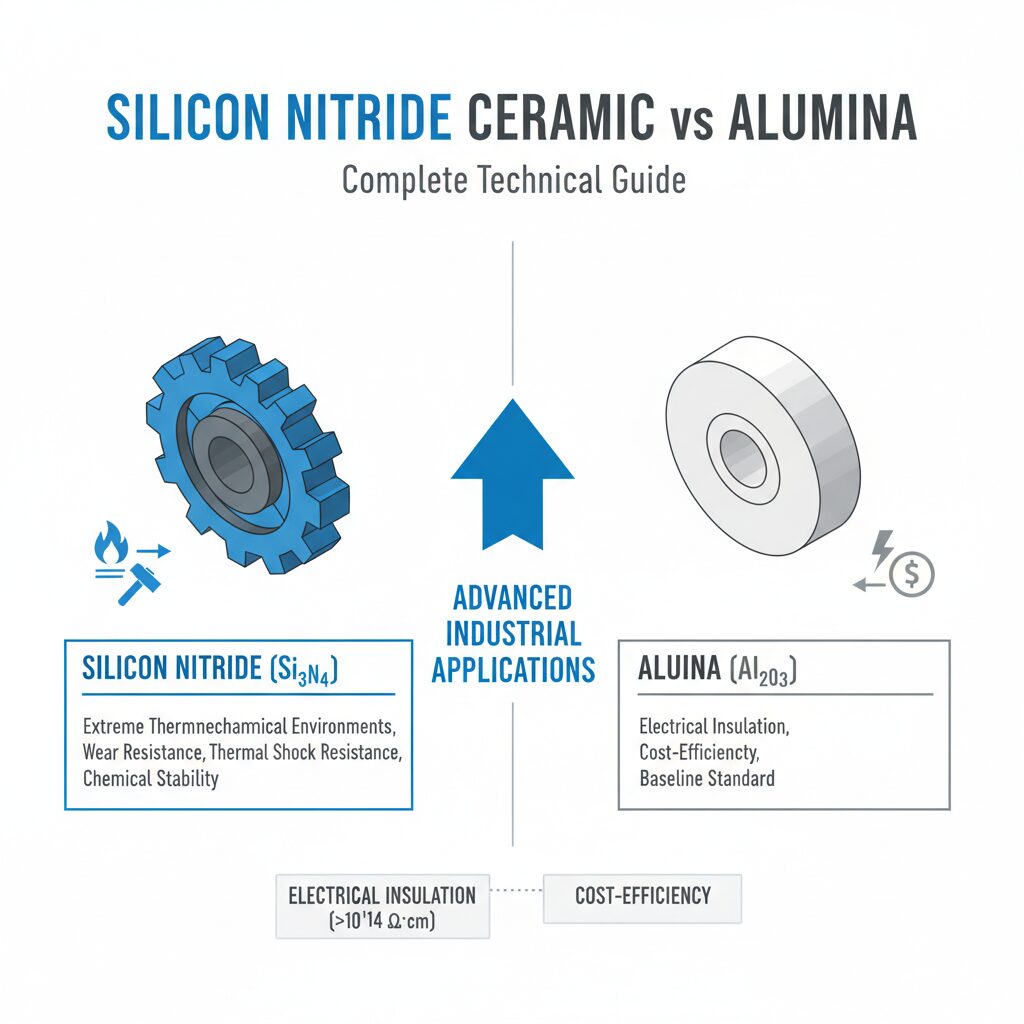
Aluminum Nitride vs. Alumina: Глинозем is the industry standard for general-purpose insulators due to its low cost and excellent mechanical stability. Alumina boasts a higher hardness of 1,500 HV, making it more resistant to abrasive wear. However, AlN dominates in thermal management. Where Alumina provides a mere 25-35 W/m·K of thermal conductivity, AlN delivers up to 230 W/m·K. This makes AlN the mandatory choice for modern high-power-density electronics where thermal bottlenecking causes component failure.
Aluminum Nitride vs. Zirconia: Цирконий (specifically YTZP) is renowned for its exceptional fracture toughness (up to 10 MPa·m½), making it highly resistant to impact and dynamic stress. However, Zirconia acts as a thermal insulator with a conductivity of only 2-3 W/m·K. If an application requires both heat dissipation and structural integrity, engineers must weigh Zirconia’s superior mechanical durability against AlN’s thermal efficiency.
Aluminum Nitride vs. Silicon Nitride: Нитрид кремния offers a well-rounded combination of high hardness (1,500 HV), excellent fracture toughness (6-8 MPa·m½). And moderate thermal conductivity (up to 80 W/m·K). While Si3N4 is vastly superior for engine components and high-speed bearings subjected to extreme mechanical shock, it cannot compete with AlN in applications that demand rapid heat spreading, such as laser diode mounts or high-frequency RF packages.
In scenarios requiring extreme wear resistance in highly corrosive environments, engineers might also consider карбид кремния (SiC). This features a hardness exceeding 2,500 HV and high thermal conductivity. Conversely, for easily machinable thermal management components, нитрид бора represents the opposite end of the spectrum, offering softness and lubricity but sacrificing mechanical strength.
Приложения
The unique intersection of high thermal conductivity, electrical insulation. And an optimized CTE allows aluminum nitride to dominate specific high-end industrial sectors. Below are the primary applications where AlN is specified over all other technical ceramics.
- Semiconductor Equipment Components: Specifically utilized in electrostatic chucks, wafer heaters. And clamp rings operating at up to 600°C. AlN is chosen because its CTE (4.5 × 10⁻⁶/°C) perfectly matches silicon wafers, eliminating thermal stress and warpage during extreme temperature cycling in vacuum chambers. Additionally, its plasma resistance ensures ultra-low particle generation in corrosive fluorine-based etching environments.
- Силовая электроника и IGBT-модули: Insulated-Gate Bipolar Transistors (IGBT) and high-power MOSFETs generate extreme localized heat fluxes often exceeding 150 W/cm². AlN serves as the foundational substrate, rapidly spreading the heat away from the silicon die while providing >15 kV/mm dielectric strength to prevent catastrophic electrical shorting.
- Optoelectronics and Laser Diode Submounts: High-power industrial laser diodes must maintain a precise operating temperature to prevent wavelength shifting and maintain optical efficiency. AlN submounts provide immediate thermal relief, transferring heat away from the active light-emitting junction faster than traditional beryllium oxide (BeO), without the associated toxicity risks.
- Microwave and RF Packages: In high-frequency 5G telecommunications and aerospace radar systems, signal loss and thermal accumulation are critical failure modes. AlN’s low dielectric constant (approx. 8.8 at 1 MHz) minimizes parasitic capacitance and signal delay, while its thermal mass easily absorbs the heat generated by high-frequency power amplification.
- High-Performance LED Heat Sinks: High-brightness UV-C and visible spectrum LEDs rely on AlN ceramic circuit boards for maximum lifespan. By maintaining the LED junction temperature below 85°C through superior thermal conductivity, AlN substrates significantly reduce lumen depreciation and extend the operational life of the lighting system beyond 50,000 hours.
Do you have a complex engineering project requiring materials that can handle extreme thermal loads? Great Ceramic provides comprehensive design-for-manufacturability (DFM) support for advanced AlN components. Request an engineering consultation today.
Производственный процесс
Producing fully dense, high-purity aluminum nitride components requires tightly controlled atmospheric processing. The material is highly sensitive to oxygen and moisture contamination during the powder stage. This can drastically reduce its final thermal conductivity. The typical manufacturing pipeline consists of powder preparation, green forming, binder burnout. And high-temperature sintering.
Методы формовки
Because the initial raw AlN powder is highly abrasive, achieving uniform density in the “green” (unfired) state is paramount. Any density gradients will result in warped parts during shrinkage.
- Литье из ленты: The dominant method for creating flat substrates used in electronics. The AlN powder is mixed with specific organic binders (like PVB), plasticizers. And solvents to create a slurry. This slurry is precisely metered over a moving carrier tape using a doctor blade, creating thin sheets ranging from 0.1mm to 1.5mm in thickness, achieving a dimensional thickness tolerance of ±0.02mm before firing.
- Холодное изостатическое прессование (CIP): Used for larger, three-dimensional components such as semiconductor heating pedestals. The powder is placed into a flexible polyurethane mold and subjected to uniform fluid pressure exceeding 200 MPa (29,000 psi) from all directions. This guarantees homogeneous compaction, preventing internal voids and minimizing differential shrinkage during sintering.
Спекание
Sintering is the most critical phase in determining the final thermal and mechanical properties. Because AlN is a covalently bonded material, it does not naturally densify well. Consequently, sintering aids—typically yttrium oxide (Y₂O₃) or calcium oxide (CaO)—are added at concentrations of 2% to 5%. During sintering, these additives react with the residual oxygen (alumina layer) on the surface of the AlN powder particles, forming a liquid yttrium-aluminate phase. This process occurs in specialized graphite-lined furnaces under a strict nitrogen gas atmosphere at temperatures ranging from 1,800°C to 1,900°C for periods of 12 to 24 hours. The yttrium acts as an oxygen scavenger, purifying the AlN crystal lattice and resulting in the massive thermal conductivity jump from ~90 W/m·K to >170 W/m·K. The component shrinks by roughly 18% to 22% during this phase.
Окончательная обработка
Due to the aggressive shrinkage and potential for minor thermal warping during the 1,900°C sintering cycle, “as-fired” parts rarely meet the strict ±0.005mm dimensional tolerances required by modern engineering assemblies. To achieve absolute precision, the sintered components undergo прецизионная обработка керамики. This step utilizes multi-axis CNC machines equipped with specialized resin-bonded and metal-bonded diamond grinding wheels, operating at spindle speeds exceeding 15,000 RPM. Rigorous coolant application and micro-feed rates are necessary to prevent subsurface damage.
Преимущества и ограничения
Преимущества
- Superior Thermal Management: At 170-230 W/m·K, AlN actively draws heat away from critical electronic junctions faster than almost any other electrically insulating material, supporting power densities exceeding 150 W/cm².
- Silicon-Matched CTE: The coefficient of thermal expansion strictly parallels that of silicon semiconductor chips up to 400°C. This eliminates the risk of solder joint fatigue, die cracking, or delamination in highly cycled power modules.
- Высокая диэлектрическая прочность: AlN exhibits a dielectric breakdown strength of over 15 kV/mm. It maintains robust electrical isolation even at elevated temperatures, ensuring operator safety and component reliability in high-voltage grids.
- Non-Toxic Alternative to BeO: Historically, beryllium oxide (BeO) was used for high thermal conductivity substrates. However, BeO dust is highly toxic and carcinogenic. AlN provides equivalent or superior thermal performance with zero toxicity risks, drastically reducing handling, machining. And disposal costs.
Ограничения
- Lower Fracture Toughness: With a K1c value of only 2.8 MPa·m½, AlN is significantly more brittle than materials like Zirconia. It is sensitive to point loading, requiring careful handling during assembly and strict control over torque values when mechanical fasteners are applied.
- Hydrolysis Vulnerability: In its raw powder form, aluminum nitride reacts vigorously with atmospheric moisture (humidity) to form aluminum hydroxide and ammonia gas. This mandates complex, expensive. And dry-atmosphere powder handling processes prior to sintering. This significantly drives up the final component cost.
Особенности обработки
When transitioning from raw material to finished product, the aluminum nitride ceramic hardness dictates the entire fabrication strategy. While a hardness of 1,100 HV is lower than that of alumina or silicon carbide, AlN is notoriously brittle and prone to edge chipping. Attempting to machine AlN with standard carbide or high-speed steel tooling is impossible. the tool will simply wear away in seconds while causing catastrophic catastrophic micro-cracking in the ceramic workpiece.
Successful precision machining relies entirely on engineered diamond abrasives. Grinding parameters must be optimized based on the grit size, concentration. And bonding matrix of the diamond wheel. For roughing operations, metal-bonded diamond wheels with a grit size of D126 (approx. 120 mesh) are employed at high surface speeds (25 to 35 meters per second) with depth-of-cut limited to 0.05mm per pass. For fine finishing to achieve a surface roughness (Ra) of less than 0.2 µm, resin-bonded diamond wheels with D46 grit or finer are required, accompanied by extremely slow feed rates (0.005mm to 0.01mm per pass).
Below is a standardized capability matrix demonstrating the exacting tolerances achievable when utilizing specialized grinding kinematics for AlN.
| Параметры обработки | Standard Tolerance | Tight Tolerance (Great Ceramic) |
|---|---|---|
| Точность размеров | ± 0.05 mm | ± 0.005 mm |
| Surface Finish (Ra) | 0.8 µm | 0.1 µm |
| Flatness | 0.02 mm | 0.002 mm |
| Концентричность | 0.05 mm | 0.01 mm |
| Hole Diameter | ± 0.05 mm | ± 0.01 mm |
Vibration is the enemy of tight-tolerance AlN machining. Multi-axis CNC grinders must be constructed with massive granite bases to absorb resonance. Furthermore, flood coolant must be applied directly at the cutting zone at pressures exceeding 15 bar to flush away the highly abrasive swarf and manage localized thermal expansion of the cutting tool. If the coolant flow is interrupted for even a fraction of a second, the localized heat generated by friction against the 1,100 HV surface will cause thermal shock, resulting in immediate subsurface cracking. Great Ceramic has perfected these specialized machining protocols, guaranteeing flawless edge integrity and dimensional stability on complex AlN geometries.
FAQ
What is aluminum nitride ceramic hardness?
Сайт aluminum nitride ceramic hardness generally measures between 1,000 and 1,200 HV (Vickers hardness) under a standard test load (e.g., HV0.5). While this is slightly softer than high-purity alumina (1,500 HV) and significantly softer than silicon carbide (2,500 HV), it remains exceptionally hard relative to conventional metals like hardened tool steel (approx. 700-800 HV). This extreme hardness makes it highly resistant to abrasive wear and mechanical deformation but also dictates that all post-sintering modifications must be performed using specialized industrial diamond abrasive tooling to prevent fracturing.
What are the main applications of aluminum nitride?
Aluminum nitride is primarily utilized in environments that require simultaneously high heat dissipation and strict electrical insulation. The main applications include semiconductor manufacturing equipment (such as high-temperature electrostatic chucks, clamp rings. And wafer heating pedestals operating up to 600°C), power electronics (substrates for high-power IGBT and MOSFET modules), optoelectronics (submounts for high-power industrial laser diodes), microwave/RF communication packages for 5G infrastructure. And advanced heat sinks for high-lumen LED arrays. Its matching CTE with silicon makes it invaluable for directly mounting semiconductor dies.
How does aluminum nitride compare to other ceramics?
Aluminum nitride’s standout feature is its thermal conductivity (170-230 W/m·K). This vastly outperforms alumina (25-35 W/m·K) and zirconia (2-3 W/m·K). While zirconia offers superior mechanical toughness (up to 10 MPa·m½ compared to AlN’s 2.8 MPa·m½) and alumina offers a more cost-effective electrical insulation solution, neither can handle high-density heat loads. Silicon nitride provides better thermal shock resistance and higher strength but only achieves a fraction of AlN’s thermal conductivity (approx. 30-80 W/m·K). Therefore, AlN is exclusively chosen when thermal management is the critical failure point in electronic assemblies.
What are the advantages of aluminum nitride?
The primary advantages of aluminum nitride include exceptionally high thermal conductivity (approaching that of metallic aluminum while remaining electrically insulating), a coefficient of thermal expansion (CTE) of 4.5 × 10⁻⁶/°C that perfectly mirrors silicon. And massive dielectric breakdown strength exceeding 15 kV/mm. Additionally, unlike legacy thermal management ceramics such as beryllium oxide (BeO), aluminum nitride is entirely non-toxic. This drastically reduces environmental compliance, manufacturing. And long-term disposal costs while offering comparable or superior thermal performance.
How is aluminum nitride machined?
Because of its hard, brittle nature and low fracture toughness (2.8 MPa·m½), sintered aluminum nitride cannot be cut with traditional metal tooling. It is machined using precision CNC grinding equipment utilizing specialized resin and metal-bonded diamond abrasive wheels. The process requires high spindle speeds (up to 24,000 RPM), exceedingly low feed rates (0.005mm/pass). And high-pressure flood coolant to mitigate thermal shock and micro-cracking. Great Ceramic leverages state-of-the-art multi-axis grinding technology to overcome these challenges, routinely delivering complex AlN components with surface finishes of Ra 0.1 µm and ultra-tight dimensional tolerances down to ±0.005mm.
Need custom aluminum nitride ceramic hardness parts? Связаться с компанией Great Ceramic для получения услуг по прецизионной обработке с жесткими допусками, или отправьте сообщение по электронной почте [email protected].
aluminum nitride ceramic hardness is widely used in advanced ceramic applications.
Узнайте больше о Aluminum Nitride Ceramic Hardness и наши услуги по прецизионной обработке керамики.