









ZTA ceramic plate for aerospace: Complete Technical Guide
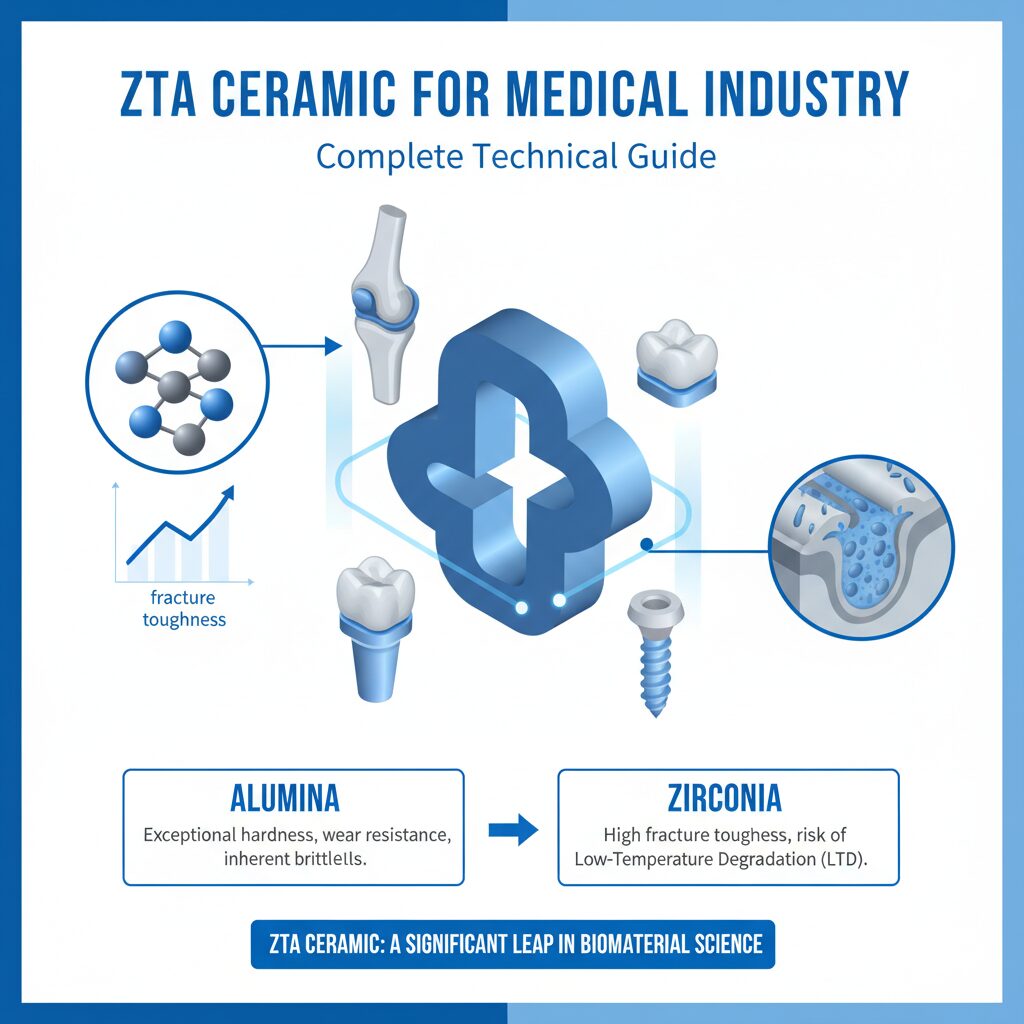
The demand for advanced structural materials in aerospace engineering has never been higher, driven by extreme operational environments characterized by violent thermal gradients, high-velocity atmospheric friction. And intense mechanical vibration. A ZTA ceramic plate for aerospace applications represents a critical engineering solution for these high-stress conditions. Zirconia Toughened Alumina (ZTA) is an advanced composite ceramic that perfectly bridges the performance gap between the extreme hardness of pure aluminum oxide and the high fracture toughness of zirconium dioxide. By engineering a two-phase microstructure, ZTA mitigates the catastrophic brittle failure common in traditional technical ceramics, making it an ideal substrate for hypersonic thermal protection systems, ballistic armor. And precision navigational instrumentation. However, realizing the full potential of ZTA requires exceptional manufacturing capabilities. At Great Ceramic, we specialize in overcoming the extreme hardness of this material, providing maquinagem de precisão em cerâmica with ultra-tight tolerances of ±0.005mm. This definitive technical guide explores the material science, comparative advantages, aerospace applications. And complex machining protocols required to produce flight-ready ZTA ceramic plates.
Ready to optimize your aerospace components? Contact Great Ceramic today to discuss your ZTA engineering requirements and receive a comprehensive manufacturing analysis.
Propriedades do material
The mechanical and thermal properties of a ZTA ceramic plate for aerospace are dictated by its biphasic microstructure. Typically composed of a 70% to 85% alumina matrix uniformly dispersed with 15% to 30% yttria-stabilized zirconia particles, ZTA leverages a phenomenon known as stress-induced phase transformation toughening. When a micro-crack begins to propagate through the alumina matrix, the high-stress field at the crack tip triggers the metastable tetragonal zirconia particles to undergo a martensitic transformation into a monoclinic crystal structure. This phase shift is accompanied by a 3% to 5% volumetric expansion. This induces localized compressive stresses that actively pinch the propagating crack shut. This mechanism elevates the fracture toughness to approximately 6.0 MPa·m½, significantly higher than pure alumina, while maintaining a Vickers hardness exceeding 1600 HV. The resulting material profile is exceptionally resilient under the dynamic mechanical loads and severe thermal shocks encountered in aerospace environments.
| Imóveis | Valor | Unidade |
|---|---|---|
| Densidade | 4h10 – 4h30 | g/cm³ |
| Dureza | 1600 – 1700 | HV |
| Resistência à flexão | 600 – 800 | MPa |
| Resistência à fratura | 5.5 – 7.0 | MPa-m½ |
| Condutividade térmica | 20 – 24 | W/m-K |
| Resistividade eléctrica | > 10^14 | Ω-cm |
| Temperatura máxima de funcionamento | 1500 | °C |
Comparação com outras cerâmicas
Material selection in aerospace engineering requires a meticulous analysis of the trade-offs between weight, thermal management, structural integrity. And manufacturing cost. A ZTA ceramic plate for aerospace occupies a highly optimized middle ground. When compared to pure alumina, ZTA provides a 50% to 70% increase in flexural strength and double the fracture toughness, virtually eliminating the risk of vibration-induced catastrophic failure in flight structures. Conversely, while monolithic zircónia offers higher maximum fracture toughness (up to 8.0 MPa·m½), it suffers from a significantly higher density (approximately 6.0 g/cm³) which introduces unacceptable weight penalties for weight-critical aerospace payloads. Furthermore, zirconia exhibits poor high-temperature strength retention above 500°C, whereas ZTA maintains structural integrity well beyond 1000°C.
When evaluated against advanced non-oxide ceramics, ZTA holds distinct economic and application-specific advantages. While nitreto de silício provides superior thermal shock resistance and lower density (3.2 g/cm³), its raw material and sintering costs are exponentially higher, making it cost-prohibitive for large-area aerospace armor or massive structural plates. Similarly, nitreto de alumínio excels in thermal conductivity (up to 170 W/m·K) but lacks the required ballistic hardness and fracture toughness for external aerospace exposure. The table below outlines these quantifiable performance metrics to guide engineering procurement decisions.
| Imóveis | ZTA ceramic plate for aerospace | Alumina (99,5%) | Zircónio (Y-TZP) | Nitreto de silício (Si3N4) |
|---|---|---|---|---|
| Condutividade térmica | 24 W/m·K | 30 W/m-K | 2,5 W/m-K | 30 W/m-K |
| Dureza | 1600 HV | 1800 HV | 1200 HV | 1500 HV |
| Resistência à fratura | 6.0 MPa·m½ | 3.5 MPa·m½ | 8.0 MPa·m½ | 7.0 MPa·m½ |
| Custo | Moderado | Baixa | Elevado | Muito elevado |
Aplicações
- Thermal Protection Systems (TPS) for Hypersonic Vehicles: At Mach 5 and above, atmospheric friction generates external skin temperatures exceeding 1200°C. A ZTA ceramic plate for aerospace is selected for TPS heat shields because its high melting point and thermal shock resistance prevent ablation, while its enhanced fracture toughness ensures the plates do not shatter under the violent acoustic and aerodynamic vibrations experienced during hypersonic flight.
- Airborne Radomes and RF Antenna Windows: Military aircraft and missile targeting systems require protective housings that are highly transparent to radio frequencies while capable of surviving supersonic impact with rain droplets and atmospheric particulates. ZTA is utilized because it provides a stable dielectric constant (typically around 9.0 at 1 MHz) alongside a 1600 HV hardness that completely mitigates high-velocity rain erosion degradation.
- Rotary Aircraft Ballistic Armor: Attack helicopters and low-altitude transport aircraft require structural armor capable of defeating armor-piercing (AP) projectiles without adding excessive weight. ZTA ceramic plates are utilized in composite armor systems because their initial high hardness blunts and fractures the incoming tungsten or steel penetrator, while the zirconia-induced toughness allows the plate to absorb up to 30% more kinetic energy than standard alumina before catastrophic fragmentation occurs.
- Inertial Navigation System (INS) Optomechanical Substrates: Ring laser gyroscopes and precision accelerometers operate on an optical scale where dimensional shifts of just a few microns can cause catastrophic navigational drift. ZTA is selected for INS mounting plates because Great Ceramic can machine these components to a flatness of 0.002mm. And the material exhibits a highly stable coefficient of thermal expansion (CTE of ~7.5 x 10^-6/°C), preventing thermal distortion during high-altitude atmospheric temperature drops.
- Jet Engine Sensor Housings and Wear Pads: Sensors mounted near turbine combustion chambers must survive localized temperatures of 1000°C, extreme high-frequency vibration. And corrosive exhaust gases. ZTA plates are chosen over carboneto de silício in specific electrical applications because ZTA offers superior electrical isolation (>10^14 Ω·cm) to prevent sensor signal shorting, while its phase-transformation toughness resists the mechanical fatigue caused by 25,000 RPM turbine vibrations.
Processo de fabrico
Producing a flight-certified ZTA ceramic plate for aerospace is a highly controlled metallurgical and chemical process that dictates the final density, microstructural homogeneity. And mechanical reliability of the component. The process begins with the precision blending of sub-micron alumina powders (average particle size 0.5 µm) and nanometer-scale yttria-stabilized zirconia powders. To prevent particle agglomeration and ensure even dispersion of the toughening zirconia phase, the powders are extensively ball-milled in a liquid suspension using high-purity milling media. Organic binders and plasticizers are added to the slurry. This is subsequently spray-dried to form a free-flowing, spherical granulated powder optimized for high-density compaction. The control of this powder morphology is critical. even a 1% deviation in bulk density at the green stage can lead to warping or micro-porosity during sintering, causing the plate to fail stringent aerospace non-destructive testing (NDT) requirements.
Métodos de moldagem
- Prensagem isostática a frio (CIP): For thick ZTA aerospace plates or monolithic armor inserts, CIP is the preferred method. The granulated powder is sealed in a flexible elastomeric mold and subjected to uniform hydraulic pressure ranging from 200 to 300 MPa. This omnidirectional pressure yields a green body with exceptionally uniform density gradients, minimizing differential shrinkage during sintering and eliminating structural weak points.
- Fundição em fita: For thin ZTA substrates used in aerospace electronics or RF windows (typically 0.5mm to 3.0mm thick), tape casting is utilized. The ceramic slurry is extruded via a doctor blade onto a moving carrier film, creating continuous, highly uniform sheets. These green sheets can be laser-cut to near-net shapes before firing, optimizing material utilization for complex aerospace geometries.
Sinterização
The sintering of a ZTA ceramic plate for aerospace is a complex thermodynamic event. The green bodies first undergo a carefully profiled thermal debinding stage between 400°C and 600°C to volatilize all organic binders without causing internal gas pressure micro-cracking. The plates are then ramped to peak sintering temperatures between 1550°C and 1650°C. During this phase, the material undergoes solid-state densification, shrinking by approximately 15% to 20%. The exact temperature profile, dwell time. And cooling rate are strictly controlled to prevent abnormal grain growth in the alumina matrix and to ensure the zirconia particles remain locked in their metastable tetragonal phase at room temperature. Over-sintering can cause the zirconia to prematurely transform to the monoclinic phase, completely negating the material’s fracture toughness.
Maquinação final
Post-sintering, the ZTA ceramic plate for aerospace achieves its full 1600 HV hardness, rendering conventional metal-cutting tools completely ineffective. To achieve the rigorous geometric tolerances required for aerospace integration—often dictating ±0.005mm dimensional accuracy, Ra 0.1 µm surface roughness. And sub-micron flatness—the plates must undergo extensive precision CNC grinding. This process utilizes custom-profiled, resin-bonded and metal-bonded diamond abrasive wheels. Given the extreme hardness of ZTA, machining must be executed on high-stiffness, vibration-damped multi-axis CNC platforms under continuous, high-pressure synthetic coolant to prevent localized thermal fracturing and manage severe diamond tool wear. Great Ceramic specializes in this final, critical phase, transforming as-fired ceramic blanks into highly precise, flight-ready components.
Vantagens e limitações
Vantagens
- Unparalleled Fracture Toughness to Weight Ratio: With a fracture toughness of up to 7.0 MPa·m½ and a density of just 4.1 g/cm³, a ZTA ceramic plate for aerospace provides impact resistance comparable to heavier metallic superalloys, allowing aerospace engineers to significantly reduce payload mass without compromising structural safety margins.
- Exceptional Wear and Fretting Resistance: Aerospace linkages and aerodynamic control surfaces experience high-frequency micro-movements that cause severe fretting wear in metals. ZTA’s 1600 HV hardness provides an ultra-low coefficient of friction and near-zero wear rates, extending the mean time between overhauls (MTBO) for dynamic aerospace assemblies.
- Superior High-Temperature Chemical Stability: Unlike refractory metals that suffer from rapid oxidation above 800°C, ZTA is an inherently stable oxide composite. It maintains completely inert chemical behavior in the presence of highly corrosive jet fuel exhausts, atomic oxygen in low Earth orbit (LEO). And salt-fog environments common in naval aviation.
- Cost-Effective High Performance: While providing performance metrics that approach those of non-oxide ceramics, ZTA can be manufactured using more traditional air-atmosphere kilns rather than the expensive vacuum or gas-pressure sintering required for silicon nitride, resulting in a highly favorable cost-to-performance ratio for large-scale aerospace procurement.
Limitações
- High Machining Difficulty and Tooling Costs: The very phase-transformation toughening mechanism that makes ZTA excellent for aerospace applications makes it exceptionally difficult to machine. The material actively resists the grinding action of diamond tools, leading to rapid tool degradation and necessitating slower feed rates. This increases final component lead times and machining costs.
- Density Limitations for Ultra-Light Scenarios: While lighter than monolithic zirconia or steel, ZTA (4.1 g/cm³) is still denser than pure alumina (3.9 g/cm³), silicon nitride (3.2 g/cm³), or aluminum (2.7 g/cm³). For ultra-lightweight satellite chassis where every gram is scrutinized, structural engineers must carefully calculate whether the increased toughness of ZTA justifies the slight weight penalty over pure alumina.
Considerações sobre maquinagem
Producing a ZTA ceramic plate for aerospace to a precision tolerance of ±0.005mm requires an advanced understanding of brittle-regime machining kinematics. Because ZTA is engineered to resist crack propagation, it requires significantly higher specific cutting energy to remove material compared to pure alumina. If improper grinding parameters are applied, the process can induce Sub-Surface Damage (SSD)—microscopic micro-cracks extending up to 50 µm beneath the machined surface. In an aerospace environment subjected to high-cycle fatigue, these SSD networks act as stress concentrators, potentially leading to catastrophic failure at loads well below the material’s theoretical yield strength.
To completely eliminate SSD and guarantee aerospace-grade structural integrity, Great Ceramic employs highly optimized, step-down CNC grinding protocols. Roughing passes are executed utilizing coarse D126 to D64 grit diamond wheels at elevated spindle speeds (15,000 to 25,000 RPM) to efficiently remove bulk material. This is followed by an intermediate semi-finishing phase. And finally, ultra-precision finishing utilizing fine D15 to D9 grit resin-bonded diamond wheels with extremely shallow depths of cut (as low as 0.001mm to 0.002mm per pass). To manage the intense frictional heat generated by cutting a 1600 HV material, we utilize high-pressure, heavily filtered coolant systems (filtered down to 5 microns) delivered precisely to the cutting zone at pressures exceeding 50 bar. This prevents localized thermal expansion that could warp the plate and immediately flushes away abrasive ceramic swarf that could otherwise cause deep surface scratching.
| Machining Stage | Granulometria do diamante | Depth of Cut (mm) | Spindle Speed (RPM) | Surface Finish Achieved (Ra) |
|---|---|---|---|---|
| Rough Grinding | D126 – D91 | 0.020 – 0.050 | 10 000 – 15 000 | > 1.2 µm |
| Semi-Finish Grinding | D64 – D46 | 0.005 – 0.010 | 15,000 – 20,000 | 0.4 – 0.8 µm |
| Precision Finishing | D15 – D9 | 0.001 – 0.002 | 20 000 – 30 000 | < 0.2 µm |
Furthermore, post-machining metrology is just as critical as the cutting itself. Great Ceramic verifies the dimensional accuracy of every ZTA ceramic plate for aerospace utilizing multi-axis Coordinate Measuring Machines (CMM) equipped with low-force ruby styli to ensure conformity to ±0.005mm tolerances. Our strict adherence to aerospace-level quality control protocols ensures that the parts delivered perfectly match the mathematical models engineered by our clients.
Require precision grinding for complex ceramic geometries? Leverage our advanced manufacturing capabilities by inquiring about our specialized ceramic CNC services today.
FAQ
What is a ZTA ceramic plate for aerospace?
A ZTA (Zirconia Toughened Alumina) ceramic plate for aerospace is an advanced composite structural component engineered from a primary matrix of aluminum oxide reinforced with 15% to 30% zirconium dioxide particles. This specific material is chosen for aerospace applications because the addition of zirconia induces a phase-transformation toughening mechanism, creating compressive stresses that stop micro-cracks from spreading. This results in a material that maintains the extreme high-temperature resistance and 1600 HV hardness of alumina, but with up to double the fracture toughness (6.0 MPa·m½), making it highly resistant to the severe mechanical vibrations and impacts encountered during flight operations.
What are the main applications of a ZTA ceramic plate for aerospace?
The main applications involve environments requiring a combination of extreme heat resistance, mechanical toughness. And wear resistance. ZTA plates are primarily utilized as Thermal Protection System (TPS) heat shields on hypersonic glide vehicles, structural ballistic armor inserts for military rotary aircraft. And high-frequency radome windows for missile guidance systems. Additionally, because of their near-zero thermal expansion and high dimensional stability when machined to ±0.005mm tolerances, ZTA plates are heavily utilized as optomechanical substrates for precision inertial navigation systems and mounting brackets for jet engine combustion sensors.
How does a ZTA ceramic plate for aerospace compare to other ceramics?
ZTA acts as an optimized middle ground between standard oxide ceramics. Compared to 99.5% Alumina, a ZTA plate is slightly denser (4.1 g/cm³ vs 3.9 g/cm³) but offers roughly 100% greater fracture toughness and 50% higher flexural strength. Compared to pure Zirconia, ZTA is significantly lighter (4.1 g/cm³ vs 6.0 g/cm³) and retains its mechanical strength at much higher temperatures (up to 1500°C), making it far more suitable for weight-sensitive aerospace applications. While non-oxides like Silicon Nitride offer superior thermal shock resistance, ZTA is significantly more cost-effective for large-scale production runs and thick armor plating.
What are the advantages of using a ZTA ceramic plate for aerospace?
The primary advantage is its exceptional fracture toughness-to-weight ratio. This protects critical aerospace structures from catastrophic brittle failure caused by high-cycle aerodynamic vibration or debris impact. ZTA also provides superior wear resistance, completely mitigating fretting corrosion on mechanical linkages. It features highly stable dielectric properties necessary for radar transparency. And unparalleled chemical stability, meaning it will not oxidize or degrade when exposed to the extreme localized heat, corrosive exhaust gases. And aggressive atmospheric conditions associated with jet engine propulsion and low Earth orbit environments.
How is a ZTA ceramic plate for aerospace machined?
Machining a ZTA ceramic plate to aerospace tolerances is exceptionally difficult due to its engineered fracture toughness and 1600 HV hardness. It requires multi-axis CNC grinding utilizing custom diamond-abrasive wheels (ranging from coarse D126 grit for roughing to ultra-fine D9 grit for finishing). To prevent sub-surface damage (SSD) and micro-cracking, extremely shallow depths of cut (0.001mm to 0.002mm) must be utilized alongside high-pressure, filtered synthetic coolant to mitigate extreme frictional heat. Great Ceramic specializes in this exact process, offering dedicated precision machining capabilities that consistently achieve aerospace-grade tolerances of ±0.005mm and highly polished surface finishes (Ra < 0.2 µm).
Need custom ZTA ceramic plate for aerospace parts? Contactar Great Ceramic para serviços de maquinagem de precisão com tolerâncias apertadas, ou envie um e-mail para [email protected].
ZTA ceramic plate for aerospace is widely used in advanced ceramic applications.
Saiba mais sobre Zta Ceramic Plate For Aerospace e os nossos serviços de maquinagem de precisão em cerâmica.