









ZTA ceramic ceramic parts for energy: Complete Technical Guide
The global energy sector operates under some of the most extreme mechanical, thermal. And chemical conditions known to engineering. From downhole oil and gas extraction enduring pressures exceeding 20,000 psi, to concentrated solar power systems operating at 800°C, material failure is not an option. Historically, metals and standard technical ceramics have forced engineers to compromise between hardness, fracture toughness. And budget. However, specifying ZTA ceramic ceramic parts for energy applications directly addresses this critical industry pain point by offering a highly engineered composite solution. Zirconia Toughened Alumina (ZTA) bridges the performance gap, integrating the extreme wear resistance of an 80-90% aluminum oxide matrix with the crack-arresting phase-transformation capabilities of a 10-20% zirconium oxide dispersion.
This comprehensive technical guide explores the exact material properties, comparative advantages. And manufacturing methodologies of ZTA. For engineers and procurement managers seeking immediate solutions, Great Ceramic provides ultra-tight tolerance fabrication. If your R&D team requires custom prototypes or volume production, request an RFQ from Great Ceramic today for guaranteed ±0.005mm precision on all energy-sector components.
Propriedades do material
Zirconia Toughened Alumina is a multi-phase composite material engineered at the microstructural level. The base matrix consists of alpha-phase aluminum oxide with a typical grain size of 1.0 to 2.0 µm, within which metastable tetragonal zirconia particles (0.2 to 0.5 µm) are homogeneously dispersed. When a micro-crack begins to propagate through the matrix under high mechanical stress, the stress field at the crack tip triggers a localized, martensitic phase transformation of the zirconia particles from the tetragonal to the monoclinic phase. This transformation induces a 3% to 5% volumetric expansion, generating profound compressive stresses (up to 400 MPa) that physically pinch the advancing crack shut. This mechanism, known as transformation toughening, yields the robust properties detailed below.
| Imóveis | Valor | Unidade |
|---|---|---|
| Densidade | 4h10 – 4h30 | g/cm³ |
| Dureza | 1500 – 1600 | HV |
| Resistência à flexão | 600 – 800 | MPa |
| Resistência à fratura | 5.0 – 7.0 | MPa-m½ |
| Condutividade térmica | 20 – 24 | W/m-K |
| Resistividade eléctrica | > 10¹⁴ | Ω-cm |
| Temperatura máxima de funcionamento | 1450 – 1500 | °C |
The density of ZTA (typically 4.15 g/cm³) is notably higher than pure aluminum oxide (3.90 g/cm³) due to the heavy zirconium element, yet it remains significantly lighter than metallic alternatives like tungsten carbide (14.5 g/cm³). The flexural strength of 800 MPa represents a 100% improvement over standard 99.5% purity technical ceramics, ensuring structural integrity in high-vibration energy equipment. Furthermore, with a thermal conductivity of 24 W/m·K, ZTA successfully dissipates localized frictional heat generated at rotating interfaces up to 3,000 RPM in pump seal applications. The dielectric strength remains superior, with an electrical resistivity exceeding 10¹⁴ Ω·cm at 20°C, making it an ideal high-tension insulator for renewable energy grids transmitting at voltages up to 800 kV.
Comparação com outras cerâmicas
Selecting the optimal technical ceramic for energy applications requires a rigorous cost-to-performance analysis. ZTA occupies a strategic middle ground, offering a tailored balance of mechanical resilience and economic viability.
| Imóveis | ZTA ceramic ceramic parts for energy | Alumina | Zircónia | Nitreto de silício |
|---|---|---|---|---|
| Condutividade térmica | 20 – 24 W/m·K | 25 – 35 W/m·K | 2.0 – 3.0 W/m·K | 25 – 30 W/m·K |
| Dureza | 1600 HV | 1500 HV | 1200 HV | 1500 HV |
| Resistência à fratura | 5.0 – 7.0 MPa·m½ | 3.5 – 4.5 MPa·m½ | 8.0 – 10.0 MPa·m½ | 6.0 – 8.0 MPa·m½ |
| Custo | Médio | Baixa | Elevado | Muito elevado |
When comparing ZTA to pure alumina/”>alumina, the primary differentiator is fracture toughness. Standard 99.5% aluminum oxide components typically exhibit a fracture toughness of roughly 4.0 MPa·m½, leaving them highly susceptible to catastrophic brittle failure when subjected to the instantaneous impact loads common in drilling operations. By integrating zirconia, ZTA increases this toughness by over 50%, reaching up to 7.0 MPa·m½, drastically reducing the probability of chip formation during heavy-duty cyclic loading at 50 Hz frequencies.
Conversely, pure Yttria-Stabilized zircónia (Y-TZP) offers exceptional fracture toughness (up to 10.0 MPa·m½) but suffers from notoriously low thermal conductivity (approximately 2.5 W/m·K) and higher raw material costs. In energy applications like high-speed pump liners, the inability to dissipate heat causes pure Y-TZP to undergo premature thermal degradation. ZTA solves this by maintaining a thermal conductivity of 24 W/m·K, effectively pulling heat away from dynamic wear surfaces.
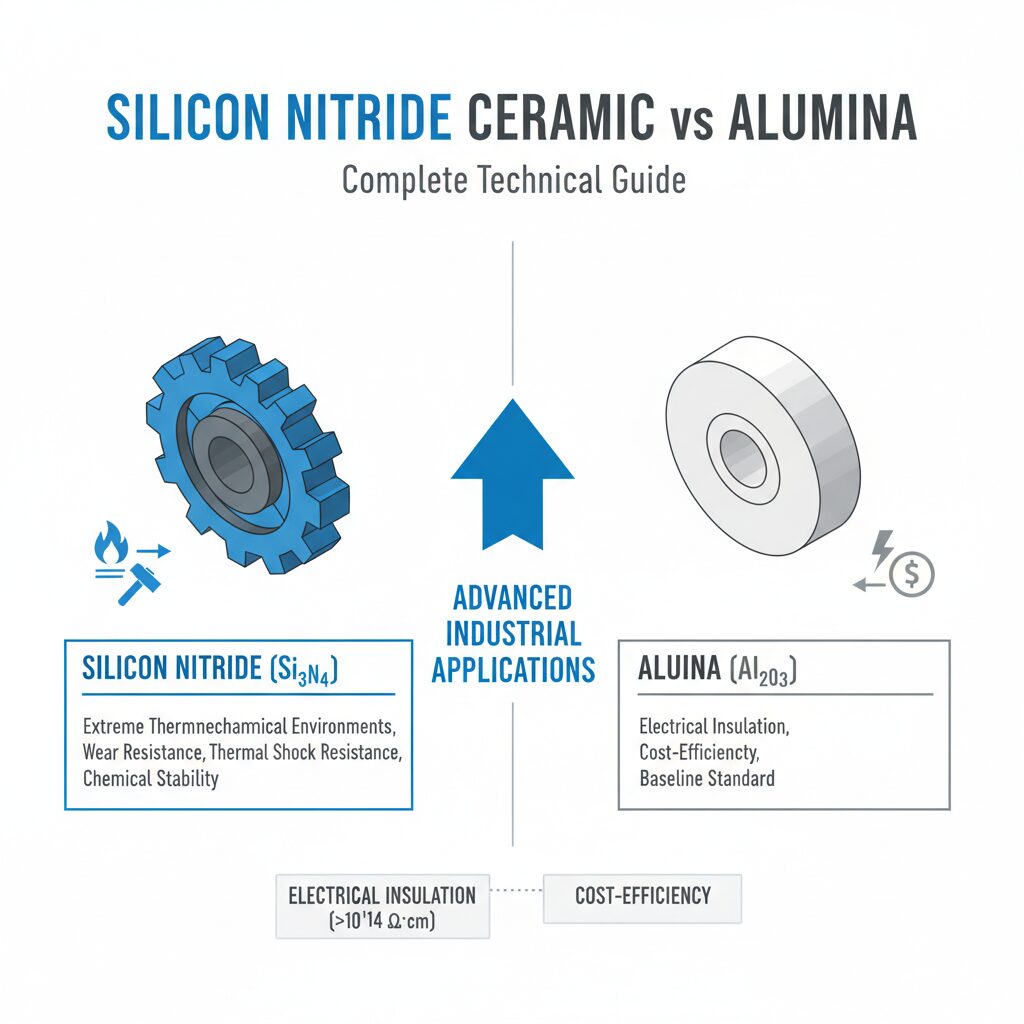
Compared to advanced non-oxides like nitreto de silício, ZTA provides a more cost-effective solution for applications that do not require absolute extreme thermal shock resistance. While silicon nitride excels in rapid temperature fluctuations (ΔT > 600°C), its manufacturing complexity and raw powder costs push it into a “Very High” cost tier. ZTA delivers 85% of the mechanical performance of Si3N4 at a fraction of the procurement cost, making it the superior ROI choice for large-scale energy deployments.
Aplicações
The unique mechanical synergy of ZTA makes it indispensable across multiple energy generation and extraction verticals. Engineers specify ZTA ceramic ceramic parts for energy systems when MTBF (Mean Time Between Failures) must be extended from months to years.
- Oil & Gas Downhole Tools (MWD/LWD): Measurement-While-Drilling telemetry systems operate in abrasive drilling muds at flow rates exceeding 1,200 GPM and pressures up to 20,000 psi. ZTA wear sleeves and flow restrictors are chosen because their 1600 HV hardness resists quartz-sand erosion, while the transformation toughening prevents the components from shattering during brutal high-shock impact events downhole.
- High-Pressure Fracking Pump Valves: Hydraulic fracturing pumps cycle abrasive proppant slurries at 15,000 psi. Standard steel valves wash out within 100 hours. ZTA valve seats and balls are selected because they increase operational lifespans to over 1,500 hours, drastically reducing downtime and maintenance overhead in high-intensity fracking fleets.
- Concentrated Solar Power (CSP) Bearings: Heliostat tracking mechanisms require bearings that can operate flawlessly without liquid lubrication at ambient temperatures exceeding 60°C, while carrying static loads of up to 5,000 N. ZTA rolling elements are utilized because their superior surface finish (Ra < 0.1 µm) eliminates galling. And their chemical inertness ensures zero corrosion in high-humidity or saline environments.
- Nuclear Reactor Coolant Pump Seals: Primary coolant pumps in pressurized water reactors (PWR) operate at 155 bar and 290°C. Mechanical face seals made of ZTA are chosen over metals because they provide zero-leakage performance. The material’s high flexural strength (700 MPa) prevents mechanical distortion under extreme hydraulic pressure, ensuring the 3-micron fluid film between seal faces remains perfectly uniform.
- Solid Oxide Fuel Cell (SOFC) Manifolds: SOFCs operate at temperatures ranging from 700°C to 1000°C, requiring gas-tight manifolds that will not degrade in reducing atmospheres. ZTA is selected because its coefficient of thermal expansion (CTE of 7.5 x 10⁻⁶ /°C) closely matches the adjacent ceramic electrolyte layers, preventing thermal expansion mismatch cracking during the cell’s heating and cooling cycles.
Processo de fabrico
Producing reliable ZTA ceramic ceramic parts for energy applications requires strict control over the microstructural evolution from raw powder to the final densified state. Great Ceramic employs a rigorously monitored multi-stage manufacturing protocol, ensuring that the 10-20% zirconia dispersion remains uniformly distributed down to the sub-micron level. This is critical for maximizing the phase-transformation toughening effect.
Métodos de moldagem
- Prensagem isostática a frio (CIP): For complex or large-scale energy components like pump liners, spray-dried ZTA powder (granule size 50-150 µm) is sealed in polyurethane molds and subjected to multi-directional hydrostatic pressure ranging from 200 to 300 MPa. This ensures a highly uniform green body density of approximately 60% theoretical, virtually eliminating the density gradients that cause warping during sintering.
- Dry Pressing: For high-volume, simple geometries like valve seats or electrical insulators, uniaxial dry pressing is utilized. Advanced CNC presses apply forces of 50 to 150 MPa, yielding rapid cycle times (up to 30 parts per minute) while maintaining precise pre-sintered dimensional tolerances of ±1.0%.
Sinterização
Sintering is the most critical thermal process, dictating the final mechanical properties. ZTA green bodies are fired in highly controlled atmospheric kilns following a precise thermal profile. The temperature is ramped at a rate of 1.5°C to 3.0°C per minute to safely burn out organic binders before reaching the peak solid-state sintering temperature of 1550°C to 1650°C. The parts are held at this peak for 2 to 6 hours to promote complete densification (>99.5% theoretical density). Crucially, the cooling rate is strictly controlled at approximately 2.0°C per minute to ensure the zirconia particles remain trapped in the metastable tetragonal phase at room temperature, rather than spontaneously transforming to monoclinic and pre-stressing the matrix.
Maquinação final
Because sintered ZTA achieves a hardness of 1600 HV, it cannot be shaped using standard high-speed steel or carbide tooling. Final dimensional accuracy is achieved through advanced maquinagem de precisão em cerâmica utilizing resin-bonded and metal-bonded diamond abrasives. Multi-axis CNC grinding centers operate at spindle speeds exceeding 10,000 RPM with diamond wheel grit sizes ranging from D151 (roughing) down to D15 (super-finishing). Copious amounts of high-pressure water-based coolant (up to 80 bar) are targeted precisely at the cutting zone to flush away ceramic swarf and prevent thermal micro-cracking at the machined surface.
Vantagens e limitações
Vantagens
- Resistência superior ao desgaste: With a Vickers hardness of 1600 HV, ZTA outlasts specialty alloys like Inconel 718 by a factor of 10x in abrasive slurry applications, drastically cutting replacement costs for energy operators.
- High Mechanical Reliability: The 7.0 MPa·m½ fracture toughness provides a massive safety margin against impact loads, significantly reducing the brittle catastrophic failure rates typically associated with 99.5% alumina components.
- Corrosion Inertness: ZTA exhibits zero degradation when exposed to harsh downhole chemicals, strong acids (like 15% HCl used in well stimulation), or concentrated alkaline solutions at temperatures up to 300°C.
- Excellent Cost-to-Performance Ratio: ZTA delivers mechanical properties approaching those of advanced non-oxide ceramics but at a raw material and processing cost closer to standard oxide ceramics, maximizing procurement budgets.
Limitações
- Thermal Shock Limitations: While better than pure alumina, ZTA’s thermal shock resistance (ΔT ~ 300°C) is inferior to carboneto de silício or silicon nitride. It is not suitable for applications experiencing instantaneous quenching from 1000°C to room temperature.
- High-Temperature Toughness Degradation: The phase transformation toughening mechanism begins to lose its efficacy at temperatures exceeding 800°C. Above this threshold, the thermodynamic driving force for the tetragonal-to-monoclinic transformation diminishes, causing the fracture toughness to revert closer to that of standard alumina.
Considerações sobre maquinagem
The very properties that make ZTA exceptional for energy applications—extreme hardness and elevated fracture toughness—create severe complexities during fabrication. Standard machining approaches result in rapid tool wear, unacceptable subsurface damage. And dimensional runout. Designing and manufacturing ZTA ceramic ceramic parts for energy demands specialized infrastructure and profound material science expertise.
Machining Challenges
The primary challenge in machining ZTA lies in the material’s specific energy of material removal. Because transformation toughening actively resists crack propagation, the cutting forces required to shear the material at the micro-level are significantly higher than when machining pure alumina. This leads to accelerated degradation of diamond abrasive grains. If the cutting feed rate exceeds 0.05 mm/rev during CNC grinding, the excessive force can induce subsurface micro-cracks up to 50 µm deep. These invisible flaws act as stress concentrators during field operation, compromising the MTBF of the energy component. Furthermore, managing the thermal load is critical. insufficient coolant flow will cause localized thermal expansion during grinding, resulting in components falling out of the required ±0.005mm tolerance band once cooled to ambient temperature.
The Great Ceramic Solution
Great Ceramic overcomes these extreme machining challenges through proprietary 5-axis CNC ultrasonic-assisted grinding technology. By oscillating the diamond cutting tool at ultrasonic frequencies (typically 20 kHz to 40 kHz) with an amplitude of 2-5 µm, we reduce the continuous cutting force by up to 40%. This intermittent cutting action allows for efficient coolant penetration, drastically lowers tool wear. And eliminates subsurface micro-cracking.
| Great Ceramic Machining Capability | Tolerance / Value | Unidade |
|---|---|---|
| Dimensional Tolerance | ± 0.005 | mm |
| Rugosidade da superfície (Ra) | ≤ 0.1 | µm |
| Concentricity | 0.01 | mm |
| Flatness | 0.005 | mm |
| Min. Hole Diameter | 0.20 | mm |
By leveraging real-time acoustic emission monitoring and precision thermal control of grinding fluids, Great Ceramic consistently meets the rigorous geometric dimensioning and tolerancing (GD&T) requirements of the aerospace, nuclear. And oil & gas sectors. We guarantee ultra-precision outcomes that standard machine shops simply cannot achieve.
FAQ
What is ZTA ceramic ceramic parts for energy?
ZTA (Zirconia Toughened Alumina) ceramic parts are advanced composite components utilized in the energy sector to withstand extreme operational environments. By combining a hard aluminum oxide matrix (80-90%) with a tough zirconium oxide dispersion (10-20%), engineers create a material that effectively arrests crack propagation. When subjected to the high pressures, abrasive slurries. And elevated temperatures found in oil drilling, nuclear reactors. And renewable energy generation, these parts offer operational lifespans that vastly exceed those of traditional metals or standard ceramics.
What are the main applications of ZTA ceramic ceramic parts for energy?
In the energy industry, ZTA is primarily deployed in areas where severe wear and high mechanical stress intersect. Key applications include wear sleeves and telemetry housings for Measurement-While-Drilling (MWD) tools operating downhole at 20,000 psi. It is also heavily used in hydraulic fracturing systems as valve seats and balls, managing abrasive sand slurries at 15,000 psi. In power generation, ZTA is utilized for mechanical pump seal faces, electrical insulators for high-voltage grids. And wear-resistant bearings in concentrated solar power tracking systems.
How does ZTA compare to other ceramics?
ZTA serves as a strategic bridge between cost-effective alumina and high-performance, high-cost non-oxides. Compared to standard alumina, ZTA offers a 50% increase in fracture toughness (up to 7.0 MPa·m½) and double the flexural strength (800 MPa), preventing the brittle failure common in high-impact energy applications. Compared to pure zirconia, ZTA provides vastly superior thermal conductivity (24 W/m·K vs 2.5 W/m·K), ensuring high-speed rotating parts don’t overheat. While silicon nitride offers better high-temperature thermal shock resistance, ZTA achieves comparable wear resistance at a significantly lower manufacturing cost.
What are the advantages of ZTA?
The core advantage of ZTA is its unique phase-transformation toughening mechanism. This actively stops microscopic cracks from growing into catastrophic component failures. This results in exceptional mechanical reliability under dynamic loads. Additionally, ZTA boasts a Vickers hardness of 1600 HV, making it virtually immune to abrasive wear from sand, rock, or metal particulates. It remains chemically inert in highly acidic or alkaline environments, provides excellent electrical insulation (>10¹⁴ Ω·cm). And offers an outstanding cost-to-performance ratio for large-scale energy infrastructure deployments.
How is ZTA machined?
Because sintered ZTA achieves extreme hardness (1600 HV), it cannot be machined with conventional cutting tools. Sintered blanks must be shaped using advanced precision ceramic machining utilizing multi-axis CNC grinding centers equipped with specialized metal or resin-bonded diamond abrasive wheels. Spindle speeds exceed 10,000 RPM. And high-pressure coolant is strictly required to prevent thermal micro-cracking. Great Ceramic utilizes proprietary ultrasonic-assisted machining techniques to reduce cutting forces by 40%, allowing us to achieve ultra-tight dimensional tolerances of ±0.005mm and pristine surface finishes (Ra ≤ 0.1 µm) without inducing subsurface damage.
Need custom ZTA ceramic ceramic parts for energy? Contactar Great Ceramic para serviços de maquinagem de precisão com tolerâncias apertadas, ou envie um e-mail para [email protected].
ZTA ceramic ceramic parts for energy is widely used in advanced ceramic applications.
Learn more about Zta Ceramic Ceramic Parts For Energy and our precision ceramic machining services.