









Cerâmica de nitreto de silício versus alumínio: Guia técnico completo
Ao conceber componentes de elevado desempenho, o debate sobre nitreto de silício cerâmica vs alumínio representa uma intersecção crítica entre a ductilidade do metal leve e a durabilidade da cerâmica avançada. Os engenheiros deparam-se frequentemente com limites de desempenho com ligas de alumínio padrão (como 6061-T6 ou 7075-T6) quando as temperaturas de funcionamento excedem os 150°C, ou quando as taxas de desgaste tribológico comprometem conjuntos mecânicos apertados. Embora o alumínio ofereça uma excelente maquinabilidade e uma baixa densidade de 2,70 g/cm³, sofre de fraca resistência a altas temperaturas, elevada expansão térmica (23,6 µm/m-°C). E suscetibilidade à escoriação. Em contrapartida, o nitreto de silício (Si3N4) oferece uma resistência à fratura sem paralelo para uma cerâmica (até 7,0 MPa-m½), mantém a integridade estrutural para além dos 1000°C. E oferece uma densidade de 3,21 g/cm³ - tornando-o apenas 18% mais pesado do que o alumínio e proporcionando mais de 15 vezes a dureza. Este guia abrangente analisa a ciência metalúrgica e dos materiais cerâmicos por detrás destes materiais, detalhando a razão pela qual a transição do alumínio para o Si3N4 maquinado com precisão é frequentemente a solução definitiva para aplicações aeroespaciais, de semicondutores e automóveis. E aplicações automóveis. Na Great Ceramic, somos especializados em superar os desafios de fabricação desses materiais avançados, fornecendo nitreto de silício componentes com tolerâncias ultra-rigorosas de ±0,005mm.
Propriedades do material
Para compreender plenamente o salto de engenharia do alumínio para as cerâmicas avançadas, é necessário examinar os dados exactos das propriedades termomecânicas. O nitreto de silício é um composto de ligação covalente. Isto determina fundamentalmente a sua extrema rigidez mecânica e estabilidade térmica em comparação com a ligação metálica do alumínio. A tabela abaixo descreve os parâmetros quantitativos específicos para o nitreto de silício de fase beta de alta qualidade. Quando se comparam estas métricas com o alumínio 6061-T6, as diferenças são gritantes: o alumínio produz uma resistência à flexão de aproximadamente 310 MPa e uma dureza de apenas 95 HV, o que o torna altamente suscetível ao desgaste abrasivo e à deformação plástica sob cargas cíclicas de elevado stress superiores a 10^7 ciclos.
| Imóveis | Valor | Unidade |
|---|---|---|
| Densidade | 3.21 | g/cm³ |
| Dureza | 1500 | HV |
| Resistência à flexão | 850 | MPa |
| Resistência à fratura | 6.5 | MPa-m½ |
| Condutividade térmica | 30 | W/m-K |
| Resistividade eléctrica | > 10^12 | Ω-cm |
| Temperatura máxima de funcionamento | 1200 | °C |
A divergência operacional torna-se mais evidente em ambientes térmicos. O alumínio começa a perder significativamente a resistência à tração a 200°C e funde completamente a cerca de 660°C. Em contraste direto, o nitreto de silício mantém uma resistência à flexão de mais de 600 MPa mesmo a 1000°C. Para além disso, o Si3N4 apresenta um coeficiente de expansão térmica (CTE) notavelmente baixo de 3,2 µm/m-°C. Quando as peças de acoplamento requerem uma precisão de ±0,005 mm num gradiente de temperatura de 20°C a 400°C, um componente de alumínio com 100 mm de comprimento expandir-se-á cerca de 0,9 mm, destruindo completamente a tolerância dimensional. Um componente de nitreto de silício com a mesma dimensão expandir-se-á apenas 0,12 mm, mantendo a integridade do sistema. Além disso, a resistividade eléctrica de > 10^12 Ω-cm garante que o Si3N4 actua como um isolador elétrico excecional, um requisito crítico em inversores EV de alta tensão onde a elevada condutividade do alumínio (3,7 x 10^5 S/cm) causaria curto-circuitos catastróficos.
Comparação com outras cerâmicas
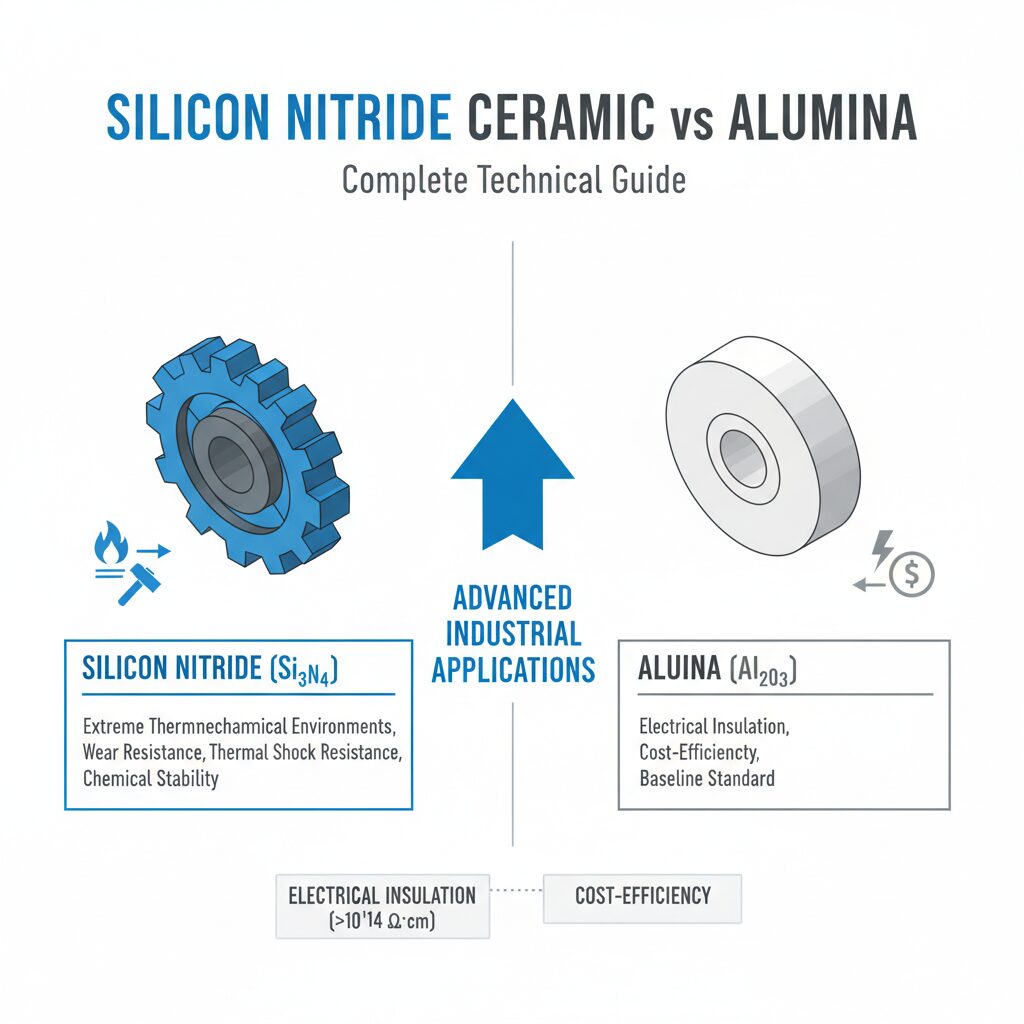
Ao avaliar as actualizações de materiais a partir do alumínio, os engenheiros têm de comparar o nitreto de silício não só com os metais, mas também com o espetro mais vasto de cerâmicas técnicas. Embora o alumínio sirva como base metálica leve, a seleção do substituto cerâmico exato requer a análise de compromissos complexos entre a cinética térmica e a mecânica da fratura. E a economia da matéria-prima.
| Imóveis | Alumínio (Ref) | Alumina | Zircónia | Nitreto de silício |
|---|---|---|---|---|
| Condutividade térmica | 167 W/m-K | 25 W/m-K | 2,5 W/m-K | 30 W/m-K |
| Dureza | 95 HV | 1440 HV | 1200 HV | 1500 HV |
| Resistência à fratura | 29 MPa-m½ | 4,0 MPa-m½ | 9,5 MPa-m½ | 6,5 MPa-m½ |
| Custo | Baixa | Baixo-Médio | Médio-Alto | Elevado |
Como os dados ilustram, a substituição do alumínio requer uma consideração cuidadosa do modo de falha específico. Se um componente de alumínio estiver a falhar estritamente devido ao desgaste abrasivo à temperatura ambiente (cerca de 25°C), alumina/”>alumina proporciona uma atualização altamente rentável, proporcionando uma dureza de 1440 HV por uma fração do custo do Si3N4. No entanto, a alumina é limitada pela sua baixa resistência à fratura de 4,0 MPa-m½. lascará facilmente sob cargas de impacto superiores a 50 MPa. Se a aplicação exigir uma elevada resistência ao impacto para substituir um suporte estrutural de alumínio, zircónia oferece uma excelente resistência à fratura de 9,5 MPa-m½ devido ao seu mecanismo de endurecimento por transformação, embora actue como isolante térmico (2,5 W/m-K).
O nitreto de silício situa-se no centro ideal destes extremos termomecânicos. Oferece a combinação mais elevada de resistência ao choque térmico (ΔT > 600°C) e dureza estrutural. Para aplicações que requerem uma gestão térmica agressiva em que os 167 W/m-K do alumínio são perdidos, os engenheiros podem também considerar nitreto de alumínio (170-200 W/m-K). No entanto, o Si3N4 continua a ser superior em termos de resistência mecânica bruta. Do mesmo modo, enquanto o carboneto de silício fornece uma dureza imensa (2800 HV) e uma resistência a temperaturas extremas até 1600°C, mas não tem a resistência à flexão (normalmente 400 MPa) para suportar as forças de flexão de alta resistência que o nitreto de silício (850 MPa) absorve facilmente.
Aplicações
A transição do alumínio para o nitreto de silício é impulsionada por parâmetros operacionais rigorosos, onde as limitações metálicas (ponto de fusão < 660°C, dureza < 100 HV, CTE elevado) causam falhas mecânicas prematuras. As aplicações a seguir destacam exatamente onde e por que os engenheiros especificam o Si3N4.
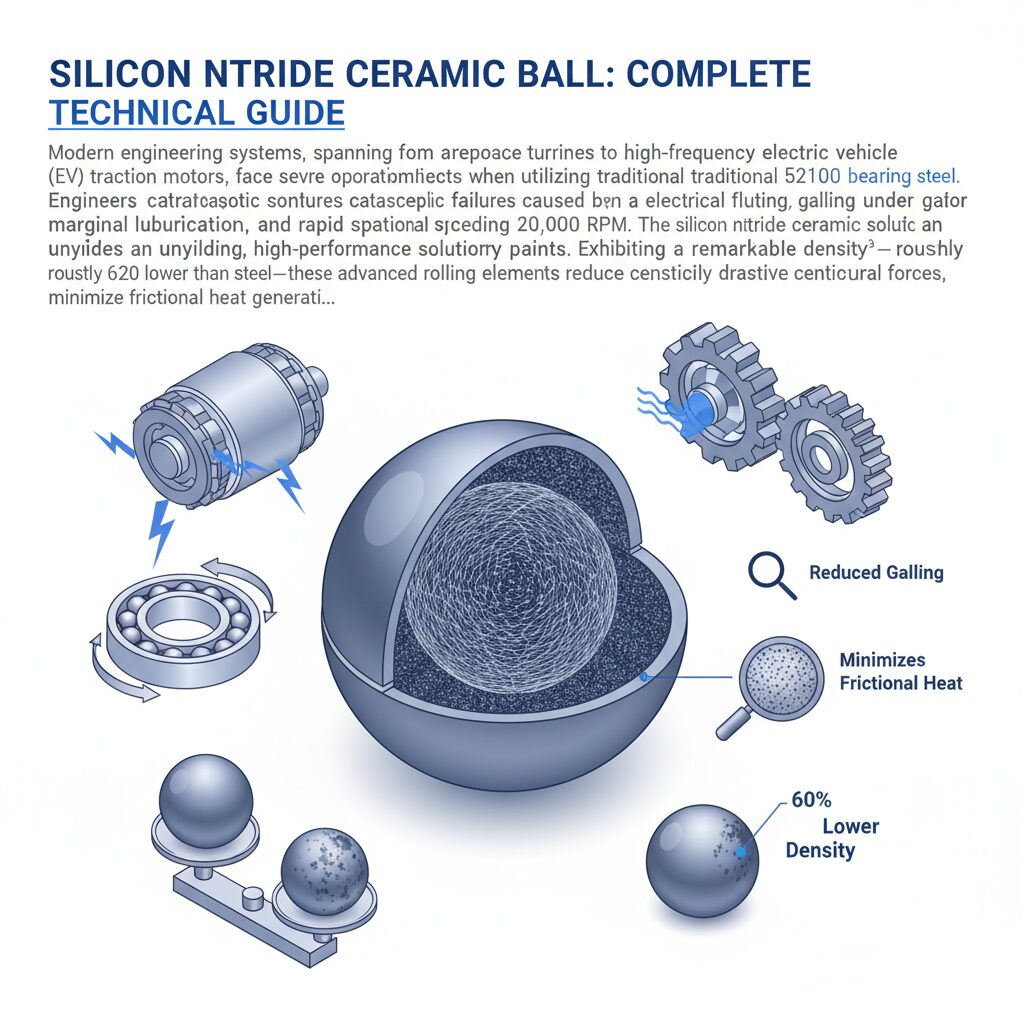
- Rolamentos de eixo de alta velocidade: Em centros de maquinagem CNC de precisão que funcionam a velocidades superiores a 40.000 RPM, as esferas e os retentores de rolamentos padrão em alumínio ou aço sofrem uma carga centrífuga e uma expansão térmica graves. O nitreto de silício é 58% mais leve do que o aço e apenas 18% mais pesado do que o alumínio, reduzindo a força centrífuga. A sua dureza de 1500 HV elimina virtualmente a micro-soldadura e a escoriação, aumentando a vida útil do rolamento em 300% a 500% em comparação com as variantes metálicas tradicionais.
- Substratos de processamento de bolachas semicondutoras: Durante o processamento térmico rápido (RTP) de bolachas de silício, as temperaturas passam rapidamente de 20°C para 1100°C a uma velocidade de 50°C por segundo. O alumínio não consegue sobreviver acima dos 600°C e liberta gases contaminantes. O Si3N4 oferece uma resistência extrema ao choque térmico, sem libertação de gases em níveis de vácuo de 10^-8 Torr. E corresponde à expansão térmica da pastilha de silício (2,6 a 3,2 µm/m-°C), evitando o deslizamento da pastilha induzido pelo stress térmico.
- Equipamento de manuseamento de alumínio fundido: Em instalações de fundição metalúrgica, tubos de proteção de termopares, tubos de aquecimento. E as panelas utilizadas para processar alumínio fundido (mantido a 700°C - 800°C) não podem ser fabricadas a partir do próprio alumínio. O nitreto de silício possui uma propriedade química única: é completamente não molhante para metais fundidos não ferrosos. Isto significa que o alumínio fundido não adere nem corrói o Si3N4, resultando em componentes que duram 12 a 18 meses, em comparação com as peças tradicionais de ferro fundido ou alumina que se dissolvem ou falham devido a choques térmicos no espaço de semanas.
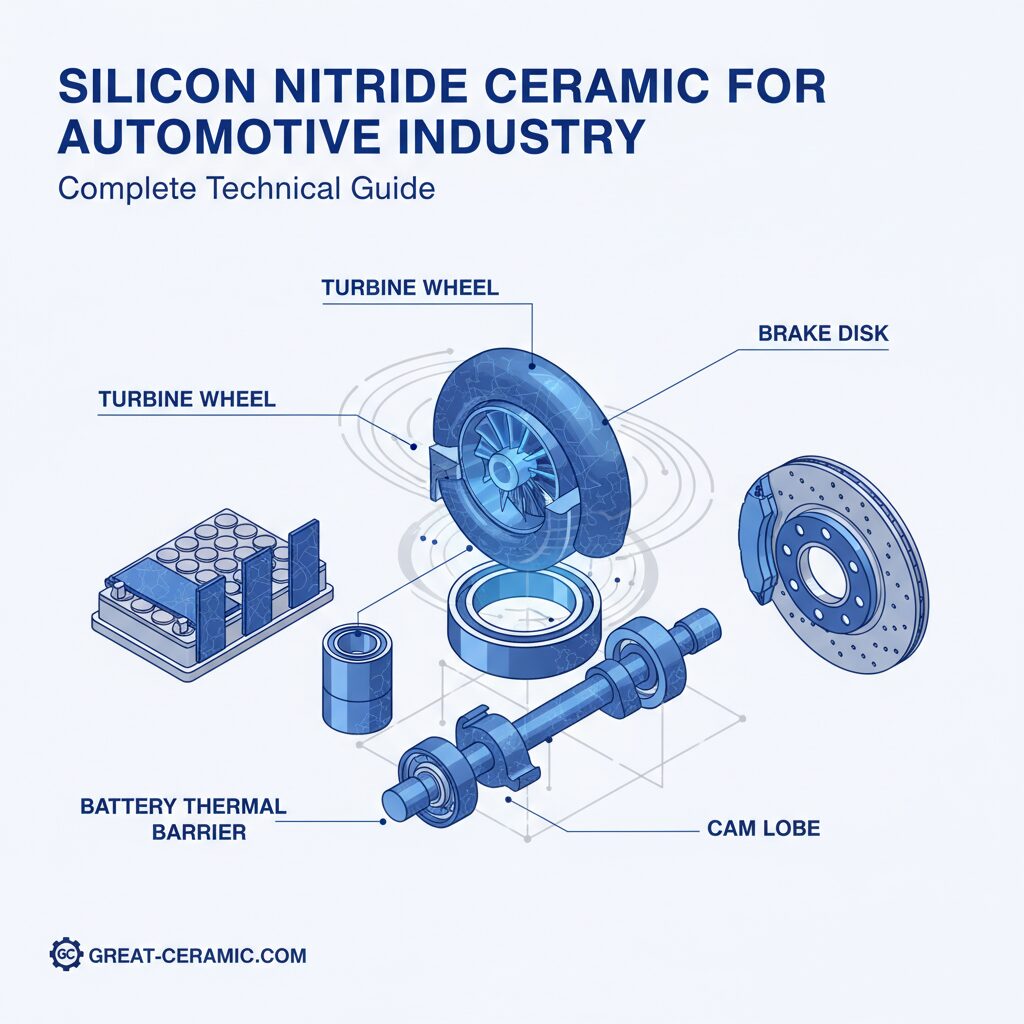
- Módulos de arrefecimento de inversores de EV para automóveis: Os inversores de alto desempenho para veículos eléctricos geram densidades de potência superiores a 30 kW/L. Os dissipadores de calor de alumínio são propensos a curto-circuitos eléctricos e corrosão galvânica quando expostos a refrigerantes à base de glicol ao longo de 10 anos de vida útil. Ao utilizar substratos de nitreto de silício com brasagem de metal ativo (AMB), os engenheiros conseguem um isolamento elétrico de > 10^12 Ω-cm, mantendo simultaneamente uma condutividade térmica suficiente (30 W/m-K) para dissipar o calor dos chips IGBT e SiC MOSFET que comutam a 20 kHz.
- Componentes de turbinas aeroespaciais: Nas unidades auxiliares de potência (APU) e nas microturbinas, os engenheiros procuram eliminar as superligas pesadas e as carcaças de alumínio de baixa temperatura. A capacidade do nitreto de silício para manter uma resistência à flexão de 600 MPa a 1000°C permite que os rotores das turbinas funcionem sem arrefecimento. Isto aumenta a eficiência termodinâmica do motor, permitindo que as temperaturas de entrada do gás excedam com segurança o ponto de fusão do alumínio de 660°C, aumentando a eficiência do combustível até 15%.
Processo de fabrico
O fabrico de cerâmica de nitreto de silício é muito mais complexo do que a maquinagem ou a fundição de alumínio. Como o Si3N4 não derrete e flui como um metal, não pode ser fundido. Além disso, a sua ligação covalente extrema impede a sinterização simples em estado sólido. O material tem de ser sintetizado através de um processo altamente controlado de metalurgia do pó em várias fases e de densificação a alta temperatura, cuidadosamente dopado com ítria (Y2O3) e alumina (Al2O3) para criar uma fase líquida durante a sinterização. Estes auxiliares de sinterização representam 2% a 10% do volume do material e são essenciais para atingir a densidade teórica de 3,21 g/cm³.
Métodos de moldagem
- Prensagem isostática a frio (CIP): Para os componentes cilíndricos e em bloco, o pó ultrafino de Si3N4 (tamanho médio das partículas < 1,0 µm) é encapsulado num molde de elastómero flexível e sujeito a uma pressão hidráulica multidirecional que varia entre 150 MPa e 300 MPa. Isto cria um compacto "verde" homogéneo com zero gradientes de densidade interna, crucial para prever a retração volumétrica exacta de 15% para 20% que ocorrerá durante a queima.
- Moldagem por injeção (CIM): Para geometrias complexas e de grande volume, semelhantes às peças de alumínio fundido, é utilizada a moldagem por injeção de cerâmica. O pó de Si3N4 é misturado com um sistema de ligante termoplástico numa proporção de aproximadamente 80% em pó para 20% em peso. A mistura é injectada em moldes de aço a temperaturas de 150°C a 200°C sob 50 MPa de pressão. O aglutinante é subsequentemente removido através de um ciclo prolongado de desbaste térmico a 400°C.
Sinterização
Ao contrário do alumínio. Este é apenas tratado termicamente a temperaturas como 530°C para endurecimento por precipitação, o nitreto de silício tem de ser submetido a sinterização por pressão de gás (GPS) ou a prensagem isostática a quente (HIP). À pressão atmosférica normal, o Si3N4 decompõe-se em silício líquido e azoto gasoso a 1850°C antes de poder densificar. Para evitar esta decomposição termodinâmica, a GPS é conduzida num forno de temperatura ultra-alta a 1700°C a 1950°C sob uma atmosfera de azoto pressurizado de 10 a 100 bar (1 a 10 MPa). Durante esta fase, o pó da fase alfa transforma-se completamente em cristais da fase beta, semelhantes a agulhas, interligados. Esta microestrutura alongada (relações de aspeto de 5:1 a 10:1) é o mecanismo metalúrgico específico que confere ao Si3N4 a sua excecional resistência à fratura de 6,5 MPa-m½, desviando a propagação de fissuras a nível microscópico.
Maquinação final
Uma vez sinterizado, o material atinge a sua dureza total de 1500 HV. Ferramentas convencionais de HSS ou de carboneto. Estas cortam alumínio a velocidades de 5000 mm/min, estilhaçam-se instantaneamente em contacto com o nitreto de silício sinterizado. A maquinação final deve ser executada utilizando centros de retificação CNC rígidos especializados, equipados com abrasivos ligados por diamante. As operações de desbaste utilizam grão de diamante grosso (por exemplo, D126 ou 120 mesh) a velocidades de fuso de 8.000 a 12.000 RPM, atingindo taxas de remoção de material de meros milímetros cúbicos por minuto. As operações de acabamento requerem discos diamantados ultrafinos (D15 ou 1000 mesh) para alcançar acabamentos de superfície de Ra 0,1 µm. Na Great Ceramic, nossa profunda experiência em maquinagem de precisão em cerâmica permite-nos manter tolerâncias geométricas críticas de ±0,005mm na concentricidade, planicidade. E paralelismo.
Apoio ao projeto de engenharia: A transição das suas plantas de alumínio para cerâmica técnica requer modificações especializadas de GD&T. Contacte hoje mesmo a equipa de engenharia da Great Ceramic para otimizar os seus ficheiros CAD para a cinemática de retificação diamantada e garantir uma produção rentável.
Vantagens e limitações
Vantagens
- Superioridade térmica extrema: O Si3N4 funciona continuamente a 1200°C, ultrapassando completamente o ponto de falha estrutural do alumínio de 200°C e o ponto de fusão de 660°C.
- Resistência excecional ao desgaste: Com uma dureza Vickers de 1500 HV comparada com a dureza de 95 HV do alumínio, o Si3N4 elimina o desgaste abrasivo, a escoriação. E a soldadura a frio em conjuntos cinemáticos de elevada fricção.
- Estabilidade dimensional superior: Um CTE de 3,2 µm/m-°C garante que as peças não se deformam ou expandem fora da tolerância durante ciclos térmicos extremos, enquanto o alumínio expande a 23,6 µm/m-°C.
- Inércia química: O Si3N4 é impermeável à oxidação até 1200°C, altamente resistente a ácidos agressivos (exceto HF). E completamente não molhante para metais não ferrosos fundidos como alumínio, zinco. E chumbo.
Limitações
- Elevado custo de fabrico: A síntese do pó bruto, sinterização pressurizada a 1800°C. E os processos lentos de retificação com diamante resultam num custo de componente que pode ser 10x a 50x superior ao de uma peça de alumínio normal maquinada por CNC.
- Fragilidade sob impacto de tração: Apesar de ter a maior resistência à fratura das cerâmicas técnicas (6,5 MPa-m½), continua a ser fundamentalmente frágil em comparação com o alumínio dúctil (29 MPa-m½). O Si3N4 não se pode deformar plasticamente para aliviar concentrações de tensão localizadas. Fratura catastrófica se as cargas pontuais excederem a sua resistência à flexão final de 850 MPa.
Considerações sobre maquinagem
A disparidade entre a maquinação de alumínio e a maquinação de nitreto de silício não pode ser exagerada. E representa o principal obstáculo para as equipas de engenharia que tentam obter componentes cerâmicos. O alumínio 6061-T6 caracteriza-se por uma excelente maquinabilidade. E permite profundidades de corte agressivas (muitas vezes superiores a 5,0 mm por passagem). O nitreto de silício sinterizado, que possui uma dureza de 1500 HV, proíbe estritamente o torneamento de ponto único ou a fresagem convencional. O mecanismo de remoção de material passa da deformação plástica por cisalhamento (no alumínio) para a micro-fratura frágil controlada através da retificação com diamante abrasivo.
Para tal, é necessária uma infraestrutura CNC especializada. As máquinas-ferramentas devem possuir uma rigidez dinâmica extrema para suprimir as vibrações submicrónicas, uma vez que a vibração durante a retificação induzirá imediatamente microfissuras subsuperficiais na cerâmica, reduzindo o módulo de Weibull e a resistência à flexão do componente até 40%. Além disso, a gestão térmica na interface ferramenta-peça é crítica. A retificação com diamante gera um imenso calor localizado (frequentemente superior a 800°C na zona de contacto microscópico). Ao contrário do alumínio. Este retira o calor rapidamente devido à sua condutividade térmica de 167 W/m-K, a condutividade mais baixa do Si3N4 de 30 W/m-K localiza o calor. Isto requer o fornecimento de alta pressão (até 1000 psi) de refrigerantes sintéticos especializados, à base de água, perfeitamente direcionados para a zona de contacto para evitar microfissuras por choque térmico.
Se a maquinabilidade for um requisito rigoroso para a prototipagem rápida e as cargas mecânicas forem baixas, os engenheiros podem considerar temporariamente materiais como nitreto de boro. Este material é suficientemente macio para ser maquinado com ferramentas normais de metal duro. No entanto, para obter o melhor desempenho na utilização final, não há substituto para o Si3N4 polido com diamante. Na Great Ceramic, atenuamos estes desafios de maquinação através da retificação avançada assistida por ultra-sons de 5 eixos. Ao aplicar vibrações axiais de alta frequência (20 kHz a 40 kHz) à ferramenta diamantada, reduzimos as forças de retificação até 30% e minimizamos o desgaste da ferramenta. E alcançamos de forma fiável tolerâncias ultra-precisas de ±0,005 mm em geometrias complexas que as oficinas mecânicas tradicionais não conseguem executar.
FAQ
O que é a cerâmica de nitreto de silício em comparação com o alumínio?
O nitreto de silício (Si3N4) é uma cerâmica técnica avançada, ligada covalentemente, conhecida pela sua elevada resistência à fratura (6,5 MPa-m½), dureza extrema (1500 HV). E resistência térmica até 1200°C. O alumínio é um metal leve e dúctil (2,7 g/cm³) com excelente maquinabilidade, mas com baixa dureza (95 HV) e um baixo ponto de fusão (660°C). A comparação evidencia uma mudança de um metal estrutural padrão, facilmente maquinável, para uma cerâmica de alto desempenho, retificada com precisão, utilizada quando as cargas mecânicas, as taxas de desgaste e os ambientes térmicos excedem os limites metálicos. E ambientes térmicos excedem os limites metálicos.
Quais são as principais aplicações do nitreto de silício?
Devido à sua elevada resistência ao choque térmico e à sua força mecânica, o nitreto de silício é muito utilizado em ambientes extremos. As principais aplicações incluem esferas de rolamentos de alta velocidade (que funcionam a mais de 40.000 RPM), equipamento de manuseamento de metal fundido (porque não molha o alumínio fundido a 800°C), substratos de arrefecimento de inversores EV para automóveis, componentes de manuseamento de bolachas semicondutoras resistentes ao plasma. E rotores de turbinas aeroespaciais de alta temperatura que funcionam sem arrefecimento a 1000°C.
Como é que o nitreto de silício se compara a outras cerâmicas?
O nitreto de silício oferece o melhor equilíbrio entre tenacidade mecânica e resistência ao choque térmico entre as cerâmicas avançadas. Embora a alumina seja mais barata, é muito mais frágil (resistência à fratura de 4,0 MPa-m½ contra 6,5 MPa-m½ do Si3N4). A zircónia tem uma tenacidade mais elevada (9,5 MPa-m½) mas falha sob choque térmico extremo devido à sua baixa condutividade térmica (2,5 W/m-K). O carboneto de silício oferece limites máximos de temperatura mais elevados (1600°C) e dureza (2800 HV), mas o Si3N4 supera-o em termos de resistência à flexão (850 MPa) e resistência ao impacto.
Quais são as vantagens de substituir o alumínio por nitreto de silício?
Substituir o alumínio por nitreto de silício produz enormes melhorias em termos de longevidade e limites operacionais. O componente ganha a capacidade de sobreviver a temperaturas de funcionamento de 1200°C (o alumínio funde a 660°C), atinge um aumento de 15 vezes na dureza (eliminando o desgaste abrasivo e a escoriação). E beneficia de um coeficiente de expansão térmica altamente estável (3,2 µm/m-°C vs 23,6 µm/m-°C), assegurando que tolerâncias dimensionais apertadas (como ±0,005mm) são mantidas ao longo de flutuações extremas de temperatura sem deformação.
Como é maquinado o nitreto de silício?
Ao contrário do alumínio. Este é cortado através de uma fresagem de carboneto de ponto único com taxas de avanço elevadas, o nitreto de silício totalmente sinterizado tem de ser maquinado utilizando uma retificação de precisão com diamante. Devido à sua dureza de 1500 HV, o processo requer centros de retificação CNC rígidos, fusos de alta velocidade (10.000+ RPM), profundidade de corte muito baixa (frequentemente < 0,01 mm por passagem). E refrigerante de alta pressão para evitar microfissuras. A Great Ceramic é especializada neste processo complexo, utilizando tecnologia de moagem multi-eixo de última geração para fornecer componentes complexos de nitreto de silício com tolerâncias ultra-precisas de ± 0,005 mm, eliminando completamente os danos de subsuperfície associados à má usinagem de cerâmica.
Precisa de peças cerâmicas de nitreto de silício personalizadas? Contactar Great Ceramic para serviços de maquinagem de precisão com tolerâncias apertadas, ou envie um e-mail para [email protected].
A cerâmica de nitreto de silício versus alumínio é amplamente utilizada em aplicações cerâmicas avançadas.
Saiba mais sobre Cerâmica de nitreto de silício versus alumínio e os nossos serviços de maquinagem de precisão em cerâmica.