









Aluminum Nitride Ceramic Insulator for Electronics: Complete Technical Guide
As modern electronic devices transition toward higher power densities and smaller form factors, thermal management has become the primary bottleneck in engineering design. Component junction temperatures frequently exceed 150°C. And power densities in advanced semiconductors routinely surpass 100 W/cm². Traditional substrates like FR4 organic boards (thermal conductivity ~0.25 W/m·K) or standard aluminum oxide ceramics fail to dissipate heat fast enough, leading to catastrophic thermal runaway and dielectric breakdown under high-voltage loads. The definitive engineering solution is an nitreto de alumínio ceramic insulator for electronics. By combining exceptional thermal conductivity (up to 230 W/m·K) with massive dielectric strength (15 kV/mm), this advanced material ensures rapid heat transfer away from sensitive chips while maintaining absolute electrical isolation. For engineers navigating complex thermal-electrical constraints, Great Ceramic offers tight-tolerance solutions, delivering custom-machined insulators with dimensional accuracies down to ±0.005mm to meet the most rigorous aerospace, automotive. And telecommunications specifications.
Propriedades do material
The performance of an aluminum nitride ceramic insulator for electronics is dictated by its unique crystallographic structure. AlN features a wurtzite crystal lattice where the covalent bonds between aluminum and nitrogen atoms allow for highly efficient phonon transmission. Unlike metals. This conduct heat via free electrons (making them electrically conductive), AlN conducts heat via phonon (lattice vibration) transfer. This fundamental mechanism yields a material that exhibits the rare combination of metallic-level thermal conductivity and ceramic-level electrical resistivity. When engineered with ultra-low oxygen impurities (typically kept below 0.1 wt%), the phonon scattering at grain boundaries is minimized, pushing thermal performance beyond 200 W/m·K. The table below outlines the precise technical specifications of high-purity AlN.
| Imóveis | Valor | Unidade |
|---|---|---|
| Densidade | 3.26 | g/cm³ |
| Dureza | 1100 | HV |
| Resistência à flexão | 320 | MPa |
| Resistência à fratura | 2.6 | MPa-m½ |
| Condutividade térmica | 170 – 230 | W/m-K |
| Resistividade eléctrica | > 1.0 x 10¹⁴ | Ω-cm |
| Temperatura máxima de funcionamento | 1000 (Ar) / 1900 (Inerte) | °C |
Beyond the baseline metrics presented in the table, engineers must consider the dielectric constant (permittivity) and dissipation factor of AlN. This sit at approximately 8.8-9.0 (at 1 MHz) and 0.0003, respectively. These values are critical for high-frequency RF applications, ensuring minimal signal loss when transmitting at frequencies ranging from 1 GHz to 40 GHz. Furthermore, the Coefficient of Thermal Expansion (CTE) of AlN is precisely 4.5 x 10⁻⁶ /K (measured between 20°C and 400°C). This value is nearly perfectly matched to that of pure Silicon (4.1 x 10⁻⁶ /K) and Gallium Nitride (GaN, 3.1-3.4 x 10⁻⁶ /K). This CTE synchronicity reduces thermo-mechanical sheer stress at the solder or brazing interface by over 80% compared to mismatched materials during thermal cycling from -40°C to +150°C, virtually eliminating the risk of delamination in direct bonded copper (DBC) and active metal brazed (AMB) assemblies.
Comparação com outras cerâmicas
Selecting the correct dielectric substrate requires a meticulous data-driven evaluation of available technical ceramics. While AlN excels in thermal management, engineers must balance thermal requirements against mechanical durability and project budgets. The following table provides a quantitative comparison between an aluminum nitride ceramic insulator for electronics and competing technical ceramics.
| Imóveis | Nitreto de alumínio | Alumina (99,5%) | Zircónio (Y-TZP) | Nitreto de silício |
|---|---|---|---|---|
| Condutividade térmica (W/m-K) | 170 – 230 | 24 - 35 | 2.0 - 3.0 | 30 - 90 |
| Dureza (HV) | 1100 | 1500 | 1200 | 1500 |
| Resistência à fratura (MPa-m½) | 2.6 | 4.0 - 4.5 | 8.0 - 10.0 | 6.0 - 8.0 |
| Custo | Elevado | Baixa | Médio | Elevado |
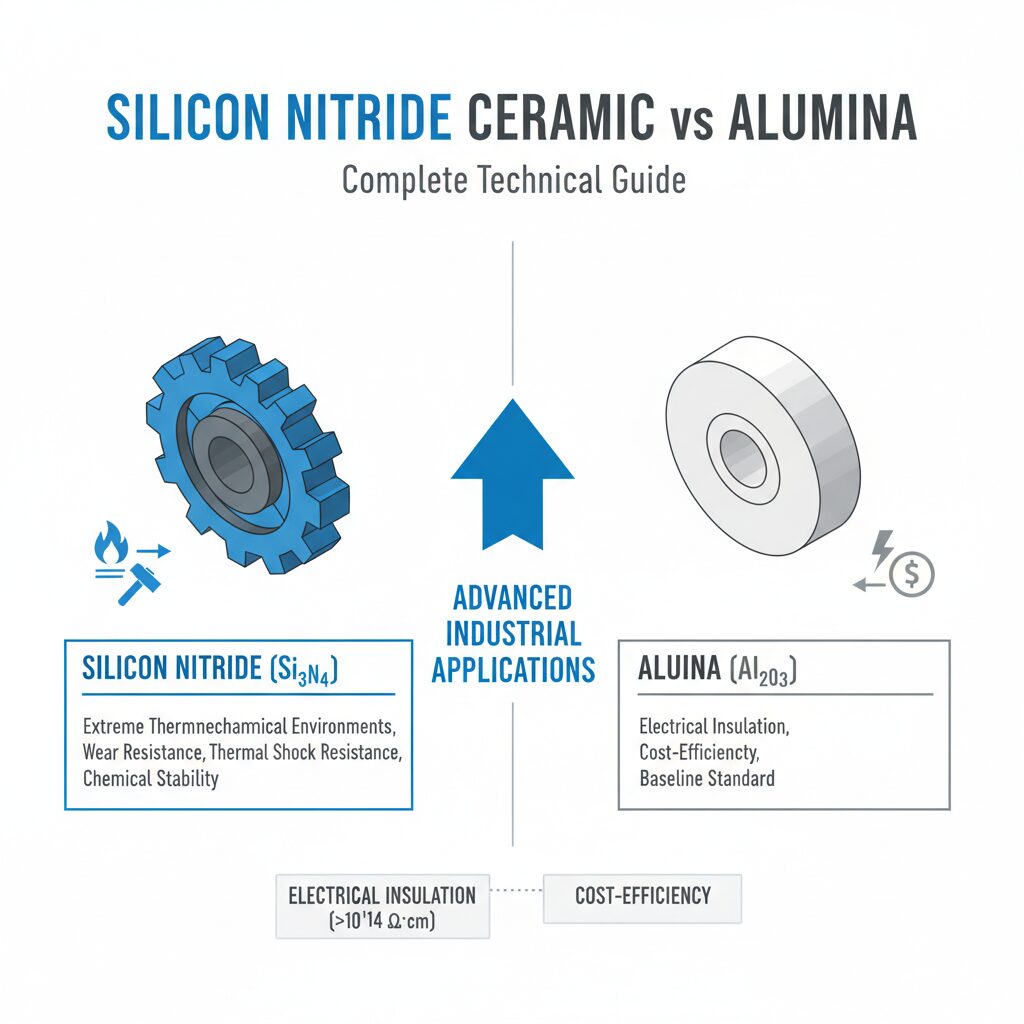
When analyzing the data, alumina/”>alumina remains the industry standard for general-purpose applications due to its economical production cost and acceptable flexural strength of 380 MPa. However, its thermal conductivity peaks at merely 35 W/m·K, causing significant thermal bottlenecking in devices generating over 50 W/cm² of heat flux. Conversely, zircónia offers unparalleled mechanical resilience, featuring a fracture toughness up to 10.0 MPa·m½ through transformation toughening mechanisms. Yet, its extreme thermal insulation properties (2.0 W/m·K) explicitly disqualify it from acting as a heat-dissipating substrate for active electronics.
The most prominent technical competitor to AlN is nitreto de silício. Si3N4 bridges the gap between mechanical strength and thermal performance. With a flexural strength exceeding 800 MPa and a fracture toughness of up to 8.0 MPa·m½, Si3N4 is highly resistant to mechanical shock and vibration, making it ideal for electric vehicle (EV) drivetrains operating under severe dynamic loads. However, its maximum thermal conductivity typically maxes out around 90 W/m·K (though specialized grades can reach 120 W/m·K). When absolute maximum heat dissipation is the non-negotiable engineering mandate—such as in concentrated laser diodes or high-voltage direct current (HVDC) transmission infrastructure—the 230 W/m·K rating of an aluminum nitride ceramic insulator for electronics makes it the undisputed optimal choice.
Aplicações
- High-Power IGBT Modules: Insulated-Gate Bipolar Transistors (IGBTs) utilized in wind turbine inverters and EV traction motors operate at voltage tiers from 1.2 kV up to 6.5 kV and switch currents exceeding 1000 A. This switching generates immense heat transients. An aluminum nitride ceramic insulator for electronics is chosen as the Direct Bonded Copper (DBC) substrate because its 15 kV/mm dielectric strength prevents high-voltage arcing, while its 200+ W/m·K thermal conductivity ensures junction temperatures remain strictly below the critical 175°C failure threshold.
- High-Brightness LED Packaging Substrates: Commercial LED arrays used in stadium lighting and automotive headlamps consume 50W to 200W of power, converting roughly 60% of that energy directly into concentrated localized heat. FR4 boards degrade and warp at these temperatures. AlN substrates are selected because they immediately wick heat away from the 1 mm² LED die, reducing the junction temperature by up to 40°C compared to alumina, thereby extending the luminous efficacy lifespan from 20,000 hours to over 80,000 hours without color shifting.
- RF and Microwave Device Packaging: In 5G telecommunications infrastructure and aerospace phased-array radars, amplifiers operate at high frequencies ranging from 3 GHz to 40 GHz. Signal fidelity is paramount. AlN is specified because its low dissipation factor (0.0003 at 1 MHz) minimizes dielectric signal absorption, while its high thermal conductivity manages the intense heat generated by Gallium Nitride (GaN) high-electron-mobility transistors (HEMTs) operating at power densities of 10 W/mm of gate periphery.
- Laser Diode Submounts: Industrial cutting lasers and medical surgical lasers rely on continuous-wave laser diodes that output hundreds of watts of optical power from extremely compact footprints (often less than 5 mm²). The quantum efficiency of these diodes drops drastically if the temperature fluctuates by even 2°C. AlN is deployed as the submount material because its ultra-fast thermal response allows active thermoelectric coolers (Peltier devices) to stabilize the diode temperature instantly, maintaining precise beam wavelength outputs.
- Semiconductor Wafer Processing Equipment (Electrostatic Chucks): During plasma etching and chemical vapor deposition (CVD), 300mm silicon wafers must be clamped securely and maintained at precise uniform temperatures (e.g., 150°C ± 0.5°C). AlN electrostatic chucks are utilized because the material can be precisely doped to achieve a specific volume resistivity (10⁸ to 10¹¹ Ω·cm) for optimal electrostatic clamping forces (Johnsen-Rahbek effect), while its native thermal conductivity ensures perfectly uniform heat distribution across the entire 300mm wafer surface.
Processo de fabrico
The fabrication of an aluminum nitride ceramic insulator for electronics is a highly complex metallurgical and chemical process. Because AlN is a covalently bonded compound, it does not melt. it sublimates at temperatures exceeding 2200°C. Therefore, solid-state or liquid-phase sintering is mandatory. The process begins with the synthesis of ultra-pure AlN powder, typically via carbothermal reduction of alumina in a nitrogen atmosphere at 1600°C. To ensure high thermal conductivity, oxygen impurities must be strictly controlled to below 1.0 mol%. Sintering aids, specifically Yttrium Oxide (Y2O3) at 3 to 5 wt%, are added to the powder matrix. During sintering, these additives react with residual surface alumina (Al2O3) on the powder particles to form liquid yttrium aluminate phases (such as YAG or YAP). This act as a densification medium and effectively “scavenge” oxygen out of the AlN crystal lattice, depositing it at the grain boundaries to preserve phonon transmission pathways.
Métodos de moldagem
- Fundição em fita: Used primarily for manufacturing flat substrates and thin insulators ranging from 0.25 mm to 1.5 mm in thickness. The AlN powder is mixed with organic binders, plasticizers. And solvents (such as toluene or ethanol) to create a slurry with a viscosity of 2000-4000 cPs. This slurry is cast over a continuous Mylar belt using a doctor blade assembly. After solvent evaporation, the flexible “green tape” is blanked, via-punched. And stacked for metallization.
- Dry Pressing and Isostatic Pressing: Utilized for three-dimensional structural insulators, chucks. And heat sinks. The powder is spray-dried with 2-3 wt% polyvinyl alcohol (PVA) binder to form flowable spherical granules (50-100 µm diameter). For uniaxial dry pressing, pressures of 100-150 MPa are applied in steel dies. For highly complex or large parts, Cold Isostatic Pressing (CIP) is employed, applying 200-300 MPa of uniform fluid pressure to achieve a green density of roughly 60% theoretical density, minimizing internal density gradients.
Sinterização
The formed green bodies undergo a critical thermal debinding process at 400°C to 600°C in a nitrogen or slightly oxidizing atmosphere to remove all organic compounds. If carbon residue remains, it degrades the dielectric strength of the final insulator. The parts are then loaded into graphite or tungsten hot-zone furnaces and sintered at 1800°C to 1900°C for 2 to 6 hours under a high-purity nitrogen gas atmosphere (0.1 MPa to 0.5 MPa pressure). The liquid phase sintering mechanism induces a volumetric shrinkage of 15% to 20%. Controlling this shrinkage uniformly is critical to achieving near-net shapes and preventing warping. This would otherwise lead to massive material removal during final grinding.
Maquinação final
Because the sintered aluminum nitride ceramic insulator for electronics exhibits a hardness of 1100 HV, standard high-speed steel or carbide tooling is completely ineffective. Final machining requires specialized multi-axis CNC platforms equipped with resin-bonded or metal-bonded diamond tooling. Operations include double-sided planetary lapping using boron carbide or diamond slurries (ranging from 9 µm down to 1 µm abrasive sizes) to achieve a surface flatness of < 0.002 mm over a 100 mm span. And a surface roughness (Ra) of < 0.1 µm. Holes and vias as small as 0.2 mm in diameter are achieved via ultra-sonic diamond drilling or precision laser ablation (using femtosecond or picosecond UV lasers to minimize the heat-affected zone). Looking to optimize your supply chain for high-performance insulators? Request a technical review from Great Ceramic to ensure your designs are optimized for precision manufacturing.
Vantagens e limitações
Vantagens
- Unmatched Thermal-Dielectric Synergy: With a thermal conductivity reaching 230 W/m·K and a dielectric strength of 15 kV/mm, it outperforms alumina’s thermal transfer by over 700% while maintaining absolute electrical isolation in high-voltage environments up to 6500V.
- Optimal CTE Compatibility: Its Coefficient of Thermal Expansion (4.5 x 10⁻⁶ /K) is virtually identical to Silicon (4.1 ppm/K) and closely matches GaN and SiC. This minimizes thermal expansion mismatch stresses, preventing solder fatigue and substrate cracking during rapid power cycling.
- Non-Toxic Alternative: Historically, Beryllium Oxide (BeO) was used for high thermal conductivity substrates (up to 280 W/m·K). However, BeO dust is highly toxic and causes berylliosis. AlN provides nearly identical thermal performance while being 100% non-toxic and compliant with strict RoHS and REACH environmental regulations.
- Inércia química: AlN demonstrates exceptional resistance to corrosive gases utilized in semiconductor manufacturing (such as fluorine and chlorine plasmas) and does not react with molten metals like aluminum or gallium, ensuring zero contamination in ultra-high vacuum (UHV) processing environments.
Limitações
- Hydrolysis Sensitivity: In its raw powder form, AlN is highly reactive with ambient moisture (H2O), undergoing a hydrolysis reaction that produces aluminum hydroxide and toxic ammonia gas (NH3). This dictates that raw materials must be stored and processed in strictly controlled low-humidity dry rooms. However, once fully sintered into a dense ceramic, this vulnerability is completely eliminated.
- High Manufacturing Costs: Due to the necessity for ultra-high-purity synthesized powders, complex yttria doping, extreme sintering temperatures (1900°C). And diamond-tooling requirements, the finished component cost of AlN can be 3 to 5 times higher than standard 96% alumina, restricting its use to premium applications where thermal failure is not an option.
Considerações sobre maquinagem
Precision machining an aluminum nitride ceramic insulator for electronics presents formidable engineering challenges primarily driven by its low fracture toughness (2.6 MPa·m½). Unlike metals that plastically deform under cutting loads, AlN strictly undergoes brittle fracture mechanisms. If the mechanical force applied by a cutting tool exceeds the material’s critical stress intensity factor, micro-cracks propagate instantaneously along grain boundaries, leading to edge chipping and catastrophic part failure. To mitigate sub-surface damage, machining must be executed in the ductile-regime, requiring aggressive control of the depth of cut and feed rates. The table below outlines standard parameters utilized in precision ceramic grinding.
| Machining Operation | Tool/Abrasive Specification | Spindle Speed (RPM) | Feed Rate (mm/min) | Coolant Type |
|---|---|---|---|---|
| Surface Grinding | Diamond Wheel (D64 – D126 grit) | 3,000 – 5,000 | 100 – 300 | Water-based Synthetic (High Lubricity) |
| CNC Micro-Milling | PCD (Polycrystalline Diamond) End Mill | 15,000 – 30,000 | 10 – 50 | Continuous Flood / Mist |
| Ultrasonic Drilling | Diamond Core Drill (D46 grit) | 5,000 – 10,000 | 1 - 5 | Deionized Water |
To achieve superior surface integrity, the machine tool must possess ultra-high static and dynamic stiffness to suppress chatter vibrations below 1.0 µm amplitudes. Wheel truing and dressing operations must be performed at precise intervals to maintain optimal diamond grit exposure. glazed wheels dramatically increase friction, generating localized thermal shocks that induce micro-cracking in the AlN substrate. Coolant delivery is equally critical. high-pressure, high-volume synthetic coolants (delivered at pressures exceeding 50 bar) are directed precisely at the grinding interface to flush away abrasive swarf and prevent thermal damage to the matrix.
Great Ceramic excels in overcoming these intricate machining challenges. Leveraging state-of-the-art 5-axis CNC grinding centers and proprietary ultrasonic-assisted machining protocols, we mitigate tool wear and drastically reduce cutting forces by up to 40%. This technological advantage allows Great Ceramic to routinely deliver complex features with a dimensional tolerance of ±0.005mm, true position accuracies of 0.01mm. And optical-grade surface finishes of Ra 0.1 µm. For highly intricate geometries or proprietary component designs, explore our maquinagem de precisão em cerâmica capabilities to guarantee absolute adherence to your most stringent GD&T specifications. Struggling with brittle material failures in your current supply? Allow Great Ceramic’s engineering team to optimize your designs for high-yield, tight-tolerance manufacturing.
FAQ
What is an aluminum nitride ceramic insulator for electronics?
An aluminum nitride ceramic insulator for electronics is an advanced engineered ceramic component designed to simultaneously provide extreme electrical insulation (dielectric strength of 15 kV/mm) and exceptional heat dissipation (thermal conductivity up to 230 W/m·K). It is synthesized from AlN powder doped with sintering aids like Yttria, formed into precise shapes. And sintered at 1900°C. These insulators are fundamental in high-power density electronics where traditional substrates like FR4 or standard alumina cannot dissipate heat fast enough, thereby preventing thermal runaway and catastrophic electrical shorts.
What are the main applications of an aluminum nitride ceramic insulator for electronics?
The primary applications revolve around power electronics and thermal management systems. They are heavily utilized as Direct Bonded Copper (DBC) and Active Metal Brazed (AMB) substrates for IGBT modules in electric vehicles and renewable energy inverters. Additionally, they serve as crucial heat-sinking submounts for high-brightness LEDs and continuous-wave laser diodes. In telecommunications, their low dielectric loss makes them ideal for 5G RF/Microwave packaging. Furthermore, in the semiconductor manufacturing sector, AlN is highly prized for constructing electrostatic chucks used in wafer processing due to its uniform thermal distribution and plasma resistance.
How does an aluminum nitride ceramic insulator for electronics compare to other ceramics?
Compared to standard alumina, AlN provides roughly 7 times the thermal conductivity (230 W/m·K vs 35 W/m·K) and features a much lower Coefficient of Thermal Expansion (CTE), making it vastly superior for mating with silicon chips. When compared to structural ceramics like carboneto de silício, AlN provides superior electrical insulation, whereas SiC acts as a semiconductor and requires complex insulating layers for electronic use. While materials like nitreto de boro offer excellent machinability and thermal shock resistance, AlN delivers significantly higher mechanical strength (320 MPa flexural strength) and a more robust density for structural support in heavy-duty electronic packaging.
What are the advantages of an aluminum nitride ceramic insulator for electronics?
The principal advantage is its unique dual-nature capability: it conducts heat like a metal but insulates electricity like a premium ceramic. Its CTE of 4.5 ppm/K perfectly mirrors silicon and gallium nitride, ensuring that under rapid thermal cycling (from -40°C to 150°C), the solder joints do not experience shear stress or fatigue, drastically improving device reliability. Additionally, AlN is entirely non-toxic, serving as a safe, RoHS-compliant direct replacement for Beryllium Oxide (BeO). This poses severe health risks during manufacturing. It also exhibits high physical hardness (1100 HV) and excellent resistance to plasma corrosion.
How is an aluminum nitride ceramic insulator for electronics machined?
Due to its high hardness (1100 HV) and low fracture toughness (2.6 MPa·m½), AlN cannot be machined using standard cutting tools. It requires precision grinding, lapping. And polishing utilizing industrial diamond abrasives (PCD tooling or resin/metal-bonded diamond wheels). Machining parameters must be strictly controlled to maintain a ductile cutting regime, requiring high spindle speeds (up to 30,000 RPM) and minute feed rates to prevent subsurface micro-cracking and edge chipping. Great Ceramic specializes in this complex process, utilizing advanced 5-axis CNC platforms and ultrasonic-assisted machining to deliver custom AlN insulators with ultra-tight tolerances of ±0.005mm and impeccable surface finishes down to Ra 0.1 µm, ensuring perfect integration into your electronic assemblies.
Need custom aluminum nitride ceramic insulator for electronics parts? Contactar Great Ceramic para serviços de maquinagem de precisão com tolerâncias apertadas, ou envie um e-mail para [email protected].
aluminum nitride ceramic insulator for electronics is widely used in advanced ceramic applications.
Saiba mais sobre Aluminum Nitride Ceramic Insulator For Electronics e os nossos serviços de maquinagem de precisão em cerâmica.