








Zirconia Ceramic Ceramic Parts: Complete Technical Guide
When engineering advanced industrial systems subjected to extreme wear, severe impact. And corrosive environments, specifying the right materials is the difference between seamless operation and catastrophic failure. Traditional metals often degrade rapidly under high friction or chemical exposure, leading to costly downtime. The ultimate solution lies in high-performance 지르코니아 ceramic ceramic parts. Known universally among materials scientists as “ceramic steel,” yttria-stabilized tetragonal zirconia polycrystal (Y-TZP) delivers unprecedented fracture toughness—often exceeding 9.0 MPa·m½—which is nearly triple that of conventional technical ceramics. This unique characteristic is driven by a stress-induced phase transformation mechanism, where localized stress forces the material’s crystalline structure to shift from a tetragonal phase to a monoclinic phase, expanding its volume by 3% to 5% and actively compressing propagating micro-cracks.
For engineers, procurement managers. And R&D teams in North America and Europe, procuring reliable zirconia ceramic ceramic parts requires a manufacturing partner capable of exceptional precision. Great Ceramic specializes in ultra-tight tolerance fabrication, consistently achieving ±0.005mm dimensional accuracy on complex geometries. Whether you require advanced fluid handling valves operating at 15,000 PSI, biocompatible medical implants, or wear-resistant deep-draw tooling, understanding the distinct thermo-mechanical properties of zirconia is critical for optimizing your component design.
Ready to transition your failing metal components to high-performance ceramics? Submit your CAD drawings to Great Ceramic today for a comprehensive engineering review and rapid RFQ.
머티리얼 속성
The performance of 지르코니아 is entirely dictated by its stabilized microstructure. Pure zirconium dioxide undergoes severe volumetric changes during temperature fluctuations. This causes spontaneous fracturing. By doping the base powder with 3 mol% yttrium oxide (Y2O3), the material stabilizes at room temperature in its highly desirable tetragonal phase. The resulting 3Y-TZP material boasts a theoretical density of 6.05 g/cm³, ensuring near-zero porosity (< 0.1%) after hot isostatic pressing (HIP). The Vickers hardness reaches 1250 HV, providing exceptional resistance against abrasive media, while its flexural strength can peak at 1200 MPa, allowing it to withstand severe dynamic mechanical loading that would shatter standard steatite or porcelain.
Thermal characteristics are equally unique. Unlike other technical ceramics that efficiently dissipate heat, zirconia is an excellent thermal insulator. Its thermal conductivity sits at a remarkably low 2.2 W/m·K at 20°C, making it ideal for localized heat shielding. Furthermore, its coefficient of thermal expansion (CTE) is 10.3 × 10⁻⁶ /°C. This closely matches that of steel alloys (typically 10-12 × 10⁻⁶ /°C). This matching CTE is a monumental advantage for mechanical engineers designing hybrid metal-ceramic assemblies, as it virtually eliminates thermally induced shear stresses at the joint interface during temperature cycling up to 1000°C.
| 속성 | 가치 | 단위 |
|---|---|---|
| 밀도 | 6.05 | g/cm³ |
| 경도 | 1250 | HV |
| 굴곡 강도 | 1000 - 1200 | MPa |
| 골절 인성 | 8.0 - 10.0 | MPa-m½ |
| 열 전도성 | 2.2 | W/m-K |
| 전기 저항 | > 10¹⁰ | Ω-cm |
| 최대 작동 온도 | 1000 | °C |
다른 세라믹과의 비교
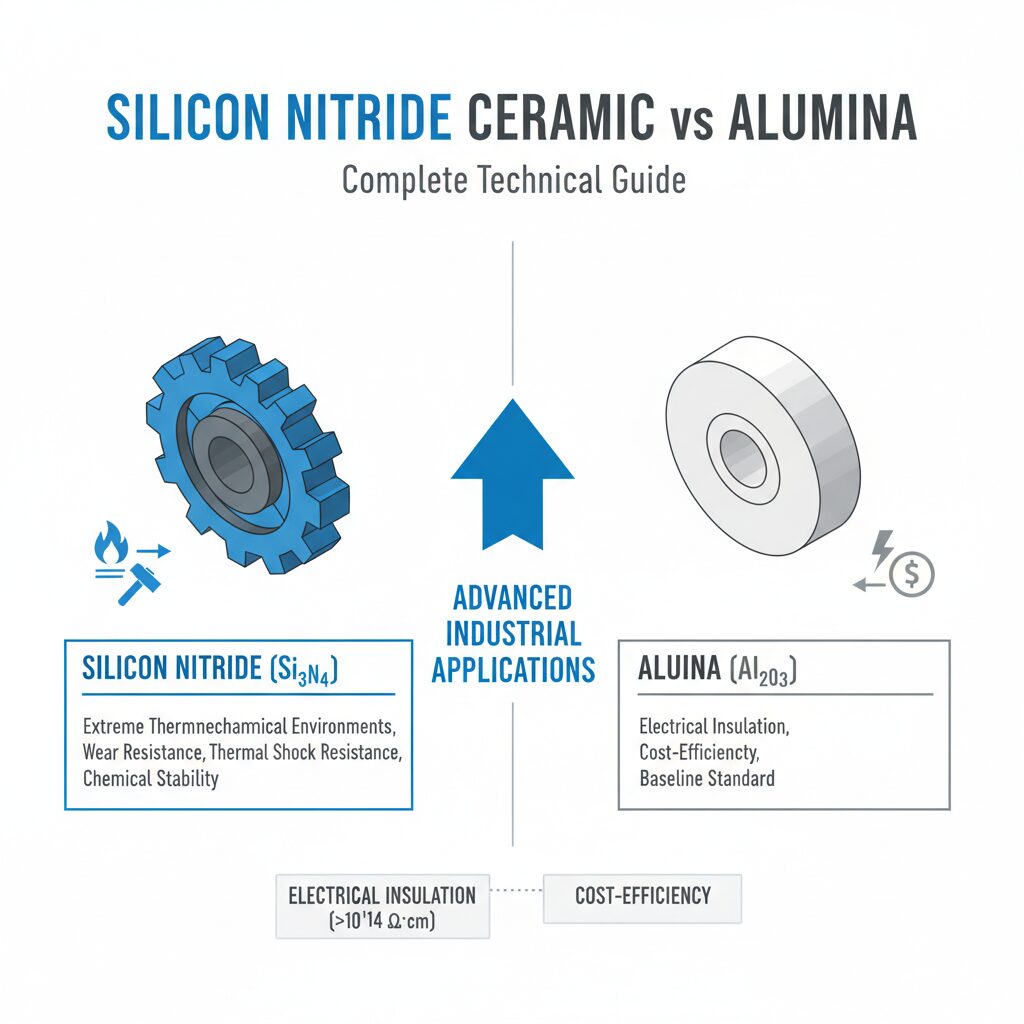
To make an informed material selection, engineers must benchmark zirconia ceramic ceramic parts against other advanced ceramics. While zirconia excels in impact resistance, 알루미나/”>알루미나 (Al2O3) is often chosen for standard wear applications due to its higher hardness (1500 HV) and lower raw material cost, though it suffers from brittleness (fracture toughness of 4.0 MPa·m½). For extreme thermal shock environments, 실리콘 질화물 (Si3N4) dominates, surviving rapid temperature drops of up to 800°C in seconds due to its incredibly low thermal expansion (3.2 × 10⁻⁶ /°C). 실리콘 카바이드 (SiC) provides the absolute highest hardness (up to 2800 HV) and thermal conductivity (120 W/m·K) for aggressive seal face applications, but it is notoriously difficult to machine and entirely lacks zirconia’s flexural resilience.
| 속성 | Zirconia Ceramic Ceramic Parts | 알루미나(99.5%) | 실리콘 카바이드(SSiC) | Silicon Nitride (GPSN) |
|---|---|---|---|---|
| 열 전도성(W/m-K) | 2.2 | 30.0 | 120.0 | 25.0 |
| 경도(HV) | 1250 | 1500 | 2600 | 1600 |
| 골절 인성(MPa-m½) | 9.0 | 4.0 | 3.5 | 7.0 |
| 비용 | 높음 | 낮음 | Medium | 매우 높음 |
애플리케이션
- Fluid Handling & Centrifugal Pump Seals: Engineered mechanical seal faces and metering pump plungers rely heavily on zirconia. In chemical processing plants, these components face highly acidic slurries containing abrasive particulates. Zirconia’s sub-micron surface finish (Ra < 0.1 µm) combined with a compressive strength of 2000 MPa results in a wear rate of less than 0.002 mm per year, outlasting tungsten carbide by up to 400%.
- Metal Wire Drawing Dies & Extrusion Tooling: In the continuous wire drawing of copper and steel, friction generates extreme localized heat and adhesive wear. Zirconia drawing dies feature a dynamic coefficient of friction of just 0.1 unlubricated against steel. This significantly reduces drawing force by up to 15%, eliminates metal galling. And maintains die orifice tolerances within ±0.002mm over millions of linear meters of drawn wire.
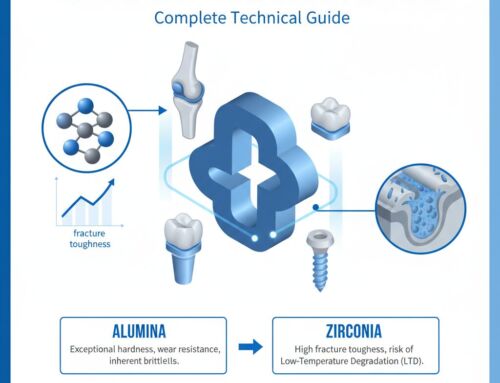
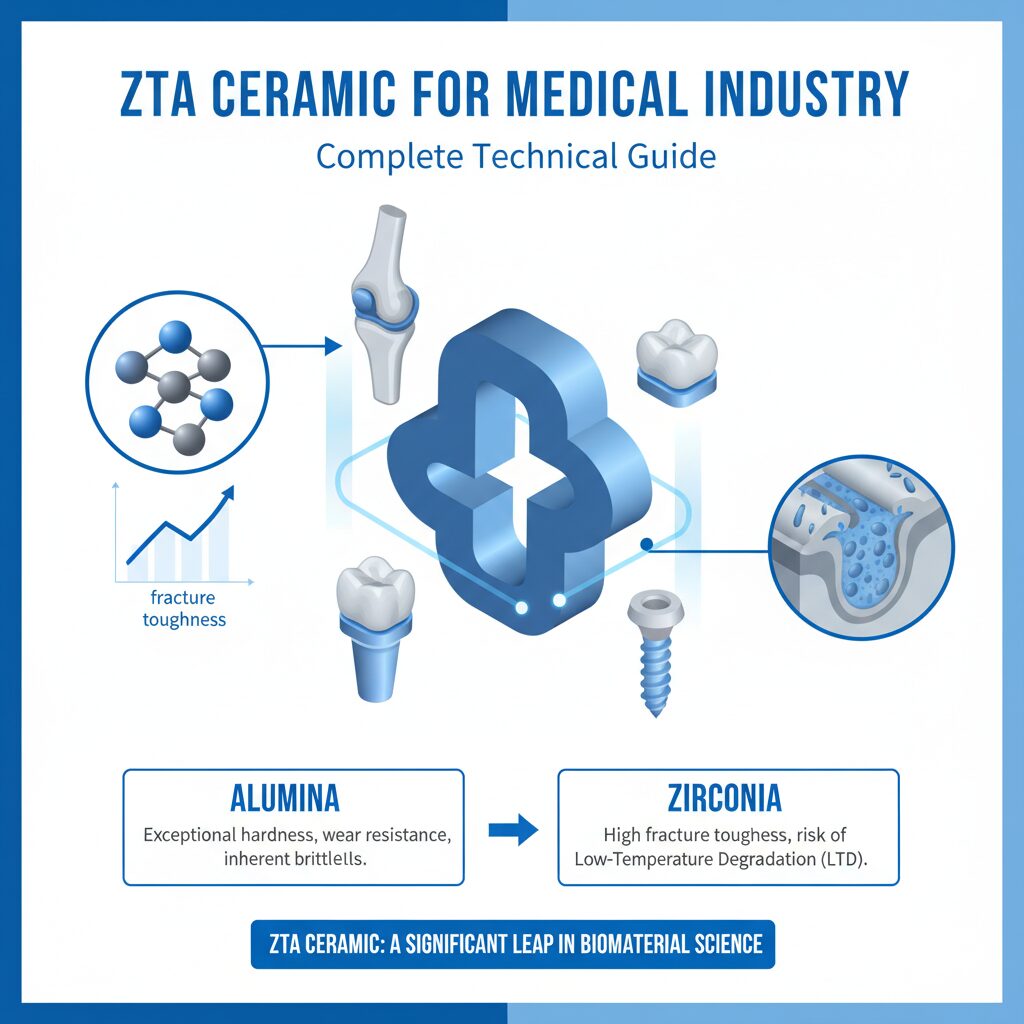
- Biomedical Orthopedic Implants: Medical device engineers utilize zirconia for hip joint replacement heads and dental abutments. Its absolute chemical inertness guarantees zero ion release in the human body (corrosion rate < 0.01 µg/cm²/day). Furthermore, its 1200 MPa flexural strength safely supports cyclic physiological loading up to 3,500 N, preventing the catastrophic implant fragmentation sometimes seen with standard alumina implants.
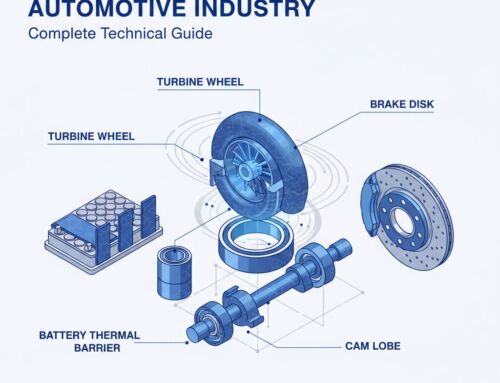
- High-Temperature Sensor Housings (Lambda Probes): In automotive and industrial boiler exhaust systems, zirconia acts as a functional ceramic. Above 600°C, yttria-stabilized zirconia exhibits oxygen ion conductivity, with electrical resistivity dropping from >10¹⁰ Ω·cm to roughly 10 Ω·cm. This unique electrochemical property makes it the universal standard material for measuring oxygen partial pressures in real-time combustion control loops.
- Deep-Hole Drilling Guide Pads: In BTA (Boring and Trepanning Association) drilling operations, the guide pads stabilize the cutting head against the bore wall. Zirconia guide pads absorb continuous chatter vibrations due to their 9.0 MPa·m½ toughness. They operate effectively at rotational speeds exceeding 3,000 RPM, preventing thermal distortion of the drilling tube while extending tool life by a factor of 5 compared to standard hard metals.
제조 프로세스
Producing precision zirconia ceramic ceramic parts is a highly controlled, multi-stage metallurgical endeavor. The process begins with ultra-pure ZrO2 and Y2O3 powders, milled to a sub-micron particle size distribution (D50 < 0.5 µm). These powders are blended with proprietary organic binders (typically 2-4% by weight) to create a flowable, spray-dried granulate. Every variable, from ambient humidity to compaction pressure, must be monitored to prevent green-state density gradients that lead to warping during thermal processing.
형성 방법
- 냉간 등방성 프레싱(CIP): For cylindrical components like pump shafts and pistons, the powder is sealed in a flexible elastomeric mold and subjected to uniform hydraulic pressure between 200 MPa and 300 MPa in a pressure vessel. This 360-degree compaction yields a green body with exceptionally uniform density (typically 55% of theoretical density), mitigating internal stress fractures and ensuring predictable linear shrinkage of exactly 20.5% during sintering.
- 세라믹 사출 성형(CIM): For intricate, high-volume geometries like micro-gears or surgical forceps, the ceramic powder is compounded with a thermoplastic polymer matrix (up to 20% binder by volume) to create a feedstock. This feedstock is injected into heated tool-steel molds at pressures reaching 100 MPa. Following a delicate chemical and thermal debinding cycle lasting 48 to 72 hours, the parts are prepped for densification.
소결
The green bodies are transferred to high-temperature atmospheric or vacuum furnaces. The sintering profile is highly complex. temperatures are ramped at a precise rate of 1°C to 2°C per minute to prevent thermal shock. Densification occurs between 1400°C and 1500°C over a dwell time of 2 to 4 hours. During this phase, capillary forces drive the elimination of pores, bringing the material to 99.9% of its theoretical density (6.05 g/cm³). For ultimate reliability in aerospace and medical applications, an additional Hot Isostatic Pressing (HIP) cycle at 1450°C under 200 MPa of argon gas pressure is applied to collapse any remaining microscopic internal voids, pushing fracture toughness to the absolute theoretical limit.
최종 가공
Due to the post-sintered hardness of 1250 HV, traditional cutting tools are completely ineffective. Final dimensioning requires extensive abrasive machining using resin and vitrified bonded diamond grinding wheels. Roughing operations utilize 100-150 grit diamond abrasives at spindle speeds of 5,000 RPM, removing bulk material. Finishing passes use ultra-fine 400-800 grit diamond wheels operating at shallow depths of cut (0.005mm to 0.010mm per pass) to achieve geometric tolerances and surface roughness (Ra) values as low as 0.02 µm. Extensive flood coolant (water-soluble synthetic fluids at 10% concentration) is pumped at 50 PSI directly into the cutting zone to prevent micro-cracking caused by frictional heat.
장점 및 제한 사항
장점
- Unparalleled Fracture Toughness: Yielding values of 8.0 – 10.0 MPa·m½, zirconia is virtually immune to the sudden brittle fracture that plagues alumina. The localized phase transformation from tetragonal to monoclinic at the tip of an advancing crack absorbs tremendous kinetic energy, actively clamping the crack shut. This allows engineers to specify ceramics in high-impact applications such as ball valves and milling media.
- Steel-Matching Thermal Expansion: With a CTE of 10.3 × 10⁻⁶ /°C, zirconia can be press-fit or shrink-fitted into stainless steel housings without the risk of loosening or shattering during thermal cycling up to 500°C. This greatly simplifies the mechanical design of hybrid assemblies, eliminating the need for complex expansion-compensating elastomers.
- Superior Surface Finish Capabilities: The ultra-fine grain structure (< 0.5 µm average grain size) of premium Y-TZP allows for optical-grade lapping and polishing. Surface roughness can be reduced to Ra 0.01 µm, achieving a mirror-like finish that drastically reduces friction coefficients in dynamic rotary seals, minimizing torque requirements on driving motors.
- Low Thermal Conductivity: At 2.2 W/m·K, zirconia acts as a robust thermal barrier. When used as an engine component, such as a valve guide or combustion chamber liner, it restricts heat rejection to the cooling system, thereby increasing the internal thermodynamic efficiency of the engine by up to 5%.
제한 사항
- 저온 열화(LTD): The most significant vulnerability of Y-TZP is hydrothermal aging. When exposed to pressurized water or steam at temperatures between 200°C and 300°C, the moisture penetrates the crystalline lattice, triggering a spontaneous transformation from the tetragonal to the monoclinic phase on the material’s surface. This causes micro-cracking and a 30% reduction in flexural strength over time. (Note: Great Ceramic offers specialized alumina-toughened zirconia (ATZ) blends to severely mitigate this specific phenomenon).
- High Mass Density: Weighing in at 6.05 g/cm³, zirconia is exceptionally heavy compared to alumina (3.9 g/cm³) and silicon nitride (3.2 g/cm³). In aerospace applications or high-speed automation robotics where payload weight and rotational inertia are critical design constraints, the high mass of zirconia components can negatively impact system dynamics.
가공 고려 사항
Achieving exacting specifications on zirconia ceramic ceramic parts presents severe challenges that only premier machine shops can overcome. The fundamental difficulty lies in the material’s high fracture toughness combined with its low thermal conductivity. Unlike metals. This evacuate heat through the chip, zirconia forces up to 80% of the frictional grinding heat back into the tool and the workpiece. If not properly managed, this thermal accumulation induces localized surface temperatures exceeding 800°C, leading to catastrophic sub-surface micro-cracking and degradation of the component’s mechanical integrity.
To combat this, Great Ceramic employs state-of-the-art 5-axis ultrasonic CNC machining centers. By oscillating the diamond cutting tool at ultrasonic frequencies (typically 20 kHz to 30 kHz) with microscopic amplitudes (10-20 µm), we drastically reduce cutting forces by up to 40%. This intermittent cutting action prevents thermal buildup, clears ceramic swarf efficiently. And eliminates edge chipping—a common defect when machining sharp 90-degree corners or delicate internal threads.
Our metrology and quality assurance protocols are integrated directly into our 정밀 세라믹 가공 workflow. Spindle speeds are optimized between 12,000 and 18,000 RPM, maintaining strict feed rates of 0.05 mm/rev. Through rigorous process control, we guarantee exceptional geometric accuracy for high-end B2B industrial clients.
| Geometric Feature | Standard Tolerance (mm) | High-Precision Tolerance (mm) |
|---|---|---|
| 외경(OD) | ± 0.010 | ± 0.005 |
| 내경(ID) | ± 0.015 | ± 0.005 |
| Linear Thickness | ± 0.010 | ± 0.003 |
| 동심도 | 0.015 TIR | 0.008 TIR |
| 표면 거칠기(Ra) | 0.4 µm | 0.05 µm |
Do you have a complex geometry that other machine shops have declined? Great Ceramic thrives on tight tolerances. Email your STEP files to [email protected] to leverage our advanced 5-axis ultrasonic machining capabilities.
FAQ
What is zirconia ceramic ceramic parts?
These are highly engineered, structural components manufactured from zirconium dioxide (ZrO2) powder that has been synthetically stabilized—typically with 3 mol% yttrium oxide (3Y-TZP). Unlike traditional ceramics that are prone to brittle shattering, zirconia parts utilize a phase-transformation toughening mechanism that gives them steel-like fracture toughness (up to 10 MPa·m½), making them ideal for extreme mechanical wear and high-impact industrial applications.
What are the main applications of zirconia ceramic ceramic parts?
Due to its high flexural strength (1200 MPa) and extreme wear resistance, zirconia is primarily deployed in demanding B2B environments. Main applications include deep-hole drilling guide pads, centrifugal pump seals for corrosive chemicals, metal wire drawing dies, biomedical joint implants. And high-temperature oxygen sensors in automotive exhausts. It replaces hardened steel and tungsten carbide in systems where unlubricated friction, corrosion, or metal contamination must be eliminated.
How does zirconia ceramic ceramic parts compare to other ceramics?
Zirconia is uniquely positioned as the “tough” ceramic. While silicon carbide is significantly harder (2600 HV vs 1250 HV) and handles extreme temperatures better, it is extremely brittle. Alumina is more cost-effective and electrically insulative but possesses half the fracture toughness of zirconia. Silicon nitride offers superior thermal shock resistance, but zirconia’s thermal expansion coefficient (10.3 × 10⁻⁶ /°C) uniquely mirrors that of steel, allowing seamless integration into hybrid metal-ceramic assemblies without thermal shearing.
What are the advantages of zirconia ceramic ceramic parts?
The primary advantage is unmatched durability under dynamic loads. Zirconia resists crack propagation better than any other monolithic technical ceramic. It also offers extreme resistance to chemical corrosion (immune to HCl, H2SO4. And NaOH at room temperature), possesses a very low coefficient of friction, achieves ultra-fine surface finishes (Ra < 0.05 µm). And functions as an excellent thermal insulator (2.2 W/m·K) to protect sensitive electronics from high-heat combustion zones.
How is zirconia ceramic ceramic parts machined?
Due to a post-sintered hardness of 1250 HV, zirconia cannot be milled or turned with standard HSS or carbide tooling. It requires precision abrasive machining using specialized diamond grinding wheels (PCD). The process utilizes high-RPM spindles, extremely shallow depths of cut (< 0.01mm). And high-pressure flood coolant to prevent thermal micro-cracking. Great Ceramic leverages advanced 5-axis ultrasonic CNC grinding centers to achieve ultra-tight tolerances down to ±0.005mm and flawless edge retention on even the most complex CAD designs.
Need custom zirconia ceramic ceramic parts? 그레이트 세라믹에 문의 공차가 엄격한 정밀 가공 서비스 또는 이메일 [email protected].
zirconia ceramic ceramic parts is widely used in advanced ceramic applications.
자세히 알아보기 Zirconia Ceramic Ceramic Parts 정밀 세라믹 가공 서비스를 제공합니다.