








Silicon Nitride Ceramic vs Alumina: Complete Technical Guide
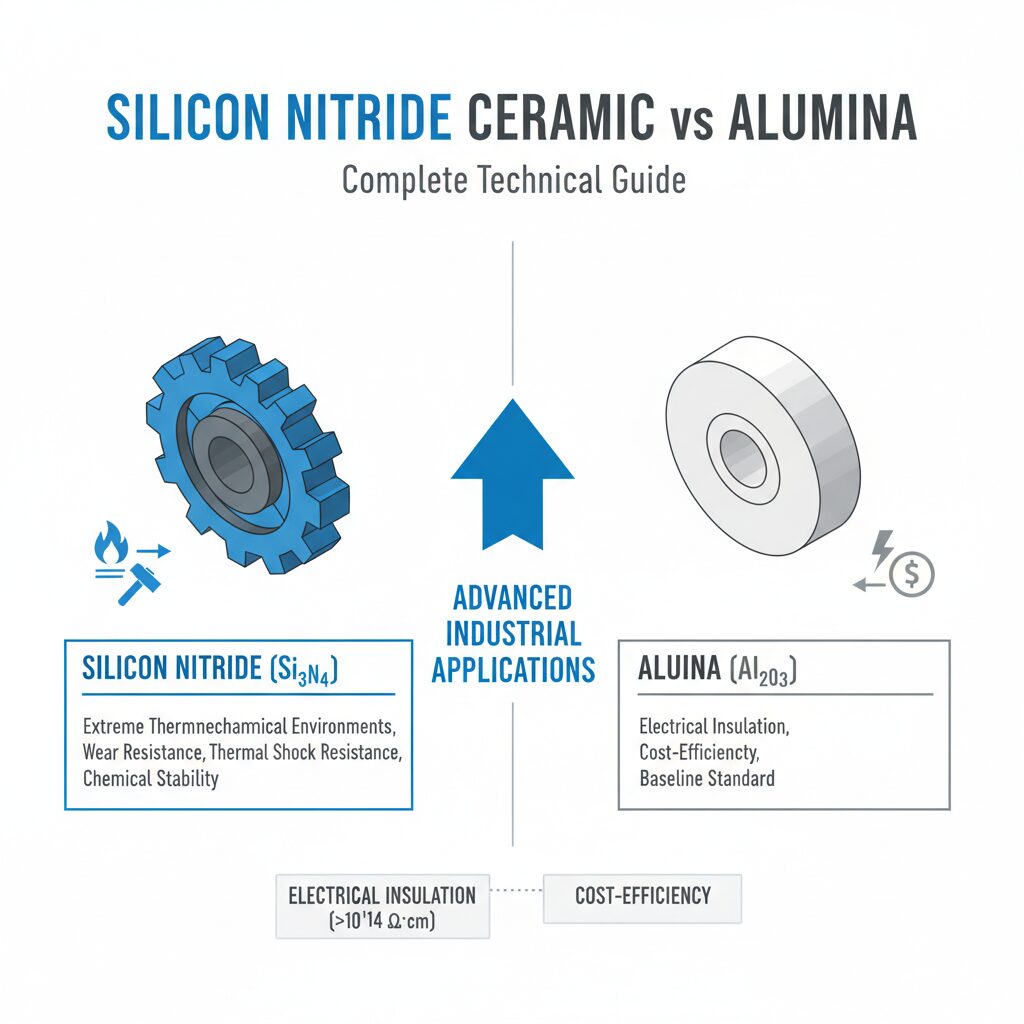
When engineering components for extreme thermomechanical environments, the debate of 실리콘 질화물 ceramic vs 알루미나 is a critical focal point for design engineers, procurement managers. And R&D teams. Advanced industrial applications are pushing the boundaries of material science, demanding components that can withstand aggressive wear, catastrophic thermal shock. And highly corrosive chemical attacks. While 알루미나 (Al2O3) has long been the baseline standard due to its excellent electrical insulation (>10^14 Ω·cm) and cost-efficiency, 실리콘 질화물 (Si3N4) represents a monumental leap in fracture toughness (up to 8.0 MPa·m½) and thermal shock resistance (capable of surviving rapid ΔT drops of over 800°C). Selecting the wrong material can lead to premature mechanical failure, expensive downtime. And complex redesigns. This comprehensive guide dissects the physical, mechanical. And thermal properties of these two dominant technical ceramics, providing data-driven insights to help you specify the optimal material for your application. If you require immediate DFM (Design for Manufacturability) analysis for your tight-tolerance project, consult our 정밀 세라믹 가공 team today.
머티리얼 속성
To accurately evaluate silicon nitride ceramic vs alumina, engineers must first establish a baseline of the intrinsic material properties. The physical and mechanical characteristics of advanced ceramics are dictated by their atomic bonding—alumina relies heavily on strong, highly stable ionic bonds, whereas silicon nitride is characterized by a high degree of covalent bonding. This covalent nature in Si3N4 restricts atomic mobility and dislocation glide, contributing to its exceptional hardness and high-temperature strength retention up to 1200°C.
Below are the foundational properties of high-purity (99%+) Silicon Nitride (Si3N4) which often serves as the premium upgrade path when standard aluminum oxide fails under operational stresses.
| 속성 | 가치 | 단위 |
|---|---|---|
| 밀도 | 3.20 – 3.30 | g/cm³ |
| 경도 | 1500 – 1800 | HV |
| 굴곡 강도 | 700 – 1000 | MPa |
| 골절 인성 | 6.0 - 8.0 | MPa-m½ |
| 열 전도성 | 20 – 30 | W/m-K |
| 전기 저항 | > 10^12 | Ω-cm |
| 최대 작동 온도 | 1200 – 1400 | °C |
Comparatively, 99.5% Alumina exhibits a significantly higher density of 3.85 to 3.90 g/cm³, making it approximately 20% heavier than silicon nitride. This specific gravity difference is highly relevant in aerospace and high-speed rotational applications where reducing centrifugal forces and moments of inertia is critical. While Alumina provides an impressive compressive strength (upwards of 2500 MPa), its flexural strength is relatively limited, typically resting between 300 and 400 MPa. Silicon nitride shatters this limitation, offering flexural strengths that routinely exceed 800 MPa, allowing for the design of thinner, lighter. And more highly stressed structural cross-sections.
다른 세라믹과의 비교
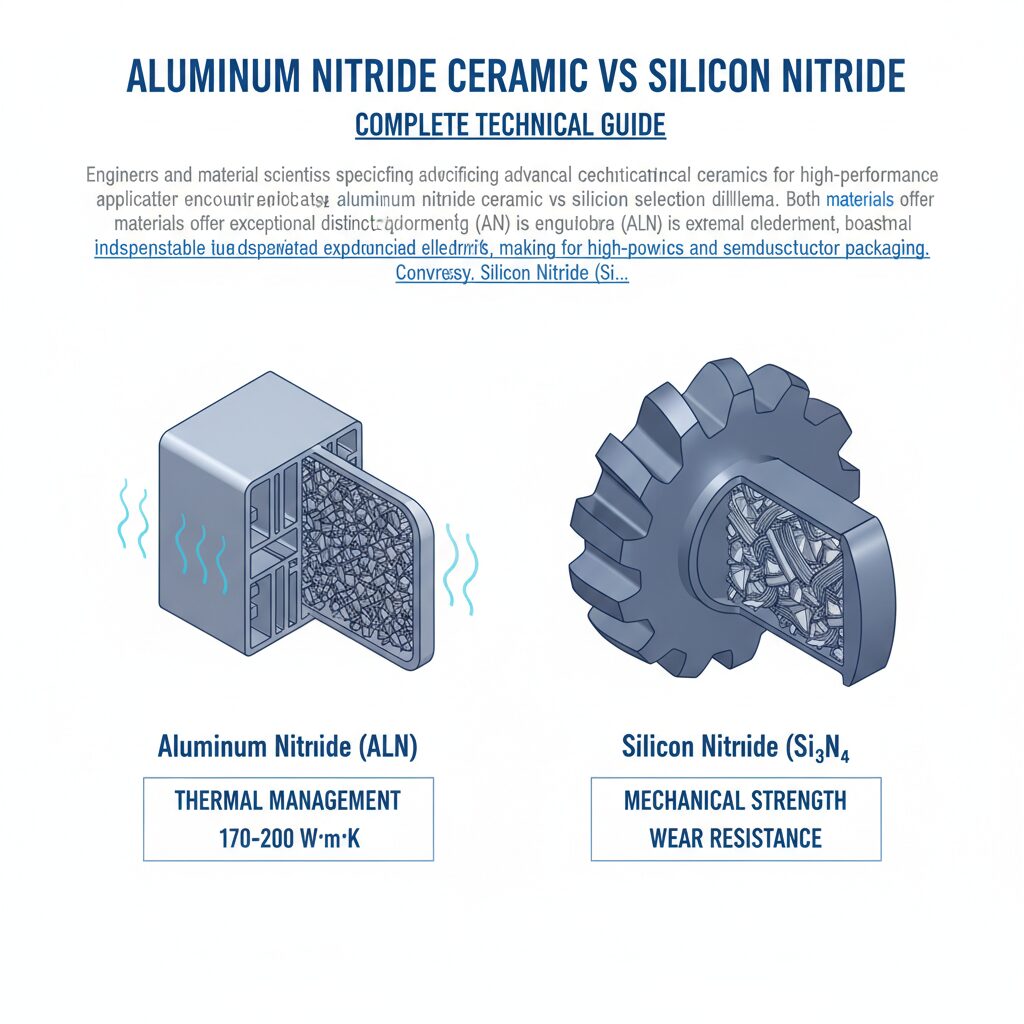
When selecting a technical ceramic, the binary choice of silicon nitride ceramic vs alumina is often expanded to include other advanced materials such as Zirconia (ZrO2) and 실리콘 카바이드 (SiC). Each material occupies a distinct niche on the thermomechanical performance spectrum. For specialized thermal management applications where dielectric properties must be maintained alongside rapid heat dissipation, engineers might also consider 질화 알루미늄 (thermal conductivity > 170 W/m·K) or 질화붕소 (highly machinable with excellent lubricity). However, for structural and wear components, the big four—SiC, Alumina, Zirconia. And Silicon Nitride—dominate the landscape.
| 속성 | 실리콘 카바이드 | 알루미나 | 지르코니아 | 질화규소 |
|---|---|---|---|---|
| 열 전도성 | 120 – 170 | 20 – 30 | 2 – 3 | 20 – 30 |
| 경도 | 2800 | 1500 – 1650 | 1200 | 1500 – 1800 |
| 골절 인성 | 4.0 - 4.5 | 3.5 – 4.0 | 8.0 - 10.0 | 6.0 - 8.0 |
| 비용 | 높음 | 낮음 | Medium | 매우 높음 |
The data in the table illustrates fundamental engineering trade-offs. Silicon Carbide offers unparalleled hardness (up to 2800 HV) and exceptional thermal conductivity (upwards of 150 W/m·K), making it the premier choice for extreme wear faces and mechanical seal rings operating under high-velocity friction. However, its fracture toughness is dangerously low (approx. 4.0 MPa·m½), making it highly susceptible to brittle failure under impact or severe point-loading. 지르코니아, specifically Yttria-Stabilized Tetragonal Zirconia Polycrystal (Y-TZP), provides the highest fracture toughness of the group (often exceeding 9.0 MPa·m½) due to its unique phase-transformation toughening mechanism. Unfortunately, Zirconia suffers from catastrophic strength degradation above 500°C and acts as a thermal insulator with a conductivity of just 2.5 W/m·K.
This is precisely where the comparison of silicon nitride ceramic vs alumina heavily favors Si3N4 for extreme hybrid environments. Silicon nitride achieves a “Goldilocks” balance: it maintains high fracture toughness (up to 8.0 MPa·m½) comparable to Zirconia, retains its mechanical strength up to 1200°C. And possesses a critically low coefficient of thermal expansion (CTE) of roughly 3.2 x 10^-6 /°C. Alumina, by contrast, has a higher CTE of 8.1 x 10^-6 /°C and lower toughness, making it highly vulnerable to thermal shock cracking if subjected to temperature gradients exceeding 200°C/sec.
애플리케이션
The divergent mechanical and thermal properties of these materials dictate their usage across different industrial sectors. Understanding exactly where and why each material is deployed clarifies the technical value proposition of silicon nitride ceramic vs alumina.
- 반도체 웨이퍼 가공 장비: Silicon nitride is overwhelmingly chosen over alumina for wafer handling end-effectors, susceptors. And lift pins. The semi industry requires materials that generate zero particulate contamination and maintain absolute dimensional stability (tolerances down to ±0.005mm) under rapid thermal cycling in plasma etching chambers. Si3N4’s low CTE (3.2 x 10^-6 /°C) ensures zero deflection under extreme localized heating up to 800°C.
- High-Temperature Welding Pins: In projection welding of automotive chassis components, extreme thermal shock and molten metal spatter are constant threats. Silicon nitride is selected here because liquid metals (like molten steel or aluminum) do not wet its surface. And it can withstand cyclic temperature variations from ambient 25°C to 1000°C instantly without micro-cracking. Alumina pins typically fracture under these rapid ΔT conditions due to lower thermal shock resistance.
- High-Voltage Electrical Insulators: Alumina is the undisputed champion and the material of choice for power grid standoffs, spark plug insulators. And high-voltage feedthroughs. At a fraction of the cost of Si3N4, 99.5% Alumina provides a staggering dielectric strength of over 15 kV/mm and volume resistivity exceeding 10^14 Ω·cm. For pure electrical isolation without severe impact requirements, alumina is the most efficient engineering choice.
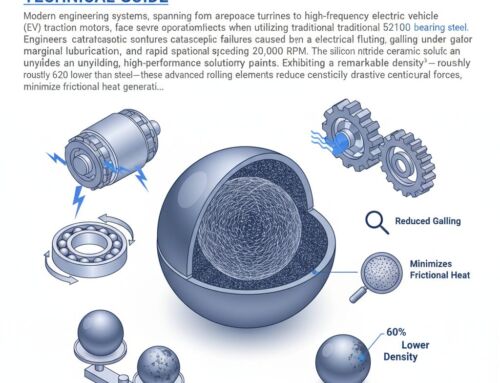
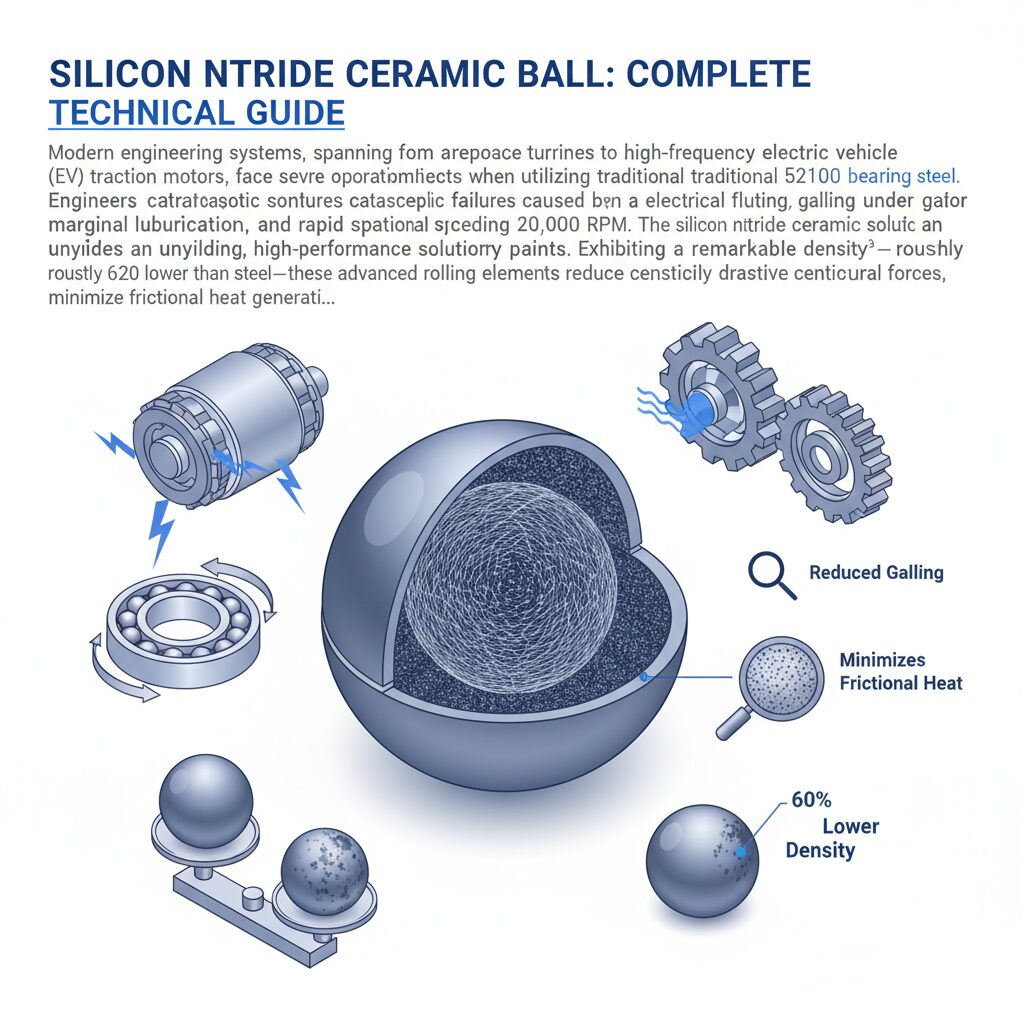
- Aerospace and EV Bearing Components: Silicon nitride is universally selected for high-speed rolling-element bearings in jet engines and electric vehicle traction motors (frequently spinning at > 20,000 RPM). Its lower density (3.2 g/cm³) reduces centrifugal load on the outer race by 40% compared to steel (7.8 g/cm³) or alumina (3.9 g/cm³), while its fracture toughness and surface finish capabilities (Ra < 0.05 μm) eliminate galling, reduce lubrication requirements. And dramatically extend rolling contact fatigue life.
- Precision Pump Seals and Valve Trim: For standard chemical processing, alumina provides excellent corrosion resistance against both acids and alkalis at room temperature, making it a highly cost-effective mechanical seal face. However, in severe slurry applications involving high pressures (>5000 PSI), abrasive particulates. And high localized frictional heating, engineers upgrade to silicon nitride or silicon carbide. Si3N4 prevents the brittle chipping at the seal edges that frequently plagues alumina components under cavitation.
제조 프로세스
The discrepancy in cost and performance between silicon nitride ceramic vs alumina is deeply rooted in their respective manufacturing paradigms. Technical ceramics are not melted and cast like metals. they are produced via complex powder metallurgy routes. The exact control of powder morphology, binder formulation, pressing pressures. And thermal profiling directly dictates the final density and grain structure of the component.
For Alumina, the process is relatively straightforward. High-purity Al2O3 powders (often sized around 1.0 to 3.0 microns) are mixed with organic binders (such as PVA) and water to form a slurry. This is then spray-dried into flowable granules. Silicon Nitride, however, requires significantly more complex powder preparation. Because covalent bonds resist diffusion, pure Si3N4 powder will not densify simply by heating. It requires the precise addition of sintering aids—typically Yttria (Y2O3) and Alumina (Al2O3) in the range of 2% to 6% by weight—to form a transient liquid phase at grain boundaries during high-temperature firing.
형성 방법
- 냉간 등방성 프레싱(CIP): Used for both alumina and silicon nitride. The granulated powder is packed into a flexible elastomeric mold and subjected to uniform fluid pressure, typically between 150 MPa and 300 MPa. This method ensures homogeneous green density (around 50-60% of theoretical density). This is critical for minimizing anisotropic shrinkage during the firing phase.
- 사출 성형(CIM): For high-volume, complex geometries like turbine blades or threaded nozzles, Ceramic Injection Molding is utilized. Powders are mixed with thermoplastic binders (upwards of 20-30% by volume) and injected into steel dies at pressures of 50 to 100 MPa. A lengthy, meticulously controlled binder burnout phase (ranging from 48 to 120 hours) is required to remove the polymers without inducing micro-cracks before the part can be sintered.
소결
The sintering stage highlights the most significant divergence in the manufacturing of silicon nitride ceramic vs alumina. Alumina can be pressureless sintered in air atmosphere furnaces. Temperatures are slowly ramped at 2-5°C per minute up to peak temperatures ranging from 1550°C to 1650°C, held for 2 to 4 hours. And then slowly cooled. This atmospheric sintering is highly scalable and cost-effective.
Silicon nitride cannot be sintered in the open air, nor can it be sintered at atmospheric pressure, because it begins to dissociate and sublime into silicon and nitrogen gas at temperatures above 1850°C. To achieve full theoretical density, Si3N4 must undergo Gas Pressure Sintering (GPS) or Hot Isostatic Pressing (HIP). In GPS, the components are placed in a graphite-lined furnace backfilled with high-purity nitrogen gas pressurized to 10 – 100 atmospheres (1 to 10 MPa). The temperature is pushed up to 1750°C – 1900°C. The high nitrogen overpressure suppresses the decomposition of the material, allowing the yttria/alumina additives to form a liquid phase that draws the alpha-phase Si3N4 grains together, causing them to precipitate as elongated, interlocking beta-phase hexagonal rod-like crystals. This interlocking microstructure is exactly what gives silicon nitride its massive fracture toughness (up to 8.0 MPa·m½).
최종 가공
After sintering, the ceramic part shrinks by approximately 15% to 22%. Predicting this shrinkage with sub-millimeter accuracy is possible, but achieving tight engineering tolerances (such as ±0.005mm) directly out of the kiln is physically impossible. Therefore, hard machining is required. Because the fired material now exhibits hardness values between 1500 and 1800 HV, traditional high-speed steel or carbide tooling is completely useless. Final machining demands high-precision CNC grinding centers equipped with resin-bonded or metal-bonded diamond grinding wheels. The component is slowly ground down to exact dimensional specifications using heavy flood coolant to manage the extreme frictional heat generated at the diamond-ceramic interface.
장점 및 제한 사항
장점
- Superior Thermal Shock Resistance (Si3N4): With a low CTE of 3.2 x 10^-6 /°C and high flexural strength (>800 MPa), silicon nitride can survive sudden temperature drops (ΔT) of 800°C to 1000°C without sustaining structural damage.
- Exceptional Fracture Toughness (Si3N4): The interlocking beta-phase grain structure of silicon nitride provides a fracture toughness of 6.0 to 8.0 MPa·m½, significantly reducing the risk of catastrophic brittle failure under impact loads compared to alumina.
- Cost-Effective Electrical Insulation (Alumina): Alumina provides dielectric strengths exceeding 15 kV/mm at a fraction of the cost of other technical ceramics, making it the undisputed choice for electronic substrates and high-voltage standoffs.
- High Compressive Strength (Alumina): With compressive strengths pushing 2500 MPa, alumina is incredibly stable under pure static compressive loading, assuming bending moments and tensile stresses are minimized.
제한 사항
- High Manufacturing and Machining Costs (Si3N4): The necessity for Gas Pressure Sintering (GPS) in high-pressure nitrogen furnaces, combined with the extreme difficulty of diamond-grinding the toughened material, makes silicon nitride components 3 to 5 times more expensive than their alumina equivalents.
- Low Thermal Shock Resistance (Alumina): Due to a relatively high CTE (8.1 x 10^-6 /°C) and moderate thermal conductivity (25 W/m·K), alumina cannot survive rapid temperature fluctuations. A sudden ΔT of just 200°C to 250°C is often sufficient to induce fatal thermal stress cracking.
가공 고려 사항
The actualization of theoretical ceramic designs depends entirely on post-sintering machining capabilities. When comparing silicon nitride ceramic vs alumina, the machining dynamics present serious engineering challenges. Machining advanced ceramics is not a cutting process. it is a brittle-fracture grinding process at the micro-scale. The energy required to remove material from a component with a hardness of 1800 HV translates directly into massive cutting forces and intense localized heating.
For Alumina, the moderate fracture toughness (3.5 MPa·m½) means the material micro-fractures relatively easily under the pressure of a diamond abrasive grain. While this makes material removal faster, it also makes alumina highly susceptible to edge chipping, surface pull-outs. And subsurface micro-cracking if the feed rate is pushed too high. Spindle speeds of 10,000 to 15,000 RPM are typically paired with slow feed rates (< 20 mm/min) to achieve an acceptable surface finish.
Silicon Nitride is notoriously difficult to machine due to its high fracture toughness. The elongated grains actively resist the micro-cracking necessary for material removal. This causes diamond grinding wheels to wear rapidly and suffer from “glazing,” where the diamond grits become dull and generate excessive friction rather than removing material. Machining Si3N4 requires continuous dressing of the grinding wheel, extremely rigid machine tool architectures to prevent chatter, acoustic emission monitoring. And ultra-high-pressure coolant delivery systems (> 70 PSI) to flush away the ceramic swarf and cool the contact zone.
At Great Ceramic, we have mastered the kinematics of hard ceramic grinding. Our 정밀 세라믹 가공 division utilizes multi-axis CNC grinding centers equipped with specific diamond grit matrices (spanning from coarse D91 for roughing to ultra-fine D15 for lapping) to process both alumina and silicon nitride. We consistently achieve dimensional tolerances of ±0.005mm, geometric positioning (GD&T) within 0.002mm. And surface finishes down to Ra 0.05μm. If you are struggling with the transition from metal to technical ceramics, our engineering team can provide immediate Design for Manufacturability (DFM) feedback to optimize your part geometry for diamond grinding, reducing both cycle time and production costs.
FAQ
What is silicon nitride ceramic vs alumina?
Silicon nitride (Si3N4) and alumina (Al2O3) are two of the most widely used advanced technical ceramics. Alumina is an oxide ceramic known for its excellent electrical insulation, high hardness. And cost-effectiveness, making it the industry standard for general wear and electronic applications. Silicon nitride is a non-oxide ceramic engineered for extreme environments. It possesses a highly covalent bond structure, yielding exceptional fracture toughness, high-temperature strength retention. And virtually unmatched resistance to thermal shock. The comparison typically boils down to cost versus extreme thermomechanical survivability.
What are the main applications of silicon nitride ceramic vs alumina?
Alumina is primarily utilized in high-voltage electrical insulators, semiconductor processing components that require chemical inertness but not extreme thermal shock resistance, heavy-duty wear liners. And pump seals operating under steady-state temperatures. Silicon nitride is reserved for the most demanding applications where alumina would immediately fail. These include aerospace rolling-element bearings (due to its low density and high fatigue life), high-temperature automotive welding pins, extreme thermal shock environments. And semiconductor wafer handling components that require zero dimensional distortion under rapid heating.
How does silicon nitride ceramic compare to other ceramics?
When plotted on a performance matrix, silicon nitride is highly balanced. It offers fracture toughness (6.0 – 8.0 MPa·m½) that closely rivals Zirconia (8.0 – 10.0 MPa·m½), but unlike Zirconia, Si3N4 maintains its strength beyond 1000°C. Compared to Silicon Carbide (SiC), silicon nitride cannot match SiC’s extreme hardness (2800 HV) or high thermal conductivity (up to 170 W/m·K), but it is vastly superior in impact resistance, as SiC is highly brittle (toughness around 4.0 MPa·m½). Materials like Aluminum Nitride and Boron Nitride are generally reserved for specialized thermal management rather than high-stress structural applications.
What are the advantages of silicon nitride ceramic vs alumina?
The critical advantage of silicon nitride over alumina is its ability to survive aggressive thermomechanical stress. Si3N4 has a much lower coefficient of thermal expansion (3.2 x 10^-6 /°C vs 8.1 x 10^-6 /°C for Al2O3) and roughly double the fracture toughness. This means silicon nitride can withstand thermal shocks of up to 1000°C without cracking, whereas alumina is at risk of fracturing with a sudden temperature change of just 200°C. Additionally, Si3N4 retains its high flexural strength (up to 1000 MPa) at temperatures where metals melt and alumina begins to rapidly lose its structural integrity. Alumina’s primary advantage is its economic viability and superior electrical volume resistivity.
How is silicon nitride ceramic machined?
Due to its extreme hardness (up to 1800 HV) and interlocking beta-phase grain structure, silicon nitride cannot be machined with standard CNC cutting tools. It requires specialized diamond grinding, honing. And lapping processes performed after the material has been sintered to full density via Gas Pressure Sintering (GPS). This involves using resin-bonded or metal-bonded diamond wheels on ultra-rigid CNC grinding machines. At Great Ceramic, our 정밀 세라믹 가공 facility specializes in these exact techniques, carefully controlling feed rates, spindle speeds. And coolant pressures to prevent subsurface micro-cracking. We routinely process complex silicon nitride and alumina components to exact ±0.005mm tolerances, ensuring flawless integration into your final assembly.
Need custom silicon nitride vs alumina parts? 그레이트 세라믹에 문의 공차가 엄격한 정밀 가공 서비스 또는 이메일 [email protected].
silicon nitride ceramic vs alumina is widely used in advanced ceramic applications.
자세히 알아보기 실리콘 질화물 세라믹 대 알루미나 정밀 세라믹 가공 서비스를 제공합니다.