








Aluminum Nitride Ceramic Rod for Automotive: Complete Technical Guide
The transition toward 800V architectures and high-density power electronics in modern electric vehicles (EVs) has created a critical thermal management bottleneck. Engineers are increasingly confronted with heat fluxes exceeding 500 W/cm² in silicon carbide (SiC) inverters and high-voltage battery management systems (BMS). Traditional metal heat sinks fail to provide the necessary electrical isolation, while standard polymeric thermal interface materials (TIMs) degrade rapidly at junction temperatures above 150°C. The optimal engineered solution is the 질화 알루미늄 ceramic rod for automotive applications. Delivering an exceptional thermal conductivity of 170 to 230 W/m·K combined with a dielectric strength of 15 kV/mm, this advanced material effectively bridges the gap between rapid heat dissipation and robust electrical insulation.
Great Ceramic specializes in the precise fabrication and tight-tolerance machining (±0.005mm) of technical ceramics designed strictly for extreme automotive environments. Whether deployed as structural thermal columns in insulated-gate bipolar transistor (IGBT) modules or as high-precision positioning pins in autonomous driving LiDAR sensors, an 질화 알루미늄 ceramic rod ensures dimensional stability across extreme thermal cycles from -40°C to 200°C. Ready to upgrade your EV thermal management architecture? Request a custom RFQ from Great Ceramic today.
머티리얼 속성
The performance of an aluminum nitride ceramic rod for automotive systems is dictated by its unique crystallographic structure. Heat transfer in AlN occurs via phonon transmission. Unlike metals. This rely on free electrons for both thermal and electrical conductivity, the covalent bonding in the AlN wurtzite lattice allows for rapid phonon propagation while severely restricting electron mobility. This results in a material that conducts heat nearly as effectively as metallic aluminum (237 W/m·K) while functioning as a premier electrical insulator.
| 속성 | 가치 | 단위 |
|---|---|---|
| 밀도 | 3.26 – 3.30 | g/cm³ |
| 경도 | 1000 – 1100 | HV |
| 굴곡 강도 | 300 – 350 | MPa |
| 골절 인성 | 2.8 – 3.2 | MPa-m½ |
| 열 전도성 | 170 - 230 | W/m-K |
| 전기 저항 | > 10¹⁴ | Ω-cm |
| 최대 작동 온도 | 1000(공기)/1900(불활성) | °C |
Beyond the primary thermal and electrical metrics, the coefficient of thermal expansion (CTE) is a critical parameter for automotive electronics. The CTE of AlN is 4.5 × 10⁻⁶ /K (measured between 20°C and 400°C). This value is nearly perfectly matched to that of silicon (4.1 × 10⁻⁶ /K) and 실리콘 카바이드 (4.0 × 10⁻⁶ /K). In automotive IGBT modules, this matched CTE prevents thermomechanical fatigue, delamination. And solder joint shear stress during thousands of rapid power cycling events where internal temperatures fluctuate by over 120°C in milliseconds.
다른 세라믹과의 비교
When selecting structural insulating rods for automotive engineering, procurement and R&D teams must weigh thermal performance against fracture toughness and component cost. While standard oxide ceramics are cost-effective, they frequently fail to meet the stringent thermal dissipation requirements of next-generation EV power trains. The following table provides a quantifiable baseline comparing an aluminum nitride ceramic rod for automotive use against other standard industrial technical ceramics.
| 속성 | 질화 알루미늄 | 알루미나 | 지르코니아 | 질화규소 |
|---|---|---|---|---|
| 열 전도성(W/m-K) | 170 - 230 | 25 – 35 | 2.0 - 3.0 | 25 – 90 |
| 경도(HV) | 1100 | 1500 – 1650 | 1200 – 1300 | 1500 - 1600 |
| 골절 인성(MPa-m½) | 2.8 – 3.2 | 3.5 – 4.5 | 8.0 - 10.0 | 6.0 - 8.0 |
| 비용 | 높음 | 낮음 | Medium | 높음 |
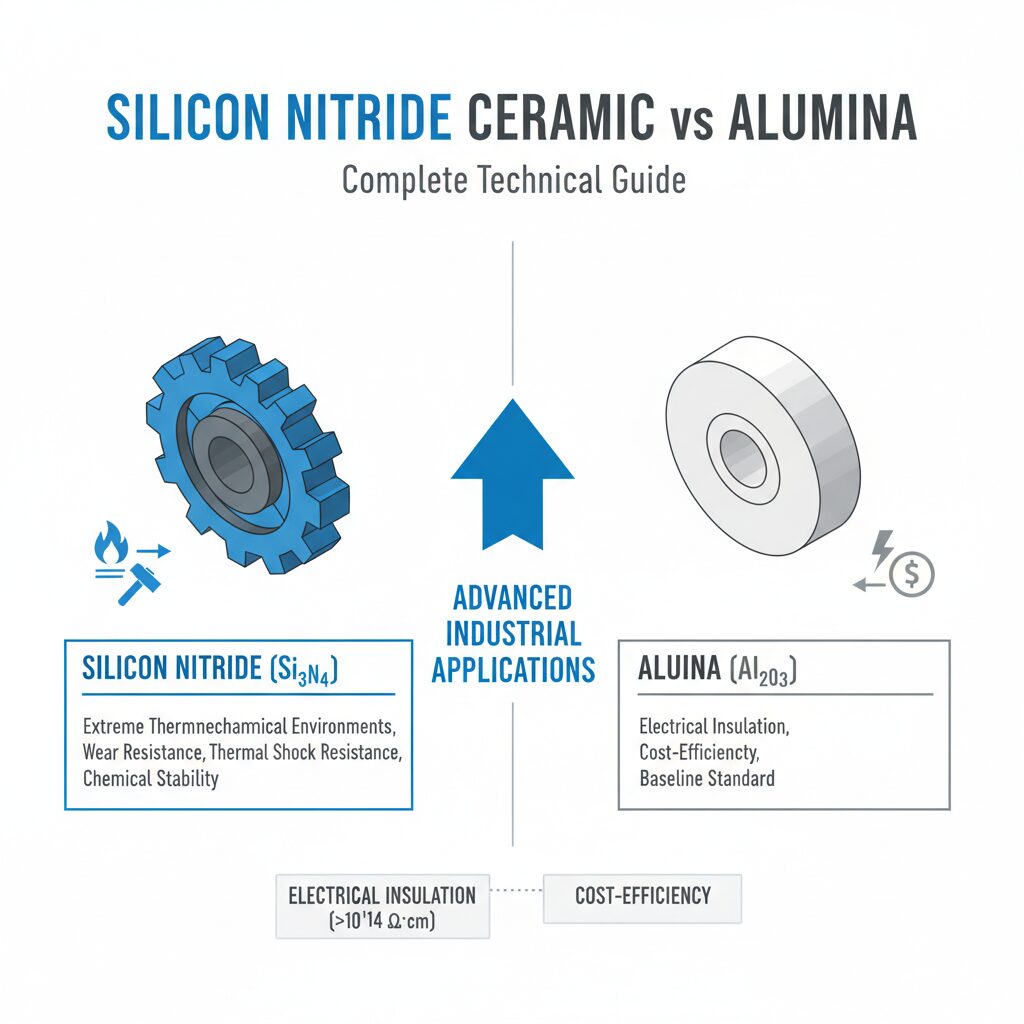
As demonstrated in the data, standard 알루미나/”>알루미나 (Al₂O₃) offers only 15% of the thermal conductivity of AlN. While alumina is sufficient for low-power 12V automotive electronics, it rapidly overheats in 800V SiC architectures. 지르코니아 (ZrO₂) excels in high-impact structural applications due to its transformation toughening mechanism (achieving up to 10.0 MPa·m½), but acts as a thermal insulator (2.0 W/m·K), making it completely unsuitable for heat sink applications. Conversely, 실리콘 질화물 (Si₃N₄) provides superior mechanical reliability and moderate thermal conductivity, but still falls short of AlN’s >170 W/m·K requirement for peak thermal density applications in direct-bonded copper (DBC) and active metal brazed (AMB) substrate standoffs.
애플리케이션
The specification of an aluminum nitride ceramic rod for automotive environments is primarily concentrated in sectors where high voltage, extreme localized heat flux. And strict dimensional stability converge. Modern EVs and Advanced Driver Assistance Systems (ADAS) heavily rely on these components to maintain system reliability and prevent catastrophic thermal runaway.
- EV Power Inverter Thermal Columns: High-voltage SiC MOSFETs generate intense localized heat spots during DC to AC conversion. AlN rods are utilized as structural support columns and thermal conduits within the inverter housing, actively drawing waste heat (often exceeding 200°C at the junction) away from the semiconductor die directly to the liquid cooling plate while maintaining a >10kV isolation barrier.
- Battery Management System (BMS) Thermistor Probes: Accurate real-time cell temperature monitoring is mandatory to prevent battery thermal runaway. AlN rods serve as the housing or mounting substrate for high-precision NTC thermistors. The material’s thermal conductivity of 200 W/m·K ensures a rapid sensor response time (<10 milliseconds), while its 10¹⁴ Ω·cm resistivity guarantees complete galvanic isolation from the 800V battery bus.
- High-Power Automotive Matrix LED Headlights: Advanced matrix LED systems utilize dense arrays of high-power diodes, generating heat fluxes up to 70 W/cm². AlN ceramic rods act as micro-heat pipe analogs, supporting the LED arrays structurally while pulling heat toward the rear aluminum heat sinks, ensuring the junction temperatures remain below the critical 120°C threshold for optimal lumen output.
- LiDAR and ADAS Laser Diode Substrates: Autonomous driving sensors require extreme optical alignment precision. With a low CTE of 4.5 ppm/K, AlN rods are used as mounting pins and standoffs for laser emitting diodes and avalanche photodiodes. This ensures that the focal length and optical alignment do not shift by more than 0.001mm across a harsh automotive ambient temperature range of -40°C to +105°C.
- On-Board Charger (OBC) Inductor Standoffs: 11kW and 22kW on-board chargers experience significant core losses and hysteresis heating in their magnetic components. AlN rods are utilized to physically mount these heavy copper-wound inductors to the chassis, providing both rigid vibration resistance (up to 30G) and a high-efficiency thermal path to the external cooling fins.
제조 프로세스
The production of a high-purity aluminum nitride ceramic rod for automotive implementation is a metallurgically complex process. Theoretical thermal conductivity of pure AlN wurtzite crystals can reach 320 W/m·K. However, trace oxygen impurities easily integrate into the crystal lattice during manufacturing, creating aluminum vacancies that scatter phonons and drastically reduce thermal performance (often below 100 W/m·K). Therefore, strict atmospheric control and specialized sintering additives are mandatory to achieve the target 170-230 W/m·K range.
형성 방법
- 냉간 등방성 프레싱(CIP): High-purity AlN powder (average particle size 1.0 – 2.0 µm) is mixed with organic binders and pressed inside a flexible elastomer mold at ultra-high pressures between 200 and 300 MPa. This method ensures highly uniform green-body density (typically 60-65% of theoretical), minimizing anisotropic shrinkage during sintering and resulting in superior mechanical consistency for thick automotive rods.
- Extrusion: For thin, elongated rods (where the length-to-diameter ratio exceeds 10:1), extrusion is preferred. The powder is formulated into a highly viscous plasticized paste using specialized thermoplastic binders, then forced through a tungsten carbide die under 15-50 MPa of pressure.
소결
The green bodies undergo a two-stage thermal cycle. First, thermal debinding occurs at 400°C to 600°C to remove all organic compounds. Second, liquid-phase sintering is executed at extreme temperatures between 1700°C and 1900°C. Because AlN is highly susceptible to oxidation, sintering must take place in a strictly controlled pure nitrogen atmosphere. To resolve the oxygen impurity issue, sintering aids—typically 3% to 5% by weight of Yttria (Y₂O₃)—are introduced. At peak temperatures, the yttria reacts with the surface aluminum oxide (Al₂O₃) on the powder particles to form liquid yttrium aluminates (e.g., Y₃Al₅O₁₂, YAlO₃). This liquid phase not only densifies the ceramic to >99% theoretical density but also acts as an oxygen getter, pulling oxygen out of the AlN lattice into the grain boundaries. This purification of the AlN grains allows for unobstructed phonon transport, locking in the high thermal conductivity.
최종 가공
Upon cooling, the sintered AlN rod contracts by approximately 18-20%. Because automotive applications require extreme precision (often h6 or g6 fits for insertion into metal housings), the “as-sintered” dimensions are insufficient. The rods must undergo rigorous post-sintering computer numerical control (CNC) machining. Given the material’s hardness of 1100 HV, traditional high-speed steel or carbide tooling is useless. Great Ceramic utilizes specialized 정밀 세라믹 가공 utilizing multi-axis CNC cylindrical grinders equipped with resin-bonded diamond abrasive wheels to achieve final dimensional tolerances down to ±0.005mm.
장점 및 제한 사항
장점
- Unmatched Thermal/Electrical Ratio: Offers 170-230 W/m·K thermal conductivity while maintaining an electrical resistivity exceeding 10¹⁴ Ω·cm, effectively outperforming metalized plastics and thermal epoxies by an order of magnitude in 800V automotive architectures.
- Perfect CTE Matching: A CTE of 4.5 × 10⁻⁶ /K eliminates thermal shear stress when directly bonded to semiconductor-grade silicon or silicon carbide dies in IGBT power modules.
- Non-Toxic Composition: Historically, Beryllium Oxide (BeO) was used for high thermal conductivity ceramics (up to 280 W/m·K), but BeO dust is highly toxic and causes berylliosis. AlN is 100% non-toxic and complies strictly with the End of Life Vehicles (ELV) Directive and RoHS regulations.
- Plasma and Gas Resistance: Highly resistant to molten metals and reactive gases, ensuring stability if exposed to harsh automotive chemical environments, battery outgassing, or coolant leaks.
제한 사항
- Moisture Hydrolysis Susceptibility: In environments with extreme humidity and high temperatures (e.g., >85°C / 85% RH), unprotected AlN can react with water vapor to form aluminum hydroxide (Al(OH)₃) and ammonia gas (NH₃). This degrades the surface and lowers thermal performance. Automotive applications typically require the rod to be hermetically sealed, passivated, or coated (e.g., with SiO₂ or parylene) if directly exposed to ambient air.
- Moderate Fracture Toughness: With a fracture toughness of 2.8 – 3.2 MPa·m½, AlN is significantly more brittle than metals and transformation-toughened zirconia. It cannot withstand severe localized impact loading or point-bending stress without shattering, requiring careful mechanical design regarding clamping forces.
가공 고려 사항
Producing an aluminum nitride ceramic rod for automotive use with reliable, repeatable dimensions is a significant engineering challenge. Machinability is strictly limited by the material’s brittleness. Improper feeds and speeds during grinding induce micro-cracking that propagates up to 0.05mm beneath the surface, drastically lowering the flexural strength of the component and introducing catastrophic failure points during high-frequency automotive vibration (e.g., 10-2000 Hz chassis vibration).
Great Ceramic engineers bypass these limitations through advanced kinematic control. We utilize 5-axis CNC grinding centers with flood coolant systems delivering synthetic grinding fluids at flow rates exceeding 50 L/min to mitigate thermal shock at the cutting zone. Our multi-stage grinding process utilizes a progressive reduction in diamond grit sizes—starting at D64 (coarse) for bulk material removal at 30 m/s peripheral wheel speed. And finishing with D15 (fine) to ensure sub-surface damage remains below 2 µm.
| 가공 매개변수 | Great Ceramic 정밀 기능 | Standard Industry Capability |
|---|---|---|
| Outer Diameter (OD) Tolerance | ± 0.005 mm | ± 0.050 mm |
| Length Tolerance | ± 0.010 mm | ± 0.100 mm |
| 표면 거칠기(Ra) | 0.1 – 0.2 µm | 0.6 – 0.8 µm |
| Concentricity / Runout | 0.005 mm | 0.020 mm |
| Straightness | 0.010 mm per 100 mm | 0.050 mm per 100 mm |
Achieving a surface roughness of Ra 0.1 µm is critical for automotive thermal management. Microscopic surface asperities trap air (a thermal insulator with a conductivity of only 0.026 W/m·K). By polishing the rod ends to tight surface finish tolerances, Great Ceramic minimizes thermal interfacial resistance when the rod is mechanically clamped against metallic heat sinks. Need extreme precision for your prototype? Submit your CAD drawings to Great Ceramic for a DFM analysis.
FAQ
What is an aluminum nitride ceramic rod for automotive?
An aluminum nitride ceramic rod for automotive is a highly engineered structural component manufactured from AlN powder. It is primarily used in electric and autonomous vehicles to solve advanced thermal management issues. It possesses the unique dual-property of acting as an excellent thermal conductor (up to 230 W/m·K) while simultaneously serving as a high-voltage electrical insulator (>10¹⁴ Ω·cm), making it indispensable for 800V EV architectures.
What are the main applications of this rod in electric vehicles?
In the EV sector, these rods are predominantly deployed as thermal support columns in silicon carbide (SiC) traction inverters, providing a physical bridge that pulls extreme heat away from active semiconductor junctions to liquid cooling plates. They are also used as insulated housings for high-voltage battery management system (BMS) temperature probes, structural standoffs for heavy onboard charger (OBC) inductors. And precision alignment pins in high-power matrix LED headlight clusters.
How does it compare to other ceramics like alumina or silicon nitride?
Compared to standard alumina, aluminum nitride provides approximately seven times the thermal conductivity (170-230 W/m·K versus 25-35 W/m·K), making it vastly superior for high-density heat dissipation. While silicon nitride offers higher physical durability and fracture toughness (up to 8.0 MPa·m½ compared to AlN’s 3.2 MPa·m½), silicon nitride’s thermal conductivity generally maxes out around 90 W/m·K. This is often insufficient for peak thermal loads in advanced IGBT EV modules.
What are the advantages of using it over metal heat sinks?
Metals like aluminum and copper are excellent thermal conductors, but they are also highly electrically conductive. In modern electric vehicles operating on 400V or 800V DC buses, placing a metal heat sink directly against a live electrical component causes instant short circuits. An AlN rod provides equivalent thermal extraction capabilities to aluminum metal while offering a dielectric breakdown strength of 15 kV/mm, ensuring complete galvanic isolation and preventing lethal high-voltage failures.
How is it machined to meet tight automotive tolerances?
Due to its hardness of 1100 HV and innate brittleness, an AlN rod cannot be machined using traditional lathes or mills. It requires specialized multi-axis CNC cylindrical grinding using resin-bonded diamond abrasive wheels under heavy flood coolant. Great Ceramic utilizes these advanced precision ceramic machining techniques, employing optimized feed rates to prevent micro-cracking, ultimately achieving automotive-grade geometric tolerances as tight as ±0.005 mm on rod diameters and an exceptional surface finish of Ra 0.1 µm.
Need custom aluminum nitride ceramic rod for automotive parts? 그레이트 세라믹에 문의 공차가 엄격한 정밀 가공 서비스 또는 이메일 [email protected].
aluminum nitride ceramic rod for automotive is widely used in advanced ceramic applications.
자세히 알아보기 자동차용 질화 알루미늄 세라믹 로드 정밀 세라믹 가공 서비스를 제공합니다.