








Alumina Ceramic for Automotive Industry: Complete Technical Guide
When engineering advanced powertrain and electronic systems, specifying the correct 알루미나 ceramic for automotive industry applications is critical to overcoming severe thermal, electrical. And tribological pain points. Modern automotive environments—ranging from 1,000°C internal combustion engine (ICE) exhaust systems to 800V next-generation electric vehicle (EV) architectures—demand materials that outperform traditional metals and plastics. Alumina (Al₂O₃) delivers exceptional dielectric breakdown strength (up to 15 kV/mm), superior abrasive wear resistance (1500 HV). And robust high-temperature stability, making it the premier choice for engineers designing sensor housings, power electronics substrates. And mechanical seals. However, integrating this ultra-hard material requires expert manufacturing capabilities to prevent micro-cracking and dimensional inaccuracies. Great Ceramic provides 정밀 세라믹 가공 services tailored to these demanding OEM specifications, consistently achieving ±0.005mm tolerances. This technical guide delivers the definitive engineering data, comparative material science. And manufacturing protocols necessary for procurement managers and R&D teams to successfully integrate alumina components into automotive assemblies.
머티리얼 속성
The performance of alumina in automotive applications is dictated by its phase purity, grain size. And theoretical density. High-purity technical alumina (typically 95% to 99.8% Al₂O₃) exhibits a tightly packed hexagonal crystalline structure. This dense ionic and covalent bonding matrix yields extreme mechanical hardness and chemical inertness. This is essential for components exposed to corrosive automotive fluids, harsh exhaust gases. And continuous mechanical friction. At a density of 3.85 g/cm³, alumina is approximately 50% lighter than standard automotive steel alloys (7.8 g/cm³), providing critical unsprung mass reductions in high-performance vehicle dynamic systems. Furthermore, its ultra-high electrical resistivity (>10¹⁴ Ω·cm) prevents current leakage in high-voltage EV battery management systems (BMS) and insulated-gate bipolar transistor (IGBT) modules, operating safely up to 1,650°C before experiencing structural degradation.
| 속성 | 가치 | 단위 |
|---|---|---|
| 밀도 | 3.80 – 3.95 | g/cm³ |
| 경도 | 1450 – 1650 | HV |
| 굴곡 강도 | 330 – 400 | MPa |
| 골절 인성 | 3.5 - 4.5 | MPa-m½ |
| 열 전도성 | 25 – 35 | W/m-K |
| 전기 저항 | >10¹⁴ | Ω-cm |
| 최대 작동 온도 | 1650 | °C |
다른 세라믹과의 비교
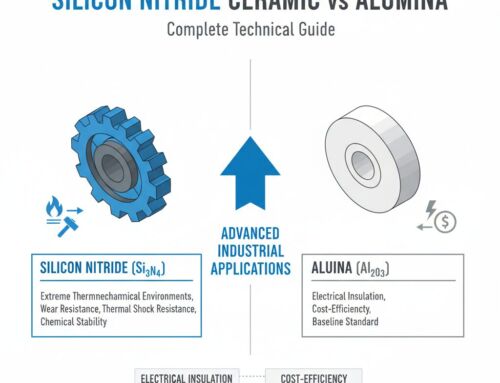
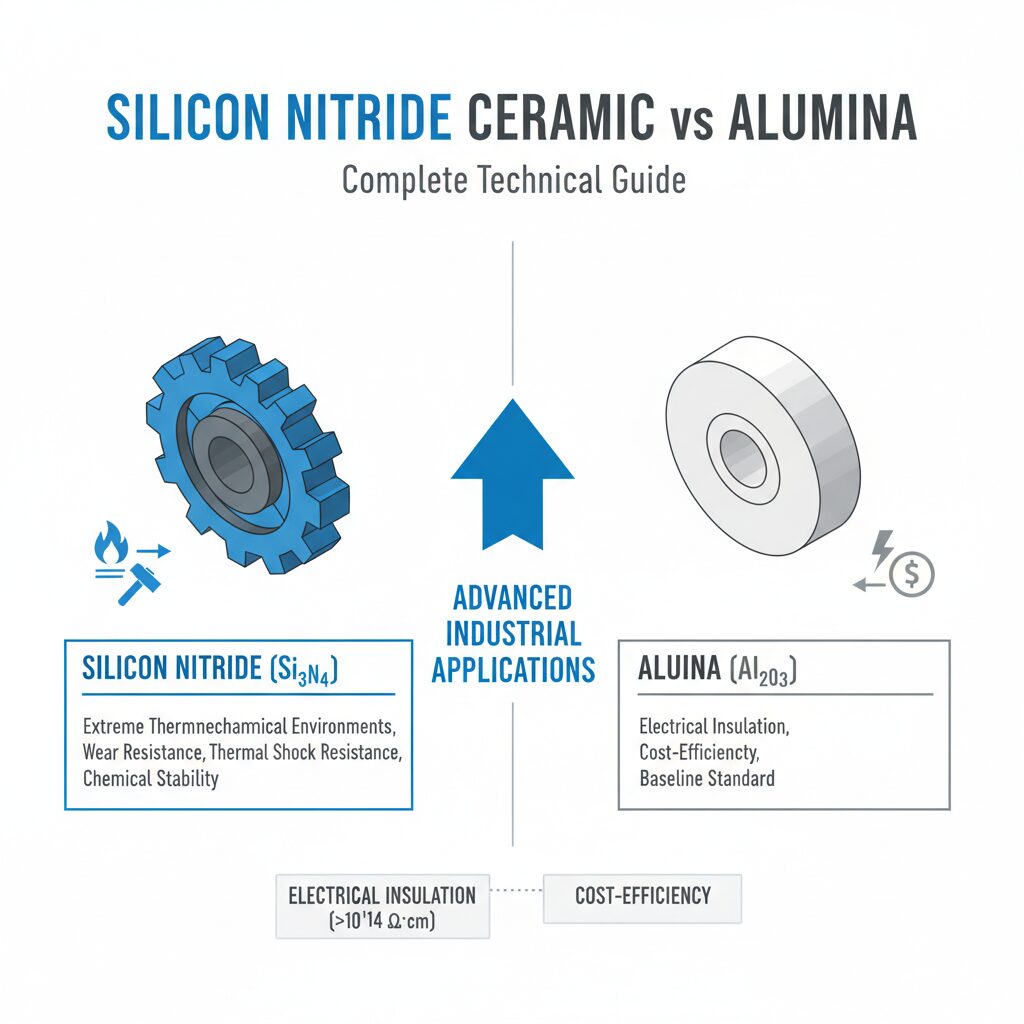
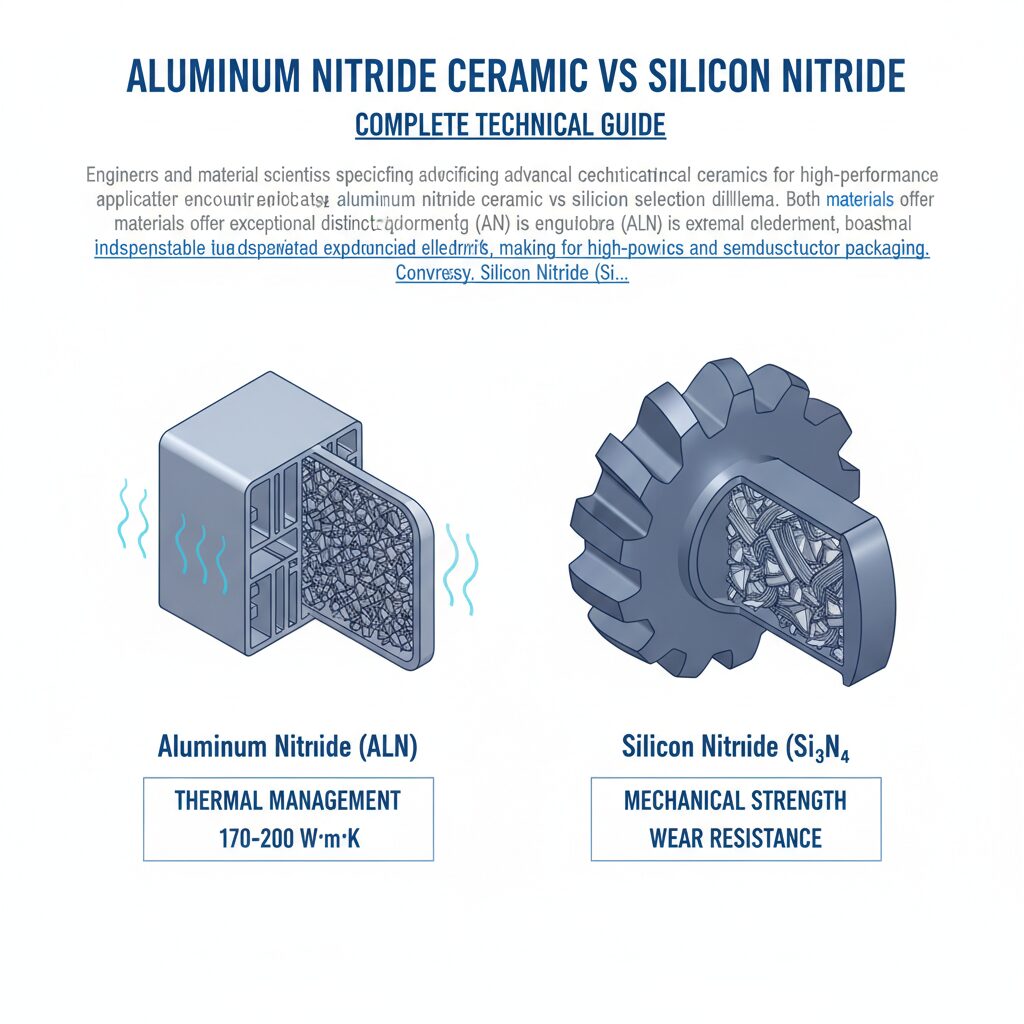
Selecting the optimal technical ceramic requires a data-driven evaluation of thermal and mechanical trade-offs. When evaluating 알루미나 against other advanced ceramics, automotive engineers must balance fracture toughness, thermal shock resistance. And volume production costs. Alumina provides an exceptional baseline of high hardness (1600 HV) and moderate thermal conductivity (30 W/m·K), making it highly cost-effective for 80% of automotive electrical insulation and wear applications. In contrast, 지르코니아 offers phase-transformation toughening, yielding a fracture toughness of 8.0 MPa·m½. This is ideal for high-impact structural components, but it fails in rapid heat-dissipation applications due to its extremely low thermal conductivity (2.5 W/m·K). For extreme thermal shock environments, such as turbocharger rotors, 실리콘 질화물 excels with superior strength (800 MPa) and thermal stability, though at a significantly higher raw material and machining cost. For ultra-high power EV inverters, 질화 알루미늄 is sometimes specified over alumina due to its massive 170 W/m·K thermal conductivity, despite its higher baseline cost.
| 속성 | Alumina Ceramic for Automotive Industry | Standard Alumina (95%) | 지르코니아(Y-TZP) | 질화규소(Si₃N₄) |
|---|---|---|---|---|
| 열 전도성 | 30W/m-K | 20 W/m-K | 2.5W/m-K | 30W/m-K |
| 경도 | 1600 HV | 1400 HV | 1200 HV | 1600 HV |
| 골절 인성 | 4.5 MPa-m½ | 3.5 MPa-m½ | 8.0 MPa-m½ | 6.5 MPa-m½ |
| 비용 | 보통 | 낮음 | 높음 | 매우 높음 |
애플리케이션
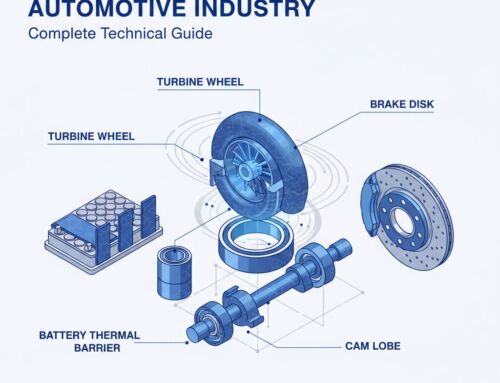
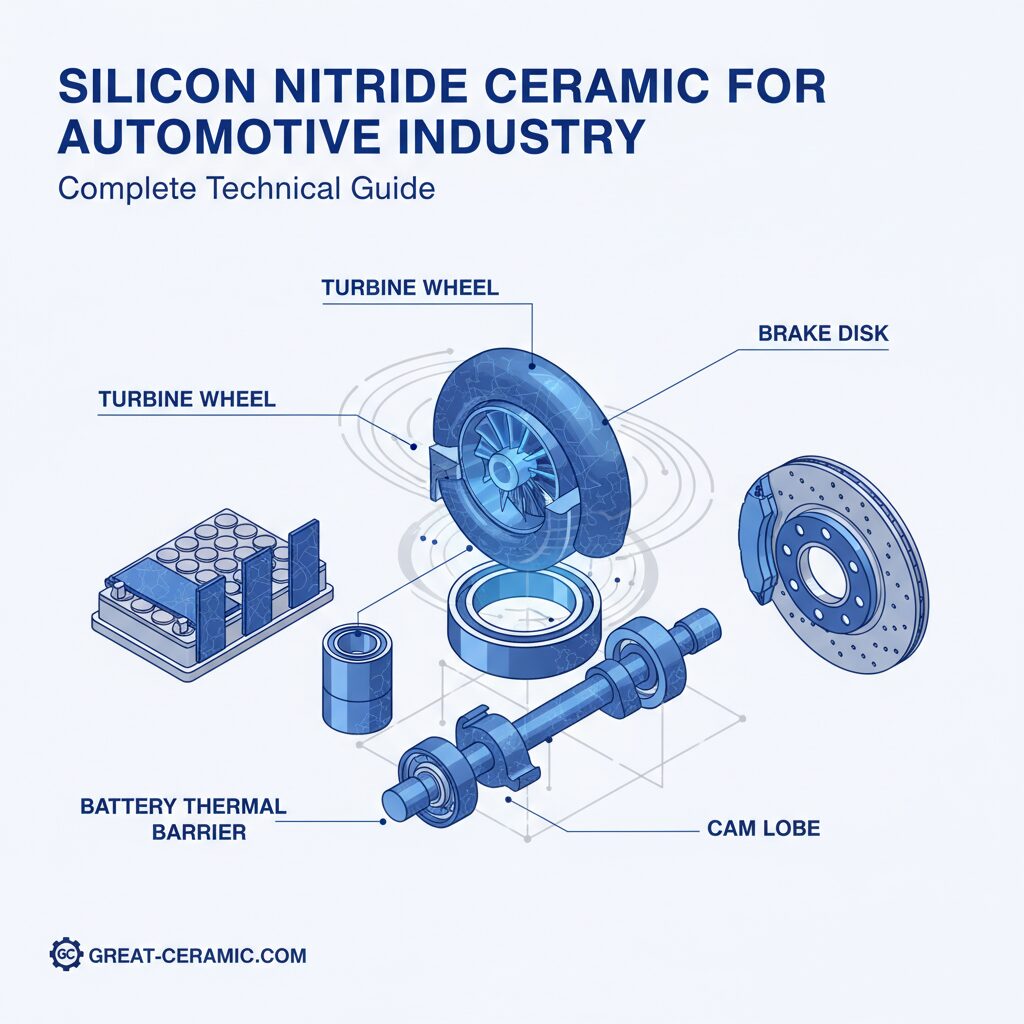
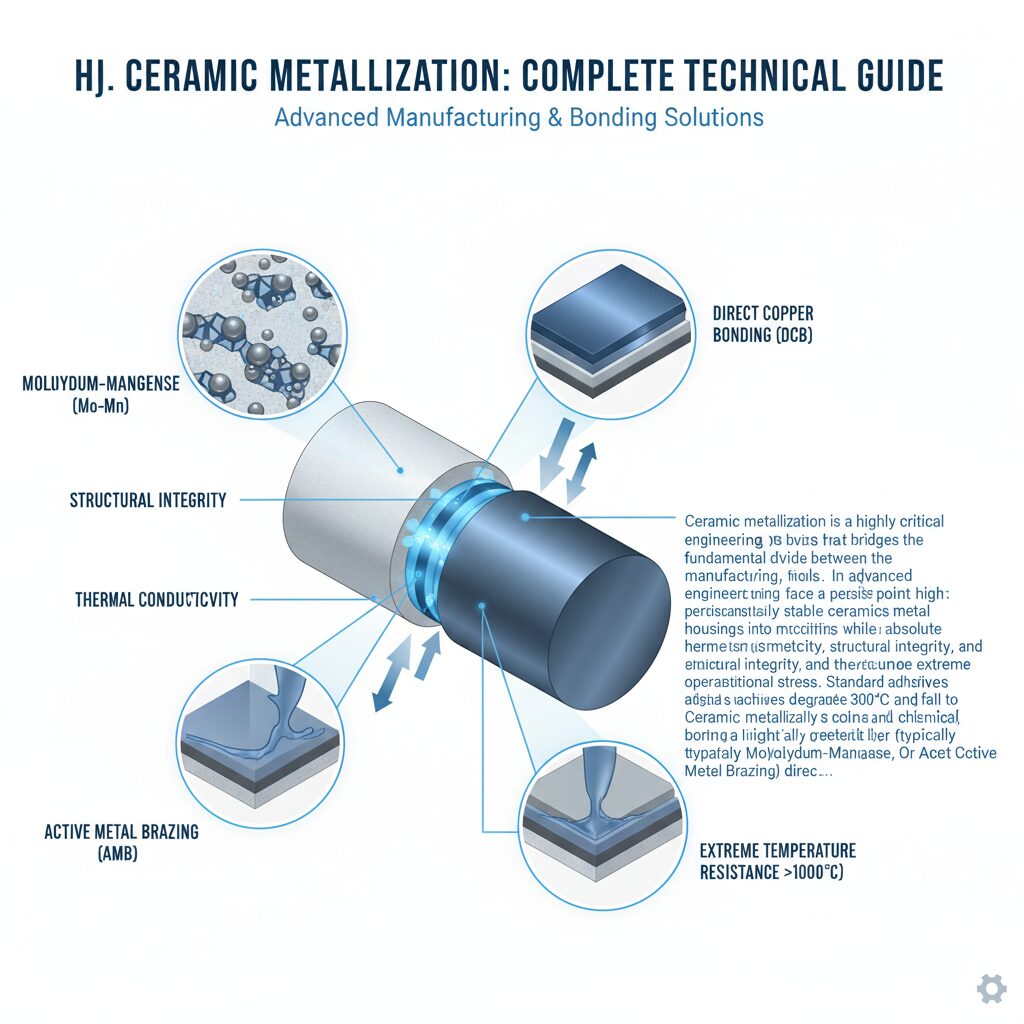
- EV Power Electronics Substrates (IGBT and SiC Modules): New energy vehicles operating on 800V and 1200V platforms require electrical isolation combined with efficient heat dissipation. High-purity alumina is selected for Direct Copper Bonded (DCB) substrates because its thermal conductivity (30 W/m·K) draws heat away from power chips, while its 15 kV/mm dielectric strength prevents catastrophic short circuits during peak acceleration loads.
- Internal Combustion Engine Spark Plug Insulators: Operating in one of the most violent automotive environments, spark plug insulators must withstand cyclic cylinder pressures exceeding 100 bar, ignition voltages up to 30,000V. And rapid thermal cycling from ambient to 1,000°C. 95% alumina is uniquely specified here because of its unmatched combination of high-temperature electrical insulation and resistance to lead/sulfur chemical attack from combustion byproducts.
- Automotive Water Pump Mechanical Seal Rings: Cooling system mechanical seals operate in continuous friction environments, often encountering abrasive micro-particles within the glycol coolant loop. Alumina (99% purity) is selected for these seal faces due to its extreme 1600 HV hardness and low coefficient of friction (when polished to Ra 0.1μm), guaranteeing leak-free performance over a required 10,000-hour operational lifespan.
- Oxygen (Lambda) and NOx Sensors: Exhaust gas sensors require a solid-state electrolyte support structure and integrated heater element that functions reliably at continuous operating temperatures of 800°C to 1,000°C. Alumina is chosen as the protective housing and heater substrate due to its absolute chemical stability in corrosive exhaust gases and its ability to maintain high insulation resistance at elevated temperatures, preventing sensor signal distortion.
- ADAS Lidar and Optical Sensor Housings: Advanced Driver Assistance Systems rely on perfectly aligned laser and camera arrays. Alumina is selected for structural sensor chassis components because its low coefficient of thermal expansion (8.1 x 10⁻⁶ /°C) ensures that the optical elements remain dimensionally stable to within ±0.005mm regardless of whether the vehicle is operating in -40°C arctic conditions or 85°C desert climates.
제조 프로세스
Transforming raw aluminum oxide powder into a precision automotive component requires a rigorous, multi-stage manufacturing sequence. The process begins with controlling the primary particle size (typically 0.5 to 2.0 micrometers) and mixing the powder with specialized organic binders to create a homogenous slurry or feedstock. This green material is then formed into near-net shapes, subjected to high-temperature sintering to achieve full densification. And finally subjected to hard machining. Achieving strict OEM automotive tolerances requires precise control over the 15% to 22% volumetric shrinkage that occurs during the densification phase, making exact thermal profiling and post-sintering precision machining absolute necessities.
형성 방법
- Isostatic Pressing: Used for cylindrical automotive components like spark plugs and sensor housings. Dry alumina powder is placed in an elastomeric mold and subjected to uniform fluid pressure (up to 200 MPa) from all directions, ensuring uniform green density and minimizing internal stresses.
- 테이프 캐스팅: Critical for EV power electronics. Alumina slurry is cast into continuous thin sheets (0.25mm to 1.0mm thickness) over a moving belt. Once dried, these flexible green tapes are punched, stacked. And laminated to create high-voltage insulation substrates.
- 세라믹 사출 성형(CIM): Utilized for complex geometric parts like water pump impellers. Alumina powder is heavily loaded with thermoplastic binders, heated. And injected into steel dies under high pressure (100 MPa), allowing for complex undercuts and internal channels.
소결
The green formed components are subjected to a carefully controlled thermal cycle in high-temperature kilns. The initial phase involves binder burnout between 300°C and 600°C to remove all organic materials without causing gas entrapment or micro-cracking. The temperature is then ramped up to the primary sintering temperature of 1,600°C to 1,700°C for 12 to 24 hours. During this phase, solid-state diffusion occurs across grain boundaries, eliminating porosity and increasing the component density from approximately 2.2 g/cm³ to a fully dense 3.85 g/cm³. Precise atmospheric control and cooling rates are required to restrict grain growth to under 5 micrometers. This is critical for maximizing final fracture toughness.
최종 가공
Because fully sintered alumina reaches a hardness of 9 on the Mohs scale (1500+ HV), conventional carbide or high-speed steel tools cannot cut it. Final machining requires specialized resin-bonded and metal-bonded diamond tooling. Processes such as cylindrical grinding, flat lapping. And multi-axis CNC ultrasonic machining are utilized to remove the final 0.05mm to 0.1mm of material. To meet automotive sealing requirements, lapping and polishing stages utilize diamond suspensions (down to 1-micron grit) to achieve ultra-smooth surface finishes of Ra 0.05μm to 0.1μm, ensuring perfect flatness for components like mechanical seal rings.
장점 및 제한 사항
장점
- Superior Dielectric Strength: Capable of withstanding up to 15 kV/mm, providing critical electrical isolation for 800V EV traction inverters and 30kV ICE ignition systems.
- 탁월한 열 안정성: Maintains structural integrity and mechanical properties at continuous operating temperatures up to 1,650°C, far exceeding the melting points of standard automotive metals.
- 탁월한 내마모성: With a Vickers hardness of 1600 HV, alumina components outlast hardened bearing steels in tribological applications, significantly extending the MTBF (Mean Time Between Failures) of mechanical pumps.
- Cost-Effective Volume Production: Compared to advanced nitrides and carbides, raw alumina powder is abundant and relatively easy to process, offering the best performance-to-cost ratio for high-volume automotive tier-1 suppliers.
제한 사항
- 낮은 파괴 인성: With a K1c value of 3.5 – 4.5 MPa·m½, alumina is intrinsically brittle. It cannot withstand high-impact mechanical shocks or point-loading without fracturing, requiring careful design engineering (e.g., generous corner radii and avoiding sharp internal undercuts).
- Vulnerability to Severe Thermal Shock: While stable at high temperatures, alumina’s moderate coefficient of thermal expansion (8.1 x 10⁻⁶ /°C) combined with its lower thermal conductivity can result in catastrophic failure during rapid thermal gradients (ΔT > 250°C/min), unlike silicon nitride which survives aggressive quenching.
가공 고려 사항
Machining alumina ceramic for automotive industry applications presents significant tribological and mechanical challenges that differentiate it entirely from metalworking. Because the material is fully densified and brittle, material removal occurs through controlled micro-fracturing rather than plastic shear deformation. If the cutting forces exceed the ultimate tensile strength of the grain boundaries, severe edge chipping, sub-surface micro-cracking. And catastrophic component failure will occur. Consequently, manufacturers must utilize ultra-rigid CNC machine tools specifically engineered for advanced technical ceramics. Great Ceramic mitigates these challenges by employing acoustic emission monitoring to detect micro-fractures in real-time and using 5-axis ultrasonic-assisted grinding. By oscillating the diamond tool at frequencies of 20 kHz, cutting forces are reduced by up to 40%, preventing subsurface damage and enabling extreme precision.
| 가공 매개변수 | 권장 값 | Operational Constraint |
|---|---|---|
| Spindle Speed (Diamond Grinding) | 25 – 35 m/s | Prevents thermal burning of resin-bonded diamond matrix |
| Depth of Cut (Roughing) | 0.010 – 0.025 mm | Minimizes severe macro-chipping on leading edges |
| Depth of Cut (Finishing) | 0.002 – 0.005 mm | Ensures sub-surface micro-crack depth remains < 5μm |
| 다이아몬드 그릿 크기(마감) | D46 to D64 (Standard) | Required to achieve an Ra finish below 0.2μm |
| 냉각수 압력 | 50 – 80 bar | High-pressure synthetic coolant evacuates ceramic swarf immediately |
Thermal management at the cutting zone is another critical machining challenge. The friction generated by diamond abrasives against 1600 HV alumina can cause localized temperature spikes exceeding 800°C. This degrades the diamond tooling and induces thermal stress in the ceramic part. Great Ceramic utilizes high-pressure, specifically formulated synthetic coolants delivered precisely to the cutting interface to flush abrasive swarf and maintain thermal equilibrium. This rigorous control of machining parameters allows our engineering teams to consistently deliver automotive components with ±0.005mm dimensional tolerances, 0.002mm concentricity. And optical-grade flatness. If your automotive R&D program is struggling with holding tight tolerances on ceramic prototypes, contact Great Ceramic’s engineering team for an immediate technical review and RFQ.
FAQ
What is alumina ceramic for automotive industry?
Alumina ceramic for the automotive industry refers to specialized, high-purity grades of aluminum oxide (typically 95% to 99.8% Al₂O₃) engineered to withstand the extreme environments of modern vehicles. Unlike standard decorative or low-grade structural ceramics, automotive-grade alumina is processed with strict controls over grain size and density to guarantee highly predictable mechanical and electrical properties. It is extensively utilized because it solves critical engineering problems related to high-temperature thermal management (up to 1,650°C), abrasive fluid handling. And high-voltage electrical insulation (handling >10¹⁴ Ω·cm resistivity), serving as a foundational material for both traditional ICE components and modern EV power systems.
What are the main applications of alumina ceramic in vehicles?
In traditional ICE vehicles, alumina is heavily used in spark plug insulators, water pump mechanical seal rings, oxygen (lambda) sensor housings. And fuel injector components due to its resistance to combustion gases and continuous wear. In the rapidly expanding EV sector, high-purity alumina is the standard material for Direct Copper Bonded (DCB) substrates used in traction inverters, IGBT modules. And DC-DC converters. Additionally, it is used for high-voltage battery terminal insulators, relay housings. And structural chassis components for ADAS lidar arrays where dimensional stability under thermal fluctuation is critical for optical alignment.
How does alumina compare to other advanced ceramics in automotive use?
Alumina is the most widely adopted technical ceramic in the automotive industry because it offers an unbeatable cost-to-performance ratio. When compared to 지르코니아, alumina lacks the extreme fracture toughness (4.5 vs 8.0 MPa·m½) but offers far superior thermal conductivity (30 vs 2.5 W/m·K) and electrical insulation at high temperatures. When compared to 실리콘 질화물, alumina cannot survive the same severe thermal shock or high-speed impacts, but it is vastly cheaper to synthesize and machine. Therefore, alumina is specified for static, high-temperature, electrically insulating. And steady-state wear applications, while other more expensive ceramics are reserved for dynamic, high-impact environments.
What are the advantages of using alumina over high-performance plastics?
While advanced engineering plastics like PEEK or PTFE are common in vehicles, they exhibit severe limitations that alumina overcomes. Alumina operates comfortably at 1,000°C+, whereas even the best high-performance polymers melt or degrade rapidly above 300°C. Furthermore, alumina boasts a hardness of 1600 HV, making it completely immune to the abrasive wear that would quickly destroy plastic seals in fluid pumps. Electrically, alumina maintains its dielectric strength even at extreme temperatures, preventing the corona discharge or electrical tracking that can compromise plastic insulators in 800V EV architectures.
How is automotive alumina machined to tight tolerances?
Machining fully sintered automotive alumina requires highly specialized equipment due to its extreme hardness (Mohs 9). Conventional metal-cutting tools are completely ineffective. Instead, manufacturers must use custom-profiled, resin-bonded or metal-bonded diamond grinding wheels. The process involves CNC multi-axis grinding, ultrasonic-assisted machining. And flat lapping, with depths of cut strictly limited to 0.002mm – 0.010mm per pass to prevent micro-cracking. High-pressure synthetic coolants (up to 80 bar) are required to control cutting zone temperatures. Great Ceramic leverages these advanced diamond machining technologies alongside real-time acoustic emission monitoring to reliably deliver complex automotive ceramic components with ultra-precise tolerances of ±0.005mm and mirror-like surface finishes of Ra 0.05μm.
Need custom alumina ceramic for automotive industry parts? 그레이트 세라믹에 문의 공차가 엄격한 정밀 가공 서비스 또는 이메일 [email protected].
alumina ceramic for automotive industry is widely used in advanced ceramic applications.
자세히 알아보기 자동차 산업을 위한 알루미나 세라믹 정밀 세라믹 가공 서비스를 제공합니다.
alumina ceramic for automotive industry is widely used in advanced ceramic applications.
자세히 알아보기 자동차 산업을 위한 알루미나 세라믹 정밀 세라믹 가공 서비스를 제공합니다.