








“`html
High-Performance ZTA Ceramic Rod for Vacuum Applications: A Comprehensive Technical Guide
In the demanding world of ultra-high vacuum (UHV) environments and precision engineering, the choice of material can mean the difference between system integrity and catastrophic failure. ZTA ceramic rod for vacuum applications has emerged as the gold standard for engineers requiring a material that bridges the gap between the hardness of alumine and the toughness of zirconia. At Great Ceramic, we specialize in the precision CNC machining of Zircone Toughened Alumina (ZTA), providing components that withstand extreme mechanical stress while maintaining hermetic seals in vacuum chambers.
This technical guide explores the material science behind ZTA, its unique advantages in vacuum technology, the intricacies of its machining process. And how it serves critical industries like semiconductor manufacturing, aerospace. And high-energy physics.
What is ZTA Ceramic? The Science of Transformation Toughening
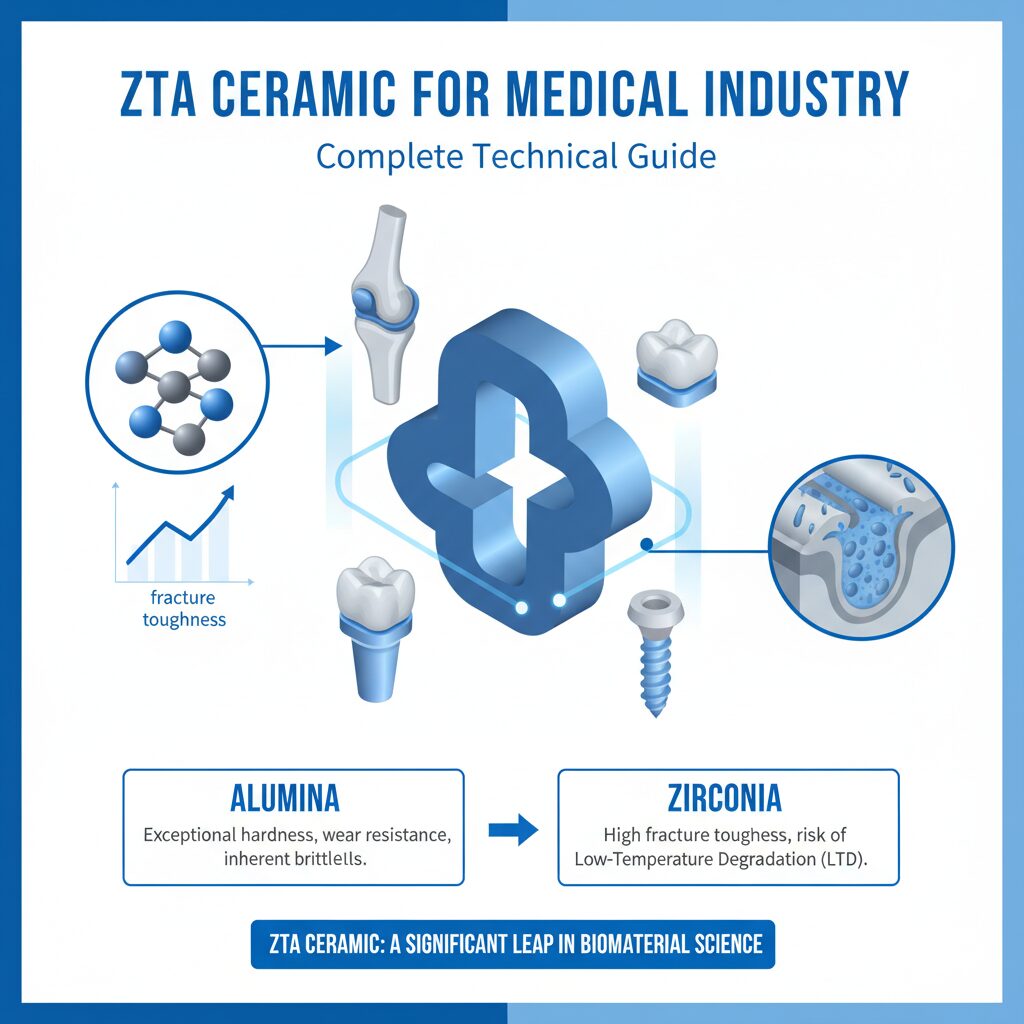
Zirconia Toughened Alumina (ZTA) is a composite ceramic material typically consisting of a matrix of Alumina (Al2O3) with a secondary phase of Zirconia (ZrO2) dispersed throughout. The Zirconia content usually ranges from 10% to 20% by weight. The primary reason for this combination is a phenomenon known as “transformation toughening.”
In standard alumina, cracks propagate easily through the brittle structure. However, in a ZTA ceramic rod, the zirconia particles are trapped in a metastable tetragonal phase during sintering. When a crack begins to form and approaches a zirconia particle, the stress field at the crack tip triggers the zirconia to transform from the tetragonal phase to the monoclinic phase. This transformation causes a volume expansion of approximately 3-5%. This creates compressive stresses that “squeeze” the crack shut, effectively arresting its growth. This makes ZTA significantly more durable and impact-resistant than pure alumina.
Why Choose ZTA Ceramic Rod for Vacuum Environments?
Vacuum systems, particularly those operating in the 10^-7 to 10^-11 mbar range, require materials with specific outgassing and structural properties. ZTA ceramic rods are preferred for several reasons:
1. Low Outgassing Rates
In a vacuum, materials can release trapped gases (outgassing). This contaminates the environment and prevents the system from reaching the desired pressure. ZTA has an incredibly dense, non-porous structure. When properly polished, its outgassing rate is negligible, making it ideal for UHV chambers used in molecular beam epitaxy (MBE) or mass spectrometry.
2. High Hermeticity
For vacuum feedthroughs and insulators, the material must be gas-tight. ZTA ceramic rods can be machined to extremely tight tolerances and brazed to metal components (like Kovar or Stainless Steel) to create hermetic seals that maintain vacuum integrity even under thermal cycling.
3. Dielectric Strength and Insulation
Vacuum environments often involve high-voltage components (such as ion sources or electron guns). ZTA provides excellent electrical insulation, maintaining its dielectric strength even at elevated temperatures where other materials might fail.
4. Thermal Stability
ZTA maintains its mechanical properties at high temperatures (up to 1500°C). This is critical for vacuum furnaces and aerospace propulsion components that experience intense heat during operation.
Technical Property Tables: ZTA vs. Traditional Ceramics
Understanding the quantitative advantages of ZTA is essential for material selection. The following table compares a standard ZTA grade used by Great Ceramic with high-purity Alumina and Yttria-Stabilized Zirconia (YSZ).
| Propriété | ZTA (20% ZrO2) | Alumina (99.7% Al2O3) | YSZ (Zirconia) |
|---|---|---|---|
| Densité (g/cm³) | 4.10 – 4.35 | 3.90 – 3.95 | 6.00 – 6.05 |
| Dureté (HV) | 1600 – 1800 | 1500 – 1700 | 1200 – 1300 |
| Résistance à la flexion (MPa) | 600 – 800 | 300 - 400 | 900 – 1100 |
| Résistance à la rupture (MPa-m½) | 5.0 - 8.0 | 3.0 – 4.0 | 8.0 – 12.0 |
| Conductivité thermique (W/m-K) | 20 – 25 | 28 – 32 | 2.0 – 3.0 |
| Rigidité diélectrique (kV/mm) | 15 - 18 | 15 - 20 | 10 – 12 |
| Max Use Temp (°C) | 1500 | 1700 | 1200 |
As shown, the ZTA ceramic rod for vacuum offers a “best of both worlds” profile, providing nearly double the fracture toughness of alumina while retaining high hardness and better thermal conductivity than pure zirconia.
CNC Machining Specifics for ZTA Ceramic Rods
ZTA is one of the most challenging ceramic materials to machine due to its high hardness and inherent toughness (the very properties that make it useful). At Great Ceramic, we utilize advanced CNC machining techniques to ensure that ZTA ceramic rods meet the exacting standards of vacuum technology.
Diamond Grinding
Since ZTA cannot be cut with traditional steel or carbide tools, we use resin-bonded or metal-bonded diamond grinding wheels. The process requires high precision to avoid “edge chipping,” a common issue with composite ceramics. We manage spindle speeds and feed rates meticulously to maintain the material’s structural integrity.
High-Precision Tolerances
For vacuum applications, particularly when the rod serves as a piston or a sealing component, tolerances are critical. We can achieve:
- Outer Diameter (OD) tolerance: ±0.001 mm
- Straightness: 0.01 mm over 100 mm length
- Roundness/Concentricity: 0.005 mm
Surface Finish (Ra) and Vacuum Performance
The surface finish of a ZTA ceramic rod for vacuum directly impacts its outgassing rate and its ability to form a seal. A rough surface provides more “real” surface area for molecules to cling to. Great Ceramic offers precision lapping and polishing services to achieve surface finishes as low as Ra 0.1 μm, ensuring a mirror-like finish that is optimal for vacuum compatibility.
Ultrasonic Machining and Laser Drilling
For rods that require internal features, such as through-holes for wiring or cooling channels, we utilize ultrasonic machining. This reduces the mechanical stress on the ZTA matrix, preventing micro-cracks that could compromise the vacuum seal under pressure differentials.
Industry Applications of ZTA Ceramic Rods
The unique mechanical and thermal properties of ZTA make it indispensable across several high-tech sectors.
1. Semiconductor Manufacturing
In plasma etching and ion implantation, components are exposed to corrosive gases and high-energy ions. ZTA rods are used as wafer handling pins, insulators in plasma chambers. And gas distribution nozzles. Its resistance to plasma erosion ensures a longer lifespan compared to standard alumina, reducing downtime in cleanroom environments.
2. High-Energy Physics and Research
Particle accelerators and synchrotrons operate under ultra-high vacuum. ZTA ceramic rods are used as high-voltage insulators and beam position monitor supports. Their ability to withstand radiation without significant degradation of mechanical properties is a key advantage.
3. Aerospace and Defense
In satellite propulsion systems, such as Hall-effect thrusters, insulators must withstand high temperatures and rapid thermal cycling. ZTA’s thermal shock resistance and mechanical strength make it an ideal choice for internal structural rods and spacers in vacuum-exposed thruster components.
4. Medical Technology
While often used in implants, ZTA is also used in medical imaging equipment (like X-ray tubes) that requires vacuum-sealed ceramic-to-metal assemblies. Its biocompatibility and strength also allow it to be used in surgical tools that must undergo repeated sterilization without losing dimensional stability.
Considérations de conception pour les ingénieurs
When designing a system that incorporates a ZTA ceramic rod for vacuum, engineers should keep the following factors in mind:
Thermal Expansion Matching
If the ZTA rod is to be joined to a metal flange, the Coefficient of Thermal Expansion (CTE) must be considered. ZTA has a CTE of approximately 7.8 – 8.2 x 10^-6/°C. It pairs well with titanium or specialized nickel-cobalt alloys (Kovar). Failure to match CTE can lead to stress fractures at the interface during bake-out cycles in vacuum systems.
Avoid Sharp Internal Corners
Ceramics are sensitive to stress concentrators. When designing custom ZTA components, engineers should specify radii at all internal corners to distribute mechanical loads and prevent cracking during both the machining process and final application.
The “Bake-out” Process
Vacuum systems are often “baked” at 200°C – 300°C to accelerate outgassing. ZTA is perfectly suited for this, but the assembly must be designed to ensure that the ceramic-to-metal bonds can handle the differential expansion during this heating phase.
Great Ceramic: Your Partner in Technical Ceramic Solutions
Great Ceramic is a leading provider of custom usinage de la céramique. We understand that every vacuum application has unique requirements, from specific dielectric needs to extreme dimensional accuracy. Our facility is equipped with state-of-the-art CNC grinding centers and inspection tools to ensure every ZTA rod meets your exact specifications.
We work closely with our clients from the prototyping stage through to full-scale production, offering material selection advice and design-for-manufacturability (DFM) feedback to reduce costs and improve performance.
Foire aux questions (FAQ)
Q1: Is ZTA better than Alumina for all vacuum applications?
Not necessarily. While ZTA has higher toughness and strength, pure Alumina (99.7%+) has slightly better thermal conductivity and a higher maximum operating temperature. If your application involves extreme heat but low mechanical impact, alumina might be sufficient. However, if there is a risk of mechanical shock or if you need thinner, stronger components, ZTA is the superior choice.
Q2: Can ZTA ceramic rods be brazed?
Yes. ZTA can be metallized (typically with a Moly-Manganese coating) and then brazed to metal components. This is a common practice for creating high-vacuum feedthroughs and hermetic seals.
Q3: What is the maximum length of ZTA ceramic rods Great Ceramic can produce?
We can machine ZTA rods in various lengths depending on the diameter. Generally, we can provide rods up to 500mm in length, but we recommend discussing specific aspect ratios with our engineering team to ensure the straightness and structural integrity of the part.
Q4: How does ZTA handle cryogenic temperatures in vacuum?
ZTA performs excellently at cryogenic temperatures. Unlike many polymers or metals that become brittle, ZTA maintains its structural integrity and electrical insulation properties even at liquid nitrogen or liquid helium temperatures. This is critical for superconducting magnets and cryo-vacuum systems.
Q5: What is the typical lead time for custom ZTA machining?
Lead times vary based on the complexity of the geometry and our current production schedule. Typically, custom CNC machined ZTA components are delivered within 3 to 6 weeks. We also offer expedited services for urgent R&D projects.
Conclusion
Le ZTA ceramic rod for vacuum is a high-performance solution for the most challenging engineering environments. By combining the best attributes of alumina and zirconia, it provides the fracture toughness, dielectric strength. And vacuum stability required for next-generation technology. Whether you are developing a new semiconductor process, an aerospace sensor, or a high-energy physics experiment, ZTA offers the reliability that standard ceramics simply cannot match.
At Great Ceramic, we combine decades of expertise with cutting-edge machining technology to deliver the world’s finest ceramic components. We invite you to leverage our technical knowledge for your next project.
Contact Great Ceramic for custom ceramic machining solutions tailored to your application.
“`
zta ceramic rod for vacuum is widely used in advanced ceramic applications.
En savoir plus sur Zta Ceramic Rod For Vacuum et nos services d'usinage céramique de précision.