








La céramique ZTA pour l'industrie médicale : guide technique complet
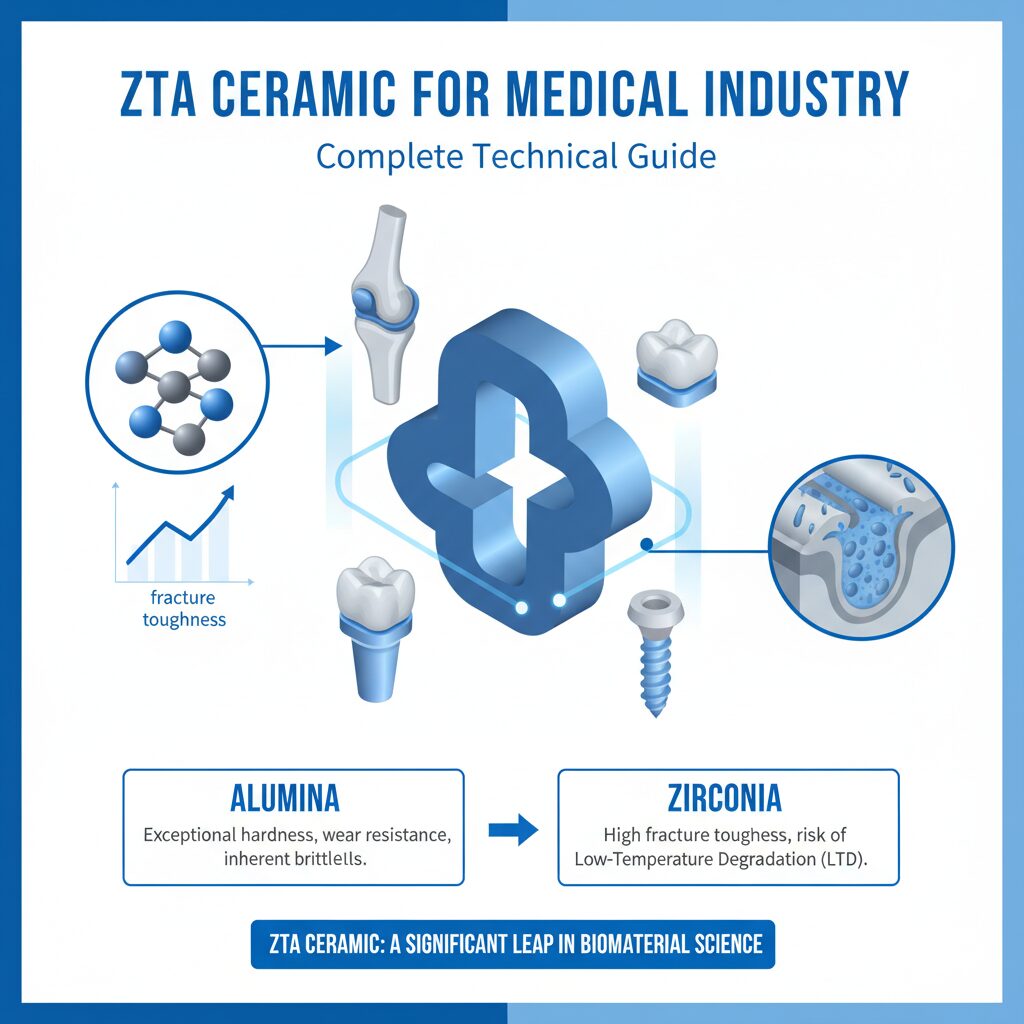
L'intégration de céramiques techniques de pointe dans le domaine de l'ingénierie biomédicale a permis de résoudre de manière définitive les défaillances critiques associées aux implants métalliques et polymères. Parmi ces matériaux, l'utilisation de Céramique ZTA pour l'industrie médicale Ces applications constituent une avancée majeure dans le domaine de la science des biomatériaux. Par le passé, les ingénieurs médicaux étaient confrontés à une dichotomie rigide : utiliser alumine/”>alumine pour leur dureté et leur résistance à l'usure exceptionnelles, mais qui présentent une fragilité inhérente, ou préciser zircone en raison de sa grande ténacité à la rupture, tout en présentant un risque de dégradation à basse température (LTD) et de vieillissement hydrothermique au sein du corps humain. L’alumine renforcée à la zircone (ZTA) comble cette lacune. En dispersant des particules de zircone tétragonale de type 15% à 25% au sein d’une matrice d’alumine, les ingénieurs obtiennent un matériau composite qui stoppe la propagation des fissures grâce à une transformation de phase induite par les contraintes, offrant une ténacité à la rupture pouvant atteindre 6,0 MPa·m½ et une dureté supérieure à 1 600 HV. Ce guide fournit une analyse technique complète des propriétés du ZTA, des processus de fabrication et des paramètres d’usinage précis requis pour les dispositifs médicaux critiques. Si votre équipe de R&D a besoin d’un prototypage immédiat ou d’une production en grande série, contacter Great Ceramic pour tirer parti de nos capacités en matière de tolérance de ±0,005 mm.
Propriétés des matériaux
La synergie microstructurale du ZTA confère des propriétés mécaniques supérieures à celles des céramiques monolithiques. Le principal mécanisme de renforcement repose sur la transformation de phase des particules de zircone tétragonale métastables en phase monoclinique lorsqu’elles sont soumises au champ de contraintes généré par la progression d’une fissure. Cette transformation s’accompagne d’une expansion volumique localisée d’environ 3% à 5%. Cela génère des contraintes de compression dans la matrice d’alumine environnante, ce qui bloque efficacement la fissure. Le tableau suivant présente les caractéristiques physiques, mécaniques et thermiques normalisées du ZTA de qualité médicale (généralement 80% Al₂O₃ / 20% ZrO₂ en poids) synthétisé avec une taille moyenne de grains inférieure à 1,5 μm.
| Propriété | Valeur | Unité |
|---|---|---|
| Densité | 4 h 10 – 4 h 30 | g/cm³ |
| Dureté | 1600 – 1800 | HV |
| Résistance à la flexion | 600 – 800 | MPa |
| Résistance à la rupture | 4,5 – 6,0 | MPa-m½ |
| Conductivité thermique | 20 – 24 | W/m-K |
| Résistivité électrique | > 10¹⁴ | Ω-cm |
| Température maximale de fonctionnement | 1500 | °C |
Le ZTA de qualité médicale doit respecter rigoureusement les normes ISO 13356 et ISO 6474-2. Cela impose des contrôles stricts sur les niveaux d’impuretés (SiO₂, Na₂O et Fe₂O₃ doivent, au total, rester inférieurs à 0,5 % en poids) afin d’éviter toute cytotoxicité in vivo. De plus, ce matériau présente une porosité ouverte nulle (0,00%), garantissant une imperméabilité absolue aux fluides biologiques. Cette caractéristique est essentielle pour prévenir la colonisation bactérienne et la formation subséquente de biofilms sur les dispositifs implantables.
Comparaison avec d'autres céramiques
Le choix de la céramique la mieux adaptée aux applications biomédicales nécessite d’évaluer les compromis en termes de performances entre la dureté, la ténacité et la biocompatibilité. Si le ZTA représente un compromis optimal, il est essentiel de replacer ses performances dans leur contexte par rapport à d’autres céramiques techniques fréquemment utilisées dans la fabrication médicale, telles que l’alumine pure, le polycristal de zircone tétragonale stabilisée à l’yttrium (Y-TZP) et les matériaux haute performance nitrure de silicium. Pour les applications soumises à une usure extrême mais à des chocs modérés, l'alumine pure peut suffire. En revanche, pour les articulations soumises à des charges, le ZTA présente un taux de défaillance nettement inférieur. Une autre céramique industrielle, carbure de silicium, offre une dureté supérieure mais ne dispose pas des autorisations de la FDA ni des profils de biocompatibilité requis pour une implantation permanente, ce qui limite son utilisation principalement aux outils externes.
| Propriété | Céramique ZTA pour l'industrie médicale | Alumine | Zircone | Nitrure de silicium |
|---|---|---|---|---|
| Conductivité thermique (W/m-K) | 22.0 | 30.0 | 2.5 | 25,0 – 30,0 |
| Dureté (HV) | 1700 | 1800 | 1200 | 1500 |
| Résistance à la rupture (MPa-m½) | 5.5 | 3.5 | 8.0 - 10.0 | 6.0 - 7.0 |
| Coût | Modérée-élevée | Faible à modéré | Haut | Très élevé |
Comme démontré, le ZTA offre une résistance à la rupture supérieure de 57% à celle de l'alumine monolithique, ce qui réduit considérablement le risque de rupture fragile catastrophique sous des charges physiologiques dynamiques. Bien que la zircone monolithique présente une ténacité à la rupture supérieure, sa sensibilité à la dégradation à basse température (lorsque des molécules d’eau pénètrent dans le réseau cristallin à la température corporelle de 37 °C et induisent une transformation spontanée) compromet sa viabilité à long terme. Le ZTA limite la teneur en zircone à environ 20%, garantissant ainsi que la matrice d’alumine contraint entièrement les particules de zircone, ce qui élimine pratiquement tout vieillissement hydrothermique tout en conservant une résistance mécanique élevée.
Applications
Les propriétés tribologiques et mécaniques uniques du ZTA ont conduit à son adoption dans divers environnements médicaux soumis à des contraintes élevées. Dans les applications physiologiques, les matériaux sont soumis à des millions de cycles de charge par an dans des environnements corrosifs et riches en sels. Le ZTA fait systématiquement preuve de taux d’usure négligeables, d’une absence totale de corrosion et d’une inertie biochimique absolue.
- Composants articulaires pour prothèse totale de hanche (PTH) : Le ZTA est largement utilisé pour la fabrication de têtes fémorales et d’inserts de cupule acétabulaire. Dans ce cas précis, la hanche humaine subit des charges dynamiques pouvant atteindre 8 fois le poids corporel (jusqu’à 7 000 N). L'alumine monolithique peut se fracturer sous ces chocs soudains, mais la résistance à la flexion de plus de 600 MPa du ZTA et son durcissement par transformation permettent d'absorber facilement ces forces. De plus, dans une articulation ZTA-sur-ZTA, le taux d’usure linéaire est exceptionnellement faible — généralement inférieur à 0,01 mm par million de cycles —, ce qui empêche la formation de débris d’usure responsables de l’ostéolyse (résorption osseuse) et du descellement aseptique. Ce phénomène se produit fréquemment avec les implants métal-sur-polyéthylène.
- Implants dentaires et piliers esthétiques : Utilisé pour les remplacements radiculaires et les piliers d’interface supportant les couronnes. Le cas de figure spécifique implique des forces de mastication (morsure) intenses et répétitives comprises entre 200 N et 800 N, associées à une exigence esthétique de coloration naturelle des dents. Les ingénieurs choisissent le ZTA car il offre la résistance à la fatigue nécessaire pour résister à des décennies de cycles de mastication sans microfractures. De plus, contrairement aux implants en titane, le ZTA est de couleur ivoire/blanc, ce qui évite l’apparition d’une ombre grise inesthétique à travers les gencives du patient, tout en présentant d’excellentes propriétés d’ostéointégration avec le tissu osseux de la mâchoire humaine.
- Scalpels chirurgicaux ophtalmiques et neurologiques : Utilisé dans les instruments chirurgicaux de coupe de haute précision. Lors d’interventions délicates telles que les incisions cornéennes ou les résections nerveuses, les chirurgiens ont besoin de lames dont le rayon de l’arête de coupe est inférieur à 1 μm. Le ZTA est privilégié car sa microstructure à grains fins (grains < 1 μm) permet un polissage au diamant pour obtenir un tranchant au niveau atomique sans effritement de l’arête. Contrairement à l’acier inoxydable, le ZTA ne génère aucun débris métallique et ne provoque aucune réaction galvanique avec les tissus. De plus, il est totalement non magnétique, ce qui rend ces scalpels sûrs à utiliser dans des champs IRM (imagerie par résonance magnétique) actifs lors d’interventions chirurgicales guidées par IRM.
- Instruments chirurgicaux endoscopiques et mini-invasifs : Utilisé pour l'isolation des composants, des ciseaux et des pinces en électrochirurgie (diathermie). Lors d’interventions laparoscopiques impliquant une cautérisation, les instruments chirurgicaux transmettent des courants électriques à haute fréquence pouvant atteindre 300 W. Le ZTA est choisi car sa résistivité électrique exceptionnelle (> 10¹⁴ Ω·cm) et sa rigidité diélectrique garantissent une isolation totale, empêchant ainsi toute brûlure accidentelle des tissus. De plus, les instruments en ZTA résistent à des stérilisations répétées à la vapeur à haute température (autoclavage à 134 °C et 2,1 bars pendant plus de 500 cycles) sans subir la dégradation hydrothermique qui affecte les composants en zircone pure.
- Roulements pour pompes sanguines cardiovasculaires : Utilisés dans les dispositifs d'assistance ventriculaire (DAV) et les cœurs artificiels en tant que paliers rotatifs à flux continu. Ces pompes fonctionnent en continu à des vitesses comprises entre 8 000 et 12 000 tr/min, directement dans la circulation sanguine humaine. Le ZTA est rigoureusement sélectionné car il peut être usiné et poli pour obtenir un état de surface Ra < 0,02 μm. Cette surface ultra-lisse et biochimiquement inerte empêche le cisaillement des globules rouges (hémolyse) et offre un environnement très défavorable à l’adhérence des plaquettes, éliminant ainsi complètement le risque de thrombose induite par le dispositif (caillots sanguins).
Processus de fabrication
La fabrication de composants ZTA de qualité médicale exige une maîtrise absolue de la métallurgie des poudres et des diagrammes de phases thermodynamiques, ainsi qu’un post-traitement de haute précision. Un écart de seulement 10 °C pendant le processus de cuisson peut provoquer une transformation de phase prématurée, entraînant l’apparition de microfissures internes et le rejet du lot. Le processus commence par le mélange homogène de poudres d’α-alumine de haute pureté avec des poudres de zircone stabilisées à l’yttrium ou au cérium, à l’aide de techniques de broyage humide à billes, afin d’obtenir une distribution granulométrique homogène inférieure à 0,5 μm.
Méthodes de formage
- Pressage isostatique à froid (CIP) : Pour la production en petites et moyennes séries de pièces symétriques (telles que les têtes fémorales), la poudre ZTA est mélangée à un liant organique, puis placée dans un moule élastomère souple. Elle est ensuite immergée dans une chambre remplie de fluide. Des pressions hydrostatiques comprises entre 200 MPa et 300 MPa sont appliquées uniformément dans toutes les directions. On obtient ainsi un compact “ vert ” présentant une densité très homogène (généralement comprise entre 55 et 60 % de la densité théorique), ce qui élimine les gradients de densité responsables du gauchissement lors du frittage.
- Moulage par injection de céramique (CIM) : Pour les pièces à grand volume et aux géométries complexes (telles que les piliers dentaires ou les manches d'instruments chirurgicaux complexes), la poudre ZTA est mélangée à des liants thermoplastiques afin de créer une matière première. Cette matière première est injectée dans des moules en acier trempé à des pressions pouvant atteindre 150 MPa et à des températures de 160 °C. Les ingénieurs doivent intégrer avec précision un facteur de retrait linéaire compris entre 15% et 22% dans la conception du moule, car le liant sera extrait thermiquement avant la densification finale.
Frittage
La densification du ZTA constitue sans doute l'étape thermodynamique la plus critique. Les pièces crues sont soumises à un profil thermique précis dans des fours à haute température, atteignant généralement des températures maximales comprises entre 1 500 °C et 1 600 °C. La vitesse de chauffage doit être contrôlée avec minutie (souvent de 1 °C à 2 °C par minute) afin de permettre la combustion complète du liant organique sans provoquer de fissuration due au dégazage. Au pic du frittage, la matrice d’alumine se densifie tandis que les particules de zircone sont maintenues dans leur phase tétragonale à haute température. Un refroidissement rapide et contrôlé est essentiel. Si le refroidissement est trop lent, la zircone peut se transformer spontanément en phase monoclinique, ce qui provoque une dilatation et la fracture de la matrice d’alumine nouvellement formée. Pour atteindre la densité théorique maximale (> 99,51 TP4T), on recourt fréquemment, après le frittage, au pressage isostatique à chaud (HIP), en utilisant de l’argon à 1 500 °C et 150 MPa afin de colmater les pores internes fermés restants.
Usinage final
En effet, le ZTA fritté atteint une dureté avoisinant les 1 800 HV (juste derrière des matériaux tels que le diamant ou le carbure de bore). Et carbure de silicium), les outils de coupe classiques deviennent inutilisables. L'usinage final nécessite un meulage au diamant intensif, un rodage et un polissage. Cette étape est extrêmement coûteuse en capital et chronophage, représentant jusqu'à 70% du coût total de la pièce. La cinématique d’usinage doit minimiser les dommages sous-superficiels, en utilisant des broches à grande vitesse (jusqu’à 40 000 tr/min) et des profondeurs de coupe de l’ordre du micromètre afin de respecter les tolérances strictes de ±0,005 mm exigées par l’industrie médicale.
Avantages et limites
Avantages
- Mécanisme de durcissement par transformation : Contrairement aux céramiques monolithiques qui subissent une rupture catastrophique dès l'apparition d'une fissure, le ZTA résiste activement à la rupture. L’expansion volumique localisée de type 4% des particules de zircone à la pointe de la fissure induit une contrainte de compression, ce qui augmente la ténacité à la rupture à 6,0 MPa·m½ et prolonge considérablement la durée de vie en fatigue cyclique des implants porteurs.
- Biocompatibilité absolue et inertie chimique : Le ZTA respecte scrupuleusement la norme ISO 10993 relative à l'évaluation biologique. Il ne libère aucun ion dans la circulation sanguine, ne provoque aucune réaction inflammatoire localisée et prévient la métallose (fréquemment observée avec les implants en titane ou en cobalt-chrome). Il est par ailleurs totalement insensible à la corrosion galvanique dans les milieux salins.
- Résistance au vieillissement hydrothermique : Les implants en zircone pure sont sujets à la dégradation à basse température (LTD) lorsqu'ils sont exposés aux fluides corporels pendant plusieurs décennies, ce qui entraîne une rugosité de surface et l'apparition de microfissures. Le ZTA atténue ce phénomène en enveloppant les particules de zircone dans une matrice rigide d’alumine, ce qui stoppe complètement le processus de vieillissement hydrothermique et garantit une durée de vie des implants supérieure à 20 ans.
- Propriétés tribologiques d'usure inégalées : Le ZTA présente un coefficient de frottement exceptionnellement faible lorsqu’il est poli jusqu’à obtenir un fini miroir (Ra < 0,02 μm). Dans les articulations (ZTA sur ZTA), les propriétés hydrophiles de la surface favorisent la lubrification par le film de liquide synovial, ce qui réduit les taux d’usure linéaires à moins de 0,01 mm³/an et élimine pratiquement les débris d’usure responsables de l’ostéolyse.
Limitations
- Coûts et complexité extrêmes de l'usinage : La dureté inhérente qui fait du ZTA un matériau idéal pour la résistance à l'usure rend son usinage après frittage extrêmement difficile. Les fabricants doivent recourir à des meules diamantées spécialisées à liant résineux ou métallique, ce qui entraîne un allongement des temps de cycle et une forte usure des outils. Cela fait grimper les coûts unitaires.
- Contraintes de conception géométrique : Malgré son mécanisme de renforcement, le ZTA reste un matériau fragile par rapport aux métaux de qualité médicale (tels que le Ti-6Al-4V). Les ingénieurs doivent concevoir des composants présentant des rayons internes généreux (minimum 0,5 mm), éviter les angles internes vifs et éliminer les contre-dépouilles susceptibles de concentrer les contraintes. Ils doivent également veiller à ce que l'épaisseur des parois soit uniforme afin d'empêcher les concentrations de contraintes.
Considérations relatives à l'usinage
La mise en œuvre de la céramique ZTA dans les applications du secteur médical repose entièrement sur la capacité à respecter des tolérances dimensionnelles précises et à obtenir des finitions de surface irréprochables. L’usinage de la ZTA est fondamentalement un processus de rupture fragile à l’échelle microscopique, plutôt qu’une déformation plastique (formation de copeaux) comme c’est le cas dans l’usinage des métaux. Le principal défi consiste à limiter les dommages sous-superficiels (microfissures sous la surface usinée). Ceux-ci peuvent réduire considérablement la résistance à la flexion d’un implant médical et constituer un point de départ pour une rupture par fatigue.
Pour remédier à cela, les ingénieurs doivent appliquer des mesures strictes usinage de précision de la céramique protocoles. La vitesse de rotation de la broche doit être comprise entre 20 000 et 60 000 tr/min afin de maintenir des vitesses de surface élevées, tandis que la profondeur de coupe (ap) doit rester extrêmement faible — souvent limitée à moins de 0,005 mm par passe lors des opérations de finition. Le dépassement de cette profondeur critique fait passer le mécanisme d’enlèvement de matière d’un meulage en régime ductile à une rupture fragile, détruisant ainsi l’intégrité de la surface.
De plus, la gestion thermique est primordiale. Le meulage du ZTA génère une chaleur localisée intense. Cela peut provoquer un choc thermique et des microfissures thermiques à la surface de la céramique. L’utilisation de systèmes de refroidissement par inondation à haute pression, fonctionnant à plus de 50 bars, est indispensable pour évacuer les copeaux de céramique et refroidir la zone de coupe. Le choix de l'outillage est tout aussi crucial. L'ébauche s'effectue à l'aide de meules diamantées à liant métallique (grain D126 à D64), tandis que la finition nécessite des meules diamantées à liant résine (grain D15 à D7) pour atteindre un Ra de 0,05 μm ou mieux.
Chez Great Ceramic, nous avons mis au point des centres de rectification CNC spécialisés, équipés de capteurs d’émission acoustique intégrés, afin de surveiller en temps réel le contact et l’usure des outils. Nos laboratoires de métrologie utilisent l’interférométrie laser et des machines à mesurer tridimensionnelles (MMT) offrant une résolution inférieure au micron afin de garantir que chaque composant médical ZTA respecte notre norme de tolérance stricte de ±0,005 mm. Si vous êtes confronté à des taux de rebut élevés ou si vous recherchez un partenaire fiable capable d’assurer un usinage ZTA à haut rendement, contactez notre équipe d'ingénieurs pour une consultation technique.
FAQ
Qu'est-ce que la céramique ZTA destinée au secteur médical ?
Le ZTA (alumine renforcée à la zircone) est une céramique technique composite de pointe obtenue par dispersion de particules de zircone tétragonale de type 15% à 25% au sein d'une matrice d'alpha-alumine. Dans le secteur médical, il est utilisé comme biomatériau haute performance destiné à remplacer l’alumine monolithique et la zircone monolithique. Il tire parti d’un mécanisme de transformation de phase induit par les contraintes pour offrir une combinaison unique de dureté exceptionnelle (environ 1 700 HV), de résistance élevée à la flexion (jusqu’à 800 MPa) et une ténacité à la rupture élevée (jusqu’à 6,0 MPa·m½). Cela permet d’éviter toute rupture fragile catastrophique tout en garantissant une biocompatibilité absolue, ce qui en fait le matériau de choix pour les implantations physiologiques à long terme.
Quelles sont les principales applications de la céramique ZTA ?
En raison de sa résistance exceptionnelle à l'usure et de son inertie biologique, le ZTA est principalement utilisé dans les implants médicaux de classe III et les dispositifs chirurgicaux de précision. Son application la plus critique se situe en orthopédie, notamment dans les têtes fémorales et les cupules acétabulaires destinées aux prothèses totales de hanche (PTH), où il empêche la formation de débris d'usure. Il est également largement utilisé dans les piliers d'implants dentaires en raison de son aspect esthétique naturel, semblable à celui des dents, et de sa résistance. Au-delà des implants, le ZTA est utilisé pour la fabrication de scalpels chirurgicaux ultra-tranchants, de composants isolants diélectriques pour l'électrochirurgie, ainsi que de composants de roulements ultra-lisses pour les pompes sanguines cardiovasculaires fonctionnant en continu.
En quoi le ZTA se distingue-t-il des autres céramiques ?
Le ZTA constitue le compromis technique optimal entre l’alumine pure et la zircone pure. Par rapport à l’alumine, le ZTA offre une augmentation d’environ 50% à 60% de la ténacité à la rupture et de la résistance à la flexion, ce qui le rend bien moins sensible à la rupture par choc. Par rapport à la zircone, le ZTA présente une dureté supérieure et, surtout, une immunité absolue à la dégradation à basse température (vieillissement hydrothermique) — un phénomène par lequel la température corporelle et l’humidité provoquent un affaiblissement progressif de la zircone monolithique. Par rapport aux céramiques structurelles avancées telles que nitrure d'aluminium (utilisé pour la gestion thermique) ou le nitrure de silicium, le ZTA offre une inertie biologique supérieure et bénéficie d'homologations ISO/FDA spécifiques pour l'implantation humaine permanente.
Quels sont les avantages de la céramique ZTA ?
Le principal avantage du ZTA réside dans son mécanisme de “ durcissement par transformation ”. Lorsqu’une microfissure commence à se former sous l’effet d’une contrainte physiologique, les particules de zircone situées à la pointe de la fissure se dilatent de 4% au cours de leur transformation de la phase tétragonale à la phase monoclinique. Cette dilatation referme la fissure, empêchant ainsi toute dégradation structurelle supplémentaire. De plus, le ZTA offre une biocompatibilité exceptionnelle (conformité à la norme ISO 10993) et ne libère aucun ion métallique dans l’organisme. Il présente des propriétés tribologiques exceptionnelles, ce qui signifie que les articulations ne subissent pratiquement aucun frottement ni aucune usure (taux d’usure < 0,01 mm³/an). Il possède également une grande stabilité hydrothermique, garantissant que l’implant conserve son intégrité mécanique pendant des décennies à l’intérieur du corps humain.
Comment la céramique ZTA est-elle usinée ?
L'usinage du ZTA est particulièrement difficile en raison de sa dureté de 1 700 HV et de sa nature fragile. Une fois la poudre formée (par CIP ou CIM) et frittée à 1 600 °C, ce matériau à haute densité ne peut être usiné qu’à l’aide d’abrasifs diamantés. Le processus repose sur la rectification CNC à grande vitesse, le rodage et le polissage. Afin d’éviter tout endommagement sous-jacent, l’usinage doit s’effectuer en “ régime ductile ”, en utilisant des profondeurs de coupe très faibles (inférieures à 0,005 mm) et un arrosage à haute pression. Great Ceramic est spécialisée précisément dans ce domaine. usinage de précision de la céramique processus, faisant appel à des centres de rectification diamantés multiaxes afin de respecter des tolérances dimensionnelles strictes de ±0,005 mm et d'obtenir les finitions de surface ultra-lisses (Ra < 0,05 μm) requises pour les implants médicaux critiques.
Vous avez besoin de pièces en céramique ZTA sur mesure pour le secteur médical ? Contacter Great Ceramic pour des services d'usinage de précision avec des tolérances serrées, ou envoyez un courriel à l'adresse suivante [email protected].
La céramique ZTA destinée à l'industrie médicale est largement utilisée dans les applications céramiques de pointe.
En savoir plus sur Zta Ceramic pour l'industrie médicale et nos services d'usinage céramique de précision.