








ZTA Ceramic Hardness: A Technical Guide to zircone-toughened-alumine/”>Alumine renforcée à la zircone Properties and Performance
In the realm of advanced engineering materials, Zirconia Toughened Alumina (ZTA) stands as a pinnacle of composite innovation. By bridging the gap between the extreme hardness of pure alumina and the superior fracture toughness of zirconia, ZTA offers a synergistic solution for high-stress industrial environments. Understanding ZTA ceramic hardness is not merely about looking at a number on a datasheet. it is about understanding how the microstructure, phase transformations. And manufacturing processes converge to create a material that resists wear, impact. And thermal degradation. At Great Ceramic, we specialize in the precision machining of these complex materials, ensuring that the inherent hardness of ZTA is harnessed for your specific industrial applications.
What is Zirconia Toughened Alumina (ZTA)?
Zirconia Toughened Alumina is a ceramic matrix composite (CMC) where zirconia particles are uniformly dispersed within an alumina matrix. Typically, the zirconia content ranges from 10% to 20% by weight. The primary goal of this composition is to leverage “transformation toughening,” a mechanical phenomenon that prevents crack propagation. While pure alumina is exceptionally hard, it is also brittle. By adding zirconia, engineers can maintain a high level of ZTA ceramic hardness while significantly increasing its ability to withstand mechanical shock.
The hardness of ZTA makes it an ideal candidate for components subjected to abrasive wear and high pressure. However, the specific hardness value can vary based on the grain size, the stabilizer used for the zirconia (such as Yttria or Magnesia). And the sintering density. In the following sections, we will explore the technical nuances of these properties and how they impact the material’s performance in the field.
Technical Property Comparison: ZTA vs. Alumina vs. Zirconia
To understand the unique position of ZTA, it is essential to compare its mechanical properties against its parent materials. The following table provides a detailed technical breakdown of these advanced ceramics.
| Propriété | Alumina (Al2O3 99.7%) | Zircone (Y-TZP) | ZTA (20% Zirconia) |
|---|---|---|---|
| Hardness (Vickers, Hv10) | 1500 – 1800 kg/mm² | 1200 – 1300 kg/mm² | 1600 – 1850 kg/mm² |
| Résistance à la rupture (K1c) | 3.5 – 4.5 MPa·m½ | 8.0 – 12.0 MPa·m½ | 6.0 – 8.5 MPa·m½ |
| Résistance à la flexion | 350 – 500 MPa | 900 – 1200 MPa | 600 – 800 MPa |
| Densité | 3.95 g/cm³ | 6.05 g/cm³ | 4.10 – 4.40 g/cm³ |
| Module d'élasticité | 370 – 400 GPa | 210 GPa | 320 – 350 GPa |
| Maximum Use Temp | 1700°C | 1000°C | 1500°C |
As the table illustrates, ZTA ceramic hardness is often comparable to or slightly higher than pure alumina, while its fracture toughness is nearly double. This balance is what makes ZTA the preferred choice for structural ceramic components.
The Physics of ZTA Ceramic Hardness
The Mechanism of Transformation Toughening
The “secret sauce” behind ZTA’s performance is transformation toughening. When a crack begins to form in the alumina matrix and approaches a zirconia particle, the stress field at the crack tip triggers a phase transformation in the zirconia. The zirconia changes from a tetragonal phase to a monoclinic phase. This transformation is accompanied by a volume expansion of approximately 3% to 5%.
This expansion creates localized compressive stress around the crack tip. Effectively, the expanding zirconia particles “squeeze” the crack shut, preventing it from spreading further through the material. This mechanism allows ZTA to maintain a high hardness profile without being as prone to the catastrophic failures seen in traditional ceramics. Consequently, the measured ZTA ceramic hardness remains stable even under cyclic loading conditions.
Grain Size and Hardness
The hardness of ZTA is also heavily dependent on grain size, following the Hall-Petch relationship. Smaller grains generally lead to higher hardness values. During the manufacturing process at Great Ceramic, we control the sintering temperatures and hold times to ensure a fine-grained microstructure. Fine grains inhibit dislocation movement and provide a more uniform distribution of the zirconia toughening agents, resulting in a material with superior wear resistance.
Factors Influencing ZTA Ceramic Performance
When selecting a material based on ZTA ceramic hardness, several environmental and manufacturing factors must be considered:
- Sintering Density: Porosity is the enemy of hardness. Even a 1% increase in porosity can lead to a significant drop in Vickers hardness and flexural strength. We utilize high-pressure sintering and hot isostatic pressing (HIP) when necessary to achieve near-theoretical density.
- Zirconia Content: Increasing zirconia content typically increases toughness but may slightly decrease the absolute hardness if the zirconia percentage exceeds 20%. The optimal balance for most wear-resistant applications is usually between 10% and 15%.
- Thermal Environment: While ZTA maintains its hardness at elevated temperatures better than many metals, prolonged exposure to temperatures above 1200°C can affect the stability of the tetragonal zirconia phase, potentially altering the material’s mechanical properties over time.
- Finition de la surface : The hardness of the surface layer can be affected by the machining process. Grinding and polishing can introduce beneficial compressive stresses or, if done incorrectly, micro-cracks that compromise the material’s integrity.
Industry Applications of ZTA Ceramic
Due to the exceptional ZTA ceramic hardness and toughness, this material has found its way into some of the world’s most demanding industries. Its ability to withstand both abrasive wear and mechanical impact makes it a versatile engineering solution.
Oil and Gas Industry
In the oil and gas sector, components are subjected to high-pressure slurries containing sand and other abrasive particulates. ZTA is used for valve seats, pump liners. And downhole tools. The hardness of the alumina matrix resists the abrasive action of the sand, while the zirconia toughening prevents the components from cracking under the high-pressure pulses of the pumping equipment.
Medical and Biomedical Engineering
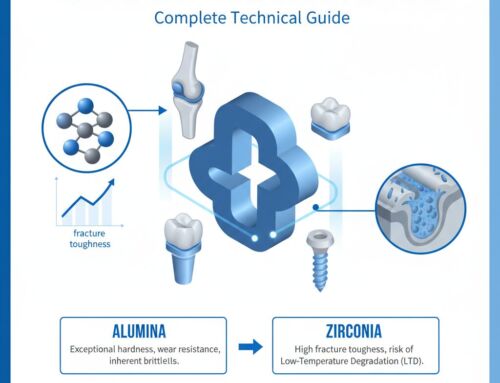
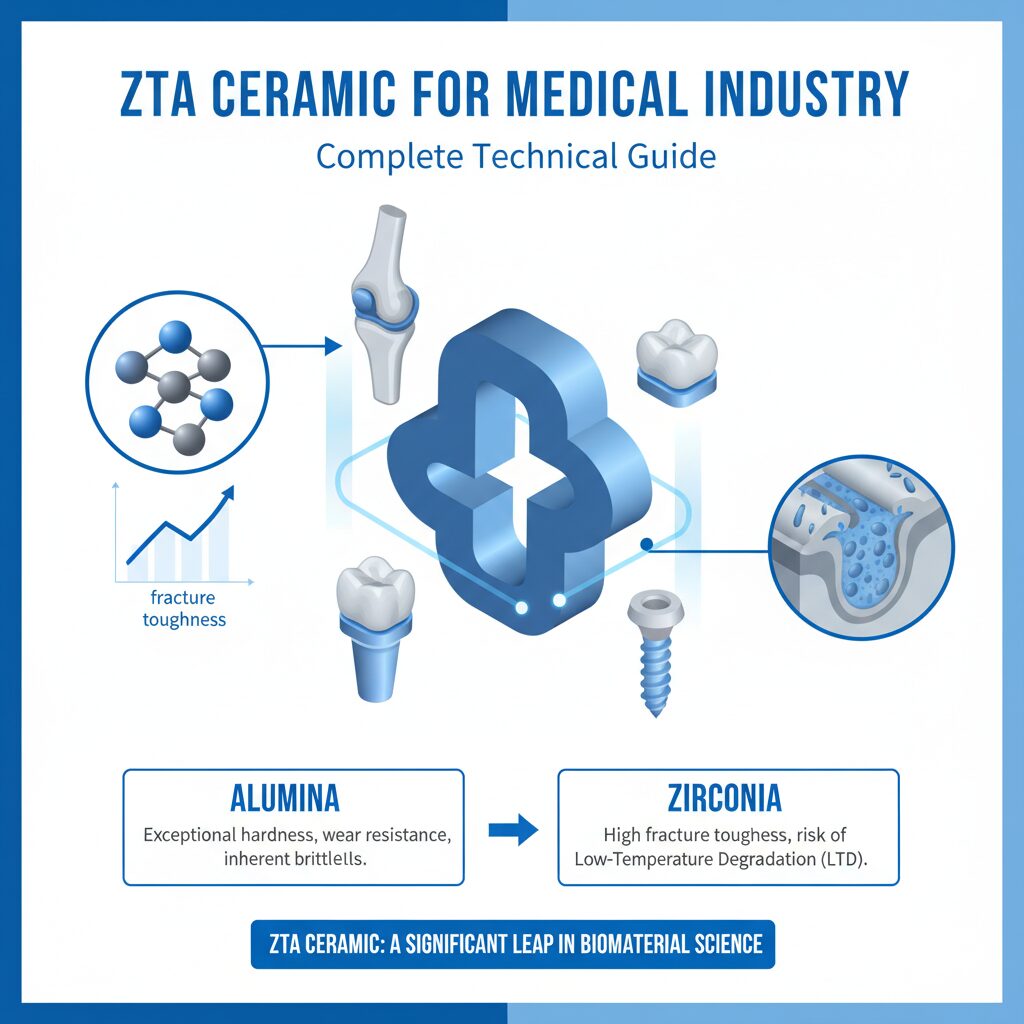
ZTA is a leading material for orthopedic implants, specifically in hip replacement balls and sockets. The biocompatibility of both alumina and zirconia, combined with the extreme wear resistance (ZTA ceramic hardness), ensures that the implant has a long service life with minimal wear debris. This is critical for patient health.
Automotive and Power Generation
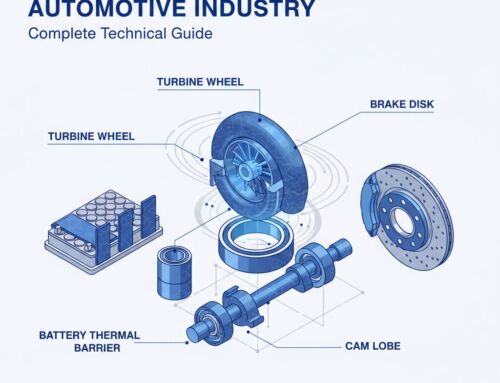
In engines and turbines, ZTA is used for components like plunger pistons, seal rings. And bearings. Its thermal stability and resistance to chemical corrosion, paired with its mechanical strength, allow it to operate in environments where lubricants may fail or where high temperatures would cause metallic components to deform.
Cutting and Milling Tools
ZTA is often utilized as a substrate for cutting tools used in machining hard metals. The high ZTA ceramic hardness allows the tool to maintain a sharp cutting edge even at high speeds, where friction-generated heat would soften high-speed steel or tungsten carbide tools.
Precision CNC Machining of ZTA Ceramics
The very properties that make ZTA desirable—its high hardness and toughness—also make it one of the most difficult materials to machine. Machining ZTA requires specialized equipment, diamond-tipped tooling. And deep technical expertise. At Great Ceramic, we have refined our CNC machining processes to handle ZTA with extreme precision.
Grinding and Finishing
Because ZTA ceramic hardness exceeds that of most traditional cutting tools, we primarily use diamond grinding. Diamond is the only material hard enough to effectively remove stock from ZTA without causing excessive tool wear. We use varying grits of diamond wheels to achieve surface finishes ranging from rough-ground to mirror-polished (Ra < 0.05 µm).
CNC Ultrasonic Machining
For complex geometries, such as small holes or intricate slots, we employ ultrasonic-assisted CNC machining. This process involves vibrating the cutting tool at ultrasonic frequencies while it rotates. This reduces the cutting force required, minimizes the risk of edge chipping. And allows for tighter tolerances in hard ZTA components.
Laser Machining
Laser technology can be used for precise cutting and drilling of ZTA. However, due to the material’s thermal properties, careful control of the laser pulse duration is required to prevent thermal shock and the formation of a “heat-affected zone” that could lower the local ZTA ceramic hardness.
Machining Parameters for ZTA
Success in machining ZTA lies in the details. Typical parameters we monitor include:
- Spindle Speed: Generally lower than those used for metals to manage heat generation.
- Feed Rate: Controlled carefully to prevent “plucking” of the ceramic grains.
- Gestion du liquide de refroidissement : Constant flow of specialized coolants is required to flush away ceramic dust (which is highly abrasive) and to prevent thermal gradients.
Foire aux questions (FAQ)
1. How does ZTA hardness compare to Tungsten Carbide?
ZTA ceramic hardness (Vickers) is generally higher than that of most grades of Tungsten Carbide. While Tungsten Carbide is tougher and more ductile, ZTA offers superior performance in high-temperature and highly corrosive environments where carbide might oxidize or corrode.
2. Can ZTA be used for impact-heavy applications?
Yes. While no ceramic is as impact-resistant as steel, ZTA is specifically engineered for toughness. Its transformation toughening mechanism makes it significantly more resistant to chipping and cracking than pure alumina, making it suitable for moderate impact applications.
3. Is ZTA ceramic electrically conductive?
No, ZTA is an excellent electrical insulator. This property, combined with its hardness, makes it ideal for use in high-voltage environments where mechanical wear is also a factor, such as in certain types of sensors or insulating bushings.
4. What is the typical tolerance achievable in machined ZTA parts?
With precision diamond grinding and CNC processes, Great Ceramic can achieve tolerances as tight as +/- 0.002mm, depending on the part geometry and size. We regularly produce components with high circularity and flatness requirements.
5. Why choose ZTA over pure Zirconia?
While pure Zirconia (Y-TZP) has higher toughness, it is more expensive and has a lower elastic modulus and lower hardness than ZTA. Additionally, Zirconia is susceptible to “low-temperature degradation” in the presence of moisture. ZTA is more stable in hydrothermal environments and offers a better balance of hardness and cost.
Conclusion
Zirconia Toughened Alumina represents a sophisticated balance of material science. By understanding and utilizing ZTA ceramic hardness, engineers can design components that are lighter, more durable. And more efficient than their metallic counterparts. Whether it is the extreme wear resistance required in a mining pump or the precision required in a medical device, ZTA provides a reliable, high-performance solution.
However, the success of a ZTA component depends heavily on the quality of the raw material and the precision of its final machining. At Great Ceramic, we bring years of experience and state-of-the-art technology to the table, ensuring that every ZTA part we produce meets the most stringent industrial standards.
Contacter Great Ceramic pour une demande personnalisée usinage de la céramique des solutions adaptées à votre application.
En savoir plus sur Zta Ceramic Hardness et nos services d'usinage céramique de précision.