








Machinable Glass Ceramic vs Plastic: Complete Technical Guide
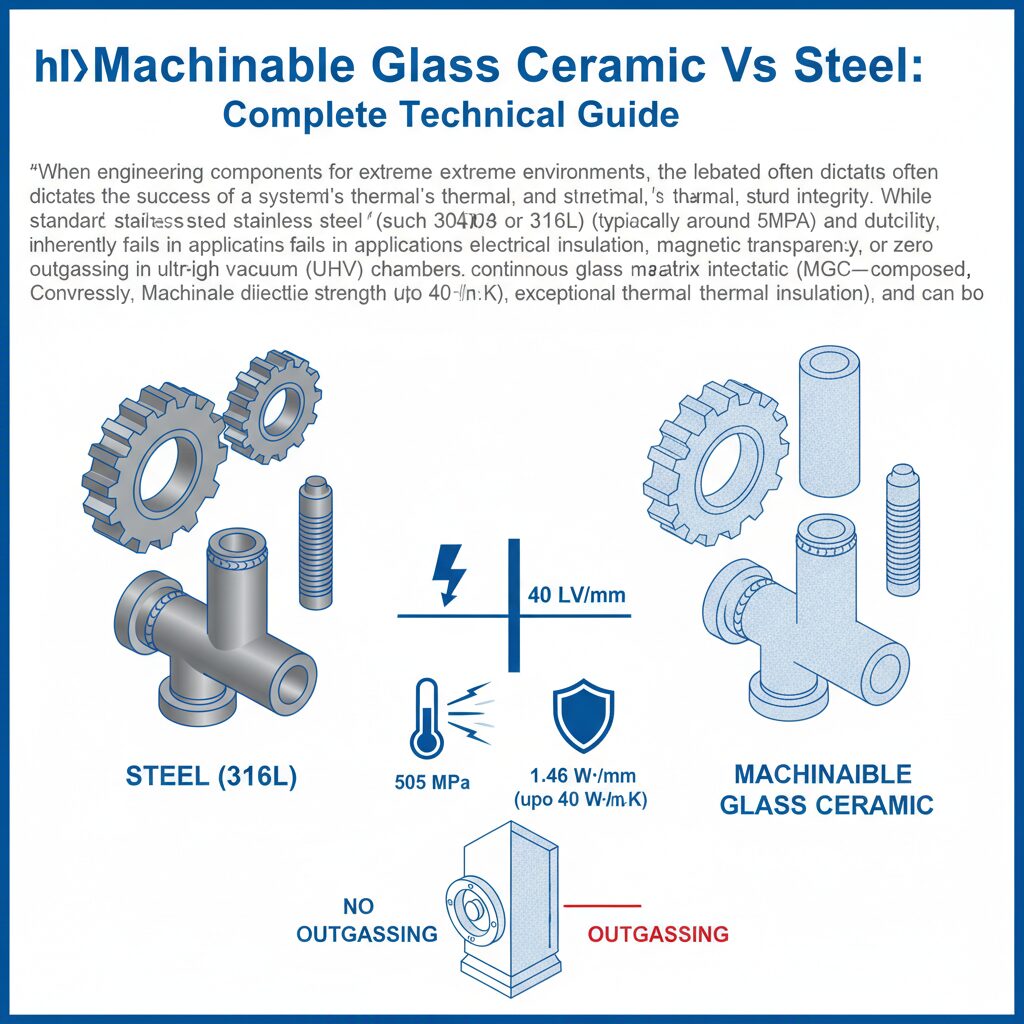
When engineering components for extreme environments, the debate of machinable glass ceramic vs plastic is a critical junction for R&D teams and procurement managers. High-performance engineering plastics—such as PEEK, PTFE. And Polyimide (Vespel)—offer excellent machinability, impact resistance. And cost-effectiveness. However, they critically fail in ultra-high vacuum (UHV) environments due to outgassing. And structurally degrade at temperatures exceeding 250°C to 300°C. In contrast, machinable glass ceramics (MGC), composed of an interlocking fluorophlogopite mica microstructure, provide zero porosity, zero outgassing, continuous operating temperatures up to 800°C. And exceptional dimensional stability. The industry pain point is often finding a material that bridges the gap between the easy machinability of polymers and the extreme thermal and electrical performance of technical ceramics. This guide provides a rigorous, data-driven analysis of both material classes, equipping engineers with the exact mechanical, thermal. And machining parameters required to transition from prototyping to RFQ. At Great Ceramic, we leverage advanced CNC technology to deliver usinage de précision de la céramique with ultra-tight tolerances of ±0.005mm, ensuring your high-performance components meet the most stringent specifications.
Propriétés des matériaux
To accurately evaluate machinable glass ceramic vs plastic, one must perform a granular review of their respective thermal, mechanical. And electrical properties. The data provided below reflects standard commercial grades of Machinable Glass Ceramic (such as Macor) compared against typical baseline metrics for high-performance thermoplastics like PEEK (Polyetheretherketone). While plastics typically exhibit a density ranging from 1.30 to 2.20 g/cm³ depending on filler content, machinable glass ceramic is significantly denser at 2.52 g/cm³. This density is paired with absolute zero porosity, a critical factor for helium leak testing and UHV systems operating at pressures below 10⁻⁹ Torr.
Thermal stability is where the divergence is most aggressive. High-performance plastics exhibit a Coefficient of Thermal Expansion (CTE) typically between 40 to 50 x 10⁻⁶ /°C. Machinable glass ceramic features a highly stable CTE of 9.3 x 10⁻⁶ /°C, matching many metals and ensuring that components manufactured to Great Ceramic’s ±0.005mm tolerances maintain their precise dimensions even under severe thermal cycling. Electrical resistivity is another deciding factor. while plastics are good insulators, they often suffer from dielectric breakdown at elevated temperatures. MGC maintains an electrical resistivity exceeding 10¹⁶ Ω·cm, making it the premier choice for high-voltage isolators in ion source mass spectrometers and aerospace sensors.
| Propriété | Value (MGC) | Unité |
|---|---|---|
| Densité | 2.52 | g/cm³ |
| Dureté | 250 | HV |
| Résistance à la flexion | 94 | MPa |
| Résistance à la rupture | 1.53 | MPa-m½ |
| Conductivité thermique | 1.46 | W/m-K |
| Résistivité électrique | >10¹⁶ | Ω-cm |
| Température maximale de fonctionnement | 800 | °C |
Comparaison avec d'autres céramiques
While deciding between machinable glass ceramic vs plastic is common for low-to-medium temperature applications, engineers must also benchmark MGC against other advanced technical ceramics to ensure optimal material selection. Unlike standard engineering plastics. This melt or deform, traditional advanced ceramics require high-temperature firing (sintering) after forming. This induces shrinkage ranging from 15% to 20%. MGC is fully dense and requires no post-machining firing, significantly accelerating prototyping cycles.
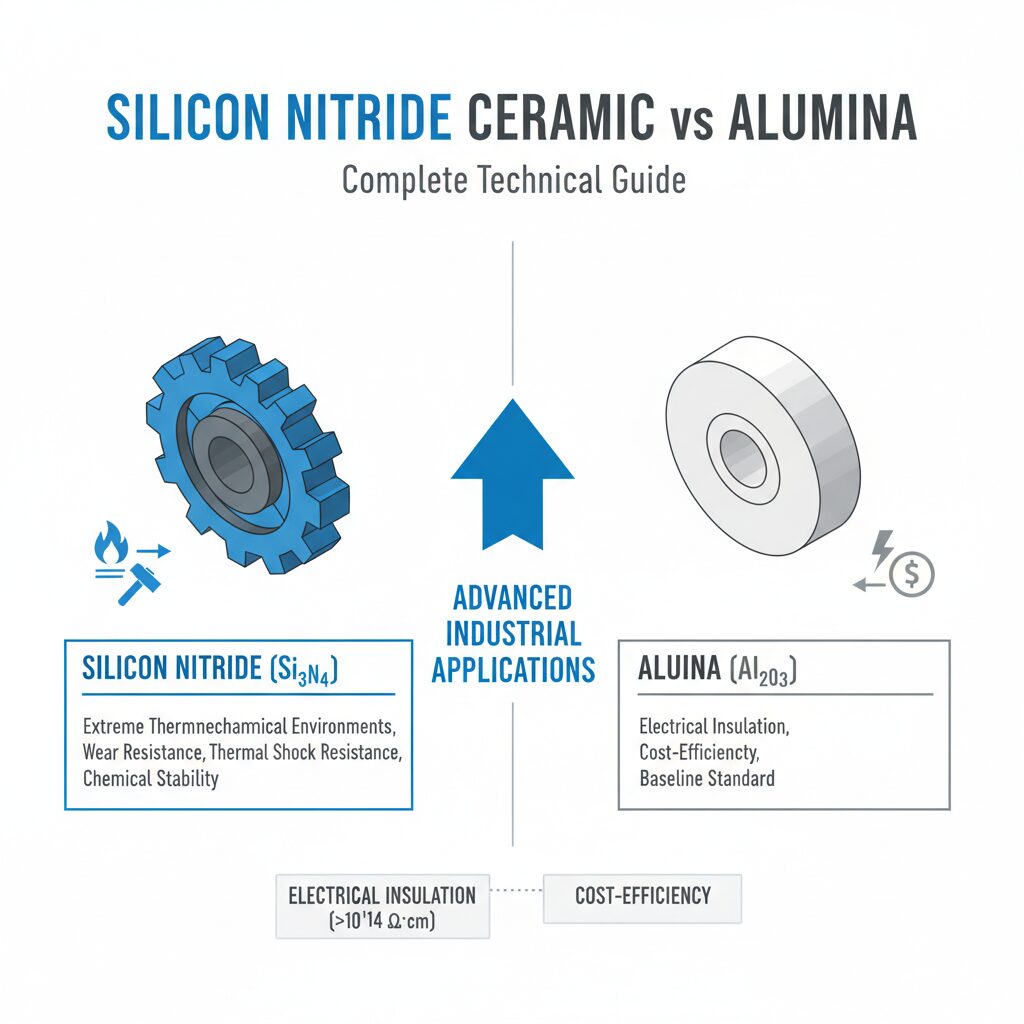
When compared to alumine/”>alumine (Al2O3). This boasts a highly respectable thermal conductivity of up to 35 W/m·K and exceptional hardness (1500 HV), MGC is notably softer (250 HV) but vastly easier to machine using standard metalworking tools. If an application demands extreme fracture toughness to resist impact—a trait where high-performance plastics normally excel—zircone (ZrO2) dominates the ceramic category with a fracture toughness of up to 10 MPa·m½, far surpassing MGC’s 1.53 MPa·m½. For extreme thermal shock applications where plastics would instantly vaporize and MGC might crack, nitrure de silicium (Si3N4) provides the optimal balance of high fracture toughness (7.0 MPa·m½) and high thermal stability. Furthermore, in applications where thermal management is the absolute priority—such as semiconductor heat sinks—engineers may bypass plastics and MGC entirely in favor of nitrure d'aluminium (AlN). This delivers a massive thermal conductivity of 170-230 W/m·K. Similarly, carbure de silicium (SiC) offers extreme hardness for wear environments, while nitrure de bore (BN) acts as a unique, machinable alternative with superior lubricity. The table below isolates these critical metrics.
| Propriété | Machinable Glass Ceramic vs Plastic | Alumine | Zircone | Nitrure de silicium |
|---|---|---|---|---|
| Conductivité thermique | 1.46 (MGC) / ~0.25 (PEEK) | 35.0 | 2.5 | 25.0 |
| Dureté | 250 (MGC) / ~20 (PEEK) | 1500 | 1200 | 1500 |
| Résistance à la rupture | 1.53 (MGC) / High Impact (PEEK) | 4.5 | 9.0 | 7.0 |
| Coût | Moyen | Faible | Moyen | Haut |
Applications
The operational environment dictates whether an engineer specifies machinable glass ceramic vs plastic. The following applications highlight specific scenarios where the unique microstructural properties of MGC fundamentally outperform long-chain polymer structures.
- Ultra-High Vacuum (UHV) Components: In vacuum systems reaching 10⁻¹⁰ Torr, plastics are entirely unviable. Polymers naturally absorb atmospheric moisture (Nylon absorbs up to 8% by weight. PEEK ~0.5%) and contain volatile organic compounds. Under deep vacuum, these compounds outgas, contaminating the vacuum chamber and ruining sensitive optics or semiconductor wafers. Machinable glass ceramic has 0% porosity and zero outgassing, making it the mandatory choice for UHV insulators, sensor housings. And feedthroughs.
- Aerospace and Space Exploration Sensors: Aerospace engineering requires materials that can survive the extreme thermal gradients of low Earth orbit—swinging from -150°C to +150°C within minutes. While plastics undergo severe dimensional changes due to high CTEs (up to 50 x 10⁻⁶ /°C), MGC remains dimensionally stable. Furthermore, MGC strongly resists atomic oxygen degradation and high-energy radiation. This rapidly embrittle and degrade standard thermoplastic chains like PTFE or Polycarbonate.
- Mass Spectrometry and Analytical Instrumentation: Within the ion source of a mass spectrometer, components must provide total electrical isolation while enduring temperatures exceeding 350°C to prevent sample condensation. High-performance plastics like PEEK structurally degrade at these temperatures, losing their dielectric strength. MGC safely operates continuously at 800°C while maintaining an electrical dielectric strength of 40 kV/mm, ensuring clean, precise ionic acceleration without electrical arcing.
- High-Power Laser System Hardware: Laser cavities demand absolute dimensional stability. Any thermal expansion causes optical misalignment, destroying the efficiency of the laser system. High-performance plastics distort under the radiant heat of flashlamps or pump diodes. Because MGC features a low CTE (9.3 x 10⁻⁶ /°C) and can be machined by Great Ceramic to ±0.005mm tolerances, it maintains critical optical alignments in mounting hardware, cavity reflectors. And insulating standoffs.
- Semiconductor Wafer Plasma Etching: During semiconductor processing, components are bombarded with aggressive fluorine and chlorine plasmas. Polymeric materials are rapidly etched, introducing carbon-based particulate contamination directly onto the silicon wafer, causing catastrophic yield loss. Machinable glass ceramic offers significantly higher resistance to plasma erosion and introduces zero organic contaminants, ensuring pristine wafer processing conditions in high-temperature chemical vapor deposition (CVD) environments.
Processus de fabrication
Understanding the fundamental differences in the manufacturing process between machinable glass ceramic vs plastic clarifies why MGC possesses its unique mechanical profile. While plastics are typically manufactured via injection molding, extrusion, or casting of petrochemical polymers, MGC is a highly engineered glass-ceramic material. Its creation relies on precise thermal treatments to precipitate specific crystal structures within a borosilicate glass matrix. The exact composition typically includes Silica (SiO2), Magnesia (MgO), Alumina (Al2O3), Potassium Oxide (K2O), Boron Trioxide (B2O3). And Fluorine (F). This unique chemistry dictates the complex manufacturing sequence below.
Méthodes de formage
- Glass Melting and Casting: The raw oxides and fluorides are weighed, mixed. And melted in a platinum or high-purity refractory crucible at temperatures exceeding 1400°C. The homogenous melt is then cast into molds to form large boules, rods, or thick plates. Unlike plastics. This can be injection molded into complex net shapes at low temperatures (200°C – 350°C), the MGC melt is formed into standard geometric blanks to be later machined down to precise specifications.
- Annealing: The cast glass blank must be immediately and carefully annealed to relieve internal thermal stresses generated during the casting process. In this state, the material is completely amorphous (a true glass) and highly brittle, bearing no machinable properties yet.
Frittage
The term “sintering” in the context of MGC is technically referred to as “ceraming.” This is a precise two-stage heat treatment process that transforms the amorphous glass into a crystalline ceramic. First, the glass is heated to a nucleation temperature (typically around 600°C to 700°C), where microscopic seed crystals begin to form throughout the matrix. Second, the temperature is elevated to a growth phase (around 900°C to 1000°C). During this phase, 2-dimensional fluorophlogopite mica crystals grow and interlock within the remaining glassy matrix. The resulting material is approximately 55% crystalline and 45% glass. It is this specific interlocking microstructure that stops crack propagation, allowing the material to be sheared by a cutting tool rather than shattering. Unlike traditional ceramics, MGC undergoes zero shrinkage after this stage, allowing for direct, precision machining.
Usinage final
The final machining phase is where MGC truly distinguishes itself from conventional advanced ceramics. Traditional alumina or zirconia must be machined in a soft “green” state, followed by a sintering process that causes unpredictable shrinkage, necessitating expensive diamond grinding to achieve tight tolerances. Machinable glass ceramic, however, can be machined in its fully dense, final state using standard high-speed steel (HSS) or tungsten carbide tooling. Great Ceramic excels in this phase, employing advanced multi-axis CNC milling and turning centers to process MGC. By utilizing specialized cooling strategies and optimized toolpaths, Great Ceramic consistently achieves demanding dimensional tolerances of ±0.005mm, intricate internal threading. And superior surface finishes without micro-fracturing the substrate.
Need to transition your plastic prototypes to extreme-environment ceramics? Contacter Great Ceramic for an engineering consultation to optimize your designs for machinable glass ceramic.
Avantages et limites
When selecting a material, engineers must rigorously weigh the operational benefits against the physical constraints. The debate of machinable glass ceramic vs plastic often comes down to balancing extreme thermal demands against mechanical impact requirements.
Avantages
- Extreme Temperature Resistance: MGC can operate continuously at 800°C and withstand peak thermal excursions up to 1000°C. High-performance plastics typically melt, warp, or permanently degrade between 250°C and 300°C.
- Zero Outgassing and Zero Porosity: Unlike polymers that absorb moisture and outgas volatile organics, MGC is completely fully dense. This makes it an uncompromising necessity for deep space applications, medical cyclotrons. And ultra-high vacuum chambers.
- Precision Machinability Without Firing: Because the material does not require post-machining sintering, it experiences zero shrinkage. Great Ceramic can repeatedly deliver complex geometries, tight tolerances (±0.005mm). And small-scale features directly from the CNC machine.
- Superior Dielectric Stability: MGC offers a dielectric strength of approximately 40 kV/mm. More importantly, its electrical resistivity remains exceptionally high even as temperatures escalate, a condition where many plastics experience dielectric breakdown and failure.
Limitations
- Low Fracture Toughness and Brittleness: With a fracture toughness of 1.53 MPa·m½, MGC is significantly more brittle than plastics like Polycarbonate or PEEK. It cannot endure high-impact shock or severe bending forces, making it unsuitable for structural load-bearing applications subject to sudden kinetic strikes.
- Chemical Susceptibility: While highly resistant to many environments, MGC contains a glass matrix that is vulnerable to halogenated acids, hydrofluoric acid. And strong concentrated alkalis at elevated temperatures. In highly corrosive, low-temperature liquid environments, chemically inert plastics like PTFE often outperform MGC.
Considérations relatives à l'usinage
Comparing the machining dynamics of machinable glass ceramic vs plastic reveals profound differences in tool interaction, thermal management. And chip formation. Plastics are inherently soft. however, they present unique challenges such as melting, smearing. And wrapping around the cutting tool. Machining plastics requires aggressive relief angles, razor-sharp high-speed steel tools. And excellent chip evacuation to prevent the localized accumulation of heat. This can warp the part or alter tight tolerances. Fixturing is also a critical challenge with plastics, as excess clamping pressure easily distorts the polymer blank.
Machinable glass ceramic behaves entirely differently. The material machines by localized microscopic fracturing. The cutting edge of the tool cleaves the interlocking mica crystals. This snap off ahead of the tool without propagating a continuous crack through the bulk material. This generates a fine, abrasive glass dust rather than the continuous ribbons of swarf seen in plastic machining. To effectively machine MGC and maintain Great Ceramic’s stringent ±0.005mm tolerance, engineers must implement specific CNC parameters. Tooling should exclusively utilize micro-grain tungsten carbide or polycrystalline diamond (PCD) to withstand the highly abrasive nature of the glass dust. Unlike plastics. This can often be machined dry or with air blasts, MGC strictly requires a continuous flood of water-soluble coolant. This coolant serves a dual purpose: it prevents localized thermal expansion at the cutting zone. And it aggressively flushes the abrasive particulate away from the tool edge, preventing premature tool wear and surface scratching.
Feed rates and cutting speeds must be meticulously controlled. When turning MGC, surface speeds of 30 to 50 surface feet per minute (SFM) with a feed rate of 0.002 to 0.005 inches per revolution (IPR) are optimal. Milling requires spindle speeds calculating to 20-35 SFM, utilizing a chip load of roughly 0.002 inches per tooth. Drilling operations mandate frequent “pecking” cycles to clear the glass dust from the flutes, preventing drill binding and subsequent substrate cracking. Finally, breakout at the exit of a cut or drill hole is a significant risk with MGC—a non-issue in plastics. Machinists must utilize sacrificial backing plates or gently chamfer edges prior to final pass cutting to prevent edge chipping.
| Paramètres d'usinage | Verre usinable Céramique | High-Performance Plastic (e.g., PEEK) | Unité |
|---|---|---|---|
| Optimal Cutting Speed (Turning) | 10 – 15 | 150 – 250 | m/min |
| Standard Feed Rate (Milling) | 0.02 - 0.05 | 0.10 – 0.20 | mm/rev |
| Primary Tool Material | Tungsten Carbide / PCD | High-Speed Steel (HSS) / Carbide | – |
| Coolant Requirement | Mandatory (Water-soluble flood) | Optional (Air blast or Water) | – |
FAQ
What is machinable glass ceramic vs plastic?
Machinable glass ceramic (MGC) is a composite material consisting of a borosilicate glass matrix reinforced with a complex network of interlocked fluorophlogopite mica crystals. This unique microstructure arrests crack propagation, allowing it to be CNC machined with standard metalworking tools without shattering. Plastics, conversely, are synthetic or semi-synthetic polymers composed of long-chain hydrocarbons. While both are highly machinable insulators, MGC provides extreme thermal resistance (up to 800°C) and zero outgassing, whereas plastics offer high impact resistance and low cost but fail at elevated temperatures and in vacuums.
What are the main applications of machinable glass ceramic vs plastic?
The choice between machinable glass ceramic vs plastic hinges on the operational environment. MGC is predominantly utilized in extreme environments where conventional polymers fail, such as ultra-high vacuum (UHV) systems, aerospace sensors, ion source components for mass spectrometers, semiconductor plasma etching equipment. And high-temperature electrical insulators. High-performance plastics are favored in applications requiring high kinetic impact resistance, continuous low-temperature wear components, chemically corrosive liquid handling (like PTFE valves). And cost-sensitive structural housings.
How does machinable glass ceramic compare to other ceramics?
Machinable glass ceramic eliminates the most significant bottleneck associated with traditional advanced ceramics: the need for high-temperature post-machining sintering and expensive diamond grinding. While materials like alumina or silicon nitride offer vastly superior hardness, wear resistance. And high-temperature limits (over 1500°C), they are notoriously difficult and expensive to machine in their fully dense state. MGC acts as an intermediate material—it is not as strong or thermally conductive as pure technical ceramics, but its ability to be immediately precision-machined to final dimensions significantly reduces manufacturing lead times and costs for complex geometries.
What are the advantages of machinable glass ceramic?
The primary advantage of MGC over engineering plastics is its thermal and vacuum stability. It operates continuously at 800°C without melting, off-gassing, or warping. It exhibits zero porosity and zero outgassing, rendering it ideal for deep vacuum applications. MGC also boasts an exceptional dielectric strength of 40 kV/mm, acting as a supreme electrical insulator at high temperatures. Mechanically, its low coefficient of thermal expansion (9.3 x 10⁻⁶ /°C) ensures that complex components machined to ±0.005mm tolerances remain dimensionally accurate despite severe temperature fluctuations.
How is machinable glass ceramic machined?
Machining MGC requires precise control of CNC parameters, specialized tooling. And thermal management. Unlike plastics that can melt or smear, MGC machines by localized microscopic fracturing, producing a highly abrasive glass dust. Operations must utilize sharp micro-grain tungsten carbide or diamond tooling operating at slow cutting speeds (30-50 SFM) and low feed rates. A continuous flood of water-soluble coolant is absolutely mandatory to flush away abrasive particulates and prevent localized heating. At Great Ceramic, we combine state-of-the-art multi-axis CNC equipment with proprietary cutting strategies to completely mitigate edge chipping, delivering flawless MGC components with ultra-precise ±0.005mm tolerances.
Need custom machinable glass ceramic vs plastic parts? Contacter Great Ceramic pour des services d'usinage de précision avec des tolérances serrées, ou envoyez un courriel à l'adresse suivante [email protected].
machinable glass ceramic vs plastic is widely used in advanced ceramic applications.
En savoir plus sur Machinable Glass Ceramic Vs Plastic et nos services d'usinage céramique de précision.