








Ingénierie de précision avec des bagues en vitrocéramique usinables pour le secteur de l'énergie
Alors que la demande mondiale en énergie propre, efficace et fiable ne cesse de croître, les matériaux utilisés dans la production, la distribution et le stockage d’énergie doivent évoluer. Les matériaux traditionnels présentent souvent des défaillances dans les conditions extrêmes des environnements à haute tension, des atmosphères chimiques corrosives ou des températures cryogéniques. C’est là que l’anneau en vitrocéramique usinable s’impose comme un composant essentiel. Alliant la polyvalence des céramiques techniques haute performance à la facilité d’usinage des métaux conventionnels, ces composants révolutionnent la manière dont les ingénieurs conçoivent leurs solutions pour le secteur de l’énergie.
Great Ceramic est spécialisée dans la fabrication de précision d'anneaux en vitrocéramique usinables et propose des solutions sur mesure répondant aux normes rigoureuses du secteur de l'énergie. De la recherche sur la fusion nucléaire à l'exploration pétrolière et gazière en fond de puits, ces anneaux assurent l'isolation thermique et électrique indispensable aux infrastructures modernes.
Qu'est-ce que la vitrocéramique usinable ?
La vitrocéramique usinable (MGC) est un matériau hybride unique composé d'une matrice de verre dans laquelle sont incorporés des microcristaux de mica fluorphlogopite. Contrairement aux céramiques traditionnelles telles que alumine ou zircone. Ces matériaux sont extrêmement durs et cassants et nécessitent un meulage au diamant après cuisson ; le MGC peut toutefois être usiné à l'aide d'outils standard en acier rapide ou en carbure. Cette propriété est due à l'imbrication des cristaux de mica. Ceux-ci agissent comme des “ freins à fissures ”, permettant un enlèvement précis de matière sans provoquer de rupture catastrophique ni de fracturation généralisée.
La possibilité d'usiner ces matériaux selon des tolérances serrées — comparables à celles obtenues avec les métaux — les rend idéaux pour les géométries complexes telles que les bagues, les entretoises et les isolateurs utilisés dans les équipements énergétiques sensibles. De plus, le MGC ne nécessite ni recuit ni traitement thermique après l'usinage, ce qui garantit la stabilité des dimensions tout au long du processus de fabrication.
Propriétés techniques de la vitrocéramique usinable
Pour comprendre pourquoi les bagues en vitrocéramique usinables sont privilégiées dans les applications énergétiques, il convient d'examiner leur profil technique complet. Les tableaux suivants présentent les propriétés mécaniques, thermiques et électriques qui caractérisent ce matériau.
Tableau 1 : Propriétés mécaniques et physiques
| Propriété | Valeur (approximative) | Unité |
|---|---|---|
| Densité | 2.52 | g/cm³ |
| Porosité | 0 (zéro) | % |
| Résistance à la flexion | 94 | MPa |
| Résistance à la compression | 345 | MPa |
| Module d'élasticité | 67 | GPa |
| Rapport de Poisson | 0.29 | - |
| Dureté Knoop (100 g) | 250 | kg/mm² |
Tableau 2 : Propriétés thermiques et électriques
| Propriété | Valeur (approximative) | Unité |
|---|---|---|
| Température maximale de fonctionnement (à vide) | 800 – 1000 | °C |
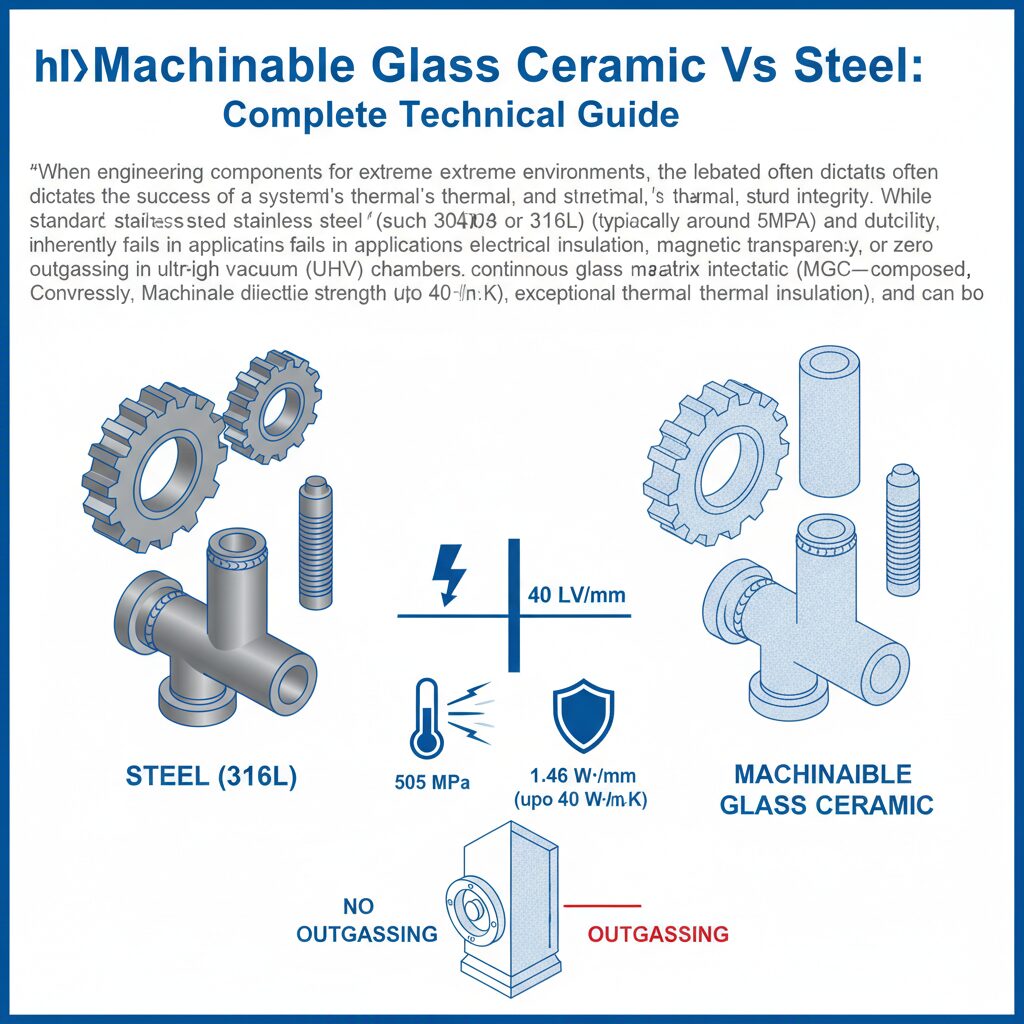
| Conductivité thermique (25 °C) | 1.46 | W/m-K |
| Coefficient de dilatation thermique | 9,3 × 10⁻⁶ | /°C |
| Rigidité diélectrique (AC) | 40 | kV/mm |
| Résistivité volumique | >10¹⁴ | Ω-cm |
| Constante diélectrique (1 MHz) | 6.0 | - |
Pourquoi cette géométrie en “ anneau ” ?
Dans le secteur de l'énergie, l'anneau est une forme géométrique fondamentale. Les anneaux servent d'isolateurs haute tension, de joints sous vide, de barrières thermiques et d'entretoises structurelles. Lorsqu'ils sont fabriqués à partir de vitrocéramique usinable, ces anneaux offrent plusieurs avantages :
- Ajustement de précision : Les bagues en vitrocéramique usinables peuvent être filetées, fendues ou rainurées afin de s'intégrer parfaitement dans des assemblages complexes.
- Étanchéité hermétique : Le MGC étant un matériau non poreux et ne présentant aucune absorption d'eau, ces bagues peuvent être utilisées dans des environnements sous vide poussé ou sous haute pression sans risque de dégazage.
- Performances isotropes : Contrairement à certains matériaux composites, les propriétés du MGC sont uniformes dans toutes les directions, ce qui garantit une performance constante de l'anneau lorsqu'il est soumis à des contraintes.
Applications industrielles dans le secteur de l'énergie
1. Énergie nucléaire et énergie de fusion
Dans les centrales nucléaires et les réacteurs à fusion de dernière génération (tels que les tokamaks), les matériaux sont soumis à un rayonnement intense, à une chaleur élevée et à des conditions de vide. Des anneaux en vitrocéramique usinables sont utilisés comme isolants électriques dans les équipements de diagnostic du plasma et comme structures de support pour les capteurs. Leur résistance au gonflement induit par les rayonnements et leur capacité à conserver leur intégrité diélectrique sous l'effet des bombardements les rendent indispensables.
2. Exploration pétrolière et gazière
Les outils de forage de fond de trou sont utilisés dans certains des environnements les plus hostiles de la planète. Ces outils nécessitent des composants électroniques protégés par des bagues isolantes capables de résister à des pressions élevées et à des températures dépassant 200 °C. La vitrocéramique usinable offre la résistance mécanique et l'isolation électrique nécessaires pour éviter les courts-circuits dans les systèmes de télémétrie des outils de forage directionnel et de mesure pendant le forage (MWD).
3. Systèmes d'énergie renouvelable
Dans les systèmes d'énergie solaire à concentration (CSP), des fluides sont chauffés à des températures extrêmes pour entraîner des turbines. Les bagues MGC servent d'isolants thermiques dans les tuyauteries et les boîtiers de capteurs, empêchant ainsi les pertes de chaleur et protégeant les équipements électroniques de surveillance sensibles contre les environnements à haute température. Par ailleurs, dans le domaine de l'énergie éolienne, les composants MGC sont à l'étude pour une utilisation dans des systèmes électroniques de puissance spécialisés à haute fréquence, où la gestion thermique est une priorité.
4. Transport et distribution d'électricité
Les transformateurs haute tension et les appareillages de commutation nécessitent des isolateurs capables de supporter des charges électriques considérables sans subir de défaillance. Les anneaux en vitrocéramique usinables sont souvent utilisés dans la fabrication de prototypes et dans la production spécialisée à faible volume, où des formes sur mesure sont nécessaires pour s'adapter à des conceptions de boîtiers spécifiques. Leur excellente rigidité diélectrique garantit la sécurité et la fiabilité des réseaux électriques.
5. Piles à combustible et électrolyseurs
À mesure que l'économie de l'hydrogène se développe, le besoin de matériaux chimiquement inertes et électriquement isolants devient primordial. Les bagues MGC sont utilisées comme entretoises et joints d'étanchéité dans les piles à combustible et les électrolyseurs, où elles doivent résister à la dégradation causée par les réactions chimiques tout en assurant une structure stable.
Particularités de l'usinage CNC des anneaux en vitrocéramique
L'une des principales raisons pour lesquelles les ingénieurs choisissent la vitrocéramique usinable pour les applications énergétiques réside dans la rapidité et la précision du processus de fabrication. Chez Great Ceramic, nous utilisons des techniques d'usinage CNC de pointe pour produire des bagues présentant des tolérances aussi strictes que ±0,01 mm.
Outillage et vitesses
Il est possible d'utiliser des outils d'usinage standard, mais il convient de respecter certains paramètres spécifiques pour éviter l'écaillage :
- Outillage en carbure : Bien que l'acier rapide (HSS) soit efficace, les outils en carbure de tungstène offrent une durée de vie nettement plus longue et de meilleurs états de surface lors de l'usinage du MGC.
- Vitesses de coupe : Les vitesses recommandées varient généralement entre 30 et 50 mètres de surface par minute. Des vitesses plus faibles permettent de réduire l'accumulation de chaleur à l'interface outil-matière.
- Vitesses d'avance : Des vitesses d'avance faibles (de 0,05 mm à 0,15 mm par tour) sont indispensables pour préserver l'intégrité du matériau et obtenir une finition lisse.
Fluides de refroidissement et lubrification
Bien que le MGC puisse être usiné à sec, l'utilisation d'un liquide de refroidissement hydrosoluble est vivement recommandée. Les liquides de refroidissement permettent d'éliminer la fine poussière de céramique (qui peut être abrasive pour les glissières de la machine) et d'éviter les contraintes thermiques localisées. Le matériau étant non poreux, le liquide de refroidissement ne sera pas absorbé et ne contaminera pas la pièce. Ceci est essentiel pour les applications sous vide.
Anneaux de tournage et de fraisage
Pour les géométries d'anneaux, le tournage CNC est la méthode principale. Il permet d'obtenir des diamètres intérieurs et extérieurs précis, ainsi que des éléments tels que des rainures pour joints toriques ou des évidements pour anneaux élastiques. Si la bague doit comporter des trous ou des fentes sur sa face ou sa périphérie, on recourt au fraisage CNC à 4 ou 5 axes afin de garantir un alignement et un espacement parfaits.
Considérations de conception pour les ingénieurs
Lors de la conception d'une bague en vitrocéramique usinable destinée à une application énergétique, tenez compte des conseils techniques suivants afin d'optimiser les performances et de réduire les coûts :
- Éviter les angles internes aigus : Utilisez des rayons dans les angles afin de réduire les concentrations de contraintes. Ceci est particulièrement important pour les anneaux soumis à une pression mécanique.
- Conception du fil : Le MGC peut être taraudé. Cependant, il est souvent préférable d'utiliser des pas de filetage plus grands ou des inserts Helicoil si la pièce doit être démontée fréquemment.
- Épaisseur de la paroi : Bien que le MGC soit un matériau résistant, les parois extrêmement fines (moins de 0,5 mm) peuvent s'avérer fragiles lors de l'usinage. Le maintien d'un rapport paroi/diamètre raisonnable garantit l'intégrité structurelle.
- Finition de la surface : L'usinage permet généralement d'obtenir une finition comprise entre environ 0,8 μm et 1,6 μm Ra. Si une finition miroir est requise pour un joint d'étanchéité sous vide, le matériau peut être poli à l'aide de pâtes diamantées.
Comparaison entre la vitrocéramique usinable et d'autres céramiques
Pourquoi choisir le MGC plutôt que l'alumine ou la stéatite pour un projet énergétique ? La réponse réside dans le coût total de possession et la rapidité de mise sur le marché.
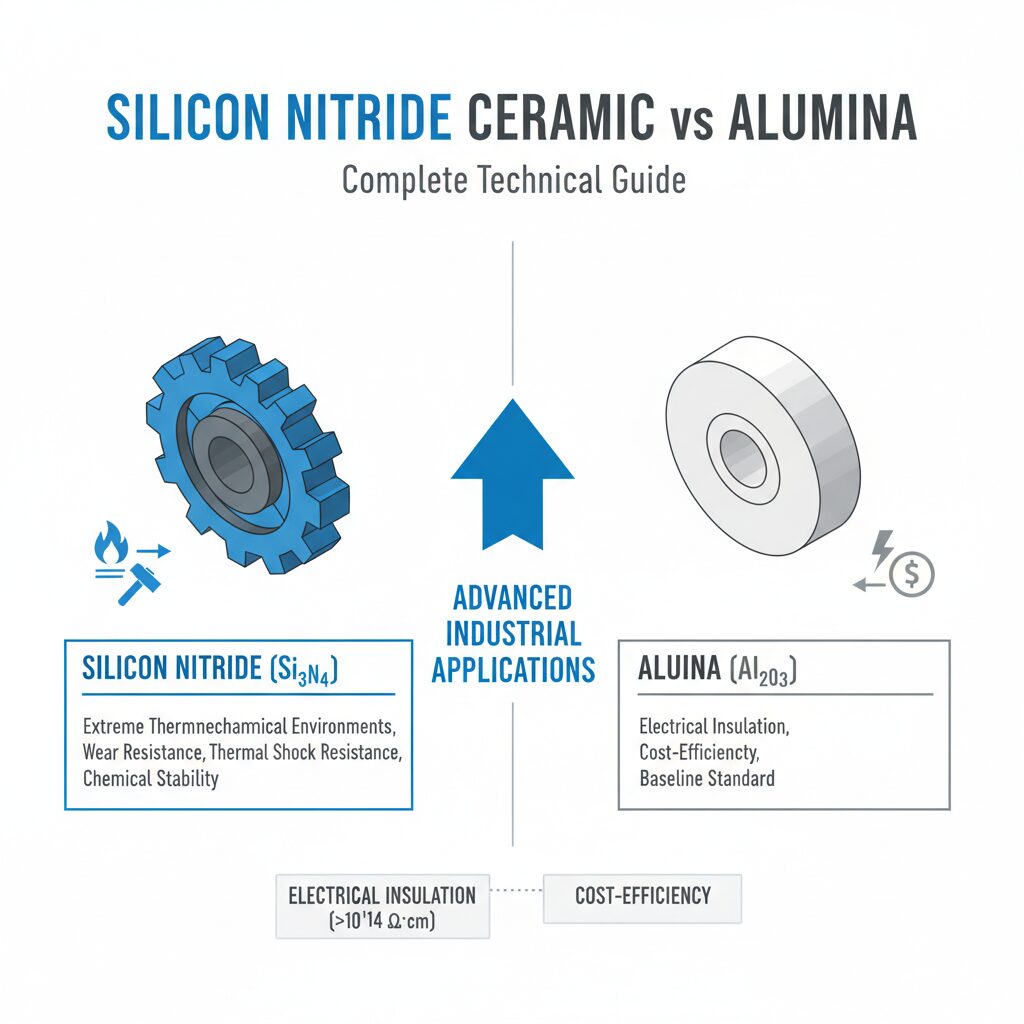
- Par rapport à l'alumine : L'alumine est plus dure et présente une meilleure résistance à la chaleur, mais elle doit être rectifiée au diamant. Ce procédé est coûteux et lent. MGC offre un profil thermique “ suffisamment satisfaisant ” (jusqu'à 1 000 °C) tout en réduisant considérablement les coûts d'usinage.
- Par rapport aux plastiques (PTFE/PEEK) : Bien que les plastiques haute performance soient des isolants, ils ne sont pas adaptés aux températures ni aux exigences de vide de nombreux systèmes énergétiques. MGC offre la rigidité et la stabilité thermique qui font défaut aux plastiques.
- Par rapport au quartz : Le quartz présente une excellente résistance aux chocs thermiques, mais il est difficile à usiner pour obtenir des formes complexes en anneau comportant des filets ou de petits détails. Le MGC est beaucoup plus polyvalent pour les conceptions complexes.
Le développement durable et l'avenir des matériaux énergétiques
La transition vers une énergie durable nécessite des matériaux durables qui ne doivent pas être remplacés fréquemment. Les bagues en vitrocéramique usinables y contribuent en offrant une durabilité exceptionnelle dans des environnements corrosifs et à haute température. Leur capacité à être usinées avec précision permet de réduire le gaspillage de matière lors de la production par rapport aux procédés traditionnels de moulage et de meulage de la céramique.
À mesure que nous évoluons vers des réacteurs nucléaires modulaires de petite taille (SMR) plus avancés et vers une électronique de puissance à haut rendement, la demande en céramiques spécialisées ne fera que croître. Great Ceramic reste à la pointe de l'innovation, en perfectionnant ses procédés d'usinage afin de relever les défis énergétiques de la prochaine génération.
Foire aux questions (FAQ)
1. Les bagues en vitrocéramique usinables peuvent-elles être utilisées dans des environnements sous vide ultra-poussé (UHV) ?
Oui. Le MGC est un matériau non poreux qui ne dégage pas de gaz lorsqu'il est correctement nettoyé. Il est largement utilisé dans les chambres UHV destinées aux secteurs de l'énergie et des semi-conducteurs.
2. Quelle est la température maximale qu'un anneau en vitrocéramique usinable peut supporter ?
En fonctionnement continu à vide, il peut fonctionner jusqu'à 800 °C. Pendant de courtes durées ou selon certaines nuances, il peut atteindre jusqu'à 1 000 °C. Cependant, sa résistance mécanique diminue à mesure qu'il s'approche de ces limites.
3. Puis-je souder ou coller des anneaux MGC à d'autres matériaux ?
Le MGC ne peut pas être soudé comme un métal, mais il peut être brasé sur des métaux si la surface est préalablement métallisée. Il peut également être collé à l'aide d'adhésifs époxy haute température ou d'adhésifs céramiques.
4. Y a-t-il des restrictions de taille pour les bagues sur mesure ?
La taille est généralement limitée par les billettes de matière première disponibles. La plupart des anneaux MGC standard sont fabriqués dans des diamètres allant jusqu’à 300 mm. Pour des besoins supérieurs, veuillez consulter notre équipe d’ingénieurs.
5. Le MGC résiste-t-il à la corrosion chimique ?
Il présente une bonne résistance à la plupart des acides et des alcalis. Il peut toutefois être attaqué par l'acide fluorhydrique et les alcalis concentrés puissants à des températures élevées.
Pourquoi s'associer à Great Ceramic ?
Choisir le bon matériau n'est que la moitié du chemin. L'autre moitié consiste à s'assurer que ce matériau est usiné conformément aux spécifications exactes requises pour votre application dans le domaine de l'énergie. Chez Great Ceramic, nous allions des décennies d'expérience dans le domaine des céramiques techniques à une technologie CNC de pointe.
Nous maîtrisons les subtilités des vitrocéramiques usinables : nous savons comment ce matériau réagit aux forces de coupe et comment gérer la poussière. Nous savons également comment obtenir les finitions de surface requises pour les applications haute tension et sous vide. Nos processus de contrôle qualité garantissent que chaque bague en vitrocéramique usinable qui quitte notre usine respecte vos tolérances strictes et vos exigences de performance.
Contacter Great Ceramic pour une demande personnalisée usinage de la céramique des solutions adaptées à votre application.
L'anneau en vitrocéramique usinable destiné au secteur de l'énergie est largement utilisé dans les applications céramiques de pointe.
En savoir plus sur Anneau en verre céramique usinable pour l'énergie et nos services d'usinage céramique de précision.