






Céramique de nitrure d'aluminium pour l'industrie chimique : Guide technique complet
Le secteur du traitement chimique opère dans certains des environnements les plus agressifs connus de l'ingénierie moderne, où les composants sont régulièrement soumis à des milieux hautement corrosifs, à des gradients thermiques massifs. Et à des pressions extrêmes. Les alliages métalliques standard - même les superalliages avancés comme Hastelloy ou Inconel - succombent fréquemment aux piqûres, à l'oxydation et à la fatigue thermique catastrophique lorsqu'ils sont exposés à des produits chimiques. Et à une fatigue thermique catastrophique lorsqu'ils sont exposés à des gaz halogénés ou à des réactions exothermiques rapides. C'est là que les nitrure d'aluminium céramique pour l'industrie chimique devient une solution technique essentielle. Offrant une conductivité thermique exceptionnelle allant jusqu'à 230 W/m-K combinée à une résistance exceptionnelle au plasma, aux métaux en fusion. Et aux réactifs chimiques agressifs, nitrure d'aluminium (AlN) comble le fossé entre la gestion thermique et l'inertie chimique. Pour les ingénieurs et les responsables des achats qui cherchent à éliminer les points chauds localisés dans les réacteurs ou à prolonger le temps moyen entre les défaillances (MTBF) dans les équipements de dépôt chimique en phase vapeur (CVD) des semi-conducteurs, il est primordial de spécifier de l'AlN usiné avec précision. Chez Great Ceramic, notre usinage de précision de la céramique garantissent que ces matériaux avancés sont livrés avec des tolérances exactes de ±0,005 mm, prêts à être intégrés dans votre infrastructure chimique la plus exigeante. Vous êtes prêt à optimiser les composants de votre réacteur ? Soumettez dès aujourd'hui un appel d'offres à Great Ceramic pour discuter de vos besoins techniques.
Propriétés des matériaux
Pour bien comprendre pourquoi les ingénieurs choisissent la céramique de nitrure d'aluminium pour les applications de l'industrie chimique, il faut examiner ses caractéristiques thermomécaniques et électriques. Contrairement aux oxydes traditionnels, l'AlN est une céramique non oxydée à liaison covalente. Cette structure atomique unique permet aux phonons de se propager avec une dispersion minimale, ce qui se traduit par une conductivité thermique qui rivalise avec celle de l'aluminium métallique (237 W/m-K) tout en conservant l'isolation électrique et l'inertie chimique des céramiques techniques avancées. La conductivité thermique maximale théorique d'un monocristal parfait d'AlN est d'environ 320 W/m-K, mais les corps frittés disponibles dans le commerce varient de 170 à 230 W/m-K en fonction des adjuvants de frittage à base d'yttrium (Y₂O₃) utilisés pour piéger les impuretés d'oxygène.
En outre, son coefficient de dilatation thermique (CTE) est exceptionnellement bas : 4,5 × 10-⁶/°C (mesuré de 20°C à 400°C). Il correspond presque parfaitement à celui du silicium (4,0 × 10-⁶/°C). Cela le rend indispensable pour les capteurs chimiques hybrides et les équipements thermographiques. Le matériau présente également une excellente rigidité diélectrique, dépassant régulièrement 15 kV/mm. Cela permet d'éviter les arcs électriques dans les cellules de traitement électrochimique à haute tension. Vous trouverez ci-dessous les données quantitatives strictes définissant l'AlN de qualité commerciale.
| Propriété | Valeur | Unité |
|---|---|---|
| Densité | 3.26 - 3.30 | g/cm³ |
| Dureté | 1100 - 1200 | HV |
| Résistance à la flexion | 300 - 340 | MPa |
| Résistance à la rupture | 2.8 - 3.5 | MPa-m½ |
| Conductivité thermique | 170 - 230 | W/m-K |
| Résistivité électrique | > 10¹⁴ | Ω-cm |
| Température maximale de fonctionnement | 1100 (oxydant) / 1900 (inerte) | °C |
Comparaison avec d'autres céramiques
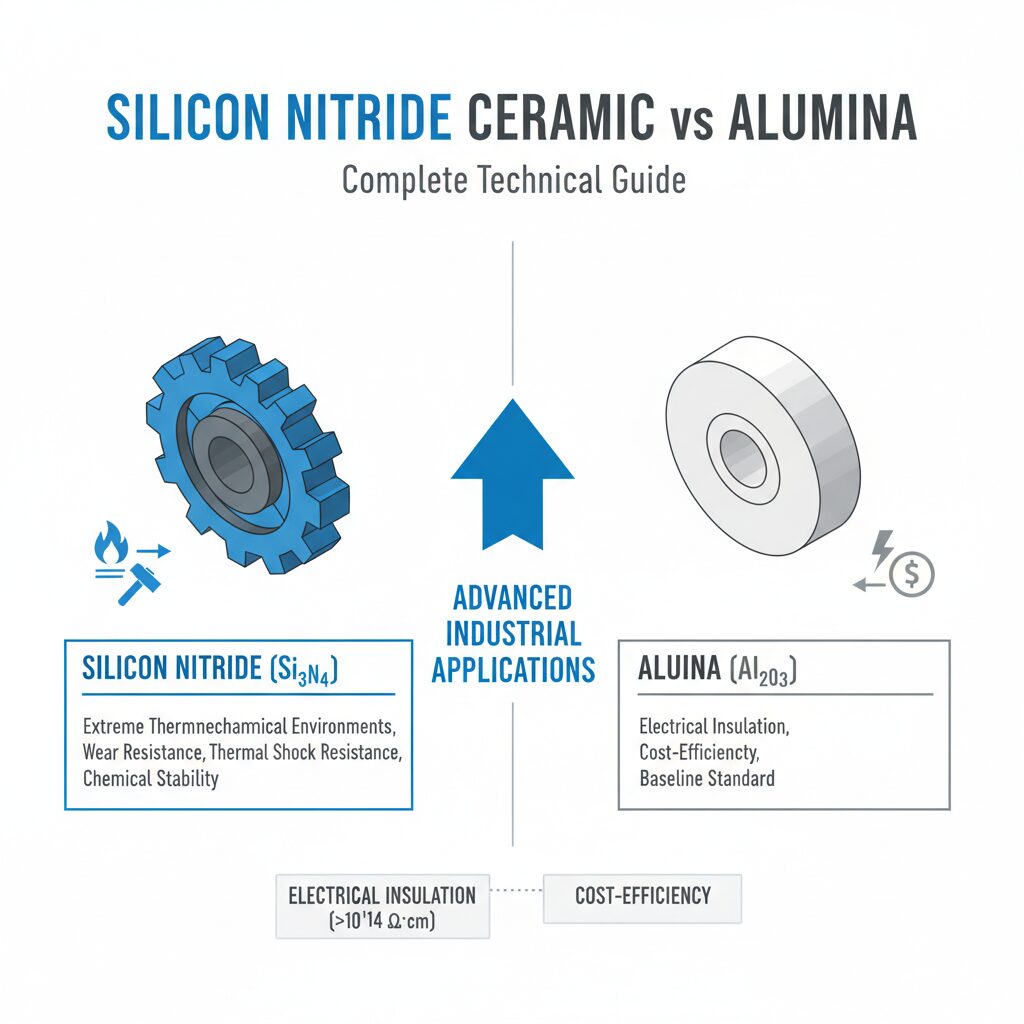
La sélection des matériaux dans le domaine du génie chimique nécessite une analyse rigoureuse du rapport coût/performance. Lors de l'évaluation de la céramique de nitrure d'aluminium pour l'industrie chimique, il est essentiel de la comparer à d'autres céramiques industrielles de premier plan : Alumine (Al₂O₃), Zircone (ZrO₂). Et le nitrure de silicium (Si₃N₄). Chaque matériau possède un profil thermomécanique distinct.
alumine/”>Alumine est le cheval de bataille de l'industrie, offrant une excellente résistance chimique de base à un faible coût, mais sa conductivité thermique culmine à seulement 35 W/m-K. L'alumine est donc très sensible aux chocs thermiques dans les réacteurs présentant des pics de température exothermiques rapides. Zircone offre une ténacité à la rupture (jusqu'à 8,0 MPa-m½) et une résistance à l'usure inégalées, mais il agit comme un isolant thermique (2-3 W/m-K). Cette situation est désastreuse pour les composants chimiques qui dissipent la chaleur. Nitrure de silicium offre une résistance mécanique et une résistance aux chocs thermiques supérieures grâce à sa structure de grains en forme d'aiguilles imbriquées, mais sa conductivité thermique (20-30 W/m-K) reste très inférieure à celle de l'AlN. Pour les applications chimiques nécessitant à la fois une dissipation rapide de la chaleur et une résistance à l'érosion par le plasma, comme dans les chambres de gravure à base de fluor, l'AlN est le choix incontesté.
| Propriété | Nitrure d'aluminium (AlN) | Alumine (99.5%) | Zircone (Y-TZP) | Nitrure de silicium |
|---|---|---|---|---|
| Conductivité thermique (W/m-K) | 170 - 230 | 24 - 35 | 2 - 3 | 20 – 30 |
| Dureté (HV) | 1100 - 1200 | 1440 - 1500 | 1200 - 1300 | 1400 - 1600 |
| Résistance à la rupture (MPa-m½) | 2.8 - 3.5 | 4.0 - 5.0 | 6.0 - 8.0 | 6.0 - 7.0 |
| Coût | Haut | Faible | Moyen | Haut |
Applications
L'intégration de la céramique de nitrure d'aluminium dans l'infrastructure de l'industrie chimique modifie fondamentalement les limites opérationnelles de l'équipement de traitement. En remplaçant le quartz, l'alumine ou les métaux revêtus par de l'AlN, les ingénieurs chimistes peuvent travailler à des températures plus élevées, utiliser des gaz réactifs plus agressifs et réduire considérablement la durée des cycles grâce à des phases de chauffage et de refroidissement accélérées. Et réduire considérablement la durée des cycles grâce à l'accélération des phases de chauffage et de refroidissement. Les applications ci-dessous mettent en évidence l'intersection critique de la gestion thermique et de la stabilité chimique de l'AlN.
- Suscepteurs semi-conducteurs à dépôt chimique en phase vapeur (CVD) : Dans les processus de croissance épitaxiale et de dépôt chimique en phase vapeur, les plaquettes de silicium doivent être chauffées uniformément à des températures comprises entre 800°C et 1200°C, tout en étant exposées à des gaz précurseurs hautement corrosifs tels que le silane, l'ammoniaque et le chlorure d'hydrogène. et le chlorure d'hydrogène. Les suscepteurs AlN offrent un profil thermique précis (ΔT < 1°C sur une tranche de 300 mm) grâce à leur conductivité thermique de plus de 170 W/m-K, tout en résistant entièrement aux environnements plasmatiques halogénés qui dégraderaient rapidement les céramiques de moindre qualité.
- Composants d'échangeurs de chaleur dans des environnements corrosifs : Les échangeurs de chaleur traditionnels à calandre reposent sur l'acier inoxydable ou l'Hastelloy. Ceux-ci souffrent de graves piqûres en présence d'acides chlorhydrique (HCl) ou fluorhydrique (HF). Les tubes et plaques en AlN usinés offrent des coefficients de transfert de chaleur presque identiques à ceux de l'aluminium métallique, mais sont chimiquement inertes face à ces milieux acides agressifs, ce qui prolonge la durée de vie des composants d'une moyenne de 4 000 heures à plus de 20 000 heures de fonctionnement continu.
- Creusets pour le traitement des métaux fondus et des sels : L'extraction et le raffinage des éléments des terres rares nécessitent souvent l'électrolyse de sels fondus à des températures supérieures à 900°C. L'AlN a la particularité de ne pas mouiller les métaux en fusion, en particulier l'aluminium, le lithium et le gallium. et le gallium. Les creusets usinés en AlN ne contaminent pas la matière fondue avec des impuretés d'oxygène (contrairement aux creusets en alumine) et peuvent résister au choc thermique des cycles rapides de chauffage par induction.
- Substrats UV-LED haute puissance pour réacteurs photochimiques : Le traitement moderne de l'eau et la stérilisation chimique utilisent des LED UV à haute intensité pour rompre les liaisons chimiques ou détruire les agents pathogènes. Ces puces génèrent un flux thermique localisé massif (dépassant souvent 100 W/cm²). Les substrats en AlN éloignent instantanément cette chaleur de la jonction du semi-conducteur, ce qui maintient la température de la jonction de la diode en dessous de 85°C, empêchant ainsi la dégradation thermique et garantissant la stabilité de la cinétique des réactions photochimiques.
- Chimie analytique Instrumentation Capteurs : Les détecteurs de conductivité thermique (TCD) utilisés en chromatographie en phase gazeuse reposent sur la mesure du refroidissement différentiel d'un filament chauffé en présence de divers gaz porteurs. L'utilisation de boîtiers de capteurs en AlN assure une stabilité thermique de base absolue, empêchant les fluctuations de la température ambiante externe de provoquer une dérive du capteur, ce qui accroît la précision de l'analyse de la masse chimique jusqu'à des seuils de parties par milliard (ppb).
Processus de fabrication
Pour obtenir les propriétés théoriques de la céramique de nitrure d'aluminium destinée à l'industrie chimique, il faut un processus de fabrication exceptionnellement contrôlé. L'AlN étant très sensible à la contamination par l'oxygène - qui crée des vides dans le réseau cristallin qui diffusent les phonons et détruisent la conductivité thermique - l'ensemble du processus, de la synthèse de la poudre à l'usinage final, doit être rigoureusement géré. La synthèse standard commence par la réduction carbothermique, qui consiste à faire réagir de l'alumine de haute pureté avec du carbone et de l'azote à 1600 °C (Al₂O₃ + 3C + N₂ → 2AlN + 3CO). La poudre obtenue est de taille sub-micronique, très réactive. Elle doit être manipulée dans des atmosphères inertes.
Méthodes de formage
- Coulée de bandes : Pour les substrats minces utilisés dans les capteurs chimiques de haute puissance ou les dissipateurs thermiques des LED, la poudre d'AlN est mélangée à des liants organiques, des plastifiants. et des solvants pour créer une pâte. Cette pâte est coulée à l'aide d'une racle en feuilles vertes précises d'une épaisseur allant de 0,25 mm à 1,5 mm.
- Pressage isostatique à froid (CIP) : Pour les composants volumétriques tels que les creusets, les blocs d'échangeurs de chaleur. et les suscepteurs, la poudre est placée dans un moule souple en élastomère et soumise à une pression hydraulique omnidirectionnelle (généralement de 200 à 300 MPa). Cela permet d'obtenir une densité verte uniforme et d'éviter le gauchissement et le retrait anisotrope pendant la phase de frittage.
Frittage
Le frittage de l'AlN est beaucoup plus complexe que celui des céramiques d'oxyde. En raison de sa liaison covalente, l'AlN présente des taux d'autodiffusion très faibles. Il nécessite des températures comprises entre 1700°C et 1900°C dans une atmosphère d'azote. En outre, le frittage en phase liquide est obligatoire. Des adjuvants de frittage, généralement de l'Yttria (Y₂O₃) ou de l'oxyde de calcium (CaO), sont ajoutés à raison de 3 à 5 wt%. Pendant le frittage, l'Y₂O₃ réagit avec la couche d'oxygène inhérente (Al₂O₃) à la surface des particules d'AlN pour former des phases liquides d'aluminate d'yttrium (par exemple, Y₃Al₅O₁₂, connu sous le nom de YAG). Cette phase liquide permet non seulement de densifier la céramique à une densité théorique >99%, mais aussi de “balayer” l'oxygène du réseau AlN, en le faisant migrer vers les joints de grains. Cette étape de purification de l'oxygène est exactement ce qui permet au matériau final d'atteindre des conductivités thermiques supérieures à 170 W/m-K.
Usinage final
À l'état fritté, les pièces en AlN se contractent d'environ 18-20% et présentent un état de surface et une tolérance dimensionnelle inadéquats pour les applications strictes du génie chimique. L'usinage final est réalisé à l'aide de centres de meulage CNC multiaxes ultramodernes. L'AlN ayant une dureté de 1100-1200 HV, les outils traditionnels en carbure sont instantanément détruits. Des meules imprégnées de diamant et des plaques de rodage ultraprécises sont utilisées. Chez Great Ceramic, nos ingénieurs contrôlent méticuleusement la profondeur de coupe, la vitesse d'avance. Et les vitesses de broche pour éviter les micro-fissures, ce qui permet d'obtenir des tolérances dimensionnelles serrées de ±0,005 mm et une rugosité de surface (Ra) inférieure à 0,1μm.
Avantages et limites
Bien que la céramique de nitrure d'aluminium destinée à l'industrie chimique offre une matrice unique de propriétés, elle n'est pas une panacée universelle. Les ingénieurs doivent soigneusement évaluer ses avantages thermomécaniques spécialisés par rapport à ses limites environnementales et mécaniques afin de garantir un déploiement optimal dans les réacteurs chimiques et le matériel d'analyse.
Avantages
- Conductivité thermique inégalée : À 170-230 W/m-K, l'AlN transfère la chaleur 5 à 7 fois plus vite que l'alumine, éliminant ainsi les gradients thermiques qui provoquent une dilatation différentielle et des défaillances catastrophiques dans les cuves de produits chimiques.
- Résistance exceptionnelle aux halogènes : L'AlN présente une perte de masse quasi nulle lorsqu'il est exposé au fluor, au chlore et aux environnements de gravure au plasma standard à des températures élevées. Et dans des environnements de gravure au plasma standard à des températures élevées, ses performances sont largement supérieures à celles du quartz et du verre borosilicaté.
- Caractéristiques de non-mouillage : Le matériau résiste fortement au mouillage par les métaux en fusion - en particulier les éléments du groupe III comme l'aluminium et le gallium - ce qui en fait le premier choix pour les composants d'extraction chimique de la pyrométallurgie.
- Coefficient de dilatation thermique (CTE) adapté : Son CDT de 4,5 × 10-⁶/°C reflète étroitement celui du silicium (4,0 × 10-⁶/°C), ce qui empêche la délamination et les contraintes mécaniques dans les assemblages silicium-céramique liés chimiquement pendant les cycles thermiques rapides.
Limitations
- Susceptibilité à l'hydrolyse à haute température : L'AlN est généralement stable dans l'eau à température ambiante, mais dans des environnements chimiques aqueux dépassant 80°C, la surface peut réagir avec l'eau (hydrolyse) pour former de l'hydroxyde d'aluminium et du gaz ammoniac (AlN + 3H₂O → Al(OH)₃ + NH₃). Il doit être protégé ou évité dans les applications de vapeur à haute température.
- Coûts de production et d'usinage élevés : L'exigence d'une synthèse de poudre ultra-pure, d'un frittage à l'azote à haute température. De plus, la rectification au diamant rend l'AlN nettement plus cher que les céramiques d'alumine ou de stéatite, ce qui relègue son utilisation aux composants critiques pour lesquels une défaillance est inacceptable.
Considérations relatives à l'usinage
Les caractéristiques mêmes qui rendent la céramique de nitrure d'aluminium pour l'industrie chimique si désirable - sa liaison covalente, sa dureté extrême (1100+ HV). et sa rigidité - la rendent aussi notoirement difficile à usiner. Dans le domaine des céramiques avancées, l'usinabilité est souvent inversement proportionnelle à la performance. L'AlN est très fragile, avec une ténacité à la rupture de seulement 2,8 à 3,5 MPa-m½. Lorsqu'il est soumis aux forces de cisaillement de la rectification CNC, le matériau est sujet à un phénomène connu sous le nom de "Sub-Surface Damage" (SSD), où des microfissures se propagent sous la surface usinée. Dans les applications chimiques, ces fissures microscopiques peuvent agir comme des réseaux capillaires, permettant à des gaz corrosifs de s'infiltrer et de dégrader prématurément le composant.
Pour surmonter ces graves problèmes d'usinage, les paramètres conventionnels de fraisage et de tournage doivent être entièrement abandonnés. Great Ceramic utilise des outils abrasifs spécialisés à liant diamant fonctionnant à des vitesses de broche très élevées (dépassant fréquemment 15 000 tours/minute) associées à des vitesses d'avance extrêmement faibles (jusqu'à 0,01 mm/tour). Cette approche cinématique garantit que l'enlèvement de matière s'effectue dans le “régime ductile” - une zone microscopique où la céramique est broyée sans déclencher de fracture fragile. La gestion du liquide de refroidissement est un autre obstacle critique. L'AlN pouvant subir une hydrolyse, des fluides de coupe spécialisés non aqueux ou chimiquement inhibés doivent être injectés avec précision dans la zone de coupe afin d'évacuer les copeaux et de gérer la chaleur induite par le frottement.
L'écaillage des arêtes est une menace persistante lors de l'usinage de géométries complexes telles que les pommes de douche de distribution de gaz ou les raccords filetés pour réacteurs chimiques. Nos techniciens utilisent des protocoles de chanfreinage personnalisés et des matériaux de support sacrificiels pour éliminer l'écaillage lorsque l'outil diamanté sort de la coupe. En combinant la technologie de rectification CNC à 5 axes avec une métrologie rigoureuse (inspection CMM), Great Ceramic fournit régulièrement des composants en AlN avec des canaux fluidiques internes complexes, atteignant une planéité de 2 bandes légères et des tolérances géométriques de ±0,005 mm. Si votre équipe d'ingénieurs a du mal à trouver des pièces en AlN de haute précision qui répondent aux normes de l'industrie chimique, consultez notre site Web. usinage de précision de la céramique pour optimiser votre conception en vue de la fabrication.
FAQ
Qu'est-ce que la céramique de nitrure d'aluminium pour les applications de l'industrie chimique ?
Le nitrure d'aluminium (AlN) est une céramique technique avancée, non oxydée, liée de manière covalente à l'aluminium et à l'azote. Dans l'industrie chimique, il est principalement utilisé pour sa rare combinaison de conductivité thermique massive (jusqu'à 230 W/m-K) et de résistance robuste aux attaques chimiques agressives, en particulier les halogènes, les plasmas et les métaux en fusion. et aux métaux en fusion. Contrairement aux alliages métalliques qui se corrodent ou aux céramiques standard qui subissent des chocs thermiques, l'AlN constitue une plate-forme stable et pure pour les réactions chimiques à haute température, le traitement des semi-conducteurs et les systèmes de gestion thermique. Et les systèmes de gestion thermique.
Quelles sont les principales applications du nitrure d'aluminium dans les procédés chimiques ?
Les principales applications concernent les environnements exigeant simultanément un transfert de chaleur extrême et une résistance à la corrosion. Parmi les principales utilisations, citons les suscepteurs et les éléments chauffants pour le dépôt chimique en phase vapeur (CVD) des semi-conducteurs, les plaques d'échangeur de chaleur pour le traitement des fluides très acides, les creusets pour la fusion des métaux et des sels des terres rares sans contamination par l'oxygène. Et les boîtiers pour les capteurs sensibles de chimie analytique (comme les chromatographes en phase gazeuse) où la stabilité thermique est strictement nécessaire pour obtenir des lectures précises.
Comment le nitrure d'aluminium se compare-t-il à d'autres céramiques comme l'alumine ou la zircone ?
La différence la plus frappante est la conductivité thermique. L'AlN transfère la chaleur à une vitesse comprise entre 170 et 230 W/m-K. C'est presque 7 fois plus rapide que l'alumine standard (24-35 W/m-K) et presque 100 fois plus rapide que la zircone (2-3 W/m-K). Bien que la zircone soit beaucoup plus résistante (jusqu'à 8,0 MPa-m½) et que l'alumine soit beaucoup plus rentable pour l'usure chimique générale, ni l'une ni l'autre ne peut survivre aux environnements de chocs thermiques sévères que l'AlN gère sans effort. En outre, l'AlN offre une correspondance CTE avec le silicium beaucoup plus étroite que l'alumine et la zircone.
Quels sont les avantages de l'utilisation du nitrure d'aluminium par rapport aux métaux dans les réacteurs chimiques ?
Les métaux, y compris les superalliages comme l'Inconel ou l'Hastelloy, se dégradent rapidement lorsqu'ils sont exposés à des halogènes (fluor, chlore) à des températures élevées, ce qui entraîne une contamination particulaire du lot chimique. L'AlN est pratiquement inerte à ces gaz. En outre, les métaux sont conducteurs d'électricité. L'AlN offre une conductivité thermique similaire à celle de l'aluminium, mais agit comme un puissant isolant électrique (rigidité diélectrique > 15 kV/mm), ce qui le rend idéal pour les réacteurs électrochimiques, les chambres à plasma et les applications où les courts-circuits électriques doivent être évités. Il est donc idéal pour les réacteurs électrochimiques, les chambres à plasma et les applications où les courts-circuits électriques doivent être strictement évités.
Comment le nitrure d'aluminium est-il usiné avec des tolérances serrées ?
En raison de sa dureté (plus de 1100 HV) et de sa faible résistance à la rupture (environ 3,0 MPa-m½), l'AlN ne peut pas être usiné avec des outils standard en acier rapide ou en carbure. Il nécessite un meulage de précision à l'aide d'outils imprégnés de diamant sur des plates-formes CNC rigides et amortissant les vibrations. Le processus exige un contrôle précis des vitesses d'avance et de rotation de la broche. Et des liquides de refroidissement spécialisés pour éviter les microfissures et l'hydrolyse pendant la coupe. Great Ceramic utilise une technologie avancée de rectification et de rodage à 5 axes pour usiner des composants en AlN avec des tolérances ultra-serrées de ±0,005 mm, garantissant une intégration parfaite dans l'infrastructure critique de l'industrie chimique.
Besoin de céramique de nitrure d'aluminium sur mesure pour les pièces de l'industrie chimique ? Contacter Great Ceramic pour des services d'usinage de précision avec des tolérances serrées, ou envoyez un courriel à l'adresse suivante [email protected].
La céramique de nitrure d'aluminium pour l'industrie chimique est largement utilisée dans les applications céramiques avancées.
En savoir plus sur Céramique de nitrure d'aluminium pour l'industrie chimique et nos services d'usinage céramique de précision.