








Résistance à la flexion de la céramique d'alumine : Guide technique complet
Comprendre alumine résistance à la flexion de la céramique est le prérequis technique le plus critique lors de la conception de composants structurels de haute performance qui doivent supporter des forces de flexion continues, des contraintes mécaniques dynamiques et une usure environnementale agressive. et une usure environnementale agressive. La résistance à la flexion, souvent appelée module de rupture (MOR) ou résistance à la rupture transversale, définit la capacité maximale d'un matériau à résister à la déformation et à la rupture fragile catastrophique sous un profil de charge spécifique. Pour les applications techniques avancées alumine (Al₂O₃), cette valeur varie généralement de 300 MPa dans les qualités de pureté standard 95% à un impressionnant 500 MPa dans les variantes de haute pureté 99,9% à grain ultrafin. Le principal problème de l'industrie réside dans la dégradation de cette résistance théorique au cours de la fabrication standard. Les microfissures de subsurface introduites par de mauvaises pratiques de broyage agissent comme des concentrateurs de stress, réduisant le seuil mécanique effectif jusqu'à 40%. La solution exige une approche sans compromis de la sélection des matériaux et du contrôle dimensionnel submicronique. Usinage de précision de la céramique L'utilisation de paramètres de rectification déterministes est essentielle pour préserver l'intégrité structurelle du réseau céramique. Great Ceramic est spécialisée dans le respect de tolérances serrées de ±0,005 mm tout en conservant une finition de surface impeccable, ce qui garantit que le module de rupture théorique correspond parfaitement aux performances réelles du composant. Pour une assistance technique immédiate et une évaluation des composants, demandez un appel d'offres à notre équipe technique dès aujourd'hui.
Propriétés des matériaux
Les propriétés mécaniques et thermodynamiques de l'alumine technique sont fondamentalement dictées par sa structure cristalline hexagonale très serrée, la force de ses liaisons interatomiques ioniques et covalentes. Et la densité de sa microstructure frittée finale. Lorsque les ingénieurs évaluent la résistance à la flexion de la céramique d'alumine, ils doivent simultanément tenir compte d'une matrice d'attributs thermomécaniques interconnectés. La ténacité à la rupture. Elle mesure la résistance du matériau à la propagation des fissures et se situe entre 3,5 et 5,0 MPa-m½, ce qui rend l'alumine très sensible aux défauts de surface. La densité théorique de l'alpha-alumine pure étant de 3,98 g/cm³, les qualités industrielles doivent atteindre une densité relative d'au moins 98% à 99,5% (supérieure à 3,80 g/cm³) afin d'éliminer les porosités interconnectées qui agiraient autrement comme des multiplicateurs de contraintes internes sous charge de flexion. Les valeurs de dureté atteignant jusqu'à 1800 HV (Vickers) garantissent une résistance extrême à l'usure, mais imposent à l'inverse de n'utiliser que des outils abrasifs au diamant de précision lors des opérations de post-frittage. Les propriétés de base requises pour effectuer une analyse par éléments finis (FEA) précise pour les applications d'ingénierie structurelle sont détaillées dans l'ensemble de données normalisées ci-dessous.
| Propriété | Valeur | Unité |
|---|---|---|
| Densité | 3.80 - 3.95 | g/cm³ |
| Dureté | 1500 - 1800 | HV |
| Résistance à la flexion | 300 - 500 | MPa |
| Ténacité à la rupture | 3.5 - 5.0 | MPa-m½ |
| Conductivité thermique | 25 - 35 | W/m-K |
| Résistivité électrique | > 10¹⁴ | Ω-cm |
| Température maximale de fonctionnement | 1700 | °C |
Comparaison avec d'autres céramiques
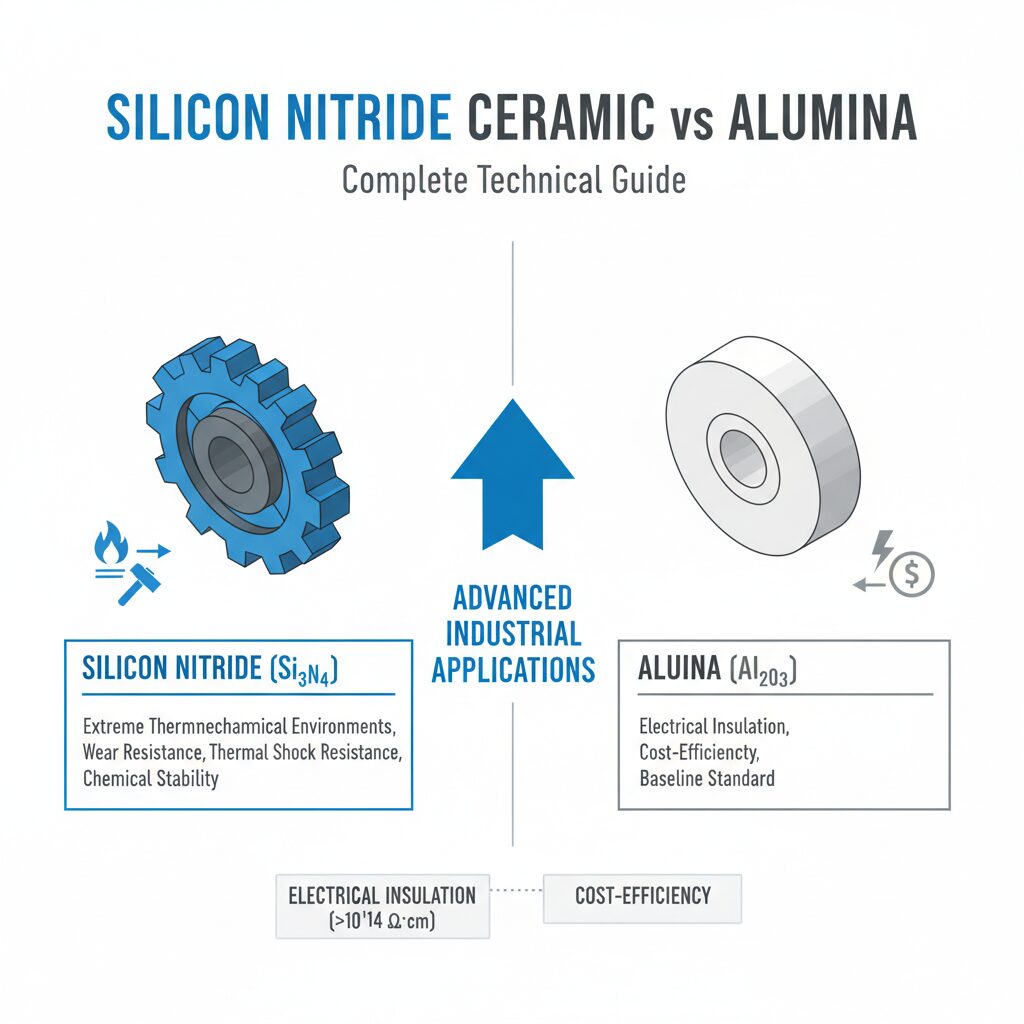
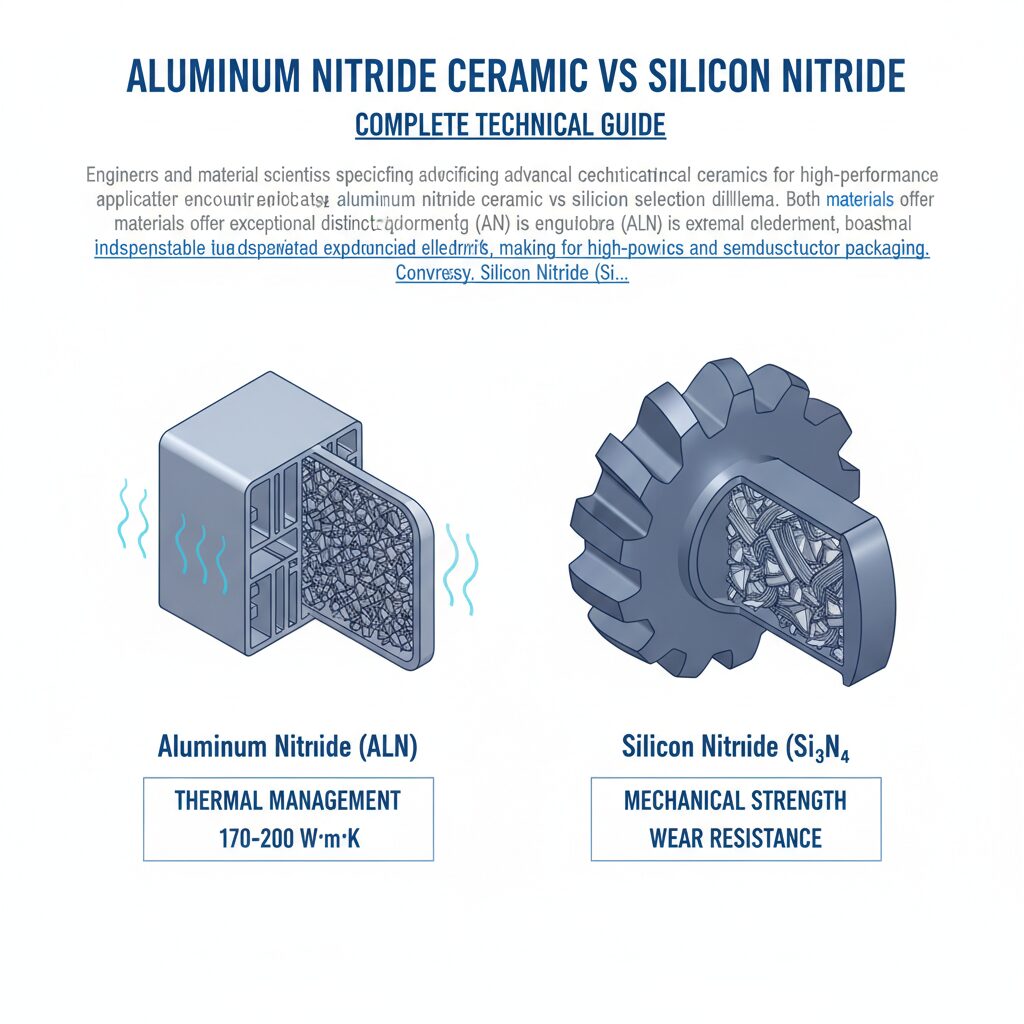
Le choix de la bonne céramique technique avancée nécessite un examen croisé, objectif et fondé sur des données, des familles de matériaux concurrentes. Bien que la résistance à la flexion de la céramique d'alumine soit suffisante pour la grande majorité des applications de l'industrie lourde et des semi-conducteurs, elle évolue dans un écosystème hautement concurrentiel où se côtoient zircone et nitrure de silicium. La zircone (en particulier le polycristal de zircone tétragonale stabilisé à l'yttrium, ou Y-TZP) subit une trempe par transformation induite par la contrainte. Cela permet d'arrêter la propagation des fissures et d'élever sa résistance à la flexion à des niveaux exceptionnels dépassant 1000 MPa, ainsi qu'une ténacité à la rupture allant jusqu'à 10,0 MPa-m½. Le nitrure de silicium présente une microstructure aciculaire imbriquée (en forme d'aiguille) qui offre un équilibre optimal entre la résistance (jusqu'à 850 MPa) et une résistance aux chocs thermiques inégalée grâce à son coefficient de dilatation thermique remarquablement bas (3,2 x 10-⁶ /°C). Cependant, l'alumine industrielle standard 95% reste la référence universellement acceptée en raison de son rapport coût/performance supérieur. Lorsque l'on évalue la variante de haute pureté 99.8% conçue spécifiquement pour une résistance maximale à la flexion de la céramique d'alumine, le matériau rivalise favorablement en termes de rigidité et d'inertie chimique tout en maintenant un niveau de coût d'approvisionnement très attractif. Le tableau suivant fournit une base de comparaison directe pour les applications environnementales standard à 20°C.
| Propriété | Alumine (99.8% Haute résistance) | Alumine (Standard 95%) | Zircone (Y-TZP) | Nitrure de silicium (Si3N4) |
|---|---|---|---|---|
| Conductivité thermique | 35 | 25 | 2.5 | 30 |
| Dureté | 1700 | 1500 | 1250 | 1600 |
| Ténacité à la rupture | 4.5 | 3.5 | 8.0 | 6.5 |
| Coût | Moyen | Faible | Haut | Très élevé |
Applications
- Effecteurs finaux pour la manipulation des plaquettes de semi-conducteurs : Dans les systèmes d'automatisation robotique à grande vitesse manipulant des tranches de silicium de 300 mm et 450 mm, les effecteurs subissent des forces d'accélération dynamiques continues atteignant 2G à 3G. La résistance à la flexion de la céramique d'alumine (supérieure à 400 MPa) et un module d'Young élevé (380 GPa) sont indispensables pour éviter les micro-vibrations et la déviation du porte-à-faux. La stabilité dimensionnelle absolue du matériau garantit un transport sûr des plaquettes sans contamination particulaire, dégazage ou décharges électrostatiques dans les environnements sous vide.
- Pistons et bagues d'étanchéité pour pompes à haute pression : Les systèmes de traitement des fluides dans les secteurs pétrochimique, pharmaceutique. et la désalinisation de l'eau soumettent les composants internes à des pressions cycliques supérieures à 150 bars (15 MPa). La résistance supérieure à la flexion de la céramique d'alumine associée à une dureté proche du diamant (1800 HV) permet aux plongeurs de résister aux moments de flexion induits par les pulsations du fluide tout en éliminant complètement l'usure de l'adhésif contre les surfaces d'accouplement. Son inertie chimique empêche la dégradation par les acides caustiques et les boues alcalines.
- Plaques de blindage aérospatiales et balistiques : Les systèmes modernes de blindage composite s'appuient sur des faces d'attaque en céramique pour perturber et briser les projectiles à énergie cinétique. Dans cette application critique, une résistance minimale à la flexion de 350 MPa, associée à une résistance à la compression de plus de 2500 MPa, est requise. La plaque d'alumine absorbe l'onde de choc initiale, fracturant la pointe du projectile et absorbant l'énergie cinétique par une fragmentation intergranulaire contrôlée et localisée, tout en protégeant les cloisons structurelles sous-jacentes destinées au personnel ou à l'aérospatiale.
- Isolants haute tension et traversées à vide : Les infrastructures de transmission d'énergie et les instruments d'analyse (tels que les spectromètres de masse) sont soumis à des contraintes diélectriques massives, nécessitant souvent des tensions de maintien supérieures à 15 kV/mm. La résistance à la flexion de l'alumine permet aux ingénieurs de concevoir des profils d'isolateurs incroyablement minces et de longue portée qui supportent simultanément de lourdes charges de conducteurs en cuivre ou en Kovar en porte-à-faux. Avec une rigidité diélectrique de >15 kV/mm et une résistivité de >10¹⁴ Ω-cm, l'alumine arrête complètement le cheminement électrique tout en soutenant physiquement l'assemblage.
- Tubes laser et composants de l'équipement plasma : Les lasers de découpe industriels et les chambres de gravure au plasma des semi-conducteurs soumettent les composants à des gaz halogènes agressifs et à des cycles thermiques rapides. La résistance à la flexion garantit que les fenêtres transparentes RF structurelles et les anneaux de distribution de gaz internes ne se déforment pas et ne se fissurent pas sous l'effet des différences de pression atmosphérique induites par le vide (101,3 kPa externe contre 10-⁶ Torr interne). En outre, la conductivité thermique de 35 W/m-K dissipe la chaleur localisée, empêchant les gradients thermiques de dépasser le module de rupture du matériau.
Processus de fabrication
L'obtention de la résistance théorique maximale à la flexion de la céramique d'alumine nécessite une philosophie de zéro défaut absolu tout au long du cycle de vie de la fabrication, en commençant par la synthèse de la poudre brute et en terminant par le broyage CNC submicronique déterministe. La matière première de base est dérivée via le processus Bayer, produisant une poudre d'alpha-alumine hautement réactive dont la taille moyenne des particules (D50) est soigneusement contrôlée entre 0,5 μm et 1,5 μm. La granulation par séchage par atomisation introduit des liants à base d'alcool polyvinylique (PVA) pour créer des agglomérats fluides de 100 μm, assurant un remplissage homogène de la matrice et éliminant les gradients de densité localisés. Si des gradients de densité existent à l'état vert, ils se manifesteront inévitablement sous forme de vides macroscopiques et de nœuds de contrainte internes après le frittage, abaissant de manière catastrophique le module de rupture structurel final. Chaque étape doit être surveillée en permanence à l'aide d'un contrôle statistique du processus (SPC) afin de garantir un module de Weibull cohérent, d'assurer une mécanique de défaillance prévisible et de permettre aux ingénieurs de concevoir avec des marges de sécurité plus faibles et des sections transversales structurelles plus minces.
Méthodes de formage
- Pressage isostatique à froid (CIP) : Pour maximiser la résistance à la flexion de la céramique d'alumine pour les billettes de grande taille, cylindriques ou asymétriques complexes, la poudre est scellée dans un moule élastomère flexible et soumise à une pression hydrostatique uniforme. Fonctionnant généralement entre 200 MPa et 300 MPa, le CIP produit une densité verte très uniforme (environ 60% de la densité théorique), éliminant complètement les gradients de densité induits par le frottement, inhérents au pressage mécanique uniaxial. Ce compactage uniforme est essentiel pour éviter le gauchissement pendant la phase de densification.
- Moulage par injection de céramique (CIM) : Pour les composants complexes et de grand volume comportant des filetages intérieurs, des contre-dépouilles et des parois minces, la CIM est utilisée. et des parois minces, le CIM est utilisé. La poudre d'alumine est mélangée à des liants thermoplastiques complexes pour former une matière première rhéologiquement stable. Ce mélange est injecté dans des moules en acier à outils usinés avec précision sous une pression énorme (jusqu'à 150 MPa). Après une phase méticuleuse de déliantage thermique et catalytique pour extraire les polymères sans induire de microfissures, la pièce verte est prête pour une consolidation à haute température extrême.
Frittage
La phase de frittage est le creuset thermodynamique où la résistance à la flexion de la céramique d'alumine est finalement intégrée dans la microstructure du matériau. Les pâtes vertes sont chargées dans des fours à atmosphère contrôlée (au gaz ou électriques) et soumises à un profil de température rigoureux qui culmine entre 1600°C et 1700°C. Pendant le séjour à haute température, la diffusion à l'état solide se produit, les particules coalescent, les joints de grains fusionnent. La porosité inhérente est violemment chassée, ce qui entraîne un retrait volumétrique allant de 15% à 22%. Pour obtenir une résistance maximale à la flexion, le temps de séjour doit être calibré avec précision pour obtenir une densité théorique >99,5% tout en supprimant simultanément une croissance anormale des grains. Une taille de grain excessive est directement inversement corrélée à la résistance à la flexion sur la base de la relation Hall-Petch. Ainsi, le maintien d'une taille de grain uniforme inférieure à 5 μm est essentiel pour obtenir des résistances supérieures à 400 MPa.
Usinage final
Étant donné que le retrait de frittage complexe du 15-22% ne permet pas d'obtenir des tolérances critiques pour l'aérospatiale ou les semi-conducteurs (±0,005 mm) à l'état “cuit”, un usinage dur final est obligatoire. Ce processus est exclusivement réalisé à l'aide de centres de meulage CNC multi-axes spécialisés, équipés de meules abrasives en diamant synthétique à haute concentration. La nature fragile de la matrice céramique signifie que tout enlèvement de matière agressif induira des microfissures sous la surface - connues sous le nom de défauts de Griffith - qui réduiront de manière exponentielle la résistance à la flexion de la céramique d'alumine obtenue. C'est pourquoi il faut appliquer des techniques de microbroyage déterministes. L'usinage commence avec des meules diamantées à gros grain D126 pour la génération de la géométrie globale, suivies par des meules à liant résine D46 et à grain fin D15 pour la finition de précision. La pression du liquide de refroidissement doit être supérieure à 20 bars dans la zone de coupe afin d'éliminer les copeaux d'abrasion et d'éteindre immédiatement la chaleur de frottement, empêchant ainsi la formation de fissures par choc thermique.
Avantages et limites
Avantages
- Rigidité structurelle exceptionnelle : Avec un module d'Young allant de 350 GPa à 390 GPa (près du double de celui de l'acier de construction standard), les composants conçus avec une céramique d'alumine à haute résistance à la flexion présentent une déflexion mécanique proche de zéro. Il s'agit là d'un avantage primordial pour les cadres de métrologie de précision et les composants optiques des semi-conducteurs.
- Résistance extrême à l'usure tribologique : La dureté de 1800 HV permet au matériau de fonctionner parfaitement dans des environnements hautement abrasifs, tels que les apex des hydrocyclones et les faces des garnitures mécaniques, en maintenant l'intégrité structurelle pendant des milliers d'heures là où l'acier à outils trempé s'abîmerait en quelques jours.
- Inertie chimique absolue : Contrairement à ses homologues métalliques, l'alumine de haute pureté est totalement imperméable à la dégradation oxydative, aux attaques agressives de l'acide fluorhydrique ou sulfurique et aux gaz corrosifs à haute température. Elle protège sa matrice interne et préserve sa résistance à la flexion même après une exposition chimique prolongée.
- Stabilité mécanique à haute température : L'alumine conserve plus de 60% de sa résistance à la flexion à température ambiante, même lorsque les environnements de fonctionnement continu atteignent 1000°C, ce qui en fait un atout inestimable pour la fixation des fours, les composants des moteurs aérospatiaux. Et les guides réfractaires pour la coulée continue.
Limitations
- La fragilité inhérente et la sensibilité aux défauts : Malgré sa résistance de base élevée, l'alumine possède une ténacité à la rupture relativement faible (3,5 - 5,0 MPa-m½). Elle ne peut pas subir de déformation plastique pour soulager les concentrations de contraintes localisées. Tout angle vif, toute arête non rayonnée ou toute rayure de surface microscopique générée lors d'un mauvais usinage réduira considérablement sa capacité de charge fonctionnelle.
- Susceptibilité aux chocs thermiques importants : Avec un coefficient de dilatation thermique modéré (8,1 x 10-⁶ /°C) combiné à une conductivité thermique moyenne, les composants en alumine standard ne peuvent pas survivre à des différentiels de température instantanés (ΔT) dépassant 200°C à 250°C. Pour les applications nécessitant une résistance extrême aux chocs thermiques, des matériaux tels que l'alumine peuvent être utilisés. carbure de silicium ou nitrure d'aluminium sont souvent recommandés.
Considérations relatives à l'usinage
C'est lors du passage d'une pièce brute frittée à un composant structurel haute performance entièrement fini que la préservation de la résistance à la flexion de la céramique d'alumine est soit atteinte, soit détruite. L'usinage des céramiques techniques n'est pas un processus de coupe, mais plutôt un mécanisme d'enlèvement de matière par rupture. Si un machiniste CNC utilise des vitesses d'avance agressives ou des profondeurs de coupe excessives, les forces localisées dépasseront la limite d'élasticité du matériau, provoquant des fissures sous la surface à des centaines de microns de profondeur dans le matériau en vrac. Lorsque des forces de flexion sont appliquées ultérieurement sur le terrain, ces microfissures invisibles se propagent à la vitesse du son, provoquant une défaillance catastrophique. Pour atténuer complètement ce phénomène, les ingénieurs de Great Ceramic utilisent un régime connu sous le nom de “rectification à régime ductile” pour les surfaces à tolérance critique.
En limitant strictement la profondeur de coupe à moins de 2,0 μm par passage et en utilisant des broches CNC très rigides et amortissant les vibrations, tournant jusqu'à 30 000 tours par minute, les abrasifs diamantés enlèvent le matériau par écoulement plastique plutôt que par rupture fragile. Cela permet de préserver méticuleusement l'état impeccable des joints de grains cristallins. Pour garantir des performances optimales, une préparation rigoureuse des arêtes, telle que l'application d'un chanfrein ou d'un rayon de 0,2 mm à 0,5 mm sur toutes les géométries tranchantes, est standardisée afin d'éliminer les points de concentration des contraintes. Pour les ingénieurs exigeant une précision absolue, Great Ceramic garantit des tolérances dimensionnelles jusqu'à ±0,005 mm, une concentricité jusqu'à 0,002 mm. Et une rugosité de surface (Ra) inférieure à 0,1 μm. Pour découvrir comment nos protocoles de fabrication avancés protègent l'intégrité structurelle de vos conceptions, contactez Great Ceramic pour des solutions d'usinage de précision.
| Paramètres d'usinage | Ebauche agressive (à éviter en cas de résistance élevée) | Finition de précision (Great Ceramic Standard) |
|---|---|---|
| Vitesse de la broche (RPM) | < 5,000 | 15,000 - 30,000 |
| Profondeur de coupe (μm/passe) | > 50.0 | 0.5 - 2.0 |
| Pression du liquide de refroidissement (Bar) | Inondation standard (5 bar) | Dirigé à haute pression (20 - 50 bar) |
| Finition de la surface (Ra) | > 1,2 μm (potentiel de fissuration élevé) | < 0,2 μm (Préserve le MOR) |
| Résistance à la flexion conservée | Réduit par 30-40% | > 98% du maximum théorique |
FAQ
Quelle est la résistance à la flexion de la céramique d'alumine ?
La résistance à la flexion de la céramique d'alumine, quantifiée comme module de rupture (MOR), est la contrainte mécanique ultime que le matériau peut supporter sous une charge de flexion avant de se fracturer. Testée de manière conventionnelle selon les normes ASTM C1161 à l'aide de dispositifs de flexion à 3 ou 4 points, elle varie généralement de 300 MPa pour les puretés industrielles standard à 500 MPa pour les qualités techniques 99.9% à grain fin et fortement raffinées. Cette mesure est la principale référence utilisée par les ingénieurs pour calculer l'épaisseur des pièces et la capacité de charge utile maximale pour les applications céramiques structurelles.
Quelles sont les principales applications nécessitant une résistance à la flexion élevée des céramiques d'alumine ?
Une résistance élevée à la flexion est strictement requise dans les applications caractérisées par des charges dynamiques sévères, des géométries en porte-à-faux. Et des différentiels de pression élevés. Les principales applications comprennent les effecteurs de manipulation des plaquettes de semi-conducteurs soumis à une accélération robotique rapide, les pistons de pompe à haute pression dans les systèmes de dosage chimique fonctionnant à plus de 150 bars, les plaques de frappe de blindage aérospatial nécessitant une absorption massive de l'énergie cinétique. Et les fenêtres structurelles transparentes aux radiofréquences dans les chambres à plasma sous vide. Dans tous ces environnements, l'incapacité à résister aux moments de flexion entraînerait un arrêt catastrophique du système.
Quelle est la résistance à la flexion de la céramique d'alumine par rapport aux autres céramiques ?
Entre 300 et 500 MPa, l'alumine constitue une excellente base structurelle, très économique. Toutefois, si une application dépasse ces paramètres, les ingénieurs doivent passer à d'autres matériaux. La zircone (Y-TZP) est nettement plus résistante, offrant une résistance à la flexion supérieure à 1000 MPa et une ténacité extrême à la rupture grâce à son durcissement unique par transformation de phase. Le nitrure de silicium est une autre alternative structurelle supérieure, offrant une résistance de plus de 800 MPa associée à une résilience aux chocs thermiques sans précédent. Inversement, si la gestion thermique extrême est plus importante que la résistance brute, des matériaux tels que le nitrure de silicium peuvent être utilisés. nitrure de bore offrent une usinabilité et une lubrification exceptionnelles, mais avec des capacités de charge en flexion beaucoup plus faibles.
Quels sont les avantages de l'optimisation de la résistance à la flexion de la céramique d'alumine ?
L'optimisation de la résistance à la flexion grâce à une sélection de haute pureté (99,5%+) et à une ingénierie micro-structurelle de précision permet la miniaturisation des composants. Une plus grande résistance structurelle permet aux ingénieurs de concevoir des composants dont l'épaisseur des parois et la section transversale sont considérablement réduites, ce qui permet d'alléger les assemblages aérospatiaux et de réduire l'inertie de rotation dans les systèmes robotiques à grande vitesse. En outre, la maximisation de la résistance est étroitement liée à l'amélioration de la fiabilité de Weibull, ce qui permet de prévoir mathématiquement la durée de vie d'un composant sans s'appuyer sur des marges de sécurité excessivement gonflées.
Comment sont usinés les composants ayant une résistance à la flexion élevée en céramique d'alumine ?
L'alumine post-frittée étant très dure (1800 HV) et cassante, elle ne peut être usinée qu'à l'aide de centres de meulage CNC multi-axes équipés d'outils abrasifs diamantés à haute concentration. Les outils de coupe conventionnels à pointe unique se brisent instantanément. Pour éviter la dégradation de la résistance à la flexion, des paramètres stricts de rectification en “régime ductile” sont utilisés - impliquant des profondeurs de coupe incroyablement faibles (moins de 2 microns), des vitesses de broche massives. Et un liquide de refroidissement à haute pression pour empêcher l'injection de microscopiques défauts de Griffith dans la surface. Great Ceramic se spécialise dans cette capacité d'usinage déterministe exacte, avec des tolérances de ±0,005 mm.
Besoin de pièces personnalisées en céramique d'alumine pour la résistance à la flexion ? Contacter Great Ceramic pour des services d'usinage de précision avec des tolérances serrées, ou envoyez un courriel à l'adresse suivante [email protected].
En savoir plus sur Résistance à la flexion de la céramique d'alumine et nos services d'usinage céramique de précision.