








Zirconia Ceramic Insulator: Complete Technical Guide
When engineering high-voltage systems and precision electro-mechanical assemblies, standard insulating materials often fail under extreme mechanical stress. A zirconia ceramic insulator provides a critical solution, bridging the gap between superior electrical resistivity (>1012 Ω·cm at 20°C) and unmatched mechanical durability. Unlike traditional glass or steatite insulators that suffer from inherent brittleness, yttria-stabilized zirconia (Y-TZP) leverages stress-induced phase transformation toughening to achieve a fracture toughness of up to 10 MPa·m½. This eliminates catastrophic failure during high-torque installation, thermal cycling. And heavy vibrational loads.
For R&D teams and procurement managers specifying components in aerospace, medical devices. And deep-hole drilling, selecting the right insulating material is paramount. This comprehensive guide details the material science, comparative performance metrics, manufacturing methodologies. And advanced machining considerations required to produce high-precision zirconia insulating components. By leveraging advanced zirconia formulations, engineers can design insulators that withstand dielectric breakdowns while surviving mechanical shocks that would instantly shatter conventional ceramics.
Need immediate engineering support for your custom insulator project? Submit your CAD files to [email protected] for a technical review.
Material Properties
The performance of a zirconia ceramic insulator is dictated by its unique microstructure. At room temperature, highly pure Y-TZP (Yttria Tetragonal Zirconia Polycrystal) acts as a high-performance dielectric barrier. The addition of 3 mol% yttria stabilizes the tetragonal crystal phase at room temperature. When a micro-crack begins to form under mechanical stress, the localized stress field triggers a transformation from the tetragonal phase to the monoclinic phase. This volumetric expansion (approximately 3% to 5%) physically compresses the crack, halting its propagation. This phenomenon gives zirconia its legendary toughness.
From an electrical standpoint, zirconia maintains excellent dielectric strength at room and moderate temperatures. It features a dielectric constant (relative permittivity) of approximately 28 to 30 at 1 MHz, making it suitable for specific high-frequency insulating applications where capacitive coupling must be managed. Below is the standardized technical data for electrical-grade Y-TZP zirconia used in insulating applications.
| Property | Value | Unit |
|---|---|---|
| Density | 6.05 | g/cm³ |
| Hardness | 1250 | HV |
| Flexural Strength | 1000 – 1200 | MPa |
| Fracture Toughness | 8.5 – 10.0 | MPa·m½ |
| Thermal Conductivity | 2.0 – 2.5 | W/m·K |
| Electrical Resistivity (at 20°C) | > 1012 | Ω·cm |
| Dielectric Strength | 10 – 15 | kV/mm |
| Max Working Temperature | 1000 | °C |
It is critical to note that while zirconia is a phenomenal insulator at room temperature, it becomes an ionic conductor at temperatures exceeding 600°C due to oxygen ion mobility. Therefore, for applications requiring electrical insulation above 1000°C, engineers typically pivot to alternative materials such as boron nitride or high-purity alumina.
Comparison with Other Ceramics
Selecting a zirconia ceramic insulator over alternative advanced technical ceramics requires a rigorous analysis of application-specific loads. Engineers must balance electrical requirements, thermal management, mechanical stress. And component cost. To provide clear differentiation, the table below compares electrical-grade zirconia insulators with other common ceramic substrates.
| Property | Zirconia Ceramic Insulator (Y-TZP) | Alumina (99.5%) | Zirconia (Mg-PSZ) | Silicon Nitride (Si3N4) |
|---|---|---|---|---|
| Thermal Conductivity | 2.5 W/m·K | 30.0 W/m·K | 2.7 W/m·K | 30.0 – 80.0 W/m·K |
| Hardness | 1250 HV | 1600 HV | 1150 HV | 1500 HV |
| Fracture Toughness | 9.0 MPa·m½ | 4.0 – 5.0 MPa·m½ | 8.0 MPa·m½ | 6.0 – 7.0 MPa·m½ |
| Dielectric Strength | 12 kV/mm | 15 kV/mm | 9 kV/mm | 14 kV/mm |
| Electrical Resistivity | 1012 Ω·cm | 1014 Ω·cm | 1010 Ω·cm | 1013 Ω·cm |
| Cost | High | Low | Medium | Very High |
Alumina vs. Zirconia: While alumina is the industry standard for electrical insulators due to its superior dielectric strength (15 kV/mm) and lower cost, it suffers from a relatively low fracture toughness (4.0 MPa·m½). In assemblies where insulators must be press-fit, bolted, or subjected to intense vibration, alumina is prone to chipping and catastrophic brittle failure. Zirconia solves this by offering more than double the fracture toughness.
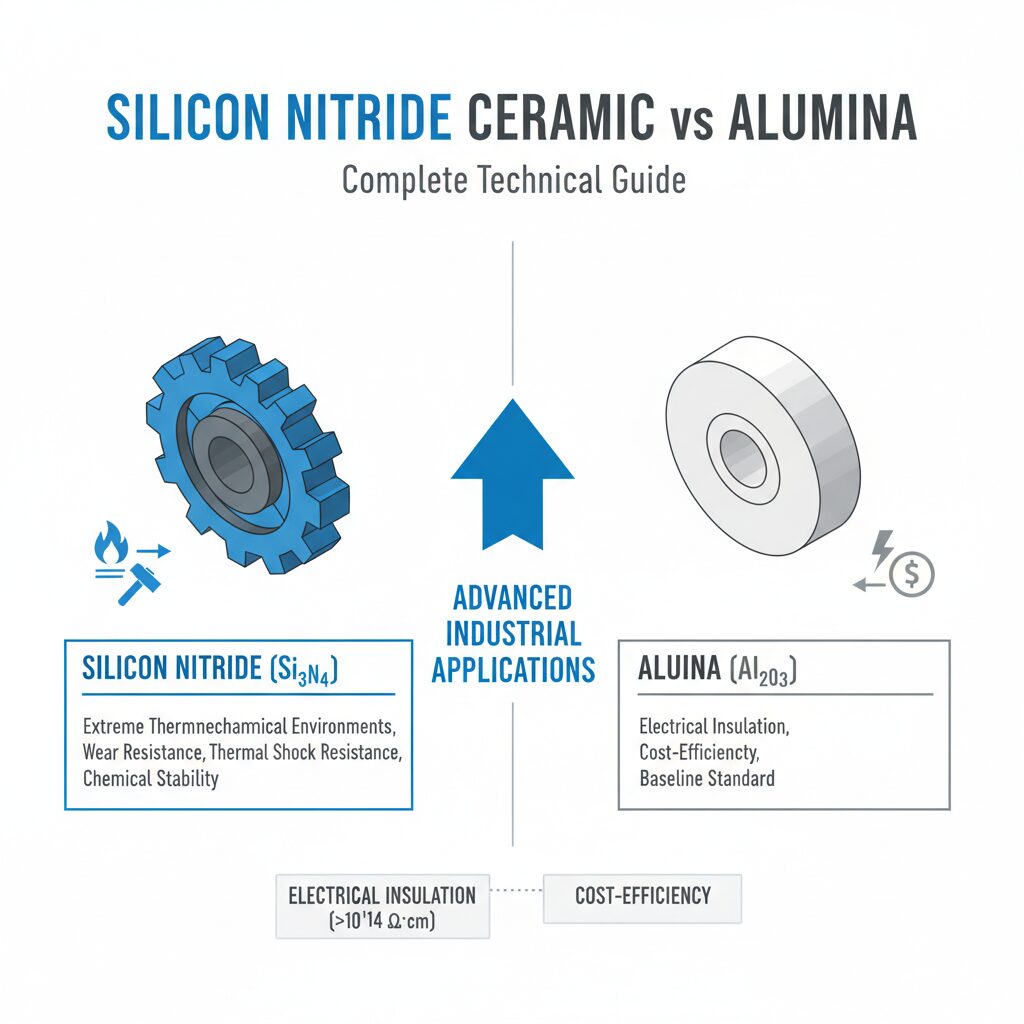
Silicon Nitride vs. Zirconia: Silicon nitride is another high-strength alternative, offering superior thermal shock resistance due to its higher thermal conductivity and lower coefficient of thermal expansion (CTE of 3.2 x 10⁻⁶ /°C vs. Zirconia’s 10.5 x 10⁻⁶ /°C). However, silicon nitride is significantly more expensive to manufacture and machine. Zirconia provides a more cost-effective solution for applications prioritizing impact resistance and room-temperature insulation over extreme thermal shock survival.
Other Thermal Management Alternatives: If the primary function of the insulator is high-power heat dissipation combined with electrical insulation, engineers should instead specify aluminum nitride. This offers an exceptional thermal conductivity of 170-200 W/m·K, vastly outperforming zirconia’s 2.5 W/m·K.
Applications
The unique intersection of high fracture toughness, chemical inertness. And high dielectric strength makes the zirconia ceramic insulator the material of choice for demanding engineering environments. Typical applications require both high-voltage isolation and extreme mechanical resilience.
- Downhole MWD/LWD Telemetry Insulators: In Measurement While Drilling (MWD) and Logging While Drilling (LWD) operations in the oil and gas sector, sensors must be electrically isolated from the drill string. A zirconia ceramic insulator is selected because it withstands hydrostatic pressures exceeding 20,000 PSI, extreme shock/vibration. And abrasive drilling muds, while maintaining signal integrity at temperatures up to 200°C.
- Medical Device Hermetic Feedthroughs: Implantable medical devices, such as pacemakers and neurostimulators, require hermetic seals to isolate internal electronics from bodily fluids. Zirconia is used because of its absolute biocompatibility, 0% porosity. And ability to be brazed to titanium housings, creating a robust, leak-free electrical insulation barrier that survives decade-long implantation.
- High-Power RF/Microwave Connectors: High-frequency communication modules utilize zirconia as structural dielectric supports. It is selected because it maintains dimensional stability under mechanical stress during coaxial cable mating cycles. And its specific dielectric constant (εr ≈ 30) can be precisely calculated into impedance matching networks for miniaturized RF components.
- Automotive & Aerospace Igniter Bodies: Next-generation jet engines and high-performance combustion engines require spark plug and igniter insulators that will not crack under extreme cylinder pressures and vibrational resonance. Zirconia is chosen over standard alumina here specifically for its flexural strength (up to 1200 MPa), preventing the insulator nose from fracturing and causing catastrophic engine failure.
- High-Vacuum (UHV) Electrical Isolators: Mass spectrometers and electron microscopes utilize extreme vacuum chambers (10-10 Torr) requiring sensor feedthroughs. Zirconia is selected because its dense, zero-porosity microstructure prevents outgassing. And its high toughness allows for high-torque metal-to-ceramic sealing via CF (ConFlat) flanges without generating micro-cracks that would compromise the vacuum.
Manufacturing Process
Achieving the optimal mechanical and electrical properties of a zirconia ceramic insulator requires strict control over the entire manufacturing lifecycle. Because zirconia relies on a delicate crystalline phase balance, any deviation in powder preparation, binder burnout, or sintering temperature can result in structural anomalies, compromised electrical resistance, or uncontrolled grain growth.
Forming Methods
The process begins with ultra-high purity sub-micron zirconia powder uniformly mixed with stabilizing agents (like yttria) and organic binders. Depending on the final geometry of the insulator, various forming methods are utilized:
- Cold Isostatic Pressing (CIP): The powder is sealed in an elastomeric mold and subjected to uniform fluid pressure ranging from 200 to 300 MPa. This method yields a highly homogeneous green body with uniform density, ideal for manufacturing long cylindrical insulators, standoff rods. And high-voltage feedthrough tubes.
- Ceramic Injection Molding (CIM): For intricate insulators with internal threads, complex splines, or miniaturized features, the powder is compounded with a thermoplastic binder and injected into a mold under high pressure. This method allows for near-net-shape manufacturing of complex electrical isolating components.
- Dry Pressing: Used for high-volume, flat, or simple geometric insulators (like washers or spacer discs). Uniaxial pressure (typically 50-100 MPa) compresses the granulated powder in a rigid steel die.
Sintering
Following forming, the green bodies undergo a precise thermal de-binding process between 300°C and 600°C to volatilize organic polymers. The insulators are then sintered in high-temperature kilns at temperatures ranging from 1400°C to 1550°C. During this phase, the zirconia particles fuse. And the material densifies to over 99.5% of its theoretical density (typically achieving >6.0 g/cm³). The material shrinks by approximately 20% to 25% linearly during sintering. Controlling the heating and cooling curve is critical. cooling too rapidly can induce residual thermal stresses, while holding at peak temperature too long can cause excessive grain growth. This degrades the fracture toughness and insulating capability.
Final Machining
Because the sintered zirconia ceramic insulator is incredibly hard (1250 HV), standard metalworking tools are entirely ineffective. Final dimensioning requires specialized precision ceramic machining using diamond-impregnated tools. Depending on the application, surfaces may require cylindrical grinding, multi-axis CNC milling, diamond core drilling, or lapping to achieve mirror-like surface finishes (Ra < 0.1 µm) necessary for high-voltage tracking resistance.
Advantages & Limitations
Specifying a zirconia ceramic insulator involves understanding both its unparalleled capabilities and its physical constraints. Engineers must evaluate these factors holistically.
Advantages
- Supreme Mechanical Toughness: With a fracture toughness up to 10 MPa·m½, zirconia is virtually immune to the chipping and cracking that plague standard glass or steatite insulators during assembly, handling. And operation under dynamic loads.
- High Wear Resistance: The extreme hardness (1250 HV) ensures dimensional stability. In dynamic applications where the insulator acts as both an electrical barrier and a mechanical guide (e.g., wire guides, sensor housings), it will not deform or abrade over millions of cycles.
- Excellent Surface Finish Capability: Due to its ultra-fine grain structure (<0.5 µm), zirconia can be polished to extreme tolerances. A high surface finish prevents the accumulation of moisture and conductive contaminants, vastly reducing the risk of high-voltage surface tracking or arc-over.
- Thermal Expansion Compatibility: Zirconia possesses a coefficient of thermal expansion (CTE) of approximately 10.5 x 10⁻⁶ /°C. This closely matches that of several structural metals like steel and iron. This allows for highly reliable shrink-fits, brazed joints. And metal-to-ceramic assemblies with minimal thermal stress.
Limitations
- High-Temperature Conductivity: Above 600°C, the oxygen vacancies in the stabilized zirconia lattice become mobile, turning the material into an ionic conductor. It is strictly limited to low-to-moderate temperature environments for electrical insulation.
- Hydrothermal Degradation (LTD): Low-Temperature Degradation can occur when Y-TZP is exposed to pressurized water or steam at temperatures between 150°C and 300°C for prolonged periods. The moisture triggers an uncontrolled phase transformation back to monoclinic, causing micro-cracking and loss of strength. (Custom grades of alumina-doped zirconia can mitigate this).
- High Density and Weight: At 6.05 g/cm³, zirconia is significantly heavier than alumina (3.9 g/cm³) and silicon carbide (3.1 g/cm³). This can be a limiting factor in weight-sensitive aerospace applications.
Machining Considerations
Manufacturing a zirconia ceramic insulator to strict engineering drawings is exceptionally challenging due to the material’s inherent toughness. While high fracture toughness prevents catastrophic failure in the field, it also actively resists material removal during the machining process, leading to rapid tool wear and high cutting forces.
When engineering high-precision insulators, engineers require extremely tight dimensional tolerances to ensure proper mating in hermetic seals or high-voltage assemblies. Great Ceramic specializes in advanced precision ceramic machining, utilizing state-of-the-art 5-axis CNC grinding centers equipped with resin-bonded and metal-bonded diamond tooling.
To machine zirconia successfully, spindle speeds often exceed 10,000 RPM, combined with precise feed rates (e.g., 5-10 mm/min) and continuous high-pressure water-based coolant application. The coolant is critical not only for clearing diamond-abrasive swarf but also to prevent localized thermal shock. This can induce micro-cracks in the ceramic substrate. Grinding wheel grit sizes must be carefully staged, often stepping down from D107 (coarse) for bulk material removal to D15 (fine) for final finishing.
The table below outlines the precise machining capabilities that Great Ceramic brings to custom insulator manufacturing, directly comparing standard industry tolerances with our advanced capabilities.
| Machining Parameter | Standard Industry Tolerance | Great Ceramic Capability |
|---|---|---|
| Linear Tolerance | ± 0.050 mm | ± 0.005 mm |
| Outer Diameter (OD) | ± 0.020 mm | ± 0.003 mm |
| Inner Diameter (ID) | ± 0.030 mm | ± 0.005 mm |
| Concentricity | 0.050 mm | 0.010 mm |
| Surface Roughness (Ra) | 0.8 µm | 0.05 µm (Polished) |
| Thread Machining | M4 and above | M2 and above (Internal/External) |
Partner with experts in tight-tolerance ceramics. Contact Great Ceramic today for a manufacturability analysis of your zirconia insulator design.
FAQ
What is a zirconia ceramic insulator?
A zirconia ceramic insulator is an electrically isolating component manufactured from advanced yttria-stabilized zirconia (Y-TZP) or partially stabilized zirconia (PSZ). It is utilized in electro-mechanical systems where high electrical resistivity (exceeding 1012 Ω·cm at room temperature) must be combined with extreme mechanical strength. Unlike traditional ceramics which are highly brittle, a zirconia insulator utilizes phase transformation toughening to absorb impact energy, achieving a fracture toughness of 8.5 to 10 MPa·m½. This makes it ideal for high-vibration, high-torque. And high-impact environments where standard glass or alumina insulators would shatter.
What are the main applications of a zirconia ceramic insulator?
Zirconia insulators are predominantly used in critical engineering environments that demand zero failure rates. Main applications include downhole telemetry insulators in the oil and gas industry (withstanding 20,000 PSI and heavy abrasion), hermetic feedthroughs in implantable medical devices (requiring strict biocompatibility and titanium brazing capability). And structural dielectric supports in high-power RF and microwave telecommunications. Furthermore, they are extensively used as high-stress standoffs in vacuum chambers and as durable igniter bodies in advanced aerospace and automotive combustion systems.
How does a zirconia ceramic insulator compare to other ceramics?
Compared to standard 99.5% alumina—the most common ceramic insulator—zirconia provides more than double the fracture toughness and flexural strength, making it vastly superior for press-fit and mechanically stressed applications. However, zirconia is denser (6.05 g/cm³ vs 3.9 g/cm³ for alumina) and typically more expensive. Compared to silicon nitride, zirconia is more cost-effective but has lower thermal conductivity (2.5 W/m·K vs 30+ W/m·K). Crucially, while alumina, silicon nitride. And boron nitride remain excellent insulators at high temperatures, zirconia transitions into an ionic conductor above 600°C, meaning its use as an insulator is strictly limited to low and moderate temperature zones.
What are the advantages of a zirconia ceramic insulator?
The primary advantage is its exceptional “steel-like” mechanical toughness, allowing components to survive heavy impacts, aggressive torquing during assembly. And constant cyclical loading without micro-fracturing. Additionally, its coefficient of thermal expansion (10.5 x 10⁻⁶ /°C) closely aligns with common steels and alloys, facilitating robust metal-to-ceramic joining with minimal residual thermal stress. Zirconia also features near-zero porosity, providing excellent vacuum integrity (outgassing resistance) and moisture barrier properties. This are critical for preventing electrical arcing and surface tracking.
How is a zirconia ceramic insulator machined?
Due to its fired hardness of 1250 HV, a zirconia ceramic insulator cannot be machined using traditional HSS or carbide tooling. Post-sintering, the material must be shaped using precision CNC grinding centers equipped with diamond-impregnated wheels and burrs. This process requires flood coolant to manage heat, highly rigid machine spindles to prevent vibration. And meticulous feed rate control to avoid edge chipping. Great Ceramic specializes in this advanced machining process, utilizing state-of-the-art metrology and multi-axis grinding to deliver custom zirconia insulators with ultra-tight tolerances down to ±0.005mm and mirror-like surface finishes (Ra 0.05 µm) for optimal dielectric performance.
Need custom zirconia ceramic insulator parts? Contact Great Ceramic for precision machining services with tight tolerances, or email [email protected].
Learn more about Zirconia Ceramic Insulator and our precision ceramic machining services.