








Comprehensive Guide to Silicon Nitride Ceramic Applications: Properties, Uses. And Machining
As industrial environments push the limits of temperature, mechanical stress. And chemical exposure, standard metals and polymers frequently fail. Enter Silicon Nitride (Si3N4). Known for its exceptional thermal shock resistance and high fracture toughness, silicon nitride bridges the gap between the brittleness of traditional ceramics and the high-temperature limitations of metallic alloys.
As a senior ceramic materials engineer, I have seen firsthand how transitioning to Si3N4 can eliminate catastrophic system failures. In this comprehensive guide, we will explore advanced silicon nitride ceramic applications, analyze its technical properties. And delve into the critical precision machining methodologies utilized here at Great Ceramic.
What is Silicon Nitride (Si3N4)? A Microstructural Overview
Silicon nitride is an advanced technical ceramic characterized by strong covalent bonding between silicon and nitrogen atoms. Unlike oxide ceramics (like Alumina), Si3N4 does not occur naturally and must be synthesized. It exists primarily in two crystallographic phases:
- Alpha (α) phase: Unstable at high temperatures, typically the starting powder phase.
- Beta (β) phase: The stable phase achieved after sintering. The elongated, interlocking needle-like grain structure of the β-phase is what gives silicon nitride its legendary fracture toughness and mechanical reliability.
Technical Properties of Silicon Nitride
The success of silicon nitride ceramic applications stems from its unique balance of properties. It boasts an incredibly low coefficient of thermal expansion (CTE) coupled with high thermal conductivity, resulting in thermal shock resistance that outperforms nearly all other advanced ceramics.
| Property Category | Specific Property | Typical Value | Unit |
|---|---|---|---|
| Physical | Density | 3.20 – 3.30 | g/cm3 |
| Porosity | 0 | % | |
| Water Absorption | 0 | % | |
| Mechanical | Hardness (Vickers) | 14 – 16 | GPa |
| Fracture Toughness (KIC) | 6.0 – 8.0 | MPa·m1/2 | |
| Flexural Strength (Room Temp) | 800 – 1000 | MPa | |
| Young’s Modulus | 300 – 320 | GPa | |
| Thermal | Maximum Use Temperature | 1200 – 1400 | °C |
| Thermal Conductivity | 20 – 30 | W/m·K | |
| Coefficient of Thermal Expansion (CTE) | 3.2 x 10⁻⁶ | /°C (20-1000°C) |
Core Silicon Nitride Ceramic Applications
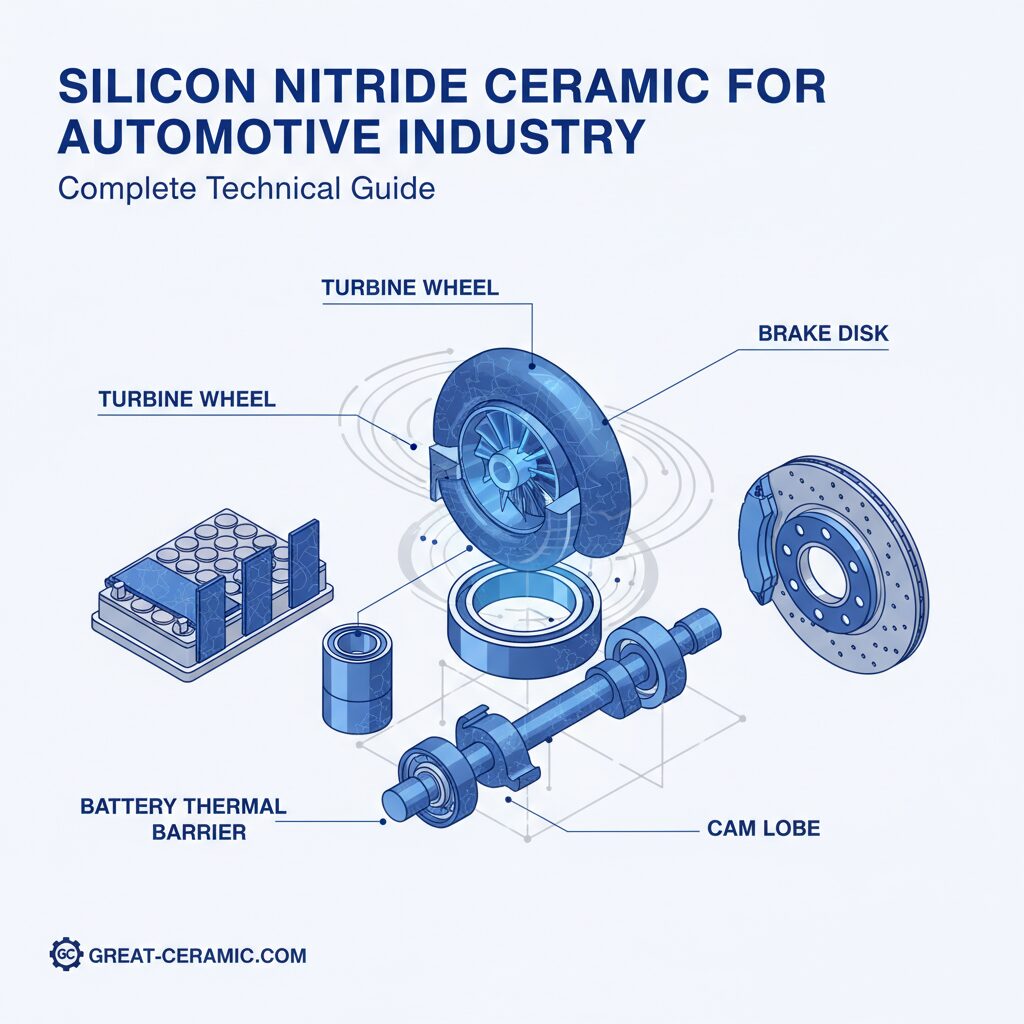
Due to its elite thermomechanical profile, Si3N4 is the material of choice for highly demanding engineering sectors. Below are the most prominent silicon nitride ceramic applications.
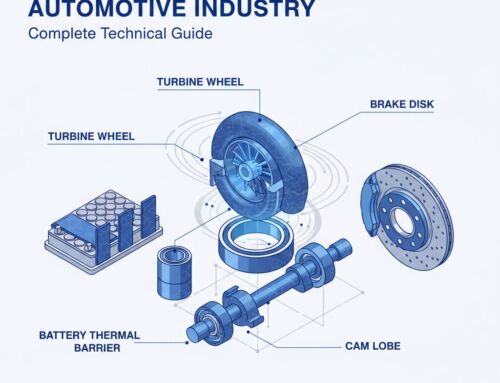
1. Automotive and Aerospace Engineering
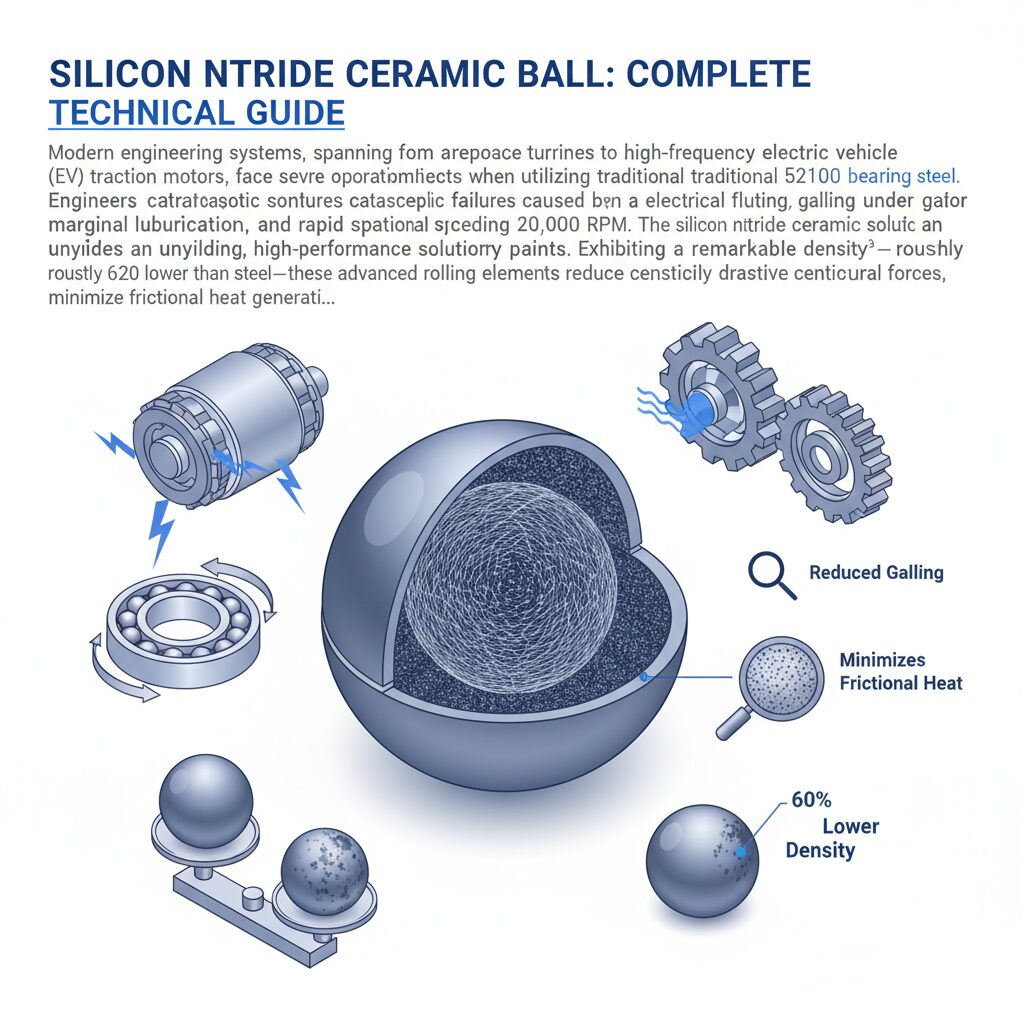
Silicon nitride’s low density (less than half that of steel) and high rolling contact fatigue resistance make it ideal for extreme kinetic applications.
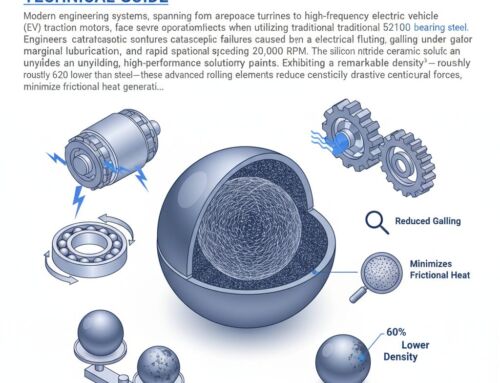
- Ceramic Bearings: Hybrid and full-ceramic bearings used in aerospace turbines and high-performance EV motors. They operate without lubrication, resist galling. And eliminate electrical arcing.
- Engine Components: Glow plugs for diesel engines, turbocharger rotors. And apex seals in rotary engines. Si3N4 reduces rotational inertia, minimizing turbo lag.
2. Semiconductor and Photovoltaic Processing
In wafer manufacturing, contamination and thermal warping are the enemies. Silicon nitride is chemically inert and handles rapid thermal processing (RTP) without micro-cracking.
- Wafer Handling Tools: End effectors, chucks. And susceptors.
- Insulating Components: High-vacuum structural insulators that resist plasma etching.
3. Molten Metal Handling and Metallurgy
Unlike metals, silicon nitride is highly resistant to wetting by molten non-ferrous metals like aluminum, zinc. And lead, making it a staple in the die-casting industry.
- Thermocouple Protection Tubes: Protects temperature sensors in molten aluminum baths, offering years of life compared to cast iron or alumina equivalents.
- Heater Tubes and Degassing Rotors: Used to introduce purification gases into molten alloys without degrading or introducing impurities.
4. Industrial Wear and Metal Forming Components
The interlocking needle-like grain structure gives Si3N4 high fracture toughness, allowing it to withstand severe impacts and abrasive wear.
- Welding Pins and Rollers: Ideal for induction welding. solder and weld spatter will not adhere to the ceramic.
- Cutting Tools: Used for high-speed machining of cast iron and hard nickel-based superalloys.
- Sandblasting Nozzles: Outlasts tungsten carbide nozzles in highly abrasive fluid and pneumatic environments.
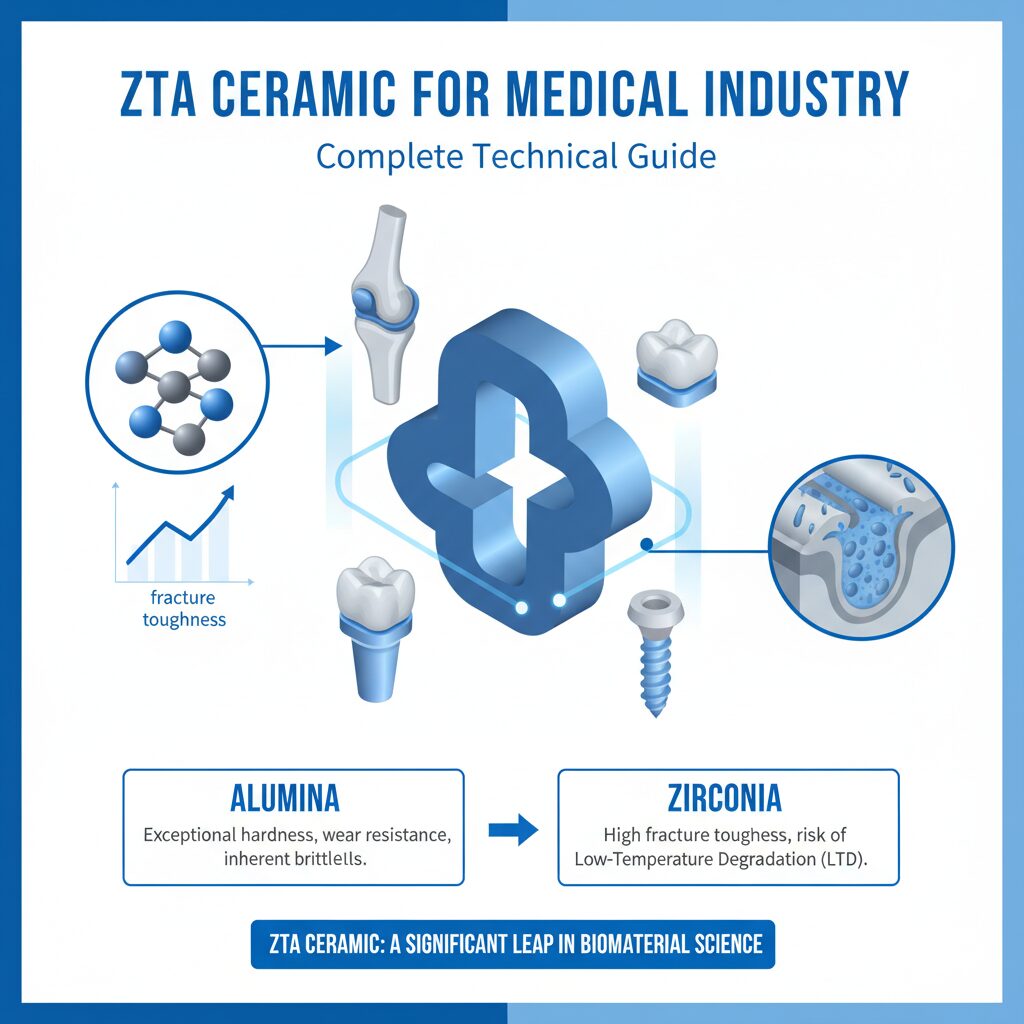
5. Medical and Biochemical Implants
An emerging application for silicon nitride is in the biomedical field. It exhibits unique anti-bacterial properties and excellent biocompatibility.
- Spinal Fusion Devices: Promotes osteointegration (bone growth) while preventing biofilm formation, offering superior outcomes compared to PEEK or titanium.
Precision Machining Considerations for Silicon Nitride
While the hardness of silicon nitride is a massive advantage in its applications, it presents a significant challenge during manufacturing. At Great Ceramic, we specialize in overcoming these barriers through advanced precision ceramic machining techniques.
Engineers must consider the following when designing Si3N4 parts:
- Green Machining vs. Hard Machining: To reduce costs, bulk material removal is performed in the “green” (unfired) state. However, because Si3N4 shrinks up to 20% during sintering, ultra-precise tolerances require post-sintering hard machining.
- Diamond Grinding: Once sintered, silicon nitride can only be machined using specialized diamond-bonded tooling. At Great Ceramic, we utilize 5-axis CNC diamond grinding to achieve surface finishes as fine as Ra 0.1 μm.
- Ultrasonic Machining: For complex geometries, micro-holes, or deep cavities, we employ ultrasonic-assisted machining to reduce tool wear and prevent micro-cracking at the cutting edge.
- Tolerances: Despite the material’s extreme hardness, Great Ceramic can hold tight tolerances up to ± 0.002 mm (2 microns) on critical bearing surfaces and seals.
Silicon Nitride vs. Other Technical Ceramics
To fully understand why engineers choose silicon nitride, it helps to compare it against other standard ceramics:
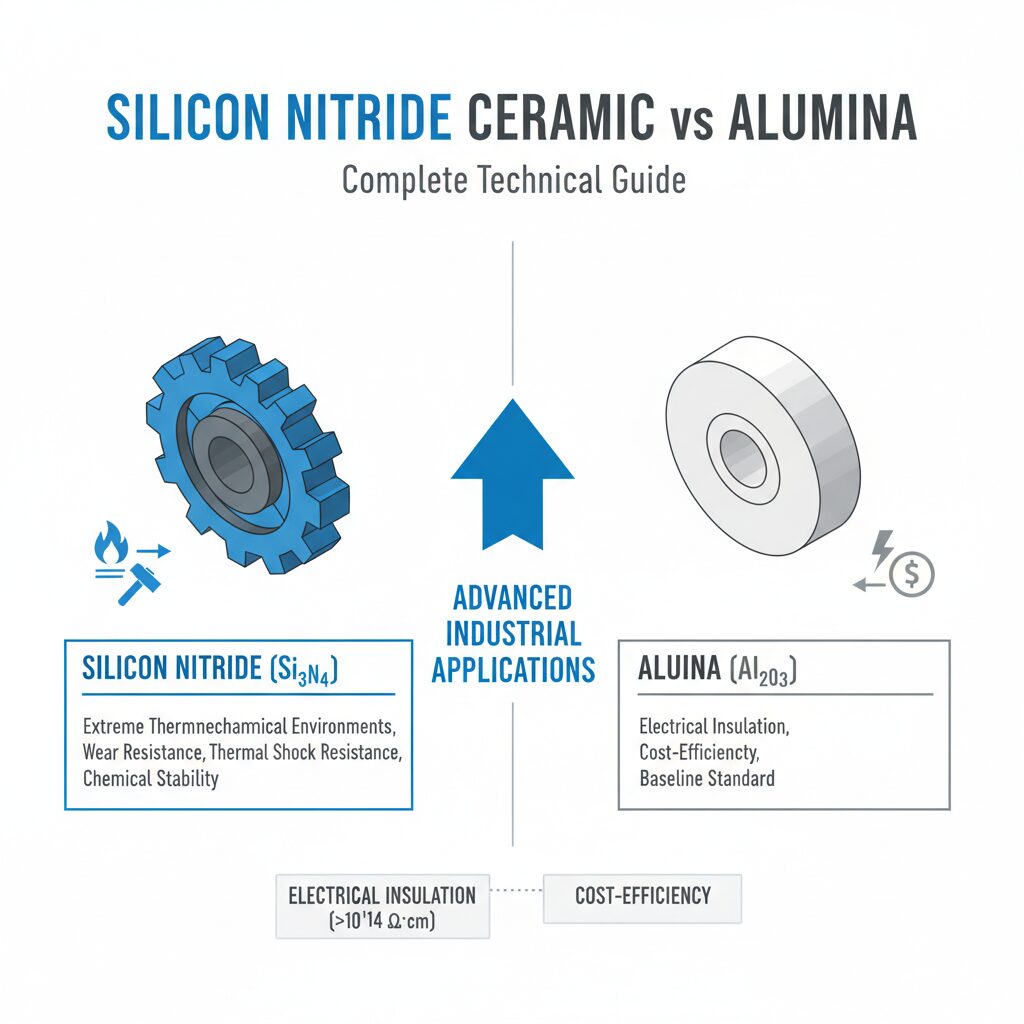
- vs. Alumina (Al2O3): Silicon nitride has vastly superior thermal shock resistance, higher fracture toughness. And better wear resistance. Alumina is cheaper but much more brittle.
- vs. Zirconia (ZrO2): Zirconia has higher fracture toughness at room temperature but rapidly loses strength above 500°C. Si3N4 maintains its strength well past 1000°C and is much lighter.
- vs. Silicon Carbide (SiC): SiC has better thermal conductivity and extreme high-temperature stability (up to 1600°C), but it is much more brittle than Si3N4. Silicon nitride is preferred when impact or dynamic mechanical stress is a factor.
Frequently Asked Questions (FAQ)
1. Is Silicon Nitride electrically conductive?
No, standard silicon nitride is an excellent electrical insulator with high dielectric strength. However, specific grades can be engineered with conductive additives if electro-static discharge (ESD) properties are required.
2. Can Silicon Nitride be threaded?
While internal and external threads can be ground into sintered silicon nitride, it is highly discouraged due to the stress-concentration at the thread roots. This can cause brittle failure. We highly recommend using threaded metal inserts, press fits, or clamping mechanisms instead.
3. Why is Silicon Nitride grey or black?
The color of Si3N4 is typically dark grey to black. This is due to the specific sintering aids (like Yttria or Alumina) added to the powder matrix to help achieve full densification during the liquid-phase sintering process.
4. Is Silicon Nitride more expensive than Alumina?
Yes. Because silicon nitride requires high-purity synthetic powders, complex sintering environments (gas-pressure sintering or hot isostatic pressing). And diamond-grinding for final dimensions, it is significantly more expensive than alumina. It is reserved for high-performance applications where standard ceramics fail.
Partner with Great Ceramic for Precision Silicon Nitride Components
Transitioning from metal to advanced ceramics requires both material science expertise and world-class manufacturing capabilities. At Great Ceramic, we don’t just supply materials. we engineer solutions.
Whether you need thermally stable semiconductor components, wear-resistant automotive bearings, or custom-machined parts for molten metal handling, our team of engineers is ready to assist. With our state-of-the-art diamond grinding and CNC capabilities, Great Ceramic delivers silicon nitride components to your exact geometric and dimensional specifications.
Contact Great Ceramic today to discuss your specific silicon nitride ceramic applications and receive a technical consultation for your next project.
silicon nitride ceramic applications is widely used in advanced ceramic applications.