








Silicon Carbide Ceramic Properties: Complete Technical Guide
When engineers and advanced system designers confront extreme operational environments characterized by severe mechanical wear, sudden thermal shock. And aggressive chemical corrosion, understanding silicon carbide ceramic properties becomes essential. Standard metallics and lower-grade ceramics rapidly degrade under high-velocity particle erosion or temperatures exceeding 1,000°C, leading to catastrophic system failures and costly downtime. Silicon carbide (SiC) stands as the premier engineering solution for these extreme applications, offering an unparalleled combination of extreme hardness (up to 2,800 HV), high thermal conductivity (150 W/m·K). And near-zero chemical reactivity across a pH range of 0 to 14. This complete technical guide explores the fundamental material properties, comparative performance metrics. And strict manufacturing protocols required to yield high-performance SiC components. For engineers requiring exact specifications, Great Ceramic specializes in advanced precision ceramic machining, delivering custom SiC components with ultra-tight tolerances of ±0.005mm to ensure seamless integration into mission-critical R&D and industrial applications. Looking to source high-precision SiC components? Contact our engineering team today for a technical consultation.
Material Properties
The exceptional silicon carbide ceramic properties originate from its highly covalent carbon-silicon chemical bond (88% covalent, 12% ionic) and its dense tetrahedral crystal lattice. This atomic configuration restricts dislocation mobility, translating to extreme macroscopic hardness and stiffness. Engineers must note that SiC exists in several distinct commercial grades—primarily Sintered Silicon Carbide (SSiC) and Reaction Bonded Silicon Carbide (RBSiC)—each exhibiting slightly varied mechanical and thermal baseline values. SSiC is composed of high-purity sub-micron powders without free silicon, providing maximum temperature and chemical resistance. Conversely, RBSiC contains approximately 8-15% free silicon, yielding excellent mechanical strength and near-net-shape manufacturing capabilities due to zero-shrinkage sintering, though its maximum operating temperature is limited by the melting point of silicon (1,350°C). The data below reflects the optimal baseline specifications for high-purity Sintered Silicon Carbide (SSiC), standardizing the metrics required for rigorous finite element analysis (FEA) and mechanical design calculations.
| Property | Value | Unit |
|---|---|---|
| Density | 3.10 – 3.21 | g/cm³ |
| Hardness | 2,500 – 2,800 | HV |
| Flexural Strength | 400 – 550 | MPa |
| Fracture Toughness | 3.5 – 4.5 | MPa·m½ |
| Thermal Conductivity | 120 – 170 | W/m·K |
| Electrical Resistivity | 10² – 10⁶ | Ω·cm |
| Max Working Temperature | 1,600 – 1,650 | °C |
Comparison with Other Ceramics
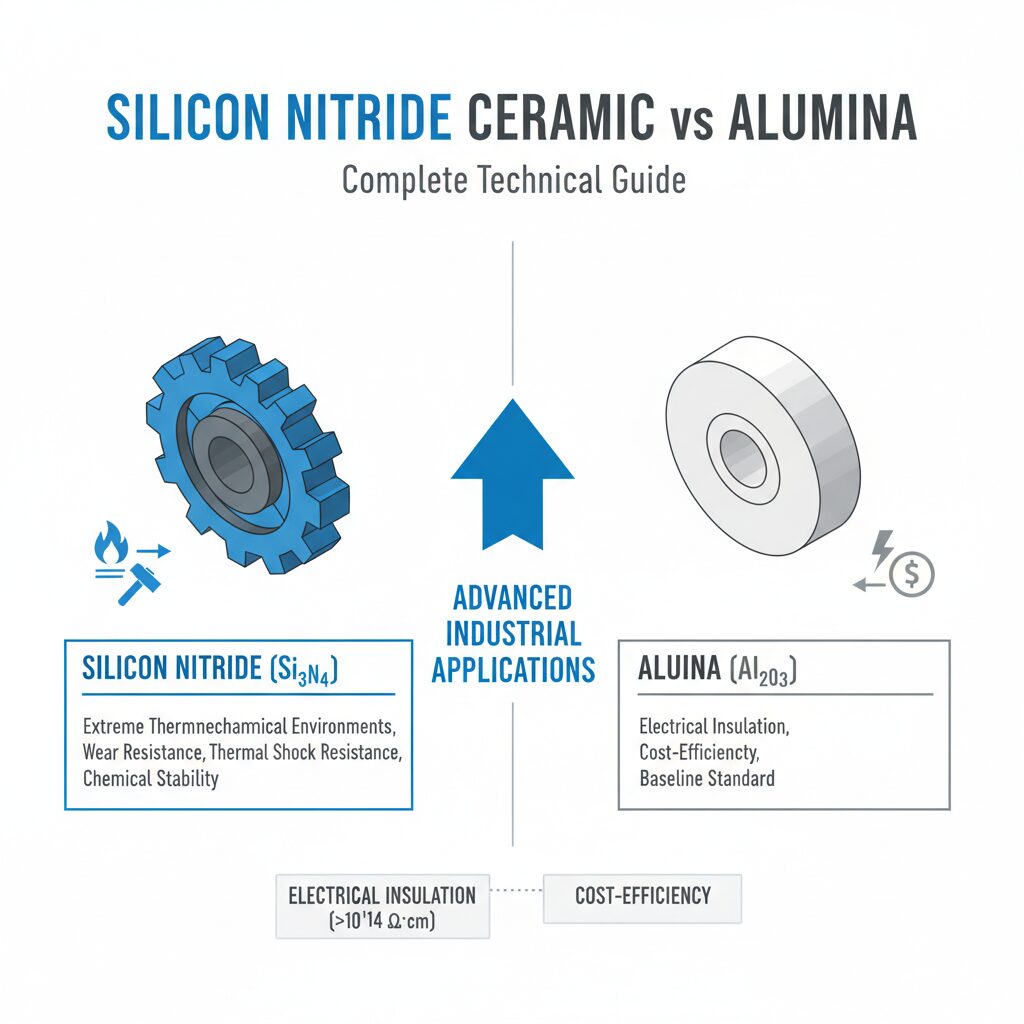
Selecting the optimal technical ceramic requires a data-driven comparison of mechanical and thermal behavior under load. While silicon carbide excels in high-temperature stiffness and thermal transfer, alternative materials like alumina/”>alumina (Al2O3), zirconia (ZrO2). And silicon nitride (Si3N4) offer distinct advantages in other engineering envelopes. For instance, zirconia features a transformation toughening mechanism that yields a fracture toughness of 8.0 – 10.0 MPa·m½, making it highly resistant to impact, whereas SiC remains relatively brittle at 4.0 MPa·m½. However, zirconia’s thermal conductivity is exceptionally low (2-3 W/m·K), causing it to fail rapidly under thermal shock conditions where SiC would effortlessly survive due to its rapid heat dissipation capabilities. Silicon nitride provides an excellent middle ground, offering high fracture toughness (6.0 – 7.0 MPa·m½) alongside moderate thermal conductivity (30 W/m·K), but at a generally higher raw material cost. When extreme dielectric strength and heat transfer are required simultaneously, engineers may also evaluate aluminum nitride (AlN). This boasts thermal conductivity up to 200 W/m·K but lacks the extreme wear resistance of SiC. The following table provides a direct numerical comparison across standard industrial grades to assist in material down-selection.
| Property | Silicon Carbide | Alumina (99.5%) | Zirconia (Y-TZP) | Silicon Nitride |
|---|---|---|---|---|
| Thermal Conductivity (W/m·K) | 150.0 | 30.0 | 2.5 | 30.0 – 80.0 |
| Hardness (HV) | 2,800 | 1,600 | 1,200 | 1,500 – 1,800 |
| Fracture Toughness (MPa·m½) | 4.0 | 4.5 | 9.0 | 6.5 |
| Flexural Strength (MPa) | 450 | 380 | 1,000 | 800 |
| Max Operating Temp (°C) | 1,600 | 1,700 | 1,000 | 1,200 |
| Cost | High | Low | Medium | Very High |
Applications
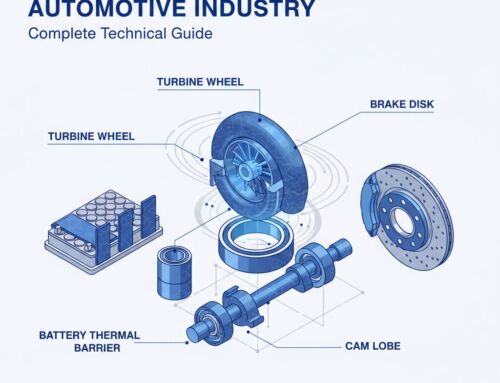
The unique combination of silicon carbide ceramic properties makes it an indispensable material across advanced industrial sectors. By leveraging its extreme thermal conductivity, high wear resistance. And dimensional stability, engineers specify SiC for components that dictate the operational ceiling of entire mechanical systems.
- Semiconductor Manufacturing Equipment: Wafer handling components, chemical mechanical planarization (CMP) rings. And Rapid Thermal Processing (RTP) susceptors rely on SiC. The material’s thermal expansion coefficient (CTE of 4.0 µm/m·K at 20-1000°C) closely matches that of silicon wafers, preventing thermal stress mismatches during high-temperature deposition processes up to 1,200°C. Furthermore, its ultra-high purity prevents heavy metal contamination in the cleanroom environment.
- Industrial Pump Mechanical Seals: In fluid handling systems processing abrasive slurries or highly corrosive acids (such as 98% sulfuric acid or concentrated hydrofluoric acid), SiC seal faces provide unparalleled longevity. The tribological pairings of SiC against SiC or SiC against carbon graphite can withstand dynamic PV (Pressure-Velocity) factors exceeding 1,000 MPa·m/s with volumetric wear rates below 0.1 microns per 100 hours of operation.
- High-Temperature Heat Exchangers: Chemical processing plants utilizing shell-and-tube or block-type heat exchangers specify SiC tubes for their superior thermal transfer. Unlike metallic tubes that suffer severe oxidation and creep deformation above 900°C, SSiC tubes maintain structural integrity up to 1,600°C in oxidizing atmospheres, facilitating highly efficient energy recovery from incinerators and industrial furnaces.
- Advanced Ballistic Armor: Military and law enforcement applications utilize SiC ceramic plates for NIJ Level III and Level IV body armor, as well as vehicular add-on armor. The extreme hardness of SiC (Mohs 9.5) shatters the hardened steel or tungsten carbide cores of armor-piercing projectiles upon impact. Its relatively low density (3.15 g/cm³) significantly reduces the areal density (weight per square meter) of the armor system compared to traditional steel plates, enhancing mobility.
- Precision Aerospace Optics: Space telescopes and advanced targeting mirrors are increasingly manufactured from CVD (Chemical Vapor Deposition) silicon carbide. The material’s extraordinarily high specific stiffness (Young’s Modulus of 410 GPa divided by density) prevents gravitational sagging and distortion during orbital deployment. Additionally, its high thermal conductivity eliminates localized thermal gradients that could cause optical aberrations when exposed to direct solar radiation in low Earth orbit.
Manufacturing Process
Achieving the optimal silicon carbide ceramic properties demands rigorous control over the entire metallurgical and ceramic manufacturing workflow. The synthesis begins with the Acheson process, where high-purity silica sand (SiO2) and petroleum coke (carbon) are reacted in an electrical resistance furnace at extreme temperatures ranging from 2,000°C to 2,500°C. The resulting alpha-SiC ingots are crushed, milled. And chemically purified to produce sub-micron powders with a highly controlled particle size distribution (typically d50 = 0.5 to 1.5 µm). To facilitate consolidation, these crystalline powders are uniformly mixed with organic binders, plasticizers. And proprietary sintering aids (such as boron or carbon for SSiC, or yttria for liquid phase sintering).
Forming Methods
The green body forming stage dictates the initial density and pre-sintering geometry of the component. Selecting the appropriate forming technique depends on the component’s geometry, required production volume. And the acceptable green density gradient.
- Cold Isostatic Pressing (CIP): Utilized for complex, three-dimensional solid geometries, blocks. And cylindrical billets. Granulated SiC powder is sealed in an elastomeric mold and subjected to omnidirectional hydraulic pressure between 200 MPa and 300 MPa. This method ensures highly uniform green density (typically 60-65% theoretical density), significantly minimizing anisotropic shrinkage and internal stress accumulation during the subsequent firing phase.
- Extrusion: Specified for manufacturing continuous profiles, heat exchanger tubes. And thermocouple protection sheaths. The SiC powder is blended into a high-viscosity paste with extensive organic binders (up to 15% by volume) and forced through a precision tungsten carbide die under high pressure. The extruded bodies require careful, humidity-controlled drying to prevent warping and cracking before sintering.
- Slip Casting: Reserved for hollow, thin-walled, or intricate geometries such as pump volutes and cyclone apexes. A stable, low-viscosity aqueous suspension (slip) of SiC powder is poured into a porous plaster mold. Capillary action draws water into the mold, depositing a densely packed layer of ceramic particles along the mold wall. Advanced variants like pressure slip casting apply up to 4 MPa of pressure to accelerate production and increase green density.
Sintering
Sintering is the critical thermal step where the compacted powder coalesces into a solid, high-density ceramic component. For Sintered Silicon Carbide (SSiC), the green bodies are fired in high-vacuum or inert argon atmosphere furnaces at temperatures between 2,100°C and 2,200°C. Solid-state diffusion drives the densification, yielding a final density exceeding 98% of theoretical maximum. Engineers must account for a significant volumetric shrinkage of 15% to 20% during SSiC sintering. In contrast, Reaction Bonded Silicon Carbide (RBSiC) involves infiltrating a porous preform of SiC and carbon with molten silicon at approximately 1,500°C in a vacuum. The liquid silicon reacts with the carbon matrix to form secondary SiC, filling the capillary voids. Because no particle coalescence occurs, RBSiC exhibits near-zero shrinkage (< 1%), allowing for the production of massive, complex geometries with tight as-fired dimensional tolerances.
Final Machining
Due to the massive volumetric shrinkage of SSiC and the geometric distortions inherent in high-temperature firing, the as-sintered components rarely meet the exacting tolerances required by aerospace, semiconductor, or precision mechanical seal applications. Final machining is executed using state-of-the-art multi-axis CNC grinding centers equipped with high-concentration resin-bonded or metal-bonded diamond abrasives. Surface planarization, cylindrical grinding. And internal bore honing are performed at specific feed rates and spindle speeds to remove material via brittle fracture. For optical or ultra-low friction applications, subsequent lapping and polishing stages using 1-micron to 3-micron polycrystalline diamond suspensions can yield surface roughness (Ra) values below 0.05 µm and flatness within one light band (0.3 µm).
Advantages & Limitations
Understanding the strict boundaries of silicon carbide ceramic properties enables engineers to deploy the material effectively while mitigating the risks of catastrophic brittle failure. The material behaves exceptionally well under compressive loads and extreme heat, but requires careful design regarding tensile stresses and point-loading.
Advantages
- Unmatched High-Temperature Oxidation Resistance: Up to 1,600°C in air, SiC reacts with oxygen to form a highly stable, self-healing, continuous passivation layer of silica glass (SiO2) on its surface. This layer retards further oxygen diffusion, preventing deep structural degradation and maintaining mechanical flexural strength where superalloys would rapidly oxidize and fail.
- Exceptional Thermal Shock Resistance: The robust combination of high thermal conductivity (150 W/m·K) and a relatively low coefficient of thermal expansion (4.0 µm/m·K) grants SiC a very high thermal shock parameter (ΔT > 400°C). Components can withstand sudden, severe temperature gradients—such as rapid cooling in quenching applications—without initiating catastrophic crack propagation.
- Extreme Tribological Wear Resistance: With a Vickers hardness of 2,800 HV (Mohs 9.5), SSiC is harder than nearly all naturally occurring substances, second only to diamond and boron carbide. This extreme surface hardness drastically reduces abrasive and adhesive wear in slurry pumps, sandblasting nozzles. And armor plating, extending MTBF (Mean Time Between Failures) by factors of 10 to 50 compared to hardened tool steels.
- Absolute Chemical Inertness: SiC exhibits outstanding corrosion resistance in highly aggressive media. It is totally impervious to all concentrated liquid acids (HCl, H2SO4, HF, HNO3) and strong caustic bases (NaOH) at temperatures boiling up to 200°C. This makes it the ultimate material for chemical process industry (CPI) seals and fluid handling components.
Limitations
- Inherent Brittleness and Low Fracture Toughness: Like all monolithic technical ceramics, SiC possesses a low fracture toughness (3.5 – 4.5 MPa·m½), making it highly susceptible to impact damage and point-loading. The complete lack of plastic deformation means that microscopic surface flaws rapidly propagate into macroscopic cracks under localized tensile stress. Engineers must design components with generous corner radii, avoid sharp internal angles. And implement compliant mounting interfaces (e.g., elastomeric O-rings) to distribute mechanical loads.
- Prohibitive Machining Complexity and Cost: Because SiC can only be machined using diamond abrasives after sintering, the material removal rate (MRR) is extremely slow. Producing complex geometries with tight tolerances results in substantial machining time and high diamond tool wear, driving up the final unit cost. Prototypes and low-volume production runs require significant capital investment compared to machinable ceramics like boron nitride (BN).
Machining Considerations
The extreme hardness that makes silicon carbide so valuable in application simultaneously creates significant challenges in manufacturing. Post-sintering modification is strictly categorized under “hard machining.” Unlike metals where material is removed via continuous ductile shearing (chip formation), SiC material removal is dominated by localized brittle micro-fracturing. If machining parameters are improperly configured, this micro-fracturing penetrates deep into the substrate, creating Sub-Surface Damage (SSD). SSD drastically lowers the flexural strength of the finished component and serves as an initiation point for catastrophic failure under operational stress.
To control SSD and achieve tight tolerances, precision grinding requires specialized kinematical parameters. The table below outlines standard industrial parameters utilized to control the brittle-ductile transition regime during precision ceramic surface grinding:
| Machining Parameter | Rough Grinding Phase | Finish Grinding Phase | Unit |
|---|---|---|---|
| Diamond Grit Size | 100 – 150 (Coarse) | 320 – 400 (Fine) | Mesh |
| Spindle Speed | 20 – 25 | 30 – 35 | m/s |
| Depth of Cut (ap) | 0.010 – 0.020 | 0.002 – 0.005 | mm |
| Table Feed Rate | 2,000 – 3,000 | 500 – 1,000 | mm/min |
| Coolant Pressure | High (Flood) | High (Flood) | – |
In addition to SSD, “edge chipping” or “breakout” is a major defect encountered when the diamond grinding wheel exits the SiC workpiece. To mitigate this, engineers must program precise tool paths, utilize sacrificial backing plates, or implement chamfering operations prior to final planarization. Furthermore, copious amounts of specialized, high-lubricity synthetic coolant must be delivered exactly to the cutting zone. This not only flushes away the abrasive swarf—preventing the diamond wheel from loading and glazing—but also dissipates the extreme localized heat generated by friction, preventing thermal micro-cracking of the ceramic matrix.
Great Ceramic specializes in overcoming these exact manufacturing hurdles. Utilizing state-of-the-art, rigid 5-axis CNC grinding centers, temperature-controlled facilities. And custom diamond tooling matrices, our engineers routinely achieve precision dimensional tolerances of ±0.005mm, cylindricity within 0.002mm. And pristine surface finishes (Ra < 0.05 µm) without compromising the structural integrity of the SiC component. To review your CAD models and tolerance stack-ups with our manufacturing experts, explore our precision ceramic machining capabilities today.
FAQ
What is silicon carbide ceramic?
Silicon carbide (SiC) is an advanced technical ceramic compound consisting of silicon and carbon atoms covalently bonded in a dense tetrahedral crystal lattice. Originally discovered in 1891 during attempts to produce artificial diamonds, it is manufactured synthetically via the high-temperature Acheson process. Industrially, it is renowned for possessing one of the highest hardness ratings of any structural material (Vickers hardness 2800 HV), exceptional thermal conductivity (up to 170 W/m·K). And absolute chemical inertness. It is deployed extensively in engineering environments where conventional metals and low-grade ceramics fail due to extreme temperature, abrasive wear, or corrosive chemical attack.
What are the main applications of silicon carbide ceramic?
Due to its elite thermo-mechanical properties, SiC is heavily utilized in high-stress industrial applications. Major applications include seal faces for high-pressure chemical fluid pumps, rapid thermal processing (RTP) susceptors and wafer chucks in semiconductor manufacturing, high-temperature heat exchanger tubes, blast nozzles. And advanced ballistic armor plates for military applications. Additionally, high-purity CVD silicon carbide is increasingly utilized in the aerospace sector to fabricate ultra-stiff, lightweight mirrors and optical structures for space telescopes, as its extremely low coefficient of thermal expansion prevents distortion in the harsh temperature fluctuations of space.
How does silicon carbide compare to other ceramics?
Silicon carbide distinguishes itself from other technical ceramics primarily through its superior thermal management and extreme hardness. Compared to standard alumina (Al2O3), SiC is nearly twice as hard and offers five times the thermal conductivity, making it far superior for high-wear and thermal shock applications. Compared to zirconia (ZrO2), SiC lacks zirconia’s high fracture toughness (which allows zirconia to resist impact better), but SiC utterly outperforms zirconia in high-temperature structural stability and heat dissipation. Compared to silicon nitride (Si3N4), SiC is harder and more thermally conductive, though silicon nitride generally provides a better balance of mechanical strength and fracture toughness at a higher raw material cost.
What are the advantages of silicon carbide ceramic properties?
The primary advantages of silicon carbide include an exceptionally high operating temperature limit (maintaining mechanical strength up to 1,600°C), superior oxidation resistance due to the formation of a protective silica glass layer at elevated temperatures. And phenomenal tribological performance characterized by minimal friction and wear rates. Furthermore, its high thermal conductivity combined with a low coefficient of thermal expansion yields excellent thermal shock resistance. Chemically, it provides zero porosity and total inertness to aggressive acids and alkalis, ensuring long operational lifespans in corrosive environments that would dissolve standard engineering alloys.
How is silicon carbide machined?
Because its hardness approaches that of diamond, sintered silicon carbide cannot be machined using conventional high-speed steel (HSS) or carbide cutting tools. Post-sintering machining requires rigid CNC grinding centers equipped with diamond-impregnated abrasive wheels. The material is removed through highly controlled, microscopic brittle fracture. To achieve tight tolerances, operations like planar grinding, cylindrical grinding, diamond honing. And lapping are performed at slow feed rates with massive volumes of liquid coolant to prevent thermal cracking and subsurface damage. Great Ceramic possesses advanced precision ceramic machining capabilities, leveraging proprietary diamond tooling to deliver custom SiC parts with dimensional tolerances down to ±0.005mm and optical-grade surface finishes.
Need custom silicon carbide ceramic parts? Contact Great Ceramic for precision machining services with tight tolerances, or email [email protected].
silicon carbide ceramic properties is widely used in advanced ceramic applications.
Learn more about Silicon Carbide Ceramic Properties and our precision ceramic machining services.