








Boron Nitride Ceramic Insulator for Semiconductor: Complete Technical Guide
In the rapidly advancing semiconductor manufacturing industry, the miniaturization of integrated circuits to sub-3nm nodes has introduced severe thermal management and electrical isolation challenges. Traditional insulating materials frequently fail under the extreme environments of vacuum chambers, high-density plasmas. And high-frequency RF applications. A high-purity boron nitride ceramic insulator for semiconductor applications provides the ultimate engineering solution. Hexagonal boron nitride (h-BN), often referred to as “white graphite,” delivers an extraordinary combination of high thermal conductivity (up to 60 W/m·K), exceptionally low dielectric constant (4.0 at 1 MHz). And unparalleled machinability. For engineers combating dielectric breakdown at voltages exceeding 35 kV/mm or managing thermal loads in 1900°C vacuum processing environments, precision-machined boron nitride is indispensable. Great Ceramic specializes in the advanced fabrication and ultra-precise machining of these critical components, holding strict tolerances of ±0.005mm to meet the exacting geometric requirements of modern semiconductor fabrication equipment. If your current insulator components are failing under thermal stress or plasma erosion, upgrading to a custom-machined boron nitride ceramic insulator for semiconductor equipment can dramatically increase your yield and MTBF (Mean Time Between Failures). Need an immediate solution? Contact Great Ceramic for a technical consultation.
Material Properties
The technical performance of a boron nitride ceramic insulator for semiconductor applications is dictated by its unique hexagonal crystal lattice structure. This imparts highly anisotropic properties. Unlike conventionally sintered technical ceramics that require diamond grinding, hot-pressed hexagonal boron nitride exhibits a unique combination of extreme electrical resistivity and softness. At room temperature, high-purity h-BN demonstrates an electrical resistivity exceeding 1014 Ω·cm, ensuring zero leakage current in sensitive microelectronic environments. Furthermore, its dielectric strength of 30 to 40 kV/mm makes it highly resistant to arcing in high-voltage ion implantation equipment. The material also features a very low dissipation factor (loss tangent) of approximately 0.0003 at 1 GHz, making it acoustically and electrically transparent for high-frequency RF wafer testing applications. Thermally, h-BN can operate continuously at 900°C in an oxidizing atmosphere, 1900°C in a vacuum (10-6 Torr). And up to 2100°C in inert environments like argon or nitrogen. Below are the standard mechanical and thermal properties of semiconductor-grade hot-pressed boron nitride.
| Property | Value | Unit |
|---|---|---|
| Density | 1.90 – 2.20 | g/cm³ |
| Hardness | 25 – 35 | HV |
| Flexural Strength | 30 – 80 | MPa |
| Fracture Toughness | 1.0 – 1.5 | MPa·m½ |
| Thermal Conductivity | 30 – 60 | W/m·K |
| Electrical Resistivity | > 10^14 | Ω·cm |
| Max Working Temperature | 1900 (Vacuum) | °C |
It is critical for design engineers to account for the anisotropic nature of hot-pressed boron nitride. Properties vary depending on the direction of the pressing axis during manufacturing. For instance, thermal conductivity can measure up to 60 W/m·K perpendicular to the pressing direction, but only 30 W/m·K parallel to it. Great Ceramic engineers meticulously orient the crystal grain alignment during the machining phase to ensure maximum thermal transfer and mechanical stability for your specific semiconductor application.
Comparison with Other Ceramics
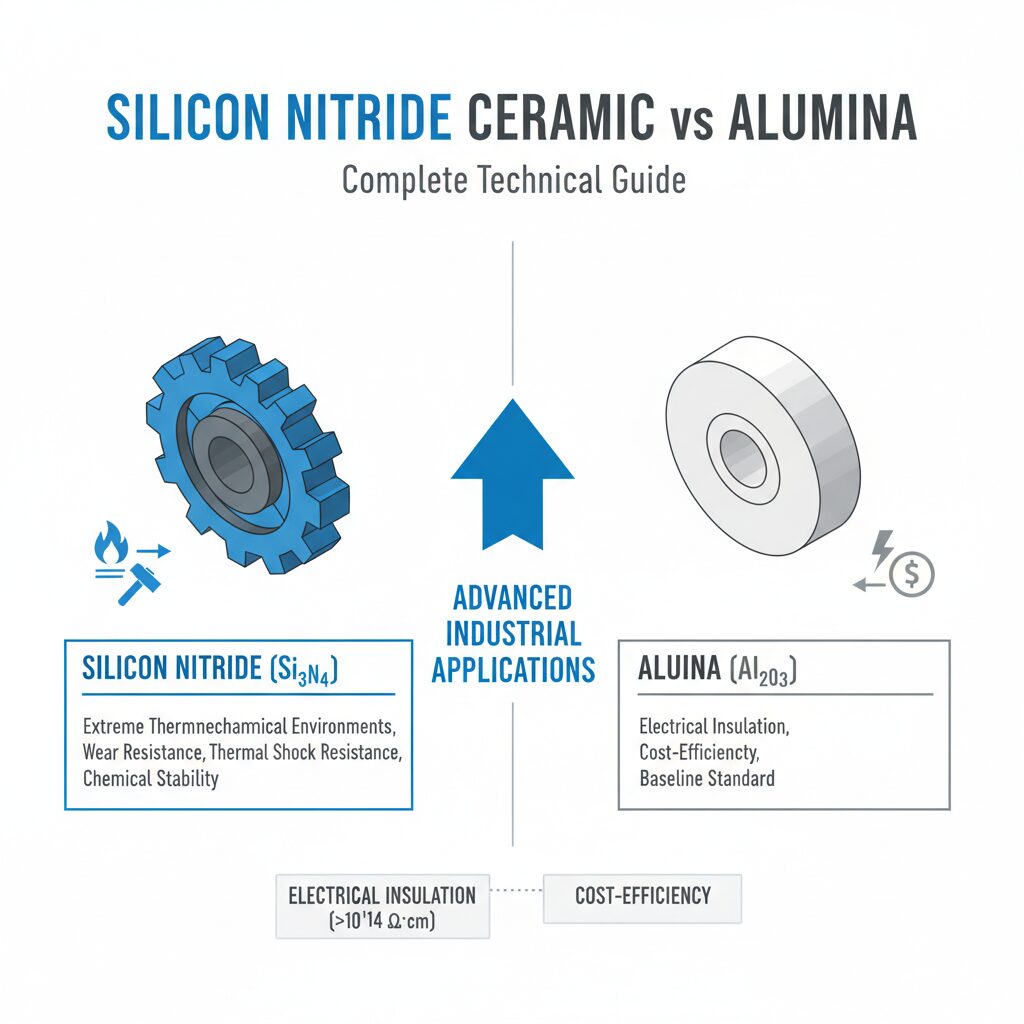
Selecting the correct dielectric material requires a data-driven comparison of thermal, electrical. And mechanical properties. While a boron nitride ceramic insulator for semiconductor applications excels in machinability and thermal shock resistance, other materials may be selected based on structural requirements. For example, alumina/”>alumina is widely used as a cost-effective insulator but falls short in high-frequency applications due to a higher dielectric constant (9.8) and lower thermal shock resistance. When structural rigidity and extreme wear resistance are prioritized over pure machinability, zirconia offers a fracture toughness of 8.0 MPa·m½, though it is an excellent thermal insulator (2.5 W/m·K). This is undesirable when heat dissipation is required. For high-temperature structural components requiring both thermal conductivity and extreme strength, silicon nitride provides an excellent balance, though it lacks the unique self-lubricating and non-wetting properties of boron nitride.
| Property | Boron Nitride Ceramic Insulator | Alumina | Zirconia | Silicon Nitride |
|---|---|---|---|---|
| Thermal Conductivity | 60 W/m·K | 30 W/m·K | 2.5 W/m·K | 30 – 90 W/m·K |
| Hardness | 25 HV | 1500 HV | 1200 HV | 1600 HV |
| Fracture Toughness | 1.5 MPa·m½ | 4.0 MPa·m½ | 8.0 MPa·m½ | 6.5 MPa·m½ |
| Cost | High | Low | Medium | High |
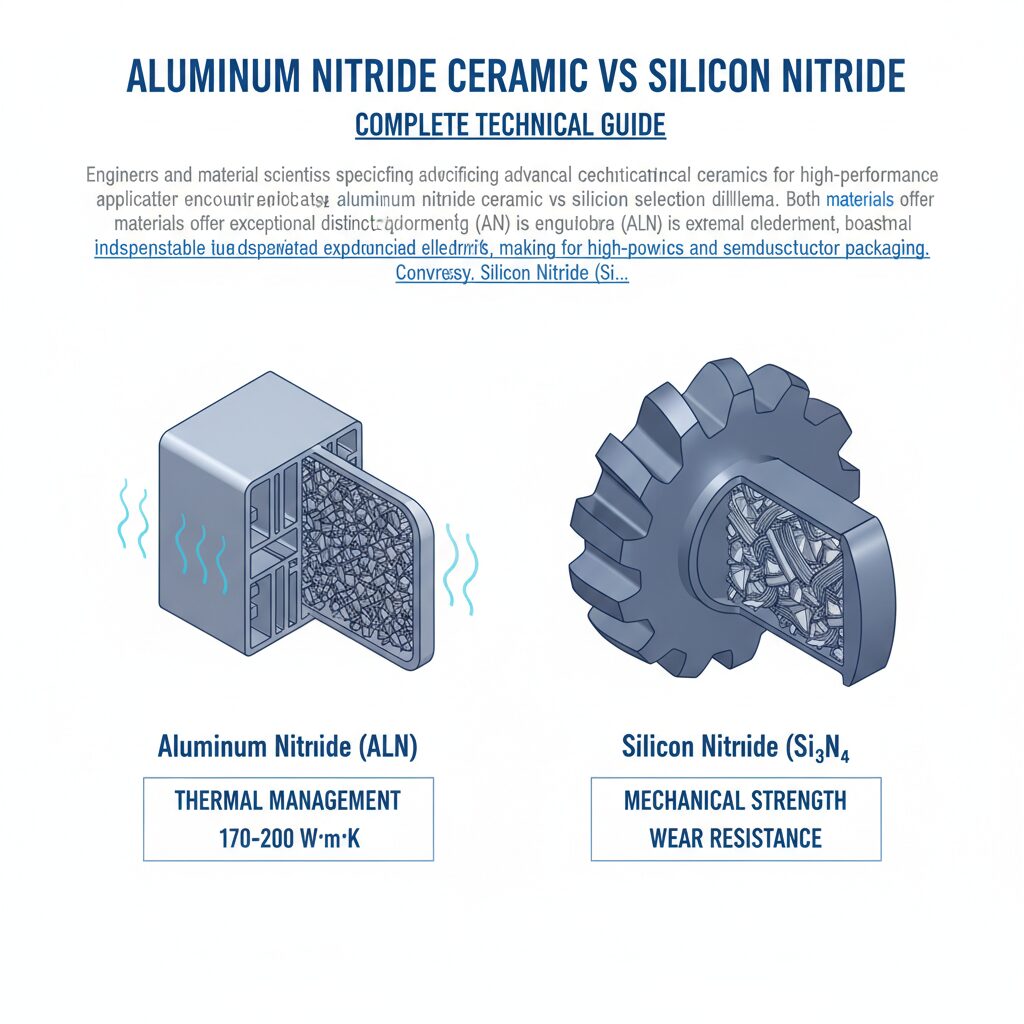
In high-power semiconductor packaging, alternative materials like aluminum nitride (up to 170 W/m·K) or silicon carbide (up to 150 W/m·K) are frequently utilized for purely thermal substrates. However, aluminum nitride is highly susceptible to moisture degradation (hydrolysis) in unsealed environments. And silicon carbide acts as a semiconductor rather than a pure insulator, limiting its use in high-voltage isolation. Boron nitride fills the specific engineering gap where a component must be rapidly custom-machined, highly insulating, thermally conductive. And completely immune to thermal shock at gradients exceeding 1000°C/min.
Applications
- PVD and CVD Equipment Insulators: In Physical Vapor Deposition (PVD) and Chemical Vapor Deposition (CVD) vacuum chambers, plasma environments generate intense heat and corrosive ions. Boron nitride is selected because it withstands temperatures up to 1900°C in vacuum (10-6 Torr) without outgassing. Its exceptional plasma resistance prevents particulate contamination, ensuring defect-free deposition on 300mm silicon wafers.
- Ion Implantation Components: Ion implanters utilize extreme voltages (up to 200 keV) to accelerate dopant ions into the silicon lattice. Boron nitride arc shields and terminal insulators are mandated here because of their massive dielectric strength (>35 kV/mm). Unlike alumina. This can succumb to micro-cracking under intense localized thermal gradients, boron nitride’s thermal shock resistance prevents catastrophic catastrophic failures during high-voltage arcing events.
- High-Power Transistor Heat Sinks: In advanced IGBT modules and high-frequency RF power amplifiers, localized heat fluxes can exceed 500 W/cm². A boron nitride ceramic insulator for semiconductor packaging is chosen because it actively dissipates this heat (60 W/m·K) while providing total electrical isolation (>1014 Ω·cm), preventing short circuits between the silicon die and the grounded metallic chassis.
- Crystal Growth Crucibles and Fixtures: During the Czochralski process or Bridgman method for growing single-crystal silicon or gallium arsenide (GaAs), crucibles must not react with molten metals. Boron nitride is highly non-wetting to molten silicon, aluminum. And gallium at temperatures approaching 1500°C. This prevents crucible degradation and protects the ultra-high purity (99.9999%) of the semiconductor crystal boule from boron or nitrogen contamination.
- Microwave Wafer Testing Fixtures: Advanced automated test equipment (ATE) probing 5G and radar semiconductor chips operates at frequencies of 40 GHz to 100 GHz. Standard insulators cause severe signal attenuation and parasitic capacitance. Boron nitride is the preferred material due to its ultra-low dielectric constant (4.0) and virtually zero dissipation factor (0.0003), allowing microwave signals to pass without distortion or power loss during critical wafer-level testing.
Manufacturing Process
The fabrication of a semiconductor-grade boron nitride insulator is a complex, multi-stage metallurgical and chemical process that dictates the final material’s purity, anisotropy. And mechanical stability. Unlike traditional ceramics that are formed via slip casting or dry pressing and then fired in open-air kilns, high-purity h-BN requires stringent atmospheric control to prevent oxidation and ensure the absolute exclusion of metallic impurities that could cause catastrophic electrical shorts in semiconductor applications. Great Ceramic ensures that every batch of raw material undergoes rigorous particle size distribution analysis and inductively coupled plasma (ICP) mass spectrometry to guarantee trace metal levels remain below 10 parts per million (ppm).
Forming Methods
- Hot Pressing (HP): The predominant method for manufacturing machinable boron nitride billets. High-purity h-BN powder is loaded into graphite dies and subjected to simultaneous high temperature (1800°C to 2000°C) and uniaxial mechanical pressure (15 to 25 MPa). This process aligns the hexagonal plate-like crystals perpendicular to the pressing axis, yielding a highly dense (up to 2.2 g/cm³) and anisotropic material with superior planar thermal conductivity.
- Hot Isostatic Pressing (HIP): For applications demanding isotropic properties and near-theoretical density, the h-BN powder is encapsulated in a sacrificial container and subjected to high-pressure argon gas (up to 200 MPa) at elevated temperatures. While more expensive, this eliminates the directional bias of thermal and mechanical properties, yielding uniform performance across all geometric axes.
Sintering
Unlike alumina or zirconia, pure h-BN powder is exceptionally difficult to sinter due to strong covalent bonding and low self-diffusion coefficients. Consequently, carefully controlled sintering aids, such as boric oxide (B2O3) or calcium borate, are often utilized at levels between 2% and 6%. The sintering process occurs in vacuum or inert nitrogen atmospheres at temperatures ranging from 1800°C to 2100°C. During this phase, grain boundary densification occurs, locking the crystal lattice. For ultra-high-purity semiconductor requirements, specialized binder-less grades are processed at even higher temperatures to volatize completely any remaining oxides, producing an insulator capable of maintaining 1014 Ω·cm resistivity at 500°C.
Final Machining
The true advantage of a boron nitride ceramic insulator for semiconductor equipment is realized in the final machining phase. Unlike hard technical ceramics that require costly and slow diamond-tool grinding, hot-pressed boron nitride boasts a Mohs hardness of approximately 2, allowing it to be machined using standard high-speed steel (HSS), solid carbide, or polycrystalline diamond (PCD) tooling. Milling, turning, drilling. And tapping can be executed with remarkable speed. However, to achieve the ±0.005mm tolerances required by the semiconductor industry, machining must be performed on rigid, high-vibration-damping CNC platforms under strict environmental controls. Because certain grades of BN are hygroscopic, Great Ceramic performs precision ceramic machining in climate-controlled environments entirely without liquid coolants, utilizing specialized high-velocity vacuum dust extraction systems to prevent atmospheric moisture absorption and tool contamination.
Advantages & Limitations
Advantages
- Exceptional Machinability: Complex geometries, micro-holes (down to 0.5mm diameter). And intricate internal threads (M2 and smaller) can be CNC machined rapidly without the risk of micro-cracking inherent in diamond grinding, drastically reducing lead times for custom semiconductor prototypes.
- Superior Thermal Management: With a thermal conductivity reaching 60 W/m·K and an exceedingly low coefficient of thermal expansion (CTE) of 1.2 x 10⁻⁶ /°C, boron nitride insulators can absorb localized heat spikes from high-power components while maintaining strict dimensional stability across broad temperature spectrums.
- Unmatched Dielectric Integrity: Providing a dielectric strength of >35 kV/mm and a volume resistivity exceeding 1014 Ω·cm, the material virtually eliminates the risk of high-voltage arcing, corona discharge. And signal leakage in dense microelectronic assemblies and ion implanters.
- Extreme Thermal Shock Resistance: The low thermal expansion combined with high thermal conductivity allows h-BN to survive instantaneous temperature drops of over 1000°C without fracturing, making it ideal for rapid thermal processing (RTP) chambers and continuous high-heat cycling.
Limitations
- Low Mechanical Strength: With a flexural strength typically ranging between 30 and 80 MPa. And a low fracture toughness of 1.5 MPa·m½, boron nitride is brittle and susceptible to impact damage or excessive torque during assembly. It cannot be used as a primary load-bearing structural component in high-stress mechanical assemblies.
- Hygroscopic Tendencies (Binder Dependent): Standard industrial grades of hot-pressed boron nitride contain boric oxide (B2O3) binders that absorb ambient atmospheric moisture. This absorbed water can degrade dielectric properties and cause rapid catastrophic outgassing in vacuum chambers. High-purity, binder-free semiconductor grades must be specified to negate this issue. This increases raw material costs.
Machining Considerations
While often compared to machining brass or Teflon, precision ceramic machining of a boron nitride ceramic insulator for semiconductor applications presents highly specific tribological and geometric challenges. The primary obstacle is the material’s anisotropy. cutting parallel to the pressing direction yields different tool deflection and chip formation characteristics than cutting perpendicular to it. This anisotropy can cause “tear-out” or severe edge chipping when drills exit the material or when end-mills negotiate sharp 90-degree external corners. To combat this, feed rates must be precisely calibrated (often between 0.05 and 0.15 mm/rev). And tool geometries require high positive rake angles to shear rather than crush the delicate crystal lattice.
Furthermore, because the material is highly abrasive in powder form, the fine dust generated during dry machining acts as a lapping compound, accelerating the wear on standard HSS tooling. This leads to rapid degradation of dimensional accuracy. Great Ceramic mitigates these challenges by employing advanced Polycrystalline Diamond (PCD) coated tooling and specialized continuous-path CNC programming, guaranteeing ultra-tight tolerances of ±0.005mm. Additionally, holding such soft material in standard vise jaws causes immediate deformation. therefore, custom vacuum chucks and conformal soft-jaws are mandatory to secure the part during ultra-precision milling operations. If your design requires intricate features or extreme precision, contact our engineering team to ensure manufacturability and flawless execution.
FAQ
What is a boron nitride ceramic insulator for semiconductor?
A boron nitride ceramic insulator for semiconductor equipment is a high-performance, machinable precision component fabricated from hot-pressed hexagonal boron nitride (h-BN). It is specifically engineered to provide critical electrical isolation, thermal dissipation. And structural support within the harsh environments of microelectronic fabrication. Because the semiconductor industry utilizes extreme high-frequency RF signals, massive voltage potentials. And highly corrosive vacuum plasmas, standard plastics and epoxies immediately disintegrate. Boron nitride serves as the ultimate dielectric barrier, capable of blocking high voltages (>35 kV/mm) and resisting plasma erosion, all while operating flawlessly at temperatures up to 1900°C in vacuum conditions. Its unique ability to be CNC machined to incredibly tight geometric tolerances (±0.005mm) makes it the standard for custom vacuum chamber shields, ion implanter components. And high-density chip testing fixtures.
What are the main applications of a boron nitride ceramic insulator for semiconductor?
The primary applications span across the entire semiconductor manufacturing and testing lifecycle. In the front-end fabrication, they are extensively utilized as arc shields, cathode insulators. And terminal barriers in Ion Implantation systems, where they prevent catastrophic electrical arcing at voltages up to 200 keV. In Physical Vapor Deposition (PVD) and Chemical Vapor Deposition (CVD) equipment, they serve as plasma-resistant insulating standoffs and crucible liners that do not outgas or contaminate silicon wafers. In the back-end assembly and testing phases, their low dielectric constant (4.0) makes them ideal for microwave and RF wafer testing probe fixtures, ensuring zero signal attenuation at 5G frequencies. Additionally, they are used as heat sinks for high-power insulated-gate bipolar transistors (IGBTs), efficiently pulling heat away from the silicon die at rates up to 60 W/m·K while maintaining absolute electrical isolation.
How does a boron nitride ceramic insulator for semiconductor compare to other ceramics?
When compared to widely used technical ceramics, boron nitride stands alone in its combination of extreme machinability and specific dielectric properties. While alumina is harder (1500 HV) and significantly cheaper, it is difficult to machine, prone to thermal shock failure at high temperature gradients. And possesses a higher dielectric constant (9.8) that disrupts high-frequency RF signals. Silicon nitride offers superior mechanical strength and fracture toughness (6.5 MPa·m½) for structural components but cannot match boron nitride’s ease of fabrication for complex prototype iterations. Aluminum nitride provides vastly superior thermal conductivity (up to 170 W/m·K) but requires diamond grinding and is highly susceptible to moisture degradation. Boron nitride is selected when a combination of rapid custom CNC machining, zero thermal shock failure. And absolute RF electrical transparency is mandated by the engineering specification.
What are the advantages of a boron nitride ceramic insulator for semiconductor?
The foremost advantage is its unparalleled machinability. Unlike conventional fired ceramics that require costly, time-consuming diamond grinding post-sintering, h-BN can be rapidly CNC machined, drilled. And threaded using standard tooling, drastically accelerating R&D prototyping cycles. Thermally, its high conductivity (60 W/m·K) and ultra-low coefficient of thermal expansion (1.2 x 10⁻⁶ /°C) grant it extreme thermal shock resistance, allowing it to survive rapid temperature fluctuations from ambient to 1000°C instantaneously without fracturing. Electrically, it offers an immense volume resistivity (>1014 Ω·cm) and a high dielectric breakdown strength (>35 kV/mm), completely preventing electrical leakage. Furthermore, high-purity grades exhibit zero outgassing in ultra-high vacuum (UHV) environments, ensuring the 300mm silicon wafers remain free from metallic or particulate contamination during processing.
How is a boron nitride ceramic insulator for semiconductor machined?
Due to its low Mohs hardness (~2), h-BN is processed using precision ceramic machining techniques that more closely resemble the milling of aerospace polymers than traditional hard ceramics. However, achieving semiconductor-grade tolerances requires immense expertise. The material is machined completely dry to prevent the absorption of liquid coolants, utilizing high-velocity vacuum systems to evacuate the highly abrasive dust. Specialized high-speed spindles and Polycrystalline Diamond (PCD) end-mills are deployed to prevent tool wear and maintain sharp edge geometries without chipping. Because the material is highly anisotropic and structurally soft, Great Ceramic engineers design custom vacuum workholding fixtures to prevent the component from flexing or crushing under clamping pressure. By precisely controlling cutting speeds, feed rates. And depth of cut, Great Ceramic consistently achieves critical dimensional tolerances of ±0.005mm and pristine surface finishes for the most demanding semiconductor applications.
Need custom boron nitride ceramic insulator for semiconductor parts? Contact Great Ceramic for precision machining services with tight tolerances, or email [email protected].
boron nitride ceramic insulator for semiconductor is widely used in advanced ceramic applications.
Learn more about Boron Nitride Ceramic Insulator For Semiconductor and our precision ceramic machining services.