








“`html
Comprehensive Guide to Aluminum Nitride Ceramic Properties, Applications. And Machining
In the realm of advanced technical ceramics, engineers frequently face a critical trade-off: materials that conduct heat efficiently typically conduct electricity as well, while excellent electrical insulators act as thermal bottlenecks. Aluminum Nitride (AlN) breaks this paradigm. By offering an exceptional combination of high thermal conductivity and robust electrical insulation, AlN has become an indispensable material in modern high-power electronics and semiconductor manufacturing.
As a leading authority in advanced material processing, Great Ceramic specializes in the precision machining of technical ceramics. In this comprehensive engineering guide, we will dive deep into aluminum nitride ceramic properties, its crystalline advantages, machining challenges. And industrial applications.
What is Aluminum Nitride (AlN) Ceramic?
Aluminum Nitride is a covalently bonded technical ceramic synthesized from the abundant elements aluminum and nitrogen. It crystallizes in a hexagonal wurtzite lattice structure. Because heat in dielectric solids is conducted via lattice vibrations (phonons), the relatively simple and tightly bound crystal structure of AlN allows phonons to propagate with minimal scattering. This fundamental atomic structure is the driving force behind its extraordinary thermal management capabilities.
Deep Dive: Key Aluminum Nitride Ceramic Properties
To understand why AlN is chosen over legacy materials like Alumina (Al₂O₃) or hazardous materials like Beryllium Oxide (BeO), we must examine its properties from a materials engineering perspective.
1. Exceptional Thermal Properties
The standout feature of AlN is its thermal conductivity. This ranges from 170 to 230 W/m·K depending on the sintering aids (such as Yttria) and the density of the final ceramic body. This is roughly 5 to 7 times higher than standard alumina.
Furthermore, AlN boasts a Coefficient of Thermal Expansion (CTE) of approximately 4.5 µm/m·K at ambient temperatures. This closely matches the CTE of Silicon (Si) and Gallium Arsenide (GaAs). This close matching is critical in semiconductor packaging, as it minimizes thermally induced mechanical stress and prevents solder joint fatigue during power cycling.
2. Superior Electrical Insulation
AlN is a wide-bandgap semiconductor that functions as a highly effective dielectric. It offers a high volume resistivity (> 1014 Ω·cm) and a high dielectric strength (typically 15-20 kV/mm). Additionally, its low dielectric constant (~8.8 at 1 MHz) reduces signal propagation delay in high-frequency RF and microwave applications.
3. Mechanical and Physical Characteristics
While slightly less dense than alumina, AlN is exceptionally hard and rigid. With a Vickers hardness of approximately 1200 kg/mm² and a Young’s Modulus of 320 GPa, it provides excellent structural integrity for thin substrates and complex structural components.
4. Chemical Stability
AlN exhibits high resistance to molten metals (like aluminum and gallium) and most semiconductor processing gases. However, at elevated temperatures in an oxygen-rich environment (above 800°C), an oxidation layer of aluminum oxide will form on the surface. While this oxide layer protects the bulk material, it can degrade the material’s thermal conductivity.
Technical Specifications: Aluminum Nitride Properties Table
Below is a comprehensive engineering data table detailing standard aluminum nitride ceramic properties. (Note: Exact values vary based on the specific grade and manufacturing process utilized).
| Property | Unit | Typical Value (AlN) |
|---|---|---|
| Density | g/cm³ | 3.26 – 3.30 |
| Water Absorption | % | 0.00 (Fully Dense) |
| Thermal Conductivity (at 20°C) | W/m·K | 170 – 230 |
| Coefficient of Thermal Expansion (20 – 400°C) | 10⁻⁶/°C | 4.5 – 4.6 |
| Volume Resistivity (at 20°C) | Ω·cm | > 10¹⁴ |
| Dielectric Constant (1 MHz) | – | 8.8 – 9.0 |
| Dielectric Strength | kV/mm | 15 – 18 |
| Flexural Strength (Bending) | MPa | 300 – 350 |
| Young’s Modulus | GPa | 320 – 330 |
| Vickers Hardness (Hv) | GPa | 11 – 12 |
| Maximum Operating Temperature (Inert) | °C | > 1600 |
| Maximum Operating Temperature (Air) | °C | 800 – 900 |
Primary Applications of AlN Ceramics
Because of its unique thermal and electrical profile, Aluminum Nitride is highly sought after for demanding industrial and electronic applications:
- Power Electronics & IGBT Modules: Used as Direct Bonded Copper (DBC) or Active Metal Brazed (AMB) substrates to dissipate massive heat loads from high-power traction inverters in EVs and wind turbines.
- Semiconductor Manufacturing: Utilized in electrostatic chucks, heater plates. And wafer handling components where thermal uniformity, plasma resistance. And CTE matching to silicon wafers are mandatory.
- Optoelectronics & LEDs: Acts as a heat sink submount for high-brightness LEDs and laser diodes, prolonging device lifespan by efficiently drawing heat away from the junction.
- RF & Microwave Packaging: High-frequency communications components benefit from AlN’s low dielectric loss tangent and ability to keep high-power RF chips cool.
Machining Considerations for Aluminum Nitride
Realizing the full potential of AlN components requires high-precision manufacturing. However, AlN poses severe challenges to conventional machining. As an expert in technical ceramic manufacturing, Great Ceramic employs specialized techniques to overcome these hurdles.
Challenges in AlN Machining
Like most technical ceramics, AlN is highly brittle and susceptible to micro-fracturing and chipping during machining. Furthermore, there is a unique chemical challenge: fine AlN dust and swarf generated during grinding can react with water (hydrolysis) to form aluminum hydroxide and ammonia gas (NH₃). This requires highly specialized coolant systems and handling protocols during wet machining.
Great Ceramic’s Precision Capabilities
To achieve tight tolerances, extreme flatness. And pristine surface finishes on AlN, Great Ceramic utilizes:
- Diamond-Tooled Grinding & Milling: We use ultra-hard diamond abrasives formulated specifically for brittle covalent materials, minimizing subsurface damage.
- Advanced Lapping & Polishing: For semiconductor chucks and substrates, we achieve optical-level flatness and sub-micron surface roughness (Ra) through multi-stage planetary lapping.
- Specialized Coolant Management: We utilize non-aqueous coolants or heavily modified synthetic fluids with rigorous exhaust and filtration systems to prevent hydrolysis and ensure a pristine machining environment.
- Laser Machining: For thin substrates, we utilize precision laser scribing and via-drilling to prevent the mechanical stress associated with traditional drilling tools.
Frequently Asked Questions (FAQ)
Is Aluminum Nitride toxic?
No, Aluminum Nitride is non-toxic in its solid form. It is widely considered the safe, eco-friendly replacement for Beryllium Oxide (BeO). This possesses similar thermal properties but poses severe health risks (berylliosis) when its dust is inhaled. (Note: Care must still be taken by machinists handling raw AlN powder due to the potential ammonia release upon contact with moisture).
Can Aluminum Nitride be metallized?
Yes. Although highly chemically stable, AlN can be successfully metallized using thick film technology (screen printing conductive pastes), thin film deposition (sputtering), or Active Metal Brazing (AMB). This metallization is crucial for soldering electronic components directly to the ceramic substrate.
How does AlN compare to Alumina (Al₂O₃)?
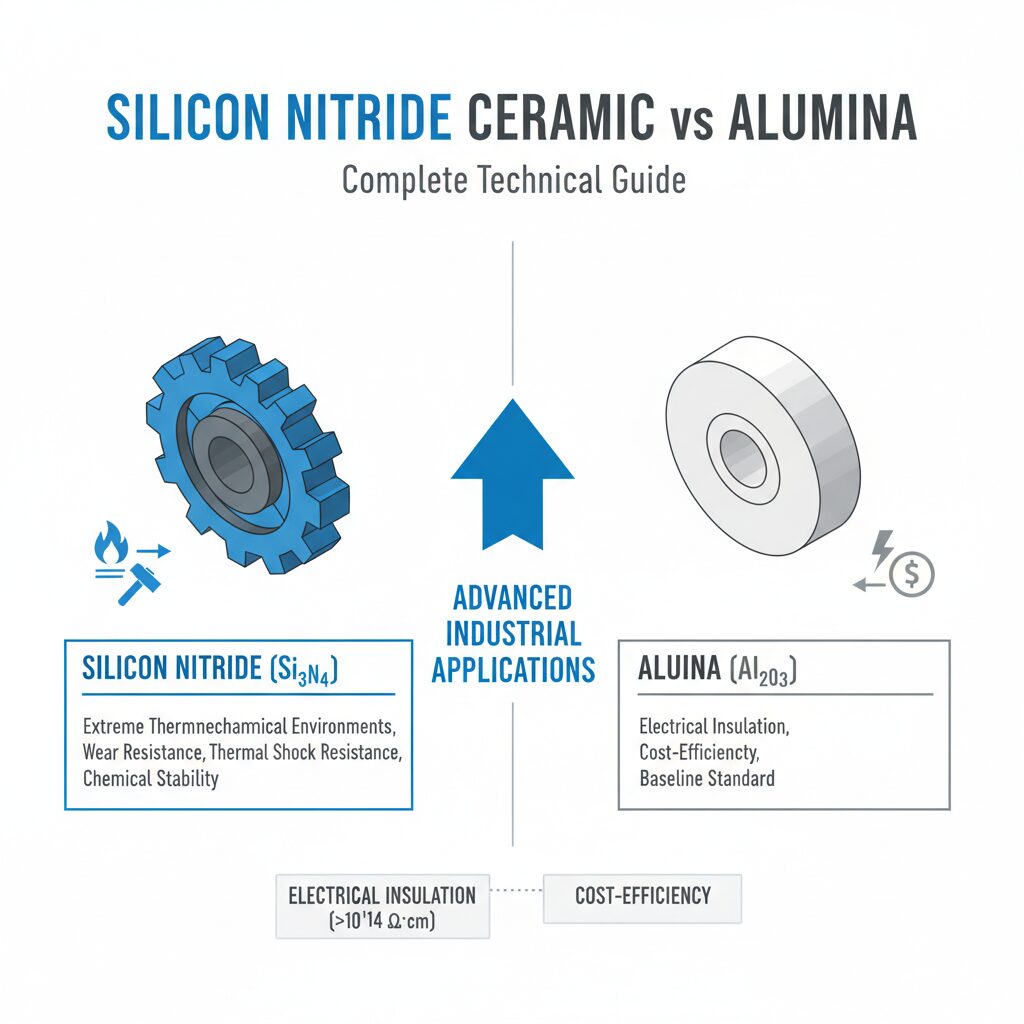
While Alumina is cheaper and sufficient for general applications, AlN boasts a thermal conductivity that is roughly 5 to 7 times higher than standard 96% Alumina. Furthermore, AlN’s thermal expansion coefficient is much closer to Silicon, making it vastly superior for high-end semiconductor applications.
Why is Aluminum Nitride black or grey sometimes?
Pure, ultra-high-grade AlN can be translucent or off-white. However, industrial AlN often appears grey, dark grey, or black. This is usually due to the addition of specific sintering aids (like yttrium oxide or carbon) used to increase thermal conductivity or to deliberately make the material opaque for optical sensor applications.
Partner with Great Ceramic for Your AlN Projects
Understanding aluminum nitride ceramic properties is only the first step. Engineering these highly resilient materials into complex, micro-precision components requires an experienced manufacturing partner. With state-of-the-art CNC grinding, lapping. And metallization capabilities, Great Ceramic is your trusted source for custom Aluminum Nitride solutions.
Contact Great Ceramic today to discuss your blueprints, thermal management requirements. And how we can bring your next high-power electronic design to life through precision ceramic machining.
“`
aluminum nitride ceramic properties is widely used in advanced ceramic applications.