








Advanced Alumina Ceramic Insulator for Medical Applications: A Complete Engineering Guide
In the rapidly advancing field of medical technology, the demand for highly reliable, biocompatible. And electrically insulating materials is at an all-time high. An alumina-ceramic/”>alumina ceramic insulator for medical applications provides the critical barrier needed to protect sensitive electronic components, patient tissue. And medical personnel from high voltages and stray currents.
Unlike standard industrial polymers or low-grade ceramics, medical-grade aluminum oxide (Al₂O₃) offers an unparalleled combination of dielectric strength, chemical inertness. And mechanical durability. At Great Ceramic, we specialize in the precision ceramic machining required to transform high-purity alumina into life-saving medical components with zero-defect tolerances.
Why Medical Devices Rely on High-Purity Alumina (Al₂O₃)
The transition from plastics to advanced technical ceramics in medical device manufacturing is driven by three core engineering requirements: dielectric reliability, biocompatibility. And sterilization endurance.
1. Superior Dielectric Strength
Medical-grade alumina exhibits a volume resistivity exceeding 1014 Ω·cm and a dielectric strength greater than 15 kV/mm. This prevents electrical leakage in high-voltage applications such as X-ray generation and ensures signal integrity in micro-electronic implants.
2. Total Biocompatibility (ISO 10993)
High-purity alumina (99.5% and above) is chemically inert. It does not degrade in the presence of bodily fluids, nor does it release toxic ions. This makes it a preferred material for Class III implantable devices, complying strictly with ISO 10993 standards for cytotoxicity, sensitization. And implantation.
3. Sterilization Degradation Immunity
Unlike medical polymers (like PEEK or PTFE) that can degrade, discolor, or embrittle after repeated sterilization cycles, an alumina ceramic insulator remains structurally and electrically unchanged through thousands of autoclave (steam), ethylene oxide (EtO), gamma radiation, or electron-beam sterilization cycles.
Material Properties Table: Medical-Grade Alumina
For medical insulators, engineers typically specify high-purity alumina (99.5% to 99.8%) to eliminate glassy phases that could compromise electrical insulation or hermetic sealing. Below are the standard mechanical and electrical properties.
| Property | Unit | 99.5% Alumina (Al₂O₃) | 99.8% Alumina (Al₂O₃) |
|---|---|---|---|
| Density | g/cm³ | 3.89 | 3.92 |
| Water Absorption | % | 0.00 (Impervious) | 0.00 (Impervious) |
| Flexural Strength | MPa | 350 | 380 |
| Compressive Strength | MPa | 2,400 | 2,600 |
| Vickers Hardness | HV | 1,700 | 1,800 |
| Dielectric Strength (AC) | kV/mm | 15.0 | 16.5 |
| Volume Resistivity (at 20°C) | Ω·cm | > 1014 | > 1015 |
| Dielectric Constant (1 MHz) | – | 9.8 | 9.9 |
| Biocompatibility | – | ISO 10993 Compliant | ISO 10993 Compliant |
Key Applications of Alumina Ceramic Insulators in Medical Devices
Because of its unique property matrix, an alumina ceramic insulator for medical use is frequently engineered into the following critical applications:
- Implantable Feedthroughs: Used in pacemakers, implantable cardioverter-defibrillators (ICDs). And neuromodulation devices. Alumina is brazed to titanium or platinum pins to create hermetic seals that isolate electrical signals while preventing body fluid ingress.
- Electrosurgical Instruments: High-frequency RF ablation tools and cauterization scalpels utilize alumina tips and insulating sleeves. The ceramic prevents electrical arcing to non-target tissues and withstands localized plasma temperatures.
- Medical Imaging (X-Ray & MRI): X-ray tubes require high-voltage insulators to separate the cathode and anode (often operating at >100 kV). Alumina provides the necessary vacuum-tight structural insulation.
- Endoscopic and Surgical Tool Components: Insulating rings, spacers. And ceramic washers are used to electrically isolate the handles of surgical instruments from their active surgical tips.
Precision Machining Considerations for Medical Alumina
Designing a medical ceramic component is only half the battle. manufacturing it to medical industry tolerances is where the true challenge lies. Because alumina reaches a 9 on the Mohs hardness scale (second only to diamond), precision machining requires specialized expertise.
At Great Ceramic, we employ advanced machining strategies to overcome these challenges:
- Green Machining: To reduce costs and lead times, we CNC machine alumina in its “green” (unfired) state. We apply precise mathematical shrinkage models to account for the 15-20% volume reduction that occurs during sintering.
- Hard Grinding & Diamond Tooling: For ultra-tight tolerances (down to ±0.002mm) required for hermetic implantable seals, post-sintering machining is necessary. We utilize 5-axis CNC diamond grinding, honing. And lapping to achieve exact geometric dimensioning and tolerancing (GD&T).
- Surface Finish Control: Medical implants often require specific surface roughness parameters (Ra) to either promote tissue integration or prevent bacterial adhesion. We can polish alumina insulators to sub-micron Ra levels.
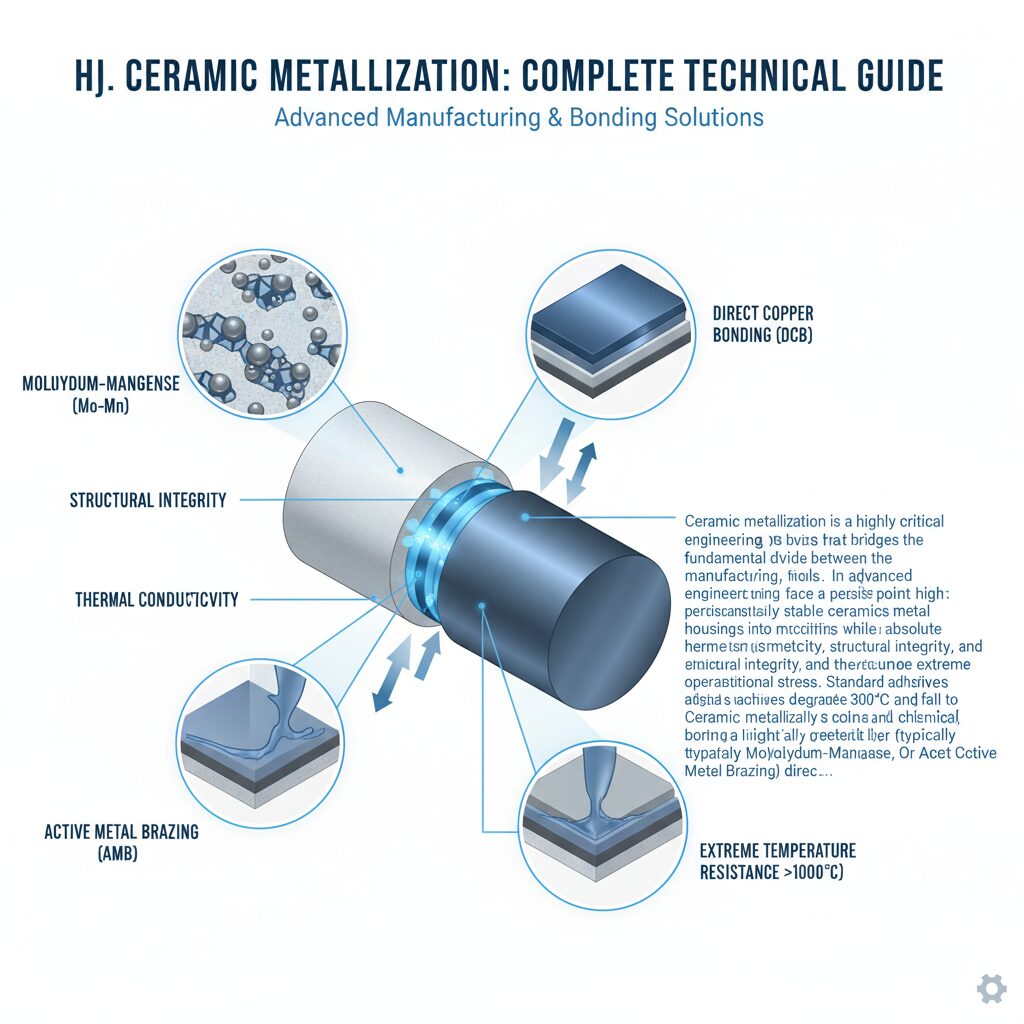
- Metallization: For insulators that must be brazed to metal housings (like titanium), we provide specialized Mo-Mn (Molybdenum-Manganese) metallization and nickel plating on the ceramic surface.
Engineering Design Guidelines (Adding Reliability to Your Parts)
To optimize the manufacturability and performance of your alumina ceramic insulator for medical use, keep these design principles in mind:
- Avoid Sharp Internal Corners: Ceramics are notch-sensitive. Use internal radii (minimum 0.5mm) to distribute mechanical stress and prevent micro-cracking during assembly.
- Optimize Wall Thickness: Maintain uniform wall thicknesses wherever possible to prevent uneven shrinkage and warping during the sintering process.
- Design for Grinding: If tight tolerances require post-fire diamond grinding, ensure the design allows tooling access. Avoid blind holes with square bottoms.
Frequently Asked Questions (FAQ)
1. What is the difference between 95% and 99.8% alumina for medical insulators?
Lower purity alumina (95%) contains silica and other glass-forming binders. While easier to metallize and machine, these glassy phases can leach trace impurities and have lower dielectric strength. For Class II and III medical devices, especially long-term implants, 99.5% to 99.8% high-purity alumina is required to guarantee strict biocompatibility and superior electrical insulation.
2. Is alumina ceramic radiopaque?
Yes, alumina has a relatively high density (approx. 3.9 g/cm³), making it inherently radiopaque. This is highly beneficial in the medical field, as it allows surgeons to easily visualize the ceramic insulator under fluoroscopy or standard X-ray during and after implantation.
3. Can alumina ceramic insulators be hermetically sealed to titanium?
Yes. By applying a refractory metal coating (metallization) to the specific areas of the alumina insulator, it can be brazed to titanium, platinum, or Kovar. This creates a vacuum-tight, hermetic seal essential for implantable batteries and microelectronics.
4. How does Great Ceramic ensure the quality of medical ceramic parts?
Great Ceramic utilizes rigorous quality control protocols, including CMM (Coordinate Measuring Machine) inspections, strict raw material batch tracing. And ultrasonic cleaning to ensure that every alumina ceramic insulator for medical applications is dimensionally perfect and free of contaminants.
Partner with Great Ceramic for Your Medical Device Needs
The performance of an alumina ceramic insulator for medical applications directly impacts patient safety and device efficacy. Do not leave your manufacturing to chance. With decades of expertise in technical ceramics and precision machining, Great Ceramic is your trusted partner for prototyping and scaling high-purity medical ceramic components.
Contact our engineering team today to discuss your blueprints, metallization needs. And tolerance requirements.
Learn more about Alumina Ceramic Insulator For Medical and our precision ceramic machining services.