







Ceramiczne podłoże z azotku boru: Kompletny przewodnik techniczny
W nowoczesnej elektronice dużej mocy, przetwarzaniu półprzewodników. W inżynierii lotniczej i kosmicznej, zarządzanie temperaturą coraz gęstszych obwodów jest krytycznym wąskim gardłem operacyjnym. Temperatury robocze rutynowo przekraczają 150°C w modułach RF wysokiej częstotliwości, podczas gdy ekstremalne środowiska produkcji półprzewodników wymagają ciągłej stabilności w temperaturze do 1900°C w warunkach próżni. Układy azotek boru podłoże ceramiczne stał się ostatecznym rozwiązaniem inżynieryjnym dla tych ekstremalnych wyzwań termicznych i dielektrycznych. W przeciwieństwie do konwencjonalnej ceramiki technicznej, heksagonalny azotek boru (h-BN) oferuje niezwykle rzadką kombinację właściwości: działa jako wysoce wydajny przewodnik ciepła (do 60 W/m-K), zapewniając jednocześnie wyjątkową izolację elektryczną (rezystywność objętościowa >10¹⁴ Ω-cm). Podłoże ceramiczne z azotku boru, często nazywane “białym grafitem” ze względu na jego heksagonalną sieć krystaliczną i właściwości smarne, zapewnia niezrównaną obrabialność, umożliwiając uzyskanie bardzo złożonych geometrii bez konieczności kosztownego szlifowania diamentowego po spiekaniu.
Wykorzystanie pełnego potencjału podłoża ceramicznego z azotku boru wymaga jednak wyjątkowej wiedzy w zakresie produkcji. Ponieważ materiał ten jest wyjątkowo miękki (typowa twardość 20-30 HV) i ma niską odporność na pękanie wynoszącą około 1,0 MPa-m½, standardowe metody mocowania CNC i oprzyrządowania często prowadzą do katastrofalnych mikropęknięć, odprysków krawędzi lub wypaczeń wymiarowych. Great Ceramic wypełnia tę lukę poprzez wykorzystanie zaawansowanego precyzyjna obróbka ceramiki do produkcji niestandardowych podłoży z azotku boru o gwarantowanych wąskich tolerancjach ±0,005 mm, zapewniających bezbłędną integrację z zespołami o znaczeniu krytycznym.
Doświadczasz wąskich gardeł w zarządzaniu termicznym w swojej aplikacji półprzewodnikowej lub RF? Prześlij swoje pliki CAD do Great Ceramic już dziś, aby uzyskać precyzyjnie obrobione podłoża z azotku boru dostarczane z dokładnością ±0,005 mm.
Właściwości materiałów
Zrozumienie dokładnych właściwości fizycznych i termicznych ceramicznego podłoża z azotku boru jest niezbędne dla właściwej integracji inżynieryjnej. Poniższe dane przedstawiają standardowy heksagonalny azotek boru (h-BN) tłoczony na gorąco, opracowany specjalnie do zastosowań w wysokiej próżni i wysokiej temperaturze. I ultra-wysokich częstotliwości. Ponieważ h-BN ma wyraźnie anizotropową strukturę krystaliczną - kowalencyjnie związane atomy boru i azotu w płaskim układzie sześciokątnym sp² utrzymywane razem przez słabe siły van der Waalsa - jego właściwości różnią się nieznacznie w zależności od kierunku prasowania. Poniższe wartości odzwierciedlają podstawowe dane izotropowe lub prostopadłe do nacisku.
| Nieruchomość | Wartość | Jednostka |
|---|---|---|
| Gęstość | 2.10 | g/cm³ |
| Twardość | 30 | HV |
| Wytrzymałość na zginanie | 35 | MPa |
| Wytrzymałość na złamania | 1.0 | MPa-m½ |
| Przewodność cieplna | 60 | W/m-K |
| Rezystywność elektryczna | > 1.0 × 10¹⁴ | Ω-cm |
| Maksymalna temperatura robocza | 1900 (próżnia) | °C |
Teoretyczna gęstość całkowicie gęstego h-BN wynosi około 2,27 g/cm³, ale wysokiej jakości podłoża ceramiczne z azotku boru tłoczone na gorąco są zwykle projektowane do gęstości między 1,90 a 2,15 g/cm³, aby zrównoważyć integralność mechaniczną z najwyższą skrawalnością. Materiał ten charakteryzuje się niezwykle niską stałą dielektryczną wynoszącą około 4,0 przy 1 MHz, a także współczynnikiem rozpraszania (styczną strat) poniżej 0,0003 przy 10 GHz. Sprawia to, że podłoże jest zasadniczo przezroczyste dla sygnałów mikrofalowych i RF o wysokiej częstotliwości, zapobiegając tłumieniu sygnału i wewnętrznemu wytwarzaniu ciepła. Co więcej, jego współczynnik rozszerzalności cieplnej (CTE) jest ściśle zbliżony do współczynnika rozszerzalności krzemu - rejestrując między 2,5 a 3,5 × 10-⁶ /°C - zapewniając, że cykle termiczne między -50°C a +200°C nie wywołują niszczących naprężeń ścinających na styku półprzewodnik-podłoże.
Porównanie z innymi materiałami ceramicznymi
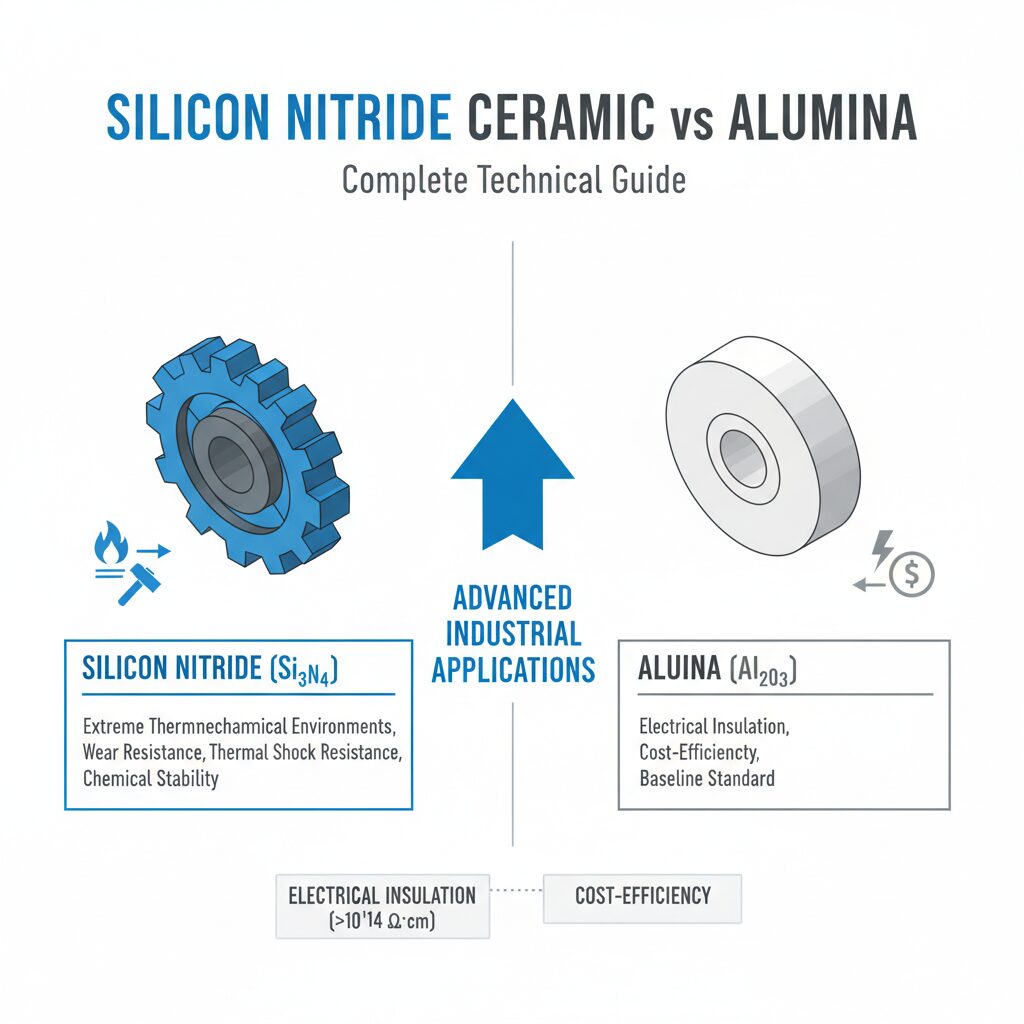
Inżynierowie muszą krytycznie ocenić ceramiczne podłoże z azotku boru w porównaniu z innymi ceramicznymi materiałami konstrukcyjnymi, aby uzasadnić jego zastosowanie. Podczas gdy jego koszt bazowy jest wyższy, eliminacja konieczności szlifowania diamentowego po spiekaniu często zmniejsza całkowity koszt geometryczny nawet o 40% w przypadku bardzo skomplikowanych części. Aby zapewnić obiektywny punkt odniesienia, porównujemy standardowy azotek boru prasowany na gorąco z trzema innymi dominującymi materiałami przemysłowymi: tlenek glinu/”>aluminium (99.5% Al₂O₃), cyrkonia (Y-TZP). I azotek krzemu (Si₃N₄).
| Nieruchomość | Azotek boru | Tlenek glinu | Cyrkon | Azotek krzemu |
|---|---|---|---|---|
| Przewodność cieplna (W/m-K) | 60.0 | 30.0 | 2.5 | 30.0 |
| Twardość (HV) | 30 | 1500 | 1200 | 1600 |
| Wytrzymałość na złamanie (MPa-m½) | 1.0 | 4.0 | 10.0 | 6.5 |
| Koszt | Wysoki | Niski | Średni | Wysoki |
Podczas projektowania radiatorów o dużej mocy, tlenek glinu jest często domyślnym wyborem ze względu na niski koszt i wysoką sztywność strukturalną (wytrzymałość na zginanie 350 MPa). Jednak ceramiczne podłoże z azotku boru zapewnia dokładnie dwukrotnie wyższą przewodność cieplną niż standardowy tlenek glinu (60 W/m-K vs. 30 W/m-K) i charakteryzuje się znacznie niższą stałą dielektryczną (4,0 vs. 9,8), zapobiegając opóźnieniom pojemnościowym w obwodach RF. Jeśli wymagana jest maksymalna wydajność termiczna, inżynierowie mogą rozważyć azotek aluminium (który osiąga do 170 W/m-K), ale AlN jest wyjątkowo twardy i trudny do obróbki w mikroskali geometrii bez kosztów wybuchowych.
Podobnie, cyrkonia oferuje niezrównaną odporność na pękanie (10,0 MPa-m½), co czyni go najlepszym wyborem dla elementów konstrukcyjnych o dużej udarności. Jednak jego przewodność cieplna wynosi fatalne 2,5 W/m-K, działając raczej jako izolator termiczny niż rozpraszacz, co natychmiast dyskwalifikuje go z zastosowań w radiatorach półprzewodnikowych. Z drugiej strony, azotek krzemu jest znakomitym materiałem pośrednim do zastosowań konstrukcyjnych w warunkach wysokich naprężeń i wysokich temperatur (często wykorzystywanym w ciężkich zastosowaniach łożysk lotniczych), ale nie może konkurować z czystą skrawalnością, ekstremalną wytrzymałością na temperaturę próżni (do 1900°C). i ekstremalną smarownością czystego heksagonalnego azotku boru. W przypadku komponentów wymagających złożonych mikrokanałów, bardzo wąskich tolerancji (±0,005 mm). I ekstremalnej odporności na zwilżanie stopionym metalem, ceramiczne podłoże z azotku boru pozostaje niekwestionowanym liderem technicznym.
Aplikacje
Unikalna struktura krystaliczna i wynikające z niej właściwości termodynamiczne ceramicznego podłoża z azotku boru sprawiają, że jest on niezbędny w wielu sektorach inżynierii o wysokiej stawce. Jego zdolność do jednoczesnego odprowadzania ciepła z aktywnych złączy przy jednoczesnym blokowaniu prądu elektrycznego i odporności na ekstremalny szok termiczny dyktuje jego użycie w następujących głównych zastosowaniach:
- Sprzęt do przetwarzania płytek półprzewodnikowych: Szeroko stosowane jako uchwyty, pierścienie zaciskowe. Oraz osłony plazmowe w komorach chemicznego osadzania z fazy gazowej (CVD) i fizycznego osadzania z fazy gazowej (PVD). Ceramiczne podłoże z azotku boru rozwija się tutaj, ponieważ pozostaje chemicznie obojętne do 1900°C w środowiskach o wysokiej próżni (<10-⁶ Torr) i nie wydziela zanieczyszczeń, które mogłyby zatruć ultra czyste wafle krzemowe.
- Elektronika mikrofalowa i RF wysokiej częstotliwości: Stosowane jako podłoża montażowe, okna radarowe. Oraz wsporniki lamp o fali bieżącej (TWT). Szczególny wybór tego materiału wynika z jego niewiarygodnie niskiej stałej dielektrycznej (4,0) i praktycznie nieistniejącej stycznej strat (<0,0003 przy 10 GHz), co zapewnia minimalne przesunięcie fazowe sygnału i brak pasożytniczej absorpcji energii mikrofalowej.
- Elektronika mocy i moduły chłodzenia IGBT: Wykorzystywany jako główne podłoże rozprowadzające ciepło między matrycami z węglika krzemu (SiC) lub azotku galu (GaN) o ekstremalnej mocy a metalowymi radiatorami. Inżynierowie wybierają go, ponieważ jego przewodność cieplna 60 W/m-K agresywnie pobiera ciepło z gęstości mocy przekraczającej 150 W/cm², podczas gdy jego rezystywność >10¹⁴ Ω-cm zapewnia, że katastrofalne wyładowanie łukowe nie wystąpi nawet przy gradientach napięcia 40 kV/mm.
- Tygle do odparowywania OLED i paneli wyświetlaczy: Obrabiane maszynowo w wysoce skomplikowanych dyszach ogniw wylotowych i tyglach źródłowych stosowanych w odparowywaniu próżniowym. Ceramiczne podłoże z azotku boru zostało wybrane, ponieważ jest całkowicie odporne na zwilżanie przez stopione metale, takie jak aluminium, miedź. I specjalistyczne związki organiczne, zapewniając, że tygiel nie pęka podczas cykli chłodzenia z powodu niedopasowanych współczynników CTE zestalonych stopów.
- Wysokotemperaturowe mocowanie w przemyśle lotniczym: Stosowane jako izolatory strukturalne, dysze pędników. Obudowy czujników w technologiach satelitarnych i napędowych. Zdolność materiału do wytrzymania natychmiastowego szoku termicznego - przetrwania natychmiastowych spadków z 1500°C do temperatury pokojowej bez katastrofalnych pęknięć (ze względu na niski moduł Younga wynoszący ~90 GPa) - czyni go obowiązkowym zabezpieczeniem w systemach orbitalnych.
Proces produkcji
Tworzenie podłoża ceramicznego z azotku boru o wysokiej czystości jest skomplikowanym procesem metalurgicznym i chemicznym, który wyraźnie kontrastuje ze standardowym zagęszczaniem proszku i spiekaniem w fazie ciekłej wykorzystywanym w przypadku konwencjonalnej ceramiki technicznej. Ponieważ wiązania kowalencyjne w sieci h-BN są niezwykle silne, materiał ten ma współczynnik dyfuzji bliski zeru nawet w podwyższonych temperaturach, co oznacza, że nie zagęści się naturalnie bez zastosowania ekstremalnego ciśnienia zewnętrznego i wysoce specyficznej chemii spoiwa.
Metody formowania
- Tłoczenie na gorąco (HP): Jest to dominująca komercyjna metoda produkcji nadających się do obróbki kęsów azotku boru. Proszek h-BN o wysokiej czystości jest mieszany ze starannie kontrolowaną ilością fazy wiążącej (często tlenku boru, B₂O₃ lub boranu wapnia) i ładowany do grafitowych matryc. Matryca jest umieszczana w piecu indukcyjnym i poddawana jednoosiowemu prasowaniu mechanicznemu pod ciśnieniem około 20-30 MPa, przy jednoczesnym podgrzewaniu do temperatury od 1800°C do 2000°C w atmosferze obojętnego azotu lub argonu. Powoduje to wyrównanie sześciokątnych płytek prostopadle do kierunku prasowania, wywołując charakterystyczne anizotropowe właściwości termiczne.
- Chemiczne osadzanie z fazy gazowej (CVD): W przypadku zastosowań o bardzo wysokiej czystości, wymagających braku spoiw, pirolityczny azotek boru (PBN) jest syntetyzowany metodą CVD. Gazowa mieszanina trójchlorku boru (BCl₃) i amoniaku (NH₃) jest wprowadzana do komory reakcyjnej o wysokiej próżni w temperaturze 1900°C. Gazy reagują i osadzają się cząsteczka po cząsteczce na rozgrzanym grafitowym trzpieniu, uzyskując anizotropowe podłoże o oszałamiającej teoretycznej czystości 99,999% i znacznie wyższej anizotropowej przewodności cieplnej (do 120 W/m-K w kierunku płaskim).
Spiekanie
W przeciwieństwie do standardowej ceramiki, takiej jak węglik krzemu. Azotek boru może być poddawany spiekaniu bezciśnieniowemu, natomiast azotek boru opiera się na “spiekaniu w stanie stałym wspomaganym ciśnieniem”. Wysokie temperatury (1800°C+) zmiękczają śladowe fazy B₂O₃, działając jako chwilowy strumień, który pozwala odrębnym ziarnom azotku boru przesuwać się i zazębiać. Po schłodzeniu materiał jest w pełni ustabilizowany. Kontrolowanie dokładnej resztkowej zawartości B₂O₃ ma kluczowe znaczenie. Podłoża niższej jakości mogą zawierać do 4% B₂O₃. Poważnie pogarsza to odporność na wilgoć, podczas gdy zaawansowane podłoża klasy elektronicznej utrzymują tę fazę ściśle poniżej 0,5%, aby zapewnić maksymalną stabilność dielektryczną w wilgotnym środowisku.
Obróbka końcowa
Po wyjęciu masywnych spiekanych kęsów z gorącej prasy, są one dzielone i frezowane do ostatecznej formy ceramicznego podłoża z azotku boru. Ze względu na miękkość “białego grafitu” (30 HV), można go obrabiać przy użyciu standardowych narzędzi skrawających ze stali szybkotnącej (HSS) lub węglika wolframu. Uzyskanie cech w skali mikro wymaga jednak wyjątkowej precyzji. W Great Ceramic obróbka końcowa jest wykonywana przy użyciu najnowocześniejszych 5-osiowych centrów obróbczych CNC, specjalistycznych narzędzi z polikrystalicznego diamentu (PCD). I zoptymalizowane prędkości posuwu. Rutynowo gwarantujemy płaskość podłoża < 0,01 mm na rozpiętości 100 mm, z tolerancjami wymiarowymi rygorystycznie utrzymywanymi na poziomie ± 0,005 mm.
Zalety i ograniczenia
Wybór ceramicznego podłoża z azotku boru wymaga starannej równowagi inżynieryjnej. Podczas gdy jego właściwości termiczne i elektryczne są niezwykłe, jego unikalna struktura krystaliczna z natury dyktuje określone ograniczenia mechaniczne, które należy uwzględnić na etapie projektowania.
Zalety
- Niezrównana obrabialność: W przeciwieństwie do twardszej zaawansowanej ceramiki, która wymaga kosztownych procesów szlifowania diamentowego, h-BN można toczyć, frezować, wiercić. I gwintowany dokładnie tak, jak mosiądz lub PTFE. Pozwala to inżynierom na projektowanie podłoży o bardzo złożonych cechach - takich jak ślepe przelotki chłodzące 0,5 mm, wewnętrzne gwinty M2. I skomplikowane kołnierze blokujące - bez wydłużania czasu realizacji lub kosztów produkcji.
- Wyjątkowa odporność na szok termiczny: Niski moduł sprężystości (~90 GPa), niski współczynnik rozszerzalności cieplnej (2,5 × 10-⁶ /°C). I wysoka przewodność cieplna (60 W/m-K) działają w doskonałej synergii, aby zneutralizować wewnętrzne naprężenia termiczne. Ceramiczne podłoże z azotku boru można szybko podgrzać do temperatury 1500°C i natychmiast schłodzić w wodzie bez doświadczania mikropęknięć, co jest niemożliwe w przypadku standardowego tlenku glinu.
- Doskonała wytrzymałość dielektryczna w wysokich temperaturach: Materiał ten charakteryzuje się wytrzymałością dielektryczną wynoszącą około 35-40 kV/mm w temperaturze pokojowej. Co ważniejsze, w przeciwieństwie do wielu polimerów lub mniejszych materiałów ceramicznych, które ulegają poważnemu przebiciu dielektrycznemu w podwyższonych temperaturach, azotek boru zachowuje ekstremalną rezystywność >10¹⁴ Ω-cm nawet podczas ciągłej pracy w temperaturze 1000°C.
- Obojętność chemiczna i właściwości niezwilżające: Azotek boru jest wysoce stabilny chemicznie i nie jest zwilżany przez stopione szkło, stopiony krzem lub ciekłe metale, takie jak aluminium, magnez. i cynk. Zapobiega to degradacji podłoża i zanieczyszczeniu krzyżowemu, gdy jest stosowany jako bariera bezpośredniego kontaktu w zaawansowanej metalurgii lub ciągnięciu kryształów półprzewodników (proces Czochralskiego).
Ograniczenia
- Niska wytrzymałość mechaniczna i odporność na pękanie: Przy wytrzymałości na zginanie wynoszącej około 35 MPa i odporności na pękanie wynoszącej zaledwie 1,0 MPa-m½, podłoże jest strukturalnie kruche. Nie jest w stanie wytrzymać dużych obciążeń dynamicznych, mocowania mechanicznego z wysokim momentem obrotowym (np. zbyt mocne dokręcenie stalowych śrub spowoduje zmiażdżenie ceramiki) ani silnych wstrząsów udarowych. Konstrukcje muszą rozkładać siły mocujące szeroko na powierzchni podłoża.
- Podatność na wchłanianie wilgoci: Niższej jakości azotek boru tłoczony na gorąco w dużej mierze opiera się na tlenku boru (B₂O₃) jako spoiwie. Ponieważ B₂O₃ jest wysoce higroskopijny, podłoża wystawione na działanie środowisk o wysokiej wilgotności będą absorbować wodę, drastycznie pogarszając ich właściwości dielektryczne i powodując pęcznienie wymiarowe. Inżynierowie muszą określić gatunki o ultra wysokiej czystości i niskiej zawartości spoiwa (oraz wstępnie wypalić komponenty w próżni w temperaturze 400°C) podczas projektowania krytycznych architektur elektrycznych.
Rozważania dotyczące obróbki
Chociaż wielokrotnie chwalono go za “wysoką skrawalność”, osiągnięcie ciągłej tolerancji ±0,005 mm na ceramicznym podłożu z azotku boru stanowi poważne wyzwanie produkcyjne, które pokonuje standardowe warsztaty maszynowe. Niezwykle niska odporność materiału na pękanie oznacza, że niewłaściwa geometria cięcia lub agresywne prędkości posuwu natychmiast spowodują poważne wykruszenia krawędzi, rozwarstwienie. I wyrywanie powierzchni.
Ponieważ materiał jest wysoce anizotropowy, narzędzie tnące oddziałuje inaczej w zależności od tego, czy jest ścinane równolegle czy prostopadle do krystalicznej płaszczyzny prasowania. Na przykład, podczas frezowania CNC w poprzek osi c, materiał ma silną tendencję do rozszczepiania się lub łuszczenia. Co więcej, standardowe mechaniczne mocowanie w imadle jest całkowicie nieskuteczne. Wymagany nacisk z łatwością przekracza granicę plastyczności ceramiki, miażdżąc kęs zanim frez końcowy w ogóle się z nim zetknie. Aby złagodzić ten problem, Great Ceramic wykorzystuje ultraprecyzyjne mocowanie próżniowe. Dzięki temu siła docisku rozkłada się idealnie równomiernie na cały obszar podłoża (utrzymując siłę docisku poniżej 0,1 MPa na milimetr kwadratowy), całkowicie eliminując miejscowe pęknięcia naprężeniowe.
Aby zademonstrować specjalistyczne parametry wymagane do obróbki bez defektów, w poniższej tabeli przedstawiono zastrzeżone ograniczenia obróbki zoptymalizowane pod kątem wysokiej czystości h-BN:
| Obsługa CNC | Materiał narzędzia tnącego | Prędkość wrzeciona (obr./min) | Prędkość posuwu (mm/obr) | Głębokość cięcia (mm) |
|---|---|---|---|---|
| Frezowanie czołowe (zgrubne) | Niepowlekany węglik spiekany | 4,000 - 6,000 | 0.15 - 0.20 | 1.00 - 2.00 |
| Frezowanie końcowe (wykańczanie) | Diament polikrystaliczny (PCD) | 10,000 - 15,000 | 0.02 - 0.05 | 0.10 - 0.25 |
| Mikrowiercenie | PCD / węglik mikroziarnisty | 12,000 - 18,000 | 0.01 - 0.03 | Cykl Peck < 0,50 |
| Precyzyjne toczenie | Płytki PCD (wysoki kąt natarcia) | 2,000 - 3,500 | 0.05 - 0.10 | 0.25 - 0.50 |
Kolejną istotną kwestią jest zarządzanie chłodziwem. Ponieważ tradycyjny h-BN może absorbować wodę ze względu na śladowe spoiwa, chłodziwa CNC na bazie wody są surowo zabronione, ponieważ niszczą integralność dielektryczną materiału i powodują pęcznienie wymiarowe. Zamiast tego obowiązkowa jest obróbka na sucho z szybkim, miejscowym odsysaniem próżniowym pyłu. Nie tylko chroni to ceramiczne podłoże z azotku boru przed zanieczyszczeniem, ale także chroni prowadnice obrabiarki przed wysoce ściernym mikropyłem powstającym podczas procesu cięcia. Dzięki ścisłemu przestrzeganiu tych zaawansowanych protokołów obróbki, Great Ceramic rutynowo dostarcza złożone podłoża o wykończeniu powierzchni Ra 0,4 µm i nieskazitelnych, pozbawionych wiórów mikrokrawędziach.
Nie ryzykuj awarii komponentów z powodu złych praktyk obróbki. Współpracuj z Great Ceramic, aby uzyskać dostęp do specjalistycznych możliwości obróbki na sucho ±0,005 mm, dedykowanych specjalnie dla zaawansowanej ceramiki technicznej.
FAQ
Czym jest ceramiczne podłoże z azotku boru?
Ceramiczne podłoże z azotku boru to wysoce zaawansowany, syntetycznie wytwarzany materiał techniczny składający się głównie z heksagonalnego azotku boru (h-BN). Powstałe pod wpływem ekstremalnego ciepła (1800°C) i ciśnienia (ponad 20 MPa) podłoże charakteryzuje się unikalnym połączeniem wysokiej przewodności cieplnej (do 60 W/m-K) i absolutnej izolacji elektrycznej (rezystywność objętościowa > 10¹⁴ Ω-cm). Jego heksagonalna sieć krystaliczna pozwala na niezwykle precyzyjną obróbkę przy użyciu standardowych narzędzi do obróbki metalu, dzięki czemu zyskał przydomek “białego grafitu”. Jest on zasadniczo wykorzystywany w branżach wymagających szybkiego rozpraszania ciepła bez ryzyka zwarcia elektrycznego.
Jakie są główne zastosowania ceramicznego podłoża z azotku boru?
Główne zastosowania dotyczą zarządzania temperaturą w wysokich temperaturach i izolacji RF o wysokiej częstotliwości. Jest szeroko stosowany w produkcji półprzewodników jako osłony plazmowe, uchwyty do komór PVD/CVD. Wysokotemperaturowe uchwyty waflowe są w stanie wytrzymać 1900°C w próżni. W elektronice służy jako podstawa zarządzania termicznego dla modułów IGBT dużej mocy, mocowań diod laserowych. I lamp o wysokiej częstotliwości (TWT). Ponadto, ze względu na swoje właściwości niezwilżające, jest często obrabiany w precyzyjnych tyglach do odparowywania do produkcji paneli OLED i zaawansowanych procesów metalurgicznych.
Jak podłoże ceramiczne z azotku boru wypada na tle innych materiałów ceramicznych?
W porównaniu do standardu tlenek glinu, Ceramiczne podłoże z azotku boru zapewnia dwukrotnie wyższą przewodność cieplną (60 W/m-K w porównaniu do 30 W/m-K) i znacznie lepszą stałą dielektryczną (4,0 w porównaniu do 9,8), dzięki czemu BN jest znacznie lepszy dla wrażliwej elektroniki o wysokiej częstotliwości. Podczas gdy azotek aluminium oferuje wyższą przewodność cieplną (do 170 W/m-K), jest wyjątkowo twardy i kosztowny w kształtowaniu złożonych geometrii. Z kolei azotek boru jest niezwykle miękki (30 HV), co pozwala na skomplikowaną, niestandardową mikroobróbkę bez konieczności stosowania kosztownego szlifowania diamentowego. Azotek boru nie jest jednak tak wytrzymały mechanicznie jak cyrkonia lub odporność na zużycie azotek krzemu, Oznacza to, że powinien być wykorzystywany wyłącznie do celów termicznych i dielektrycznych, a nie do przenoszenia obciążeń strukturalnych.
Jakie są zalety ceramicznego podłoża z azotku boru?
Jego zaletą jest rzadkie połączenie doskonałej przewodności cieplnej (60 W/m-K) z ogromną izolacją elektryczną (>10¹⁴ Ω-cm) i wysoką wytrzymałością dielektryczną (40 kV/mm). Co więcej, jego współczynnik rozszerzalności cieplnej (2,5 - 3,5 × 10-⁶ /°C) ściśle odpowiada krzemowi, eliminując ryzyko destrukcyjnych naprężeń termicznych w zastosowaniach półprzewodnikowych z bezpośrednim łączeniem. Wreszcie, jego wyjątkowa skrawalność drastycznie skraca czas realizacji i koszty produkcji związane z wytwarzaniem złożonych, ściśle tolerowanych geometrii wewnętrznych - co jest prawie niemożliwe lub wysoce kosztowne w przypadku tradycyjnej twardej ceramiki.
Jak obrabia się ceramiczne podłoże z azotku boru?
W przeciwieństwie do konwencjonalnej ceramiki technicznej, która wymaga szlifowania diamentowego po spiekaniu, podłoże ceramiczne z azotku boru może być obrabiane przy użyciu standardowych narzędzi z węglika wolframu lub diamentu polikrystalicznego (PCD) przy wysokich prędkościach wrzeciona (ponad 10 000 obr./min). Ponieważ jednak materiał ten charakteryzuje się niską odpornością na pękanie (1,0 MPa-m½), wymaga bardzo precyzyjnych technik, takich jak niskie prędkości posuwu (0,02 - 0,05 mm/obr) i mocowanie próżniowe (ciśnienie <0,1 MPa), aby zapobiec mikropęknięciom i odpryskom krawędzi. Proces musi być wykonywany całkowicie na sucho, przy użyciu odsysania pyłu o dużej prędkości zamiast płynnych chłodziw, aby zapobiec wchłanianiu wilgoci. Great Ceramic specjalizuje się właśnie w tym precyzyjna obróbka ceramiki proces, konsekwentnie dostarczając niestandardowe komponenty h-BN z gwarantowanymi tolerancjami ±0,005 mm.
Potrzebujesz niestandardowych części ceramicznych z azotku boru? Kontakt Great Ceramic w przypadku usług precyzyjnej obróbki skrawaniem o wąskich tolerancjach lub wyślij wiadomość e-mail na adres [email protected].
Dowiedz się więcej o Ceramiczne podłoże z azotku boru i nasze usługi precyzyjnej obróbki ceramiki.