






Machinable Glass Ceramic Properties: Complete Technical Guide
When engineering advanced systems for aerospace, ultra-high vacuum (UHV), or semiconductor applications, materials selection often forces a compromise between mechanical performance, dielectric strength. And manufacturing lead times. The unique machinable glass ceramic properties eliminate this compromise by offering the performance of a high-grade technical ceramic combined with the machining versatility of a standard metal. Unlike traditional ceramics that require expensive diamond grinding and long post-sintering processes, machinable glass ceramics (such as Macor) can be milled, turned. And drilled using standard high-speed steel (HSS) or carbide tooling. Great Ceramic specializes in exploiting these unique machinable glass ceramic properties to deliver complex geometries with ultra-tight tolerances down to ±0.005mm. In this comprehensive technical guide, we analyze the material’s microstructure, evaluate its mechanical and thermal properties, detail the manufacturing process. And outline the precise machining parameters required to transition your designs from rapid prototypes to high-performance production components without the traditional constraints of hard ceramic machining.
머티리얼 속성
The remarkable machinable glass ceramic properties originate from its highly engineered, two-phase microstructure. The material consists of roughly 55% fluorophlogopite mica crystals (KMg₃AlSi₃O₁₀F₂) embedded within a 45% continuous borosilicate glass matrix. This highly crystalline structure acts as a localized crack-arresting mechanism. When a cutting tool impacts the surface, the interlocking mica flakes (typically measuring 5 to 20 micrometers in length and 1 to 2 micrometers in thickness) deflect microscopic fractures, causing the material to cleave cleanly at the microscopic level rather than propagating macroscopic brittle fractures. This unique morphology ensures zero porosity, exhibiting an apparent porosity of 0.00% and a continuous operating capability in vacuum environments up to 10⁻¹¹ Torr.
Thermally, the material features an exceptional coefficient of thermal expansion (CTE) of 9.3 × 10⁻⁶ /°C (from 25°C to 300°C). This closely matches many structural metals, including sealing glasses and various steel alloys, making it ideal for hermetic brazing applications. Electrically, its dielectric properties are outstanding, boasting an electrical resistivity exceeding 10¹⁶ Ω·cm at room temperature and a dielectric constant of 6.03 at 1 kHz, providing robust insulation in high-voltage environments.
| 속성 | 가치 | 단위 |
|---|---|---|
| 밀도 | 2.52 | g/cm³ |
| 경도 | 250 | HV |
| 굴곡 강도 | 94 | MPa |
| 골절 인성 | 1.53 | MPa-m½ |
| 열 전도성 | 1.46 | W/m-K |
| 전기 저항 | >10¹⁶ | Ω-cm |
| 최대 작동 온도 | 800 | °C |
다른 세라믹과의 비교
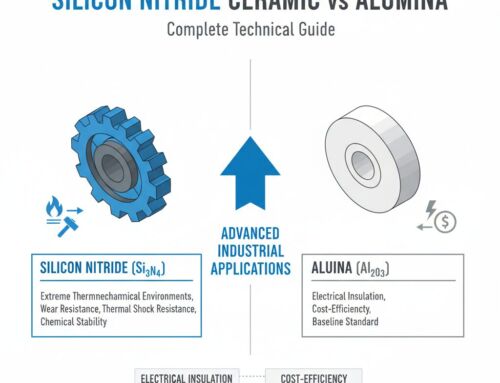
To fully leverage machinable glass ceramic properties, engineers must contextualize its performance against conventional technical ceramics. While machinable glass ceramic offers unparalleled fabrication speed and complex geometry realization without green-stage shrinkage calculations, it trades off some ultimate mechanical strength and thermal conductivity when compared to 알루미나/”>알루미나 또는 지르코니아. For instance, alumina provides a superior flexural strength of 300-400 MPa and a thermal conductivity ranging from 24 to 35 W/m·K, but it requires diamond-tipped tooling and extensive post-firing grinding to achieve ±0.005mm tolerances. Similarly, high-performance structural materials like 실리콘 질화물 drastically outperform machinable glass ceramics in fracture toughness (up to 8.0 MPa·m½) and wear resistance, yet the machining costs and lead times are significantly higher.
Conversely, when comparing dielectric properties and thermal shock resistance, machinable glass ceramics often outperform standard polymers and rival specialized insulators like 질화붕소, specifically due to its completely non-porous structure and lack of outgassing under extreme vacuum conditions.
| 속성 | 가공 가능한 유리 세라믹 | 알루미나 | 지르코니아 | 질화규소 |
|---|---|---|---|---|
| 열 전도성 | 1.46 W/m·K | 24-35 W/m·K | 2.2 W/m·K | 20-30 W/m·K |
| 경도 | 250 HV | 1500 HV | 1200 HV | 1500 HV |
| 골절 인성 | 1.53 MPa·m½ | 3.5-4.5 MPa·m½ | 8.0-10.0 MPa·m½ | 6.0-8.0 MPa·m½ |
| 비용 | Low Machining / Medium Raw | High Machining / Low Raw | High Machining / Medium Raw | Highest Machining / High Raw |
애플리케이션
The unique combination of zero porosity, extreme dielectric strength. And precision machinability makes this material indispensable across multiple high-stakes engineering sectors. Because parts can be finalized directly on a CNC mill without secondary firing, iterational R&D cycles are reduced from weeks to days.
- Ultra-High Vacuum (UHV) Components: Operating at pressures down to 10⁻¹⁰ Torr requires materials with absolutely zero outgassing. Machinable glass ceramic is entirely non-porous and can be safely baked out at 600°C to remove surface contaminants. Its lack of volatile constituents makes it the standard choice for UHV feedthroughs, insulators. And sensor housings where traditional plastics would immediately degrade.
- Aerospace and Defense Insulators: In airborne radar and satellite communication systems, components endure massive temperature fluctuations. With a CTE of 9.3 × 10⁻⁶ /°C and a dielectric strength of 40 kV/mm, this material perfectly insulates high-voltage electronics while maintaining dimensional stability from -200°C to +800°C, surviving thermal shocks that would fracture standard glass.
- Medical and Analytical Equipment: Diagnostic imaging devices such as MRI machines and mass spectrometers require non-magnetic, bio-inert. And electrically insulative components. Machinable glass ceramic exhibits no magnetic interference, resists chemical degradation from heavy sterilization protocols. And maintains stable physical properties under extreme radiation exposure.
- Semiconductor Manufacturing Jigs: In wafer fabrication environments, particulate generation is catastrophic. Machinable glass ceramics do not shed particles during thermal cycling or mechanical handling. They are frequently used for electrostatic chucks, wafer handling end-effectors. And ion-implantation fixtures where high dimensional stability (tolerances of ±0.005mm) is crucial. If your semiconductor application requires advanced tooling, explore our 정밀 세라믹 가공 capabilities.
- Laser and Optical Assemblies: High-power laser systems generate immense localized heat and require rigid mounting structures to maintain optical alignment. The material’s thermal stability, combined with the ability to machine microscopic M1.6 tapped holes and intricate mounting geometries, allows optical engineers to design monolithic, perfectly aligned laser cavity reflectors and lens mounts.
제조 프로세스
Unlike conventional technical ceramics that rely on powder pressing and high-shrinkage sintering profiles, machinable glass ceramics are manufactured through a controlled melting and crystallization process known as “ceramming.” This complex thermodynamic process is what ultimately dictates the distinct machinable glass ceramic properties, ensuring the exact ratio of the glass matrix to crystalline structure.
형성 방법
- Glass Melting and Casting: The raw materials—primarily silica (SiO₂), magnesium oxide (MgO), alumina (Al₂O₃), potassium oxide (K₂O), boron oxide (B₂O₃). And fluorine (F)—are thoroughly blended and melted in a platinum or high-refractory crucible at temperatures exceeding 1400°C. The molten glass is then cast into continuous slabs, billets, or rods. At this stage, the material is entirely amorphous and highly susceptible to thermal shock.
- Annealing: The cast glass blocks are slowly cooled in a controlled annealing lehr to relieve internal residual stresses caused by the initial casting process, preventing spontaneous shattering.
소결
While not “sintered” in the traditional powder-metallurgy sense, the critical thermal processing step is the controlled crystallization (ceramming). The annealed glass billets are placed in specialized high-temperature kilns and undergo a precise two-stage thermal profile. First, the temperature is raised to approximately 600°C to 700°C to initiate the nucleation of the fluoride-based seed crystals. Following nucleation, the temperature is further elevated to between 900°C and 950°C. During this phase, the fluorophlogopite mica crystals grow outwards from the nucleating sites. This temperature profile is meticulously controlled. variations as small as 5°C can alter the crystal aspect ratio, fundamentally destroying the material’s machinability. Once the microstructure reaches the optimal 55% crystallinity, the material is slowly cooled to room temperature.
최종 가공
Once the ceramming process is complete, the material has achieved its final mechanical state. There is no subsequent firing required. Final machining is executed using traditional metalworking equipment, including multi-axis CNC mills, lathes. And surface grinders. Because the material undergoes localized micro-cleavage rather than bulk plastic deformation (like metals) or catastrophic brittle fracture (like standard ceramics), exceptionally complex features—such as deep blind holes, ultra-thin walls (down to 0.5mm). And internal threads—can be machined directly into the billet. Great Ceramic leverages specialized tool paths and vibration-dampening workholding to hold exacting tolerances of ±0.005mm during this final phase.
장점 및 제한 사항
장점
- Rapid Prototyping and Iteration: Because parts are machined from solid billets in their fully dense state without the need for post-machining shrinkage compensation or extended kiln firing schedules, turnaround times are reduced by up to 80% compared to traditional technical ceramics.
- Exceptional Machinability: Using standard tungsten carbide end mills, high-speed steel drills. And conventional tapping tools, the material can be machined to extreme precision. Surface finishes as fine as 0.05 µm Ra can be achieved through standard lapping and polishing techniques.
- Zero Porosity and Hermetic Sealing: With an apparent porosity of absolute zero, the material demonstrates a helium leak rate of less than 10⁻¹¹ atm cc/s. It can be easily metalized using thick-film inks or sputtering, allowing for robust hermetic brazing to titanium, Kovar, or copper.
- Superior Electrical and Thermal Insulation: It provides excellent high-voltage arc resistance (dielectric strength of 40 kV/mm) and maintains an incredibly low thermal conductivity (1.46 W/m·K), effectively isolating sensitive electronic arrays from adjacent heat sources.
제한 사항
- Lower Ultimate Mechanical Strength: With a flexural strength of 94 MPa and a compressive strength of 345 MPa, it cannot withstand the severe structural loads, high-impact forces, or heavy abrasive wear that materials like silicon nitride or alumina can endure.
- Temperature Thresholds: While excellent for many high-temp applications, continuous use should not exceed 800°C. And absolute peak temperature must not surpass 1000°C. Above 1000°C, the fluorophlogopite mica crystals begin to degrade, outgassing fluorine and severely compromising the structural integrity.
가공 고려 사항
Understanding and controlling the specific machining variables is critical to realizing the full potential of machinable glass ceramic properties. Although it can be machined with standard metalworking tools, treating it exactly like a metal will result in edge chipping, tool wear. And compromised tolerances. The fundamental mechanism of material removal relies on the micro-fracturing of the mica crystals. Consequently, cutting forces must be directed carefully to avoid propagating macro-cracks through the brittle glass matrix.
To provide a clear baseline, the following table outlines the foundational machining parameters required to safely process machinable glass ceramics:
| Machining Operation | Tool Material | Cutting Speed (SFM) | Feed Rate (Inches/Rev) | Coolant Recommendation |
|---|---|---|---|---|
| Turning (Roughing) | Carbide (C2) | 30 – 50 | 0.002 – 0.005 | Water-soluble flood coolant |
| Milling (Finishing) | Carbide (Micro-grain) | 20 – 35 | 0.001 – 0.002 per tooth | Water-soluble flood coolant |
| Drilling | Carbide / HSS | 15 – 25 | 0.001 – 0.002 | Flood coolant + frequent peck cycles |
| Tapping | HSS (2-flute) | Hand tap or < 10 RPM | Match thread pitch | Generous cutting oil/lubricant |
Machining Challenges & Technical Solutions:
One of the most persistent challenges engineers face when machining this material is “breakout” or edge chipping, particularly at the exit point of drilled holes or along the trailing edge of a milled profile. Because the material lacks ductility, the cutting force of a drill bit pushing through the final few micrometers of material will cause the unsupported bottom surface to spall and chip out. To resolve this, Great Ceramic engineers utilize sacrificial backing plates (often made of glass, acrylic, or brass) perfectly flush against the exit surface, transferring the load and preventing fracture. Additionally, drill bits must be ground with specific geometries, typically requiring a 118° point angle and zero rake angle to scrape the material rather than aggressively lifting it.
Heat generation is another critical machining challenge. Despite the localized micro-cracking absorbing some energy, the low thermal conductivity (1.46 W/m·K) means that frictional heat is not easily dissipated into the workpiece. instead, it concentrates at the tool tip. If localized temperatures exceed the material’s thermal shock threshold, micro-cracking will propagate deeply into the component, destroying internal tolerances and dielectric integrity. Therefore, copious amounts of water-soluble flood coolant must be used, directed precisely at the cutting interface. Air cooling is generally insufficient for tight-tolerance CNC operations.
Finally, tool path programming must be adapted. Climb milling is heavily preferred over conventional milling, as it directs cutting forces into the bulk of the material rather than tearing away at the fragile outer edges. When cutting complex geometries, tool engagement angles and step-down depths must be tightly controlled—often limited to 0.5mm per pass for heavy roughing and 0.05mm for finishing passes. At Great Ceramic, we merge decades of materials science expertise with state-of-the-art multi-axis CNC technology, ensuring that every inherent challenge of machinable glass ceramics is expertly managed to deliver your ±0.005mm tolerance components flawlessly.
FAQ
What is machinable glass ceramic properties?
Machinable glass ceramic properties refer to the unique thermal, electrical. And mechanical characteristics resulting from a specialized microstructure containing 55% fluorophlogopite mica crystals within a continuous borosilicate glass matrix. This dual-phase composition allows the ceramic to be machined with high-speed steel or carbide tooling—preventing crack propagation via micro-cleavage—while retaining the high dielectric strength (40 kV/mm), zero porosity. And thermal stability associated with advanced technical ceramics.
What are the main applications of machinable glass ceramic properties?
Due to its high precision formability and exceptional vacuum performance, this material is extensively utilized in ultra-high vacuum (UHV) environments, aerospace and defense electrical insulators. And semiconductor manufacturing jigs. Furthermore, its bio-inert and non-magnetic nature makes it an ideal choice for medical diagnostic equipment (such as MRI machine components) and complex laser optical assemblies where exact CTE matching and thermal stability are required.
How does machinable glass ceramic properties compare to other ceramics?
While standard technical ceramics like alumina or zirconia offer superior raw mechanical strength (e.g., flexural strength >300 MPa compared to the 94 MPa of machinable glass), they require costly diamond grinding and lengthy post-sintering processes. Machinable glass ceramics prioritize rapid fabrication, extreme dimensional stability without shrinkage calculations. And tight tolerances (±0.005mm) while matching the dielectric insulation and zero-porosity vacuum performance of their harder counterparts.
What are the advantages of machinable glass ceramic properties?
The primary advantage is the dramatic reduction in lead times and manufacturing costs for complex geometries, as parts can be CNC milled directly from solid billets with standard tooling and no post-firing. Additional advantages include zero porosity (no outgassing in high vacuum), a continuous maximum working temperature of 800°C, a highly stable coefficient of thermal expansion (matching many metals for hermetic sealing). And an exceptional electrical resistivity greater than 10¹⁶ Ω·cm.
How is machinable glass ceramic properties machined?
It is machined using standard multi-axis CNC mills, lathes. And drills utilizing tungsten carbide or high-speed steel tools. To mitigate edge chipping and heat-induced micro-cracking, specialized machining parameters must be applied: slower cutting speeds (20-35 SFM for milling), shallow feed rates, zero-rake tool geometries, climb milling tool paths. And generous applications of water-soluble flood coolant. Through expert handling, Great Ceramic provides elite 정밀 세라믹 가공 services to achieve ±0.005mm tolerances in this unique material.
Need custom machinable glass ceramic properties parts? 그레이트 세라믹에 문의 공차가 엄격한 정밀 가공 서비스 또는 이메일 [email protected].
machinable glass ceramic properties is widely used in advanced ceramic applications.
자세히 알아보기 Machinable Glass Ceramic Properties 정밀 세라믹 가공 서비스를 제공합니다.