








Boron Nitride Ceramic Properties: Complete Technical Guide
Engineers consistently face complex thermal management and electrical isolation challenges when designing systems for ultra-high vacuum, aerospace. And high-temperature metallurgical applications. Standard technical ceramics frequently fail under rapid thermal cycling or extreme thermal shock, leading to catastrophic system failures and costly downtime. Understanding 질화붕소 세라믹 속성 is the definitive solution to overcoming these multifaceted engineering pain points. Colloquially known as “white graphite,” hexagonal boron nitride (h-BN) delivers a rare, paradoxical combination: it features exceptional thermal conductivity (reaching up to 120 W/m·K) while simultaneously acting as a superior electrical insulator with a dielectric strength exceeding 35 kV/mm. Furthermore, its inherent dry lubricity and chemical inertness make it an indispensable material for extreme-environment operations. However, transforming this highly advanced, easily cleavable raw material into functional, high-precision components requires specialized fabrication techniques. This comprehensive technical guide details the mechanical, thermal. And electrical properties of boron nitride, compares it against alternative industrial ceramics. And breaks down the advanced 정밀 세라믹 가공 strategies Great Ceramic utilizes to achieve rigorous ±0.005mm dimensional tolerances.
Engineering Support Notice: If your project requires immediate manufacturing intervention, submit your 3D CAD files to [email protected] to leverage Great Ceramic’s expertise in tight-tolerance 질화붕소 fabrication.
머티리얼 속성
The operational capabilities of hexagonal boron nitride are heavily dictated by its anisotropic crystal lattice structure. Much like graphite, h-BN consists of strong covalent boron-nitrogen bonds within its basal plane (bond length of 0.144 nm), while the layers themselves are held together by weak Van der Waals forces with an interlayer distance of 0.333 nm. This unique molecular architecture yields highly directional physical characteristics. For instance, the coefficient of thermal expansion (CTE) measures approximately 0.5 × 10⁻⁶/°C parallel to the pressing direction, whereas it expands to roughly 2.0 × 10⁻⁶/°C in the perpendicular orientation. Understanding these directional variances is critical for engineers calculating thermal clearances in high-temperature assemblies operating above 1500°C.
Electrically, boron nitride stands apart from its graphite structural counterpart. Due to the electronegativity difference between boron (2.04) and nitrogen (3.04), the electrons are localized, effectively eliminating electrical conductivity. The volume resistivity of high-purity h-BN remains remarkably stable, exceeding 10¹⁴ Ω·cm at 25°C and maintaining a robust 10⁴ Ω·cm even at extreme temperatures reaching 1000°C. Coupled with a low dielectric constant of approximately 4.0 and a dissipation factor (loss tangent) of just 0.0003 at 1 MHz, boron nitride is an optimal dielectric material for high-frequency RF, microwave. And radar applications where signal attenuation must be kept below 0.1 dB.
To provide accurate baseline engineering data, the following table outlines the standard properties of industrial-grade hot-pressed hexagonal boron nitride. Note that properties can shift by 15-20% based on the specific binder system (such as calcium borate or boric oxide) utilized during the sintering process.
| 속성 | 가치 | 단위 |
|---|---|---|
| 밀도 | 1.90 – 2.25 | g/cm³ |
| 경도 | 20 – 30 (Mohs 2) | HV |
| 굴곡 강도 | 30 – 85 | MPa |
| 골절 인성 | 1.0 - 1.5 | MPa-m½ |
| 열 전도성 | 30 – 120 (anisotropic) | W/m-K |
| 전기 저항 | > 10¹⁴ | Ω-cm |
| 최대 작동 온도 | 900 (Air) / 2200 (Vacuum) | °C |
Because boron nitride properties fluctuate significantly based on the manufacturing route, engineers must select the appropriate grade. To ensure comprehensive material selection, the secondary table below highlights the divergent thermal and mechanical properties across the three primary industrial grades: Hot-Pressed Binderless BN, Calcium-Enhanced BN. And Pyrolytic Boron Nitride (PBN).
| Boron Nitride Grade | 순도(%) | Max Temp in Vacuum (°C) | 굴곡 강도(MPa) | 열 전도성(W/m-K) |
|---|---|---|---|---|
| Hot-Pressed (Binderless) | 99.0+ | 2000 | 45 | 60 |
| Calcium-Enhanced (CABN) | 97.5 | 1800 | 85 | 45 |
| Pyrolytic BN (CVD) | 99.99+ | 2200 | 150 | 60 (⊥) / 200 (∥) |
다른 세라믹과의 비교
When engineering high-performance systems, selecting the correct ceramic substrate requires a careful quantitative balance between thermal management capabilities, structural integrity. And manufacturing feasibility. Boron nitride is rarely chosen for structural load-bearing applications. instead, it is deployed when thermal shock resistance and high-temperature lubricity supersede raw tensile or compressive strength. For instance, high-purity 알루미나/”>알루미나 (99.5% Al₂O₃) provides exceptional hardness (1500 HV) and structural rigidity (350 MPa flexural strength) but suffers from a relatively low thermal conductivity of 24-30 W/m·K. This makes alumina susceptible to catastrophic thermal shock if subjected to temperature gradients exceeding 250°C/min. In stark contrast, boron nitride can routinely survive extreme thermal shocks (ΔT > 1500°C) without micro-cracking, largely due to its ultra-low elastic modulus (approx. 40 GPa) and low thermal expansion.
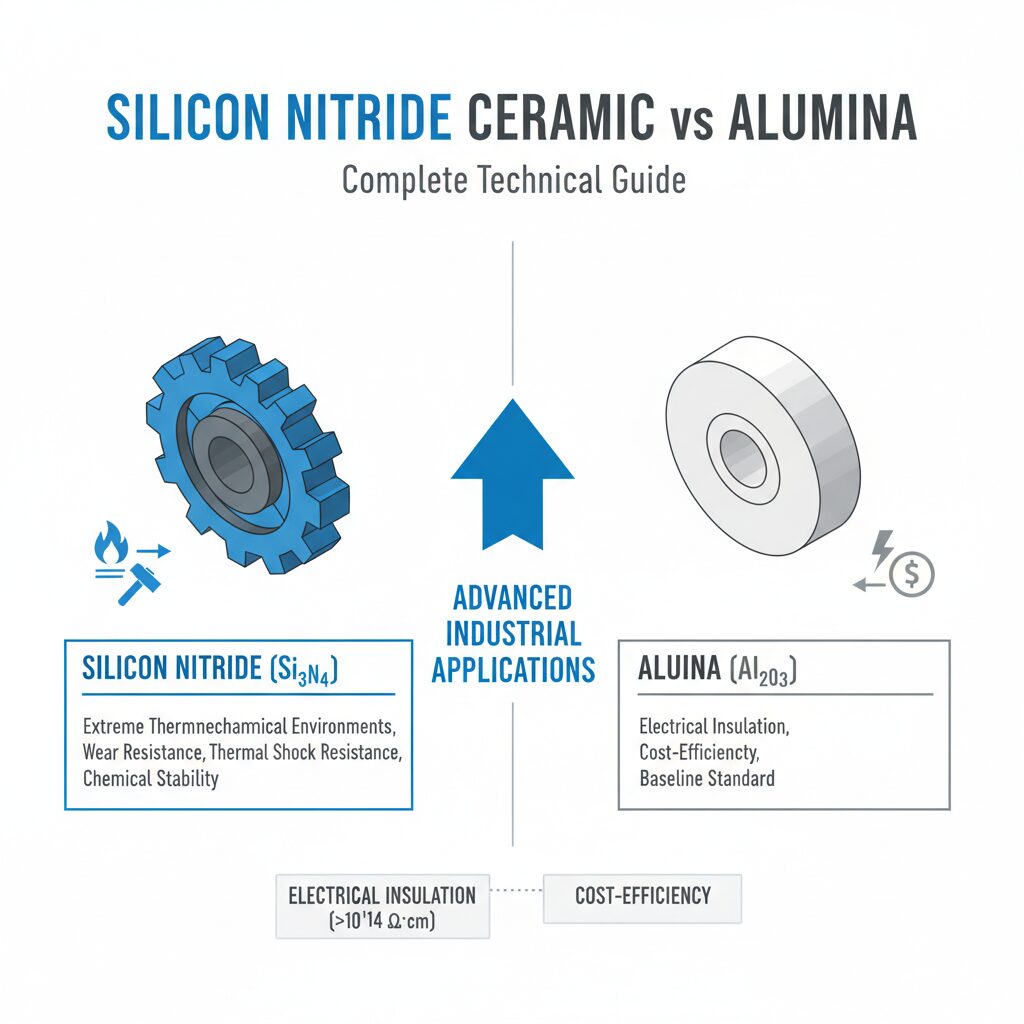
Compared to advanced structural materials like 지르코니아 (YTZP) and 실리콘 질화물 (Si₃N₄), boron nitride offers vastly superior machinability. Zirconia boasts an industry-leading fracture toughness of 8.0 to 10.0 MPa·m½ and a flexural strength of 1000+ MPa, making it ideal for high-impact mechanical components. However, zirconia’s thermal conductivity is severely limited to roughly 2.5 W/m·K, acting as a thermal insulator rather than a conductor. Silicon nitride offers an excellent middle ground for high-stress, high-temperature applications, featuring 800 MPa flexural strength and moderate thermal conductivity (30 W/m·K). Yet, machining sintered Si₃N₄ or 실리콘 카바이드 requires extensive, expensive diamond grinding, whereas boron nitride can be precisely milled using standard tungsten carbide or polycrystalline diamond (PCD) tooling, drastically reducing lead times and manufacturing costs.
If thermal conductivity is the singular driving requirement but structural rigidity is also mandatory, engineers often look toward 질화 알루미늄 (AlN). AlN achieves impressive thermal conductivity values between 170 and 200 W/m·K with a strength of 300 MPa. However, AlN is highly susceptible to hydrolysis if exposed to moisture, whereas specific binderless grades of boron nitride remain completely inert in humid environments.
| 속성 | 질화붕소 | 알루미나(99.5%) | 지르코니아(YTZP) | 질화규소 |
|---|---|---|---|---|
| 열 전도성 | 30 – 120 W/m·K | 24 - 30 W/m-K | 2.0 – 3.0 W/m·K | 20 - 30W/m-K |
| 경도 | 20 – 30 HV | 1500 - 1650 HV | 1200 - 1300 HV | 1500 - 1600 HV |
| 골절 인성 | 1.0 – 1.5 MPa·m½ | 4.0 - 5.0 MPa-m½ | 8.0 - 10.0 MPa-m½ | 6.0 - 7.0 MPa-m½ |
| 비용 | Moderate/High | 낮음 | 보통 | 높음 |
애플리케이션
- Ultra-High Vacuum (UHV) Furnace Components: Boron nitride is routinely utilized for high-temperature insulators, standoff washers. And thermal shielding inside UHV furnaces. The material’s ability to maintain structural stability and exhibit near-zero outgassing at temperatures up to 2000°C in vacuum environments (10⁻⁶ torr) ensures that sensitive metallurgical or semiconductor payloads are not contaminated during extended thermal processing cycles.
- PVD and CVD Crucible Liners: In Physical Vapor Deposition (PVD) and Chemical Vapor Deposition (CVD) metallization processes, molten metals like aluminum (melting point 660°C) and titanium (melting point 1668°C) are vaporized. Boron nitride is chosen for crucible liners because it is completely non-wetting to most molten metals. This non-wetting characteristic (contact angle > 120°) prevents the molten metal from adhering to or chemically reacting with the crucible walls, ensuring 99.99% purity of the deposited metallic thin films.
- 반도체 웨이퍼 가공 장비: Due to its exceptional electrical resistivity (>10¹⁴ Ω·cm) and high thermal conductivity, h-BN is heavily integrated into semiconductor manufacturing. It is frequently deployed as electrostatic chuck components, ion implant beam stops. And plasma chamber liners. The material’s high dielectric breakdown strength (up to 40 kV/mm) prevents electrical arcing during high-voltage plasma ignition sequences while simultaneously dissipating the massive thermal loads generated by the plasma.
- Microwave and Radar Antenna Windows: Aerospace and defense engineering teams specify boron nitride for radomes and microwave transmitting windows. With a tightly controlled dielectric constant of 4.0 and an exceptionally low loss tangent (0.0003 at 10 GHz), boron nitride allows high-frequency electromagnetic waves to pass through with virtually zero signal attenuation or distortion. Furthermore, its thermal shock resistance prevents the window from fracturing during the extreme aerodynamic heating (exceeding 800°C) experienced during hypersonic atmospheric re-entry.
- Molten Metal Atomization Nozzles: In the production of advanced metallic powders for additive manufacturing (3D printing), molten metals are forced through atomization nozzles at high pressures (up to 50 bar). Boron nitride nozzles are selected because they resist chemical corrosion from molten superalloys, while the material’s inherent lubricity ensures a smooth, uninterrupted flow of liquid metal, resulting in highly spherical powder particles with tightly controlled size distributions (typically 15-45 μm).
제조 프로세스
Transforming raw boron powder and nitrogen gas into fully dense, high-purity boron nitride ceramic components is a highly complex metallurgical process. Unlike standard technical ceramics that can be uniaxially pressed and pressureless sintered, the covalent bonds within the h-BN crystal lattice restrict mass transfer and diffusion. Therefore, achieving a theoretical density greater than 95% requires the simultaneous application of extreme heat and immense mechanical pressure. The precise manipulation of these manufacturing parameters dictates the final anisotropic properties of the ceramic matrix.
형성 방법
- 핫 프레스(HP): This is the dominant commercial forming methodology for h-BN. High-purity boron nitride powder (particle size roughly 1 to 5 μm) is loaded into a graphite die assembly. The system is heated to temperatures ranging between 1800°C and 2000°C under an inert argon or nitrogen atmosphere. Simultaneously, hydraulic rams apply a uniaxial pressure of 20 to 30 MPa. The combination of heat and pressure forces the platy h-BN crystals to align perpendicularly to the pressing direction, resulting in a dense billet (typically up to 400mm in diameter) with strong anisotropic mechanical and thermal properties.
- Chemical Vapor Deposition (CVD): To produce Pyrolytic Boron Nitride (PBN), engineers utilize a CVD process. Precursor gases, typically boron trichloride (BCl₃) and ammonia (NH₃), are introduced into a vacuum reaction chamber heated to approximately 1900°C at ultra-low pressures (1 Torr). The gases react and deposit h-BN atom-by-atom onto a heated graphite mandrel. This process yields a material with ultra-high purity (99.999%), theoretical density (2.27 g/cm³). And near-zero porosity, making it the premier choice for semiconductor crystal growth crucibles.
소결
Because hot pressing simultaneously forms and densifies the material, a standalone sintering step is often bypassed for standard h-BN blocks. However, in proprietary grades utilizing specific fluxing agents (like B₂O₃), secondary high-temperature annealing cycles (sintering) are conducted at 1600°C for 12 to 24 hours. This post-processing step ensures the complete volatilization of residual binders and stabilizes the crystal lattice, mitigating internal residual stresses that could cause warping or micro-fracturing during subsequent final machining operations.
최종 가공
Due to its Mohs hardness of 2 (comparable to talc or graphite), hot-pressed boron nitride is highly machinable in its fully sintered state. However, the platy, layered structure means the material is prone to delamination and edge chipping. Great Ceramic utilizes 5-axis CNC machining centers equipped with high-velocity spindles operating between 6,000 and 10,000 RPM. By employing razor-sharp, positive-rake Polycrystalline Diamond (PCD) tooling and extremely light feed rates (0.02 – 0.05 mm/rev), Great Ceramic successfully suppresses mechanical breakout, achieving exceptional surface finishes of Ra 0.2 μm and holding critical dimensional tolerances as tight as ±0.005mm.
Ready to initiate your custom manufacturing project? Leverage Great Ceramic’s industry-leading expertise in 정밀 세라믹 가공 to ensure your boron nitride components meet exact aerospace or semiconductor specifications. Contact our engineering team at [email protected].
장점 및 제한 사항
장점
- Extreme Thermal Shock Resistance: The combination of low thermal expansion (1.5 x 10⁻⁶/°C), low elastic modulus (40 GPa). And high thermal conductivity allows h-BN to survive instantaneous temperature drops of over 1500°C without initiating catastrophic thermal stress fractures.
- Unmatched Machinability: Unlike alumina or silicon carbide which require costly diamond grinding processes post-sintering, h-BN can be turned, milled. And drilled using standard cutting mechanics, slashing prototyping lead times by up to 70% and drastically reducing overall manufacturing costs.
- Superior High-Temperature Electrical Insulation: Maintaining a volume resistivity greater than 10¹⁴ Ω·cm at room temperature and over 10⁴ Ω·cm at 1000°C, h-BN provides fail-safe electrical isolation in high-voltage vacuum environments, easily outperforming standard aluminum oxide.
- Chemical Inertness and Non-Wetting Properties: Boron nitride is highly resistant to chemical attacks from molten metals, cryolite. And various glass melts. With a contact angle exceeding 120° for molten aluminum, it completely eliminates crucible contamination and extends the lifespan of metallurgical foundry equipment.
제한 사항
- 낮은 기계적 강도: With a flexural strength heavily bottlenecked between 30 and 85 MPa. And a fracture toughness of just 1.0 to 1.5 MPa·m½, boron nitride cannot be utilized for structural, load-bearing applications, nor can it survive high-impact kinetic environments.
- Moisture Sensitivity in Lower Grades: Certain industrial grades of hot-pressed boron nitride utilize a boric oxide (B₂O₃) binder. This binder is hygroscopic, meaning it will actively absorb atmospheric moisture. This can degrade its dielectric properties and cause swelling. These specific grades must be stored in desiccators or baked out at 300°C before deployment in vacuum systems.
가공 고려 사항
While the low hardness of boron nitride (Mohs 2) generally classifies it as an easily machinable ceramic, achieving strict B2B industrial tolerances (±0.005mm) presents a unique array of complex machining challenges. The primary obstacle is the material’s extreme susceptibility to mechanical pull-out, edge chipping. And delamination. Because the Van der Waals forces holding the basal planes together are exceptionally weak, standard cutting tools with negative rake angles will crush and tear the material rather than shearing it cleanly. To circumvent this, Great Ceramic utilizes highly specialized Polycrystalline Diamond (PCD) or micro-grain solid carbide end mills engineered with aggressive, high-positive rake geometries. These specialized tools slice through the h-BN layers with minimal cutting force, preventing sub-surface damage.
Furthermore, because many standard grades of h-BN are hygroscopic due to residual boric oxide binders, traditional water-based CNC coolants cannot be used. Exposure to aqueous coolants will cause the boron nitride matrix to swell, instantly destroying the dimensional accuracy and rendering tight ±0.005mm tolerances impossible to hold. Therefore, the material must be strictly machined dry, utilizing high-velocity, localized vacuum extraction systems to remove the fine, abrasive dust from the cutting zone. This dry-machining requirement necessitates extremely precise control over spindle speeds (often regulated between 4,000 and 8,000 RPM) and feed rates to prevent localized frictional heating from expanding the workpiece during the milling cycle. Great Ceramic tightly controls the ambient temperature of its machining and metrology laboratories to a strict 20±1°C, ensuring that thermal expansion does not artificially skew CMM (Coordinate Measuring Machine) validation reports.
FAQ
What is boron nitride ceramic?
Boron nitride is an advanced technical ceramic compound consisting of equal numbers of boron and nitrogen atoms. The most common industrial form is hexagonal boron nitride (h-BN). This features a layered, crystalline structure identical to graphite. Due to this unique molecular arrangement, h-BN is frequently referred to as “white graphite.” It is highly prized in engineering applications for its rare ability to combine excellent thermal conductivity (up to 120 W/m·K) with exceptional electrical insulation (>10¹⁴ Ω·cm), all while maintaining a low Mohs hardness of 2 that permits rapid, high-precision conventional machining.
What are the main applications of boron nitride ceramic?
Due to its high thermal stability and chemical inertness, boron nitride is predominantly utilized in extreme-temperature and high-vacuum environments. Major applications include thermal insulators and shielding in Ultra-High Vacuum (UHV) furnaces, non-wetting crucible liners for molten metal Physical Vapor Deposition (PVD), plasma chamber components for semiconductor wafer processing equipment, electrostatic chucks. And microwave transparent radomes. Additionally, it is used extensively as a highly specialized atomization nozzle material for the production of advanced 3D printing metal powders.
How does boron nitride compare to other ceramics?
Boron nitride distinguishes itself through its machinability and thermal shock resistance, rather than structural strength. Compared to 알루미나 그리고 지르코니아. This boast flexural strengths of 350 MPa and over 1000 MPa respectively, h-BN is structurally weak, with flexural strengths ranging from only 30 to 85 MPa. However, h-BN can survive instantaneous thermal shocks of 1500°C without cracking, whereas alumina and zirconia will catastrophically fracture under gradients of just 250°C/min. Furthermore, h-BN is fully machinable with standard tooling, whereas 실리콘 질화물 requires slow, highly expensive diamond grinding processes.
What are the advantages of boron nitride ceramic?
The primary advantages of h-BN include extreme thermal shock resistance due to its low CTE (1.5 x 10⁻⁶/°C) and low elastic modulus (40 GPa), remarkable high-temperature electrical resistance (maintaining 10⁴ Ω·cm at 1000°C). And excellent dielectric strength (up to 40 kV/mm). Additionally, its non-wetting characteristics make it highly resistant to corrosion from molten metals (like aluminum, copper. And titanium). And its low hardness allows for extremely cost-effective and rapid CNC machining compared to conventional technical ceramics.
How is boron nitride machined?
Despite being soft (Mohs 2), machining boron nitride requires specialized techniques to prevent edge chipping, delamination. And moisture absorption. It is strictly machined dry—without aqueous coolants—to prevent the hygroscopic binder systems from swelling and ruining dimensional accuracy. Operators must use razor-sharp, positive-rake Polycrystalline Diamond (PCD) or solid carbide tooling with low feed rates (0.02 – 0.05 mm/rev) to achieve clean shearing. Great Ceramic leverages state-of-the-art 5-axis CNC equipment and rigorous climate-controlled environments to conquer these machining challenges, consistently delivering 정밀 세라믹 가공 services with guaranteed ±0.005mm tolerances and Ra 0.2 μm surface finishes.
Need custom boron nitride parts? 그레이트 세라믹에 문의 공차가 엄격한 정밀 가공 서비스 또는 이메일 [email protected].
boron nitride ceramic properties is widely used in advanced ceramic applications.
자세히 알아보기 질화 붕소 세라믹 특성 정밀 세라믹 가공 서비스를 제공합니다.