









Resistività elettrica della ceramica al carburo di silicio: Guida tecnica completa
Man mano che le applicazioni ingegneristiche avanzate si spingono oltre i confini degli ambienti operativi estremi, la comprensione carburo di silicio La resistività elettrica della ceramica diventa fondamentale per i team di ricerca e sviluppo, i responsabili degli acquisti. E per gli ingegneri progettisti. A differenza delle ceramiche avanzate tradizionali che agiscono universalmente come isolanti elettrici, carburo di silicio (SiC) presenta un profilo elettrico altamente sintonizzabile. A seconda del processo di produzione, del politipo (come 4H, 6H o 3C). e della concentrazione di drogante, la sua resistività elettrica può variare di ben 12 ordini di grandezza: da livelli altamente conduttivi intorno a 10-² Ω-cm a livelli altamente isolanti superiori a 10¹¹ Ω-cm. Questa capacità unica di isolamento da semiconduttore a isolante, unita a un'eccezionale conducibilità termica (fino a 170 W/m-K) e a un'estrema durezza meccanica (2.800 HV), fa del SiC il materiale principe per le apparecchiature di produzione di semiconduttori, le infrastrutture ad alta tensione e i sistemi di gestione termica. E per i sistemi di gestione termica.
Il raggiungimento di requisiti geometrici precisi per queste applicazioni ad alte prestazioni richiede utensili specializzati e una profonda conoscenza metallurgica. Great Ceramic affronta questi problemi del settore offrendo lavorazioni con tolleranze ridotte fino a ±0,005 mm, assicurando che i vostri complessi componenti in SiC soddisfino le specifiche strutturali ed elettriche. Avete bisogno di un supporto ingegneristico esperto per il vostro prossimo progetto? Contattate Great Ceramic per discutere i vostri requisiti di lavorazione di precisione..
Proprietà dei materiali
Le caratteristiche macroscopiche del carburo di silicio sono dettate dal suo forte legame covalente (circa 88% covalenti e 12% ionici). La resistività elettrica del carburo di silicio è intrinsecamente legata al suo ampio bandgap. Questo varia da 2,36 eV per il 3C-SiC a 3,26 eV per il 4H-SiC. Allo stato ultrapuro, il SiC funziona come un potente isolante elettrico a temperatura ambiente. Tuttavia, l'introduzione intenzionale o meno di impurità, come azoto o fosforo (droganti di tipo n) e alluminio o boro (droganti di tipo p), crea portatori di carica che alterano drasticamente il profilo di resistività.
Oltre alle caratteristiche elettriche, il SiC mantiene l'integrità strutturale a temperature in cui i metalli si fondono e i polimeri si disintegrano. Il materiale presenta una densità altamente stabile, compresa tra 3,10 e 3,21 g/cm³ a seconda della metodologia di sinterizzazione. La sua resistenza alla flessione rimane costante fino a 1.500°C, una soglia in cui altre ceramiche tecniche subiscono un grave degrado meccanico. La tabella seguente illustra le metriche fisiche, meccaniche, termiche ed elettriche standard per il sinterizzato diretto. E elettrici per il carburo di silicio sinterizzato direttamente (SSiC).
| Proprietà | Valore | Unità |
|---|---|---|
| Densità | 3.10 - 3.15 | g/cm³ |
| Durezza | 2500 - 2800 | HV |
| Resistenza alla flessione | 400 - 450 | MPa |
| Resistenza alla frattura | 4.0 - 4.5 | MPa-m½ |
| Conducibilità termica | 120 - 170 | W/m-K |
| Resistività elettrica | 10-¹ - 10¹¹ | Ω-cm |
| Temperatura massima di lavoro | 1600 - 1650 | °C |
È fondamentale per gli ingegneri notare che la resistività elettrica della ceramica di carburo di silicio presenta un coefficiente di temperatura negativo. Con l'aumento della temperatura operativa da 20°C a 1.000°C, l'eccitazione termica porta gli elettroni nella banda di conduzione, abbassando progressivamente la resistività elettrica. Questa relazione termico-elettrica non lineare deve essere calcolata con precisione quando si progettano elementi riscaldanti industriali o ricettori di semiconduttori ad alta temperatura.
Confronto con altre ceramiche
Quando si sceglie una ceramica tecnica, gli ingegneri devono valutare i compromessi tra conducibilità termica, isolamento elettrico, tenacità meccanica e producibilità. E la producibilità. Sebbene il carburo di silicio offra una resistenza superiore alle alte temperature e all'usura, viene spesso confrontato con altre ceramiche a base di ossidi e non ossidi per determinare il rapporto ottimale tra costo e prestazioni.
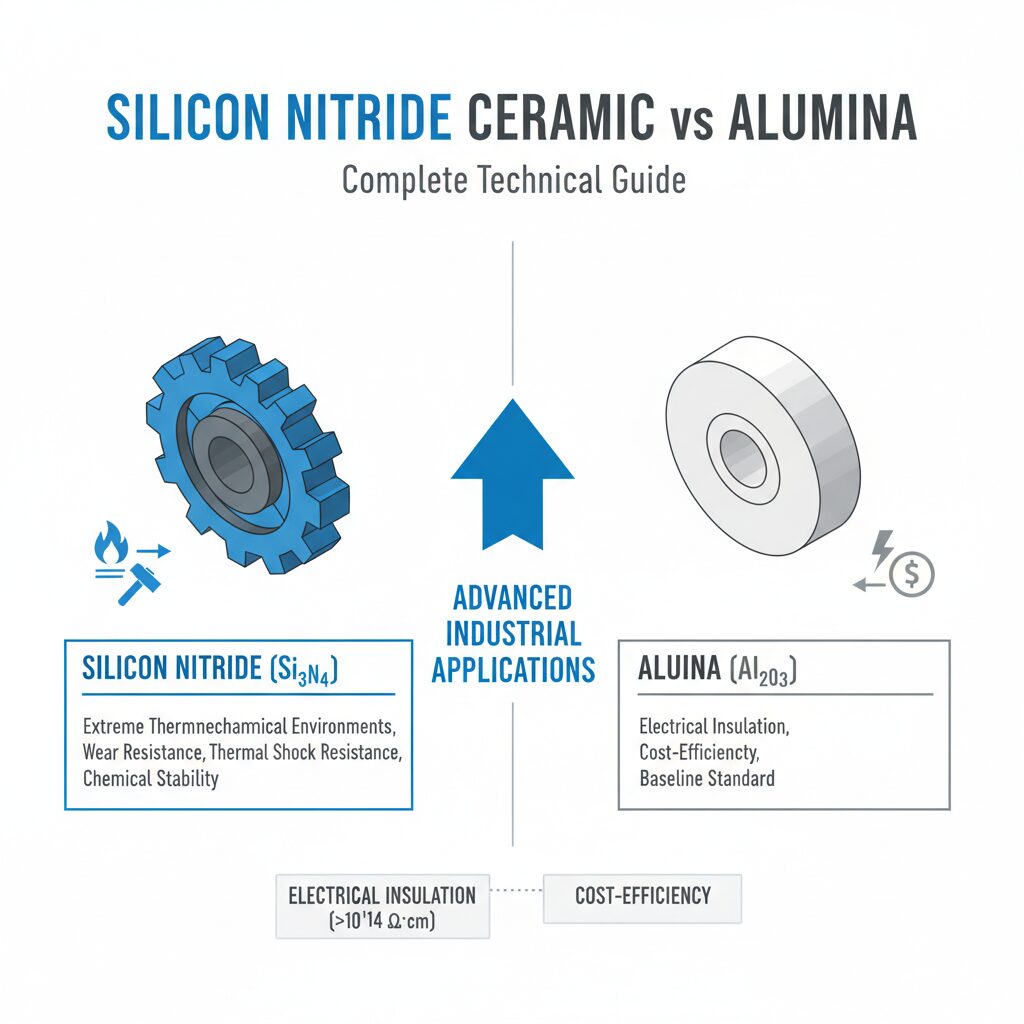
Ad esempio, allumina/”>allumina (Al₂O₃) offre una soluzione altamente economica con un eccellente isolamento elettrico di base (>10¹⁴ Ω-cm), ma soffre di una conducibilità termica relativamente scarsa (25-35 W/m-K), che lo rende suscettibile di shock termico a gradienti di temperatura superiori a 250°C. Zirconia (ZrO₂) vanta la più alta tenacità alla frattura (fino a 10 MPa-m½) e resistenza alla flessione, comportandosi meccanicamente più vicino all'acciaio, ma la sua conducibilità termica è estremamente bassa (2-3 W/m-K), agendo come un isolante termico piuttosto che come un conduttore.
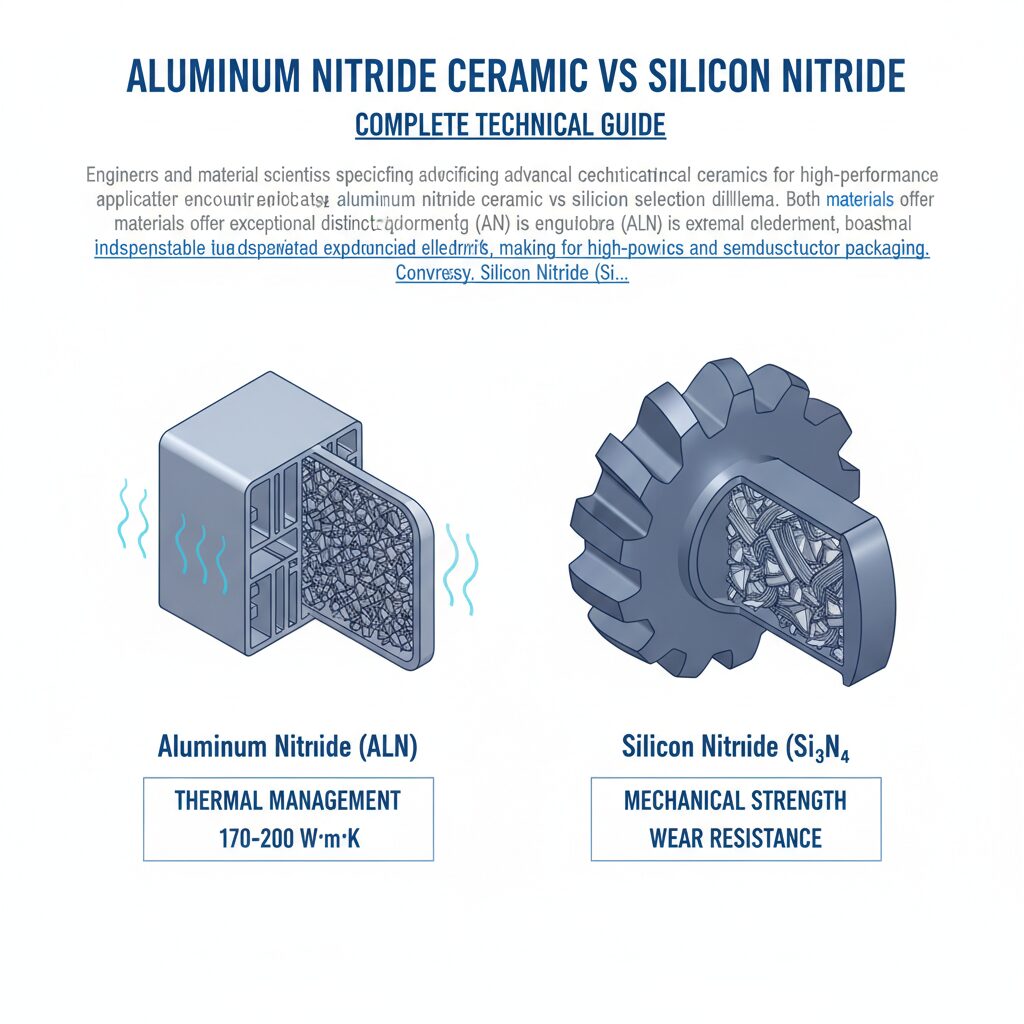
Al contrario, nitruro di silicio (Si₃N₄) offre la migliore combinazione di resistenza agli shock termici e tenacità alla frattura tra le ceramiche avanzate, gestendo facilmente le rapide fluttuazioni di temperatura. Tuttavia, quando l'applicazione richiede una durezza estrema (resistenza all'usura), la massima conducibilità termica e una resistività elettrica specificamente sintonizzabile. e una resistività elettrica specificamente sintonizzabile, il carburo di silicio rimane ineguagliato. Inoltre, per le applicazioni che richiedono un'elevata conducibilità termica abbinata a un isolamento elettrico assoluto, gli ingegneri possono considerare anche nitruro di alluminio (170-230 W/m-K) o nitruro di boro, Anche se questi materiali presentano spesso limitazioni meccaniche e costi di lavorazione diversi.
| Proprietà | Carburo di silicio | Allumina (99,5%) | Zirconia (Y-TZP) | Nitruro di silicio |
|---|---|---|---|---|
| Conducibilità termica (W/m·K) | 120 - 170 | 25 - 35 | 2.0 - 3.0 | 20 - 30 (fino a 90) |
| Durezza (HV) | 2500 - 2800 | 1500 - 1650 | 1200 - 1300 | 1400 - 1600 |
| Durezza alla frattura (MPa-m½) | 4.0 - 4.5 | 4.0 - 5.0 | 8.0 - 10.0 | 6.0 - 8.0 |
| Costo | Alto | Basso | Medio | Alto |
Applicazioni
La natura variabile della resistività elettrica della ceramica di carburo di silicio, unita alla sua profonda resistenza meccanica e termica, ne facilita l'impiego nei settori industriali e tecnologici più esigenti. Grazie alla precisa progettazione della microstruttura del materiale, i produttori di componenti possono adattare il SiC a ruoli altamente specializzati.
- Apparecchiature per il trattamento dei semiconduttori: I componenti per la manipolazione dei wafer, come i mandrini elettrostatici, i susceptor. e wafer fittizi, richiedono un controllo meticoloso della resistività elettrica (spesso mirata con precisione tra 10⁸ e 10¹⁰ Ω-cm per il bloccaggio elettrostatico). Il SiC viene scelto perché il suo coefficiente di espansione termica (4,0 x 10-⁶ /K) si avvicina molto a quello dei wafer di silicio, prevenendo lo stress termico e la generazione di particelle durante la lavorazione termica rapida (RTP) a temperature fino a 1.200°C.
- Resistenze elettriche industriali: Nei forni elettrici e nelle fornaci. e negli ambienti di lavorazione dei materiali ad alta temperatura, il SiC è fortemente drogato per ottenere una bassa resistività elettrica (da 10-¹ a 10 Ω-cm). Quando una corrente elettrica attraversa la ceramica, genera un calore estremo attraverso il riscaldamento Joule. Il SiC viene scelto rispetto agli elementi riscaldanti metallici (come il disiliciuro di molibdeno) perché può sostenere un funzionamento continuo in atmosfere ossidanti a 1.600°C senza subire una degradazione catastrofica.
- Componenti di isolamento ad alta tensione: Il carburo di silicio intrinseco di elevata purezza funge da eccellente isolante dielettrico con una resistività superiore a 10¹¹¹ Ω-cm. Viene utilizzato nelle infrastrutture della rete elettrica, negli scaricatori di sovratensione. e negli interruttori ad alta tensione. Il SiC viene scelto perché la sua elevata conducibilità termica dissipa efficacemente gli immensi carichi termici generati dalle correnti ad alta tensione, impedendo la fuga termica, una modalità di guasto comune agli isolanti tradizionali in polimero o vetro.
- Guarnizioni meccaniche e cuscinetti in ambienti corrosivi: Le pompe per il trattamento chimico che trattano fanghi altamente acidi o alcalini si affidano a facce di tenuta in SiC. Anche se la resistività elettrica gioca un ruolo secondario, il materiale viene scelto perché la sua estrema durezza (2.800 HV) resiste all'usura abrasiva del particolato. Inoltre, la sua inerzia chimica impedisce la corrosione anche se esposto ad acido fluoridrico o a soluzioni calde di idrossido di sodio.
- Substrati per elettronica di potenza EV: Gli inverter avanzati per veicoli elettrici richiedono substrati in grado di isolare elettricamente i componenti e di allontanare rapidamente il calore dalle matrici di semiconduttori SiC o GaN ad alta potenza. La ceramica SiC può essere progettata per mantenere un'elevata resistività elettrica, offrendo al tempo stesso una conducibilità termica superiore a 150 W/m-K. Viene scelta per consentire densità di potenza più elevate, permettendo agli ingegneri di ridurre le dimensioni fisiche e il peso dei sistemi di raffreddamento degli EV.
Processo di produzione
Il passaggio dalla sabbia di silice grezza a un componente ceramico di precisione richiede processi termodinamici e meccanici altamente controllati. Poiché il carburo di silicio non è presente in natura in quantità sufficienti (si trova solo in tracce come il minerale moissanite), deve essere sintetizzato industrialmente. La materia prima di base è generalmente prodotta attraverso il processo Acheson, in cui la sabbia di silice (SiO₂) e il coke di petrolio (carbonio) vengono fatti reagire in un forno a resistenza elettrica a temperature estreme, che vanno dai 1.600°C ai 2.500°C. La struttura cristallina risultante determina la linea di base iniziale per la resistività elettrica della ceramica di carburo di silicio.
Metodi di formatura
Once the synthesized SiC is milled into sub-micron powders (typically 0.5 to 2.0 µm in diameter) and mixed with specific sintering aids (such as boron, carbon, or yttria) and organic binders, it is shaped into a “green body.” The forming method is selected based on the component’s geometric complexity and required green density.
- Pressatura isostatica a freddo (CIP): The ceramic powder is sealed in a flexible elastomeric mold and subjected to uniform hydrostatic fluid pressure ranging from 200 to 300 MPa. This method ensures uniform density distribution throughout the part, minimizing shrinkage variations during sintering. CIP is ideal for large, solid geometries like cylindrical billets, armor plates. And thick-walled tubes.
- Slip Casting and Extrusion: For complex internal geometries, slip casting involves pouring a liquid suspension of SiC powder into a porous plaster mold. This draws out the liquid via capillary action, leaving a solid layer of ceramic. Extrusion, on the other hand, forces a highly viscous ceramic paste through a specific die geometry under pressures of 10 to 50 MPa. Extrusion is the standard method for manufacturing long, continuous profiles such as kiln furniture beams, heat exchanger tubes. And rod-shaped heating elements.
Sinterizzazione
Sintering is the critical thermal step where the loosely bound powder particles fuse into a dense, monolithic ceramic structure. Because of the strong covalent bonds in SiC, the self-diffusion coefficient is extremely low, making it practically impossible to sinter pure SiC without the application of ultra-high temperatures and specialized techniques. The choice of sintering method directly determines the final porosity, mechanical strength. And the ultimate silicon carbide ceramic electrical resistivity.
To demonstrate the impact of different manufacturing pathways, the following table compares three primary types of SiC: Sintered Silicon Carbide (SSiC), Reaction Bonded Silicon Carbide (RBSiC). And Chemical Vapor Deposition (CVD) Silicon Carbide.
| Material Grade | Processo di produzione | Densità (g/cm³) | Resistività elettrica (Ω-cm) | Free Silicon Content |
|---|---|---|---|---|
| SSiC | Pressureless Sintering (2100°C) | 3.10 - 3.15 | 10² – 10⁶ (Tunable) | 0% |
| RBSiC | Liquid Silicon Infiltration (1500°C) | 3.00 – 3.10 | ~10⁻¹ – 10¹ (Low) | 8% – 15% |
| CVD SiC | Gas Phase Deposition (1300°C) | > 3.20 | > 10¹⁰ (Highly Insulating) | 0% |
Pressureless Sintering (SSiC): The green body is heated in an inert argon or vacuum atmosphere to temperatures between 2,100°C and 2,200°C. Sintering aids like boron and carbon facilitate densification by reducing the surface energy of the solid-vapor interface. SSiC shrinks by approximately 15-20% during this phase, requiring precise calculation to achieve near-net shape. SSiC contains no free silicon, resulting in superior high-temperature strength and excellent chemical resistance.
Reaction Bonding (RBSiC): The green body is formulated with a mixture of SiC powder and carbon. During the thermal cycle (around 1,500°C), molten silicon is introduced and drawn into the porous structure via capillary action. The liquid silicon reacts with the carbon to form secondary SiC, bonding the original particles together. RBSiC exhibits almost zero shrinkage (< 1%), making it ideal for extremely large or complex parts. However, the residual free silicon (8-15%) limits its maximum operating temperature to 1,350°C and drastically lowers its electrical resistivity, making it highly conductive compared to SSiC.
Lavorazione finale
Following sintering, the ceramic component achieves its extreme hardness. Conventional cutting tools like high-speed steel (HSS) or tungsten carbide are instantly destroyed upon contact with sintered SiC. Consequently, all final shaping, drilling. And surface finishing must be executed using specialized diamond-abrasive grinding processes. High-speed CNC grinding centers use diamond wheels (typically ranging from D46 to D15 grit sizes) under high-pressure coolant (up to 50 bar) to achieve the final dimensions. The precision required at this stage is immense. This is why partnering with an expert in lavorazione di precisione della ceramica is essential for achieving critical tolerances and mirror-like surface finishes (Ra < 0.1 µm).
Vantaggi e limiti
Understanding the dualistic nature of SiC is paramount for effective engineering integration. The material offers profound capabilities but requires strict design considerations to mitigate its structural constraints.
Vantaggi
- Highly Tunable Electrical Profile: The ability to manipulate the silicon carbide ceramic electrical resistivity from highly conductive to an absolute dielectric allows engineers to use one core material platform across completely different functional requirements—from heating elements to high-voltage insulators.
- Exceptional Thermal Conductivity: Operating at 120-170 W/m·K, SiC pulls heat away from critical junctions at a rate exponentially faster than alumina or zirconia, mitigating localized thermal stresses and drastically improving component lifespan in high-heat flux environments.
- Estrema inerzia chimica: The strong covalent bonding provides absolute resistance to oxidation, strong acids (HCl, H₂SO₄, HF). And strong alkalis. SSiC suffers zero weight loss even after prolonged immersion in boiling concentrated acids.
- Superior Wear Resistance: With a Knoop hardness exceeding 26.8 GPa (2,800 HV), SiC is one of the hardest materials available, ranking just below diamond and boron carbide. This translates to an exceptionally long service life in abrasive slurry, tribological. And high-friction applications.
Limitazioni
- Intrinseca fragilità: As with all advanced ceramics, SiC lacks the ability to deform plastically. Its fracture toughness is relatively low (4.0 – 4.5 MPa·m½). It is highly susceptible to catastrophic failure from impact loads, localized point stresses, or improper mechanical fastening. Design engineers must utilize compressive loading and avoid tensile stress concentrations.
- High Manufacturing and Machining Costs: The extreme temperatures required for synthesis and sintering, combined with the slow, diamond-dependent final machining process, render SiC a premium material. It is significantly more expensive to produce than standard alumina components, necessitating clear justification based on performance requirements.
Considerazioni sulla lavorazione
The very characteristics that make silicon carbide exceptional in application—its extreme hardness, stiffness. And chemical resilience—make it notoriously difficult to machine. Post-sintered SiC components possess a hardness of 2,800 HV. Because of its brittle nature, material removal during CNC grinding does not occur through ductile shearing (as seen in metal cutting) but through controlled micro-fracturing. If machining parameters are not optimized, the cutting forces will propagate micro-cracks deep beneath the component surface, leading to a phenomenon known as Sub-Surface Damage (SSD). Severe SSD severely compromises the mechanical integrity of the component, increasing the probability of premature failure under operational stress.
To safely machine silicon carbide, parameters must be meticulously controlled. Spindle speeds must be exceptionally high, often operating between 10,000 and 30,000 RPM, while maintaining incredibly low feed rates (e.g., 0.1 to 0.5 mm/min for deep hole drilling) and shallow depths of cut (often less than 5 microns per pass). The transition depth from ductile to brittle removal for SiC is typically less than 1 micrometer. Therefore, achieving a mirror finish without inducing subsurface cracking requires specialized resin-bonded diamond wheels, rigid machine tool kinematics that suppress harmonic vibrations. And high-volume, high-pressure flood coolant to mitigate localized thermal damage at the cutting zone.
Great Ceramic excels in overcoming these formidable machining challenges. Utilizing state-of-the-art multi-axis CNC grinding centers equipped with continuous dressing technology and advanced acoustic emission sensors, we monitor the grinding process in real-time. This ensures that every component is machined within the ductile regime. Our proprietary machining protocols allow us to consistently deliver precision SiC parts with dimensional tolerances down to ±0.005mm, concentricity within 0.01mm. And surface roughness as fine as Ra 0.05 µm. Ensure your complex ceramic components are manufactured flawlessly. Learn more about our precision ceramic machining solutions or request a technical consultation today.
FAQ
What is silicon carbide ceramic electrical resistivity?
Silicon carbide ceramic electrical resistivity refers to the material’s inherent resistance to the flow of electric current. Because SiC is a wide-bandgap semiconductor (2.36 to 3.26 eV), its baseline resistivity is naturally high. However, by carefully controlling the polytype structure, manufacturing method (like reaction bonding vs. pressureless sintering). And introducing specific dopants (such as nitrogen, aluminum, or boron), its resistivity can be engineered across a massive spectrum—from 10⁻¹ Ω·cm (highly conductive, used for heating elements) to over 10¹¹ Ω·cm (highly insulating, used in high-voltage substrates). Furthermore, this resistivity exhibits a negative temperature coefficient, meaning the material becomes more electrically conductive as operational temperatures increase.
What are the main applications of silicon carbide ceramic?
Due to its remarkable blend of thermal, mechanical. And electrical properties, SiC is deployed in extreme-environment applications. Highly conductive SiC is utilized to manufacture industrial heating elements that operate continuously at 1,600°C. Specific resistivity-controlled SiC (10⁸ – 10¹⁰ Ω·cm) is heavily used in semiconductor fabrication equipment for electrostatic chucks, susceptors. And dummy wafers. Highly insulating SiC serves as high-voltage dielectric supports and thermal management substrates for power electronics. Additionally, its extreme hardness makes it the standard material for mechanical seal faces and bearings in highly abrasive and corrosive chemical processing pumps.
How does silicon carbide compare to other ceramics?
Silicon carbide stands out for its exceptional thermal conductivity (120-170 W/m·K) and extreme hardness (2500-2800 HV). When compared to alumina, SiC offers vastly superior thermal shock resistance and a higher maximum operating temperature, though alumina is more cost-effective for simple insulation. Compared to zirconia, SiC is much harder and handles heat far better, whereas zirconia acts as a thermal insulator with higher fracture toughness (meaning zirconia is less brittle). Compared to silicon nitride, SiC offers better thermal conductivity and wear resistance, while silicon nitride generally provides better fracture toughness and superior resistance to sudden, extreme thermal shocks.
What are the advantages of tunable resistivity in silicon carbide?
The primary advantage of tunable silicon carbide ceramic electrical resistivity is extreme design versatility. Engineers can utilize the exact same foundational material to achieve entirely different functional goals. A semiconductor engineer can spec a SiC chuck with moderate resistivity to enable precise electrostatic clamping of silicon wafers without electrostatic discharge (ESD) damage. Conversely, a power grid engineer can spec high-purity insulating SiC to prevent electrical arcing while simultaneously using the material to pull massive amounts of thermal energy away from high-voltage nodes. This eliminates the need to bond different materials together. This often leads to failure due to mismatched thermal expansion coefficients.
How is silicon carbide machined to high tolerances?
Because post-sintered silicon carbide is incredibly hard and brittle, it cannot be turned or milled using traditional metal-cutting tools like high-speed steel or carbide. It must be machined using high-speed multi-axis CNC grinding centers equipped with diamond-abrasive tooling. To achieve tight tolerances like ±0.005mm without inducing subsurface micro-cracks, machinists must use extremely high spindle speeds (up to 30,000 RPM), very shallow depths of cut (under 5 microns), low feed rates. And high-pressure coolant. Great Ceramic specializes in this exact process, leveraging advanced grinding kinematics and proprietary tooling setups to deliver defect-free, ultra-precise ceramic components ready for immediate integration.
Need custom silicon carbide parts? Contatto Great Ceramic for precision machining services with tight tolerances (±0.005mm), or email our engineering team directly at [email protected] to discuss how we can optimize your next advanced ceramic project.
silicon carbide ceramic electrical resistivity is widely used in advanced ceramic applications.
Per saperne di più Resistività elettrica della ceramica al carburo di silicio e i nostri servizi di lavorazione della ceramica di precisione.