








Silicon Carbide Ceramic Electrical Resistivity: Complete Technical Guide
As advanced engineering applications push the boundaries of extreme operational environments, understanding silisyum karbür ceramic electrical resistivity becomes critical for R&D teams, procurement managers. And design engineers. Unlike traditional advanced ceramics that universally act as electrical insulators, silisyum karbür (SiC) exhibits a highly tunable electrical profile. Depending on the manufacturing process, polytype (such as 4H, 6H, or 3C). And dopant concentration, its electrical resistivity can span an astonishing 12 orders of magnitude—from highly conductive levels around 10⁻² Ω·cm to highly insulating levels exceeding 10¹¹ Ω·cm. This unique semiconductor-to-insulator capability, coupled with exceptional thermal conductivity (up to 170 W/m·K) and extreme mechanical hardness (2,800 HV), positions SiC as the premier material for semiconductor fabrication equipment, high-voltage infrastructure. And thermal management systems.
Achieving the precise geometrical requirements for these high-performance applications requires specialized tooling and deep metallurgical understanding. Great Ceramic addresses these industry pain points by delivering tight-tolerance machining down to ±0.005mm, ensuring your complex SiC components meet both structural and electrical specifications. Need expert engineering support for your next project? Contact Great Ceramic to discuss your precision machining requirements.
Malzeme Özellikleri
The macroscopic characteristics of silicon carbide are dictated by its strong covalent bonding (approximately 88% covalent and 12% ionic). The silicon carbide ceramic electrical resistivity is intrinsically linked to its wide bandgap. This ranges from 2.36 eV for 3C-SiC to 3.26 eV for 4H-SiC. In its ultra-pure state, SiC functions as a potent electrical insulator at room temperature. However, the intentional or unintentional introduction of impurities—such as nitrogen or phosphorus (n-type dopants) and aluminum or boron (p-type dopants)—creates charge carriers that drastically alter the resistivity profile.
Beyond electrical characteristics, SiC maintains structural integrity at temperatures where metals melt and polymers disintegrate. The material exhibits a highly stable density of 3.10 to 3.21 g/cm³ depending on the sintering methodology. Its flexural strength remains consistent up to 1,500°C, a threshold where other technical ceramics experience severe mechanical degradation. The table below outlines the standard physical, mechanical, thermal. And electrical metrics for direct sintered silicon carbide (SSiC).
| Mülkiyet | Değer | Birim |
|---|---|---|
| Yoğunluk | 3.10 – 3.15 | g/cm³ |
| Sertlik | 2500 - 2800 | HV |
| Eğilme Dayanımı | 400 - 450 | MPa |
| Kırılma Tokluğu | 4.0 - 4.5 | MPa-m½ |
| Termal İletkenlik | 120 - 170 | W/m-K |
| Elektriksel Dirençlilik | 10⁻¹ – 10¹¹ | Ω-cm |
| Maksimum Çalışma Sıcaklığı | 1600 – 1650 | °C |
It is vital for engineers to note that silicon carbide ceramic electrical resistivity features a negative temperature coefficient. As operational temperature increases from 20°C to 1,000°C, thermal excitation elevates electrons into the conduction band, progressively lowering the electrical resistivity. This non-linear thermal-electrical relationship must be precisely calculated when designing industrial heating elements or high-temperature semiconductor susceptors.
Diğer Seramiklerle Karşılaştırma
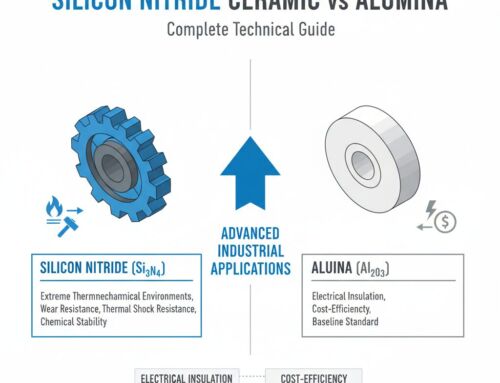
When selecting a technical ceramic, engineers must evaluate the trade-offs between thermal conductivity, electrical insulation, mechanical toughness. And manufacturability. While silicon carbide offers superior high-temperature strength and wear resistance, it is frequently compared against other oxide and non-oxide ceramics to determine the optimal cost-to-performance ratio.
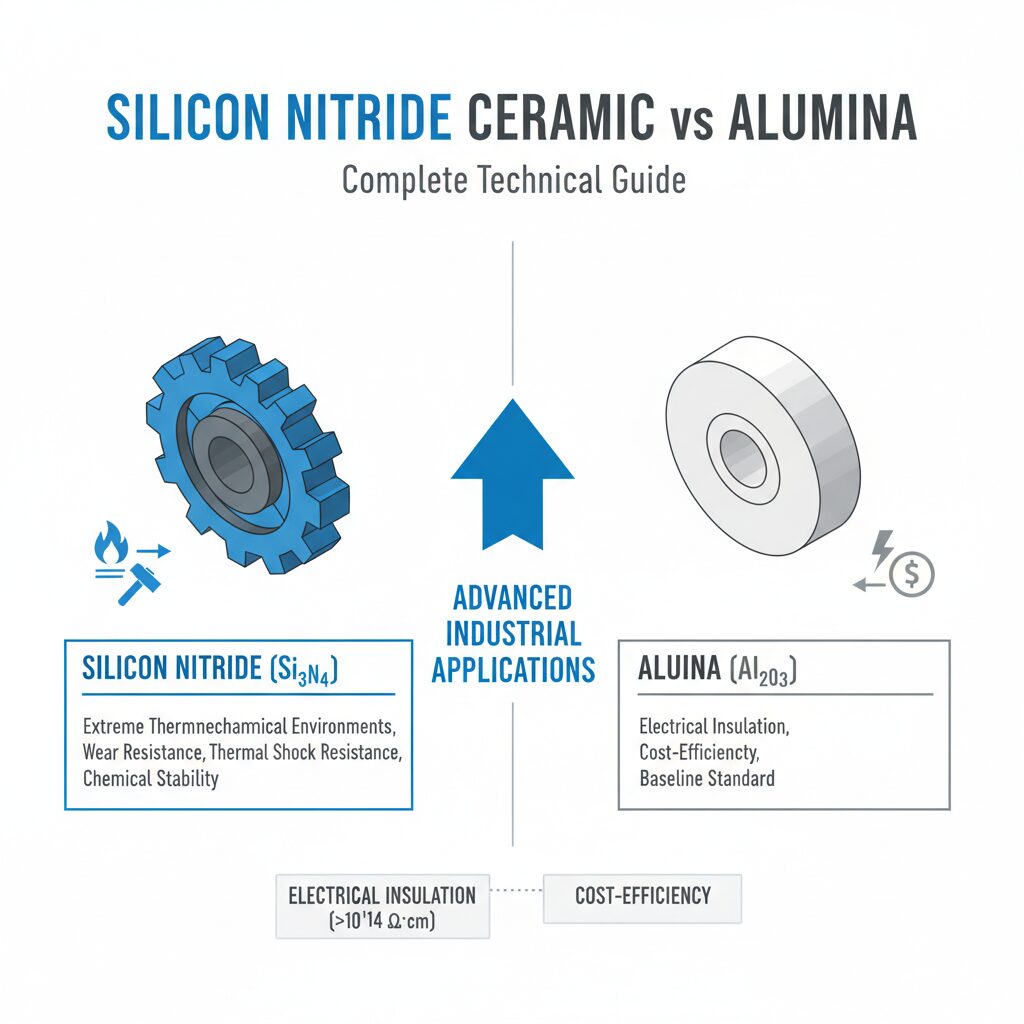
For example, alümina/”>alümina (Al₂O₃) provides a highly cost-effective solution with excellent baseline electrical insulation (>10¹⁴ Ω·cm), but suffers from relatively poor thermal conductivity (25-35 W/m·K), making it susceptible to thermal shock at temperature gradients exceeding 250°C. Zirkonya (ZrO₂) boasts the highest fracture toughness (up to 10 MPa·m½) and bend strength, behaving mechanically closer to steel, but its thermal conductivity is extremely low (2-3 W/m·K), acting as a thermal insulator rather than a conductor.
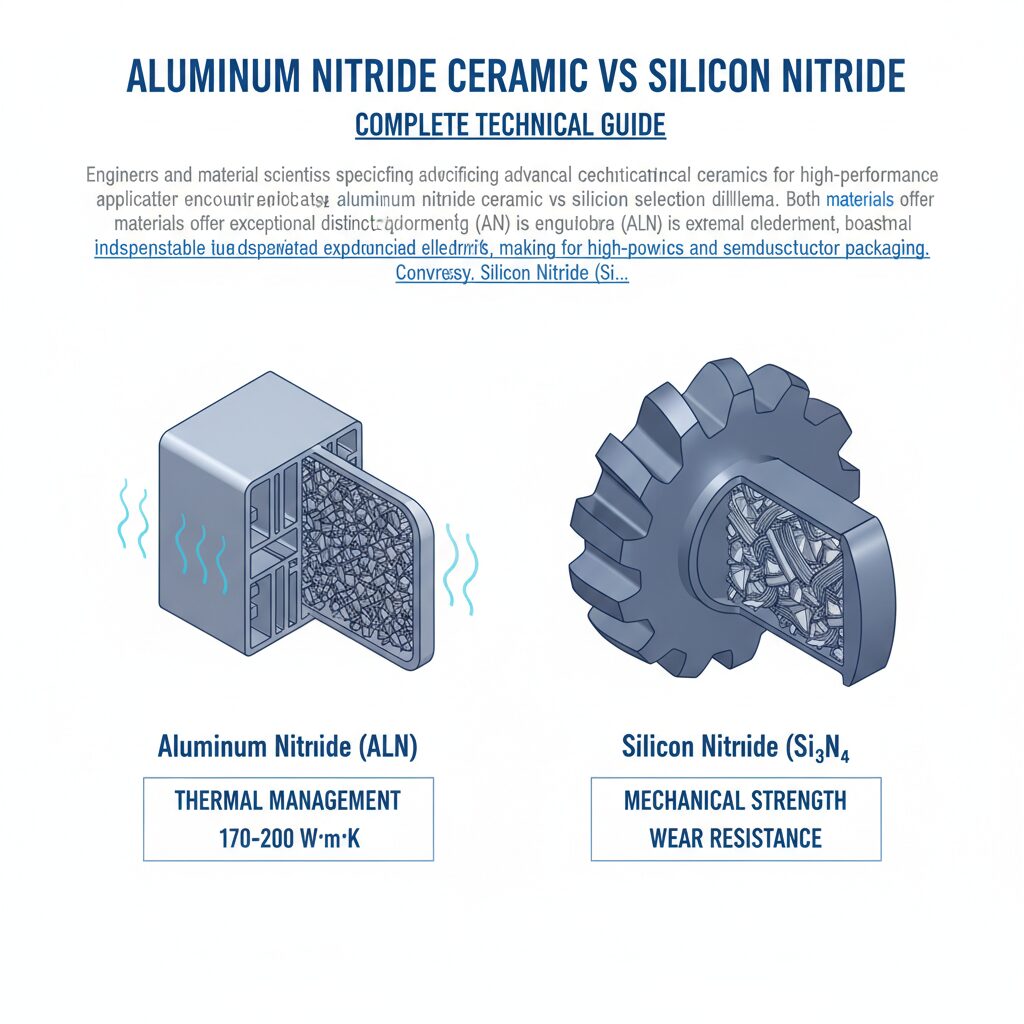
In contrast, silisyum nitrür (Si₃N₄) offers the best combination of thermal shock resistance and fracture toughness among advanced ceramics, handling rapid temperature fluctuations easily. However, when the application strictly demands extreme hardness (wear resistance), maximum thermal conductivity. And specifically tunable electrical resistivity, silicon carbide remains unmatched. Furthermore, for applications requiring supreme thermal conductivity paired with absolute electrical insulation, engineers may also consider alüminyum nitrür (170-230 W/m·K) or bor nitrür, though these materials often present different mechanical limitations and machining costs.
| Mülkiyet | Silisyum Karbür | Alumina (99.5%) | Zirkonya (Y-TZP) | Silisyum Nitrür |
|---|---|---|---|---|
| Termal İletkenlik (W/m-K) | 120 - 170 | 25 - 35 | 2.0 - 3.0 | 20 – 30 (up to 90) |
| Sertlik (HV) | 2500 - 2800 | 1500 - 1650 | 1200 - 1300 | 1400 – 1600 |
| Kırılma Tokluğu (MPa-m½) | 4.0 - 4.5 | 4.0 - 5.0 | 8.0 - 10.0 | 6.0 - 8.0 |
| Maliyet | Yüksek | Düşük | Orta | Yüksek |
Uygulamalar
The variable nature of silicon carbide ceramic electrical resistivity, combined with its profound mechanical and thermal resilience, facilitates its deployment across the most demanding industrial and technological sectors. By precisely engineering the material’s microstructure, component manufacturers can tailor SiC to fulfill highly specialized roles.
- Semiconductor Processing Equipment: Wafer handling components, such as electrostatic chucks, susceptors. And dummy wafers, require meticulous control over electrical resistivity (often targeted precisely between 10⁸ and 10¹⁰ Ω·cm for electrostatic clamping). SiC is chosen because its coefficient of thermal expansion (4.0 x 10⁻⁶ /K) closely matches that of silicon wafers, preventing thermal stress and particle generation during rapid thermal processing (RTP) at temperatures up to 1,200°C.
- Industrial Heating Elements: In electric furnaces, kilns. And high-temperature material processing environments, SiC is heavily doped to achieve a low electrical resistivity (10⁻¹ to 10 Ω·cm). When an electrical current passes through the ceramic, it generates extreme heat via Joule heating. SiC is chosen over metallic heating elements (like molybdenum disilicide) because it can sustain continuous operation in oxidizing atmospheres at 1,600°C without catastrophic degradation.
- High-Voltage Insulation Components: High-purity, intrinsic silicon carbide acts as an excellent dielectric insulator with resistivity exceeding 10¹¹ Ω·cm. It is utilized in power grid infrastructure, surge arresters. And high-voltage switches. SiC is chosen because its high thermal conductivity efficiently dissipates the immense thermal loads generated by high-voltage currents, preventing thermal runaway—a failure mode common in traditional polymeric or glass insulators.
- Mechanical Seals and Bearings in Corrosive Environments: Chemical processing pumps handling highly acidic or alkaline slurries rely on SiC seal faces. While the electrical resistivity plays a secondary role here, the material is chosen because its extreme hardness (2,800 HV) resists abrasive wear from particulates. And its chemical inertness prevents corrosion even when exposed to hydrofluoric acid or hot sodium hydroxide solutions.
- EV Power Electronics Substrates: Advanced electric vehicle inverters require substrates that can electrically isolate components while rapidly pulling heat away from high-power SiC or GaN semiconductor dies. SiC ceramics can be engineered to maintain high electrical resistivity while offering thermal conductivity exceeding 150 W/m·K. It is chosen to enable higher power densities, allowing engineers to reduce the physical size and weight of EV cooling systems.
Üretim Süreci
The journey from raw silica sand to a precision-engineered ceramic component requires highly controlled thermodynamic and mechanical processes. Because silicon carbide does not occur naturally in sufficient quantities (found only in trace amounts as the mineral moissanite), it must be synthesized industrially. The baseline raw material is typically produced via the Acheson process, where silica sand (SiO₂) and petroleum coke (carbon) are reacted in an electric resistance furnace at extreme temperatures ranging from 1,600°C to 2,500°C. The resulting crystalline structure dictates the initial baseline for the silicon carbide ceramic electrical resistivity.
Şekillendirme Yöntemleri
Once the synthesized SiC is milled into sub-micron powders (typically 0.5 to 2.0 µm in diameter) and mixed with specific sintering aids (such as boron, carbon, or yttria) and organic binders, it is shaped into a “green body.” The forming method is selected based on the component’s geometric complexity and required green density.
- Soğuk İzostatik Presleme (CIP): The ceramic powder is sealed in a flexible elastomeric mold and subjected to uniform hydrostatic fluid pressure ranging from 200 to 300 MPa. This method ensures uniform density distribution throughout the part, minimizing shrinkage variations during sintering. CIP is ideal for large, solid geometries like cylindrical billets, armor plates. And thick-walled tubes.
- Slip Casting and Extrusion: For complex internal geometries, slip casting involves pouring a liquid suspension of SiC powder into a porous plaster mold. This draws out the liquid via capillary action, leaving a solid layer of ceramic. Extrusion, on the other hand, forces a highly viscous ceramic paste through a specific die geometry under pressures of 10 to 50 MPa. Extrusion is the standard method for manufacturing long, continuous profiles such as kiln furniture beams, heat exchanger tubes. And rod-shaped heating elements.
Sinterleme
Sintering is the critical thermal step where the loosely bound powder particles fuse into a dense, monolithic ceramic structure. Because of the strong covalent bonds in SiC, the self-diffusion coefficient is extremely low, making it practically impossible to sinter pure SiC without the application of ultra-high temperatures and specialized techniques. The choice of sintering method directly determines the final porosity, mechanical strength. And the ultimate silicon carbide ceramic electrical resistivity.
To demonstrate the impact of different manufacturing pathways, the following table compares three primary types of SiC: Sintered Silicon Carbide (SSiC), Reaction Bonded Silicon Carbide (RBSiC). And Chemical Vapor Deposition (CVD) Silicon Carbide.
| Material Grade | Üretim Süreci | Yoğunluk (g/cm³) | Elektriksel Dirençlilik (Ω-cm) | Free Silicon Content |
|---|---|---|---|---|
| SSiC | Pressureless Sintering (2100°C) | 3.10 – 3.15 | 10² – 10⁶ (Tunable) | 0% |
| RBSiC | Liquid Silicon Infiltration (1500°C) | 3.00 – 3.10 | ~10⁻¹ – 10¹ (Low) | 8% – 15% |
| CVD SiC | Gas Phase Deposition (1300°C) | > 3.20 | > 10¹⁰ (Highly Insulating) | 0% |
Pressureless Sintering (SSiC): The green body is heated in an inert argon or vacuum atmosphere to temperatures between 2,100°C and 2,200°C. Sintering aids like boron and carbon facilitate densification by reducing the surface energy of the solid-vapor interface. SSiC shrinks by approximately 15-20% during this phase, requiring precise calculation to achieve near-net shape. SSiC contains no free silicon, resulting in superior high-temperature strength and excellent chemical resistance.
Reaction Bonding (RBSiC): The green body is formulated with a mixture of SiC powder and carbon. During the thermal cycle (around 1,500°C), molten silicon is introduced and drawn into the porous structure via capillary action. The liquid silicon reacts with the carbon to form secondary SiC, bonding the original particles together. RBSiC exhibits almost zero shrinkage (< 1%), making it ideal for extremely large or complex parts. However, the residual free silicon (8-15%) limits its maximum operating temperature to 1,350°C and drastically lowers its electrical resistivity, making it highly conductive compared to SSiC.
Son İşleme
Following sintering, the ceramic component achieves its extreme hardness. Conventional cutting tools like high-speed steel (HSS) or tungsten carbide are instantly destroyed upon contact with sintered SiC. Consequently, all final shaping, drilling. And surface finishing must be executed using specialized diamond-abrasive grinding processes. High-speed CNC grinding centers use diamond wheels (typically ranging from D46 to D15 grit sizes) under high-pressure coolant (up to 50 bar) to achieve the final dimensions. The precision required at this stage is immense. This is why partnering with an expert in hassas serami̇k i̇şleme is essential for achieving critical tolerances and mirror-like surface finishes (Ra < 0.1 µm).
Avantajlar ve Sınırlamalar
Understanding the dualistic nature of SiC is paramount for effective engineering integration. The material offers profound capabilities but requires strict design considerations to mitigate its structural constraints.
Avantajlar
- Highly Tunable Electrical Profile: The ability to manipulate the silicon carbide ceramic electrical resistivity from highly conductive to an absolute dielectric allows engineers to use one core material platform across completely different functional requirements—from heating elements to high-voltage insulators.
- Olağanüstü Termal İletkenlik: Operating at 120-170 W/m·K, SiC pulls heat away from critical junctions at a rate exponentially faster than alumina or zirconia, mitigating localized thermal stresses and drastically improving component lifespan in high-heat flux environments.
- Aşırı Kimyasal İnertlik: The strong covalent bonding provides absolute resistance to oxidation, strong acids (HCl, H₂SO₄, HF). And strong alkalis. SSiC suffers zero weight loss even after prolonged immersion in boiling concentrated acids.
- Üstün Aşınma Direnci: With a Knoop hardness exceeding 26.8 GPa (2,800 HV), SiC is one of the hardest materials available, ranking just below diamond and boron carbide. This translates to an exceptionally long service life in abrasive slurry, tribological. And high-friction applications.
Sınırlamalar
- Doğal Kırılganlık: As with all advanced ceramics, SiC lacks the ability to deform plastically. Its fracture toughness is relatively low (4.0 – 4.5 MPa·m½). It is highly susceptible to catastrophic failure from impact loads, localized point stresses, or improper mechanical fastening. Design engineers must utilize compressive loading and avoid tensile stress concentrations.
- High Manufacturing and Machining Costs: The extreme temperatures required for synthesis and sintering, combined with the slow, diamond-dependent final machining process, render SiC a premium material. It is significantly more expensive to produce than standard alumina components, necessitating clear justification based on performance requirements.
İşleme ile İlgili Hususlar
The very characteristics that make silicon carbide exceptional in application—its extreme hardness, stiffness. And chemical resilience—make it notoriously difficult to machine. Post-sintered SiC components possess a hardness of 2,800 HV. Because of its brittle nature, material removal during CNC grinding does not occur through ductile shearing (as seen in metal cutting) but through controlled micro-fracturing. If machining parameters are not optimized, the cutting forces will propagate micro-cracks deep beneath the component surface, leading to a phenomenon known as Sub-Surface Damage (SSD). Severe SSD severely compromises the mechanical integrity of the component, increasing the probability of premature failure under operational stress.
To safely machine silicon carbide, parameters must be meticulously controlled. Spindle speeds must be exceptionally high, often operating between 10,000 and 30,000 RPM, while maintaining incredibly low feed rates (e.g., 0.1 to 0.5 mm/min for deep hole drilling) and shallow depths of cut (often less than 5 microns per pass). The transition depth from ductile to brittle removal for SiC is typically less than 1 micrometer. Therefore, achieving a mirror finish without inducing subsurface cracking requires specialized resin-bonded diamond wheels, rigid machine tool kinematics that suppress harmonic vibrations. And high-volume, high-pressure flood coolant to mitigate localized thermal damage at the cutting zone.
Great Ceramic excels in overcoming these formidable machining challenges. Utilizing state-of-the-art multi-axis CNC grinding centers equipped with continuous dressing technology and advanced acoustic emission sensors, we monitor the grinding process in real-time. This ensures that every component is machined within the ductile regime. Our proprietary machining protocols allow us to consistently deliver precision SiC parts with dimensional tolerances down to ±0.005mm, concentricity within 0.01mm. And surface roughness as fine as Ra 0.05 µm. Ensure your complex ceramic components are manufactured flawlessly. Learn more about our precision ceramic machining solutions or request a technical consultation today.
FAQ
What is silicon carbide ceramic electrical resistivity?
Silicon carbide ceramic electrical resistivity refers to the material’s inherent resistance to the flow of electric current. Because SiC is a wide-bandgap semiconductor (2.36 to 3.26 eV), its baseline resistivity is naturally high. However, by carefully controlling the polytype structure, manufacturing method (like reaction bonding vs. pressureless sintering). And introducing specific dopants (such as nitrogen, aluminum, or boron), its resistivity can be engineered across a massive spectrum—from 10⁻¹ Ω·cm (highly conductive, used for heating elements) to over 10¹¹ Ω·cm (highly insulating, used in high-voltage substrates). Furthermore, this resistivity exhibits a negative temperature coefficient, meaning the material becomes more electrically conductive as operational temperatures increase.
What are the main applications of silicon carbide ceramic?
Due to its remarkable blend of thermal, mechanical. And electrical properties, SiC is deployed in extreme-environment applications. Highly conductive SiC is utilized to manufacture industrial heating elements that operate continuously at 1,600°C. Specific resistivity-controlled SiC (10⁸ – 10¹⁰ Ω·cm) is heavily used in semiconductor fabrication equipment for electrostatic chucks, susceptors. And dummy wafers. Highly insulating SiC serves as high-voltage dielectric supports and thermal management substrates for power electronics. Additionally, its extreme hardness makes it the standard material for mechanical seal faces and bearings in highly abrasive and corrosive chemical processing pumps.
How does silicon carbide compare to other ceramics?
Silicon carbide stands out for its exceptional thermal conductivity (120-170 W/m·K) and extreme hardness (2500-2800 HV). When compared to alumina, SiC offers vastly superior thermal shock resistance and a higher maximum operating temperature, though alumina is more cost-effective for simple insulation. Compared to zirconia, SiC is much harder and handles heat far better, whereas zirconia acts as a thermal insulator with higher fracture toughness (meaning zirconia is less brittle). Compared to silicon nitride, SiC offers better thermal conductivity and wear resistance, while silicon nitride generally provides better fracture toughness and superior resistance to sudden, extreme thermal shocks.
What are the advantages of tunable resistivity in silicon carbide?
The primary advantage of tunable silicon carbide ceramic electrical resistivity is extreme design versatility. Engineers can utilize the exact same foundational material to achieve entirely different functional goals. A semiconductor engineer can spec a SiC chuck with moderate resistivity to enable precise electrostatic clamping of silicon wafers without electrostatic discharge (ESD) damage. Conversely, a power grid engineer can spec high-purity insulating SiC to prevent electrical arcing while simultaneously using the material to pull massive amounts of thermal energy away from high-voltage nodes. This eliminates the need to bond different materials together. This often leads to failure due to mismatched thermal expansion coefficients.
How is silicon carbide machined to high tolerances?
Because post-sintered silicon carbide is incredibly hard and brittle, it cannot be turned or milled using traditional metal-cutting tools like high-speed steel or carbide. It must be machined using high-speed multi-axis CNC grinding centers equipped with diamond-abrasive tooling. To achieve tight tolerances like ±0.005mm without inducing subsurface micro-cracks, machinists must use extremely high spindle speeds (up to 30,000 RPM), very shallow depths of cut (under 5 microns), low feed rates. And high-pressure coolant. Great Ceramic specializes in this exact process, leveraging advanced grinding kinematics and proprietary tooling setups to deliver defect-free, ultra-precise ceramic components ready for immediate integration.
Need custom silicon carbide parts? Great Ceramic ile iletişime geçin for precision machining services with tight tolerances (±0.005mm), or email our engineering team directly at [email protected] to discuss how we can optimize your next advanced ceramic project.
silicon carbide ceramic electrical resistivity is widely used in advanced ceramic applications.
Hakkında daha fazla bilgi edinin Silikon Karbür Seramik Elektriksel Direnç ve hassas seramik işleme hizmetlerimiz.