








Silisyum Nitrür Ceramic Block for Chemical Applications: High-Performance Solutions for Aggressive Environments
In the demanding world of chemical processing, material failure is not just an inconvenience—it is a significant safety hazard and a major financial drain. When traditional metals and polymers succumb to corrosion, erosion. And thermal fatigue, engineers turn to advanced technical ceramics. Among these, the silicon nitride ceramic block for chemical applications stands out as a premier material choice. Known for its exceptional toughness, thermal shock resistance. And chemical inertness, silicon nitride (Si3N4) provides the reliability required for the most aggressive industrial environments.
Great Ceramic specializes in the precision manufacturing and CNC machining of these advanced materials. This guide explores the technical properties, manufacturing processes. And specialized applications of silicon nitride ceramic blocks, demonstrating why they are the gold standard for modern chemical engineering.
Understanding Silicon Nitride (Si3N4) Composition
Silicon nitride is a synthetic chemical compound composed of silicon and nitrogen. Unlike traditional ceramics that are oxide-based, Si3N4 is a non-oxide ceramic with strong covalent bonding. This atomic structure is responsible for its high strength and hardness. In its crystalline form, it primarily exists in two phases: alpha and beta. The needle-like microstructure of the beta phase provides the material with its unique fracture toughness, acting as a natural reinforcement against crack propagation.
For chemical applications, the purity and sintering method of the silicon nitride ceramic block are critical. Depending on the intended use, additives such as yttria (Y2O3) or alumina (Al2O3) are used as sintering aids to achieve full density while maintaining the material’s chemical integrity.
Technical Properties of Silicon Nitride Ceramic Blocks
The selection of a silicon nitride ceramic block for chemical processes is driven by its data-backed performance. Below is a comprehensive table detailing the typical technical properties of high-performance Si3N4.
| Mülkiyet | Birim | Typical Value (Si3N4) |
|---|---|---|
| Yoğunluk | g/cm³ | 3.20 – 3.30 |
| Sertlik (Vickers) | GPa | 15 - 18 |
| Eğilme Dayanımı (Oda Sıcaklığı) | MPa | 600 – 900 |
| Basınç Dayanımı | MPa | 2500 – 3000 |
| Kırılma Tokluğu (K1c) | MPa-m½ | 5.0 – 8.0 |
| Termal İletkenlik | W/m-K | 20 – 30 |
| Termal Genleşme Katsayısı | 10⁻⁶/°C | 3.0 – 3.4 |
| Maximum Operating Temp (Inert) | °C | 1400 |
| Dielektrik Dayanım | kV/mm | 15 - 20 |
The most striking feature of the silicon nitride ceramic block is the combination of high fracture toughness and low thermal expansion. This allows the material to withstand rapid temperature changes (thermal shock) that would cause other ceramics like alumina to shatter instantly.
Corrosion Resistance in Chemical Environments
Chemical processing often involves exposure to concentrated acids, alkalis. And reactive gases. A silicon nitride ceramic block for chemical use is engineered to resist these agents. The material is chemically inert to most organic and inorganic acids, with the notable exception of hydrofluoric acid (HF) and hot phosphoric acid.
In alkaline environments, silicon nitride maintains its stability at moderate temperatures. Its resistance to molten non-ferrous metals (like aluminum and zinc) also makes it useful in peripheral chemical processes involving metallurgy. The formation of a thin, protective silicon dioxide layer on the surface of the block at high temperatures provides further oxidation resistance up to approximately 1200°C.
Resistance to Cavitation and Erosion
In fluid handling, chemical components are often subjected to high-velocity flow and cavitation. Metals suffer from “corrosion-erosion,” where the protective oxide layer is mechanically stripped away, exposing fresh metal to chemical attack. Because a silicon nitride ceramic block is significantly harder than stainless steel or titanium, it resists this mechanical wear, ensuring the component’s geometry remains precise over thousands of hours of operation.
Types of Silicon Nitride Materials
Not all silicon nitride ceramic blocks are created equal. The manufacturing process determines the final density and mechanical capabilities of the block.
- Reaction Bonded Silicon Nitride (RBSN): Created by nitriding a silicon powder compact. It features 15-20% porosity and lower strength but offers excellent dimensional stability during firing.
- Gas Pressure Sintered Silicon Nitride (GPSN): Sintered under high nitrogen pressure. This method produces a near-fully dense material with excellent mechanical properties, making it the standard for most chemical blocks.
- Hot Pressed Silicon Nitride (HPSN): Uniaxial pressure is applied during sintering. This results in maximum theoretical density and the highest possible strength, though it limits the shapes to simple blocks or plates.
- Sintered Reaction Bonded Silicon Nitride (SRBSN): Combines the cost-effectiveness of RBSN with the density of GPSN.
Precision CNC Machining of Silicon Nitride Blocks
Because of its extreme hardness (approaching that of diamond), machining a silicon nitride ceramic block for chemical applications requires specialized equipment and expertise. Great Ceramic utilizes advanced CNC centers to transform raw blocks into high-precision components.
Green Machining vs. Hard Machining
The most efficient way to produce complex silicon nitride parts is through “green machining.” This process involves machining the material in its pre-sintered, compacted powder state. In this stage, the material has a consistency similar to chalk, allowing for faster material removal and lower tool wear. However, engineers must account for a precise shrinkage factor (often 15-25%) that occurs during the final sintering process.
For applications requiring micron-level tolerances and superior surface finishes (Ra < 0.2 µm), hard machining is performed after sintering. This involves:
- Elmas Taşlama: Using resin-bonded or metal-bonded diamond wheels to remove material.
- Ultrasonik İşleme: Utilizing high-frequency vibrations combined with abrasive slurry to create intricate holes or cavities.
- Lepleme ve Parlatma: Vital for chemical seals and valve seats to ensure gas-tight fits.
Machining Challenges and Solutions
The primary challenge in machining silicon nitride is its brittle nature. Incorrect feed rates or spindle speeds can cause micro-cracking or “chipping” at the edges. Great Ceramic employs rigid CNC setups and specialized cooling systems to maintain thermal stability during the grinding process, ensuring the structural integrity of every silicon nitride ceramic block.
Key Industry Applications
The versatility of the silicon nitride ceramic block for chemical use allows it to be integrated into various high-stakes industries.
1. Petrochemical and Oil & Gas
In downhole tools and refinery equipment, components are exposed to hydrogen sulfide (H2S), CO2. And abrasive sand. Si3N4 blocks are machined into valve trims, choke beans. And hydrocyclone liners to prevent premature failure in these harsh conditions.
2. Semiconductor Manufacturing
The semiconductor industry uses highly corrosive plasma etchants and cleaning chemicals. Silicon nitride’s high purity and resistance to plasma erosion make it ideal for wafer handling components, etch chamber liners. And chemical vapor deposition (CVD) hardware.
3. Pharmaceutical Processing
In pharmaceutical production, avoiding contamination is paramount. Metals can leach ions into the product. Silicon nitride blocks are used to create pill pressing dies, pump pistons. And mixing paddles that are chemically inert and easy to sterilize.
4. Chemical Pump and Valve Components
Pumps handling concentrated sulfuric acid or caustic soda rely on silicon nitride for mechanical seal faces, bearings. And shafts. The material’s low coefficient of friction when polished reduces energy loss and heat generation.
Comparison: Silicon Nitride vs. Other Technical Ceramics
When selecting a material for a chemical block, it is important to understand how silicon nitride compares to its peers.
Silicon Nitride vs. Alümina (Al2O3)
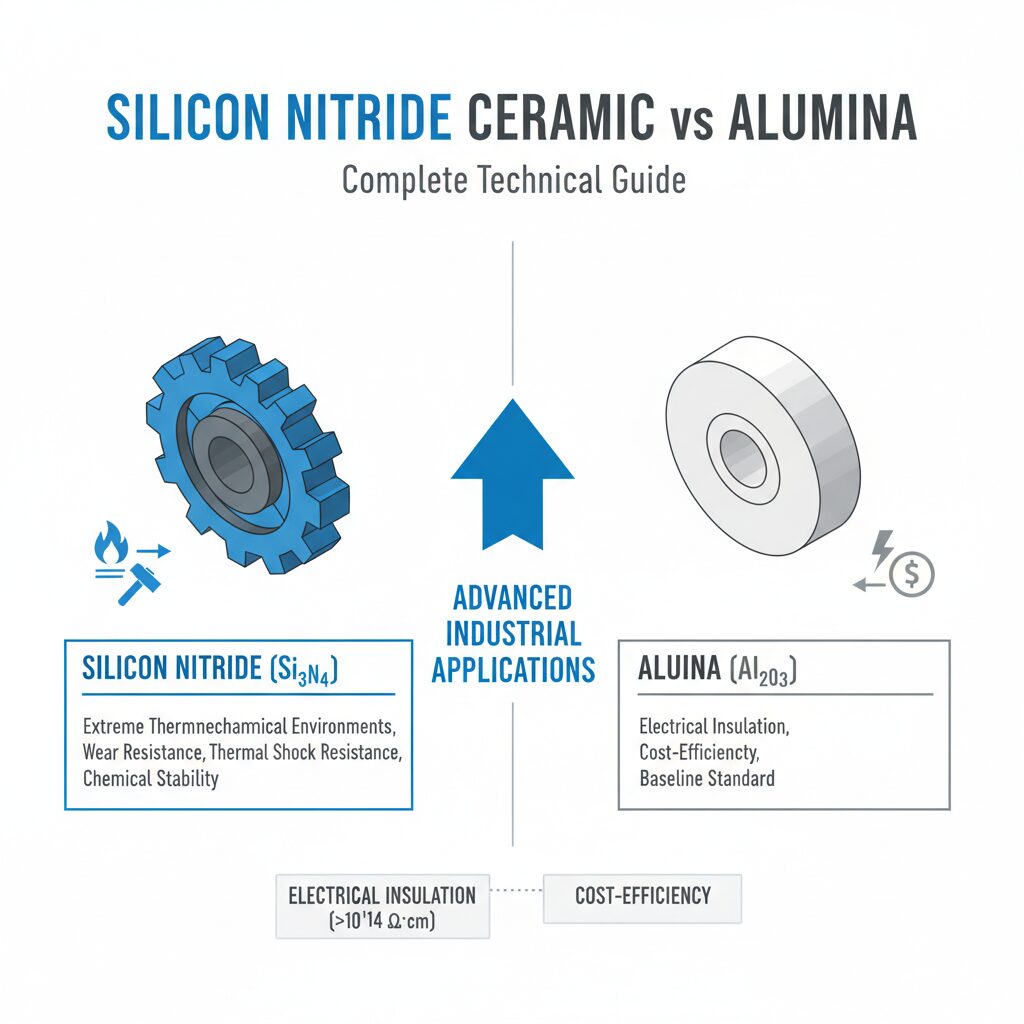
While alumina is more cost-effective and offers good chemical resistance, it lacks the thermal shock resistance and toughness of silicon nitride. In applications with fluctuating temperatures, alumina is prone to cracking, whereas Si3N4 remains stable.
Silicon Nitride vs. Zirconia (ZrO2)
Zirconia offers high toughness at room temperature but suffers from “low-temperature degradation” or aging in the presence of steam or moisture. Silicon nitride does not suffer from this phase transformation, making it more reliable for long-term chemical immersion.
Silicon Nitride vs. Silicon Carbide (SiC)
Silicon carbide is harder and more chemically resistant to certain acids than silicon nitride. However, silisyum karbür is extremely brittle. Silicon nitride is preferred for applications where the component might experience mechanical impact or vibration.
Mühendisler için Tasarım Hususları
When designing a part to be machined from a silicon nitride ceramic block for chemical use, several principles should be followed to optimize performance and reduce costs:
- Avoid Sharp Corners: Use radii on all internal and external corners to distribute stress and reduce the risk of chipping during machining.
- Simplify Geometries: While Great Ceramic can achieve complex shapes, simplifying the design reduces the time spent on diamond grinding.
- Tolerance Realism: Only specify tight tolerances (microns) where absolutely necessary, such as for mating surfaces or seal faces.
- Wall Thickness: Maintain uniform wall thickness to prevent internal stresses during the sintering process.
The Future of Silicon Nitride in Chemical Engineering
As chemical processes move toward higher temperatures and higher pressures to increase efficiency, the demand for silicon nitride ceramic blocks continues to grow. Innovations in Additive Manufacturing (3D printing) of silicon nitride are beginning to emerge, allowing for even more complex internal geometries, such as microfluidic channels for chemical reactors. This were previously impossible to machine.
Furthermore, the drive for “Green Chemistry” requires catalysts and reactors that can withstand long cycles without degradation. The longevity of Si3N4 helps reduce the environmental footprint of industrial operations by minimizing waste and the frequency of replacement parts.
Sıkça Sorulan Sorular (SSS)
Is silicon nitride resistant to all chemicals?
While it is exceptionally resistant to most acids and bases, it is attacked by hydrofluoric acid, hot phosphoric acid. And strong concentrated boiling caustic solutions. Always consult a chemical compatibility chart before selection.
What is the maximum size of a silicon nitride ceramic block?
Maximum sizes are typically dictated by the capacity of the sintering furnaces and hot presses. Common sizes range up to 300mm x 300mm, though custom larger blocks can be produced through specialized processes.
Can silicon nitride be used for high-temperature sensors?
Yes, due to its high dielectric strength and thermal stability, it is an excellent material for protecting thermocouples and other sensors in chemical reactors.
How does the cost of silicon nitride compare to stainless steel?
The initial cost of a silicon nitride ceramic block is higher than stainless steel. However, in aggressive chemical environments, the service life of Si3N4 can be 10 to 50 times longer, leading to a much lower total cost of ownership (TCO).
Is it possible to join silicon nitride to metal?
Yes, silicon nitride can be joined to metal components using active metal brazing, shrink-fitting, or specialized adhesives, allowing for hybrid assemblies in chemical systems.
Sonuç
The silicon nitride ceramic block for chemical applications represents the pinnacle of material science for harsh environments. Its unique combination of mechanical toughness, thermal shock resistance. And chemical stability allows it to thrive where metals fail. By partnering with a precision manufacturer like Great Ceramic, companies can leverage advanced CNC machining to create bespoke solutions that enhance the reliability and efficiency of their chemical processes.
Whether you are dealing with abrasive slurries, corrosive acids, or extreme thermal cycles, silicon nitride provides the durability required for 21st-century industrial challenges.
Özel siparişler için Great Ceramic ile iletişime geçin serami̇k i̇şleme uygulamanıza özel çözümler.
silicon nitride ceramic ceramic block for chemical is widely used in advanced ceramic applications.