









Silicon Nitride Ceramic Seal Ring for Energy: Complete Technical Guide
In the highly demanding energy sector, component failure is not merely an inconvenience. it results in catastrophic downtime, severe environmental hazards. And immense financial losses. The azotek krzemu ceramic seal ring for energy applications represents the apex of tribological and structural material engineering, engineered to withstand the extreme pressures, abrasive particulates. And aggressive chemical environments inherent in power generation and extraction operations. While traditional metals degrade under cavitation and standard ceramics like tlenek glinu suffer from brittle fracture under severe mechanical shock, silicon nitride offers a unique microstructure of interlocking beta-phase grains that delivers unprecedented fracture toughness and thermal stability. This complete technical guide explores the thermomechanical properties, manufacturing protocols. And precision machining requirements necessary to produce reliable seal faces. For engineers facing persistent seal failures in high-pressure rotating equipment, Great Ceramic provides custom precision machining solutions with strict dimensional control down to ±0.005mm tolerances. If you require immediate technical consultation on material selection or engineering design, contact Great Ceramic’s engineering team to optimize your next sealing application.
Właściwości materiałów
The superior performance of the silicon nitride ceramic seal ring for energy derives directly from its intrinsic thermomechanical properties. At the microstructural level, silicon nitride ($Si_3N_4$) exhibits a hexagonal crystalline structure. During the sintering process, alpha-phase powder transforms into elongated, needle-like beta-phase grains. This specific morphology creates an interlocking structural matrix. This provides a highly effective crack-deflection mechanism. When localized stress initiates a micro-crack, the propagating fissure is forced to navigate around these elongated grains, absorbing substantial fracture energy and preventing catastrophic failure. This property is crucial for mechanical seals subjected to the intense hydraulic hammering and high-speed start-stop cycles common in energy sector pumps. Furthermore, the strong covalent bonding (predominantly $Si-N$) ensures exceptional hardness and resistance to chemical attack, maintaining seal face integrity even in environments containing high concentrations of hydrogen sulfide ($H_2S$) or supercritical carbon dioxide ($CO_2$).
| Nieruchomość | Wartość | Jednostka |
|---|---|---|
| Gęstość | 3.20 - 3.25 | g/cm³ |
| Twardość | 1500 - 1600 | HV |
| Wytrzymałość na zginanie | 750 – 900 | MPa |
| Wytrzymałość na złamania | 6.5 - 8.0 | MPa-m½ |
| Przewodność cieplna | 25 - 30 | W/m-K |
| Rezystywność elektryczna | > 10^14 | Ω-cm |
| Maksymalna temperatura robocza | 1100 - 1200 | °C |
Porównanie z innymi materiałami ceramicznymi
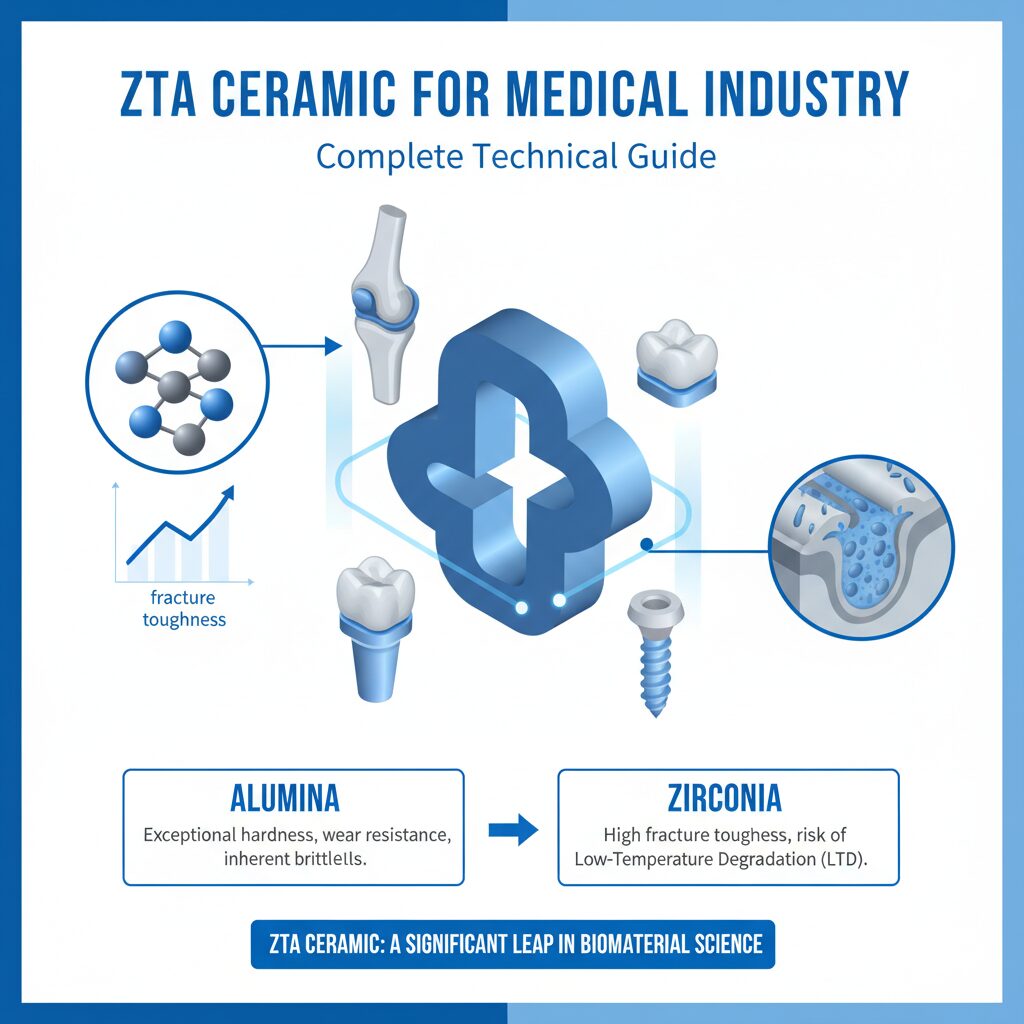
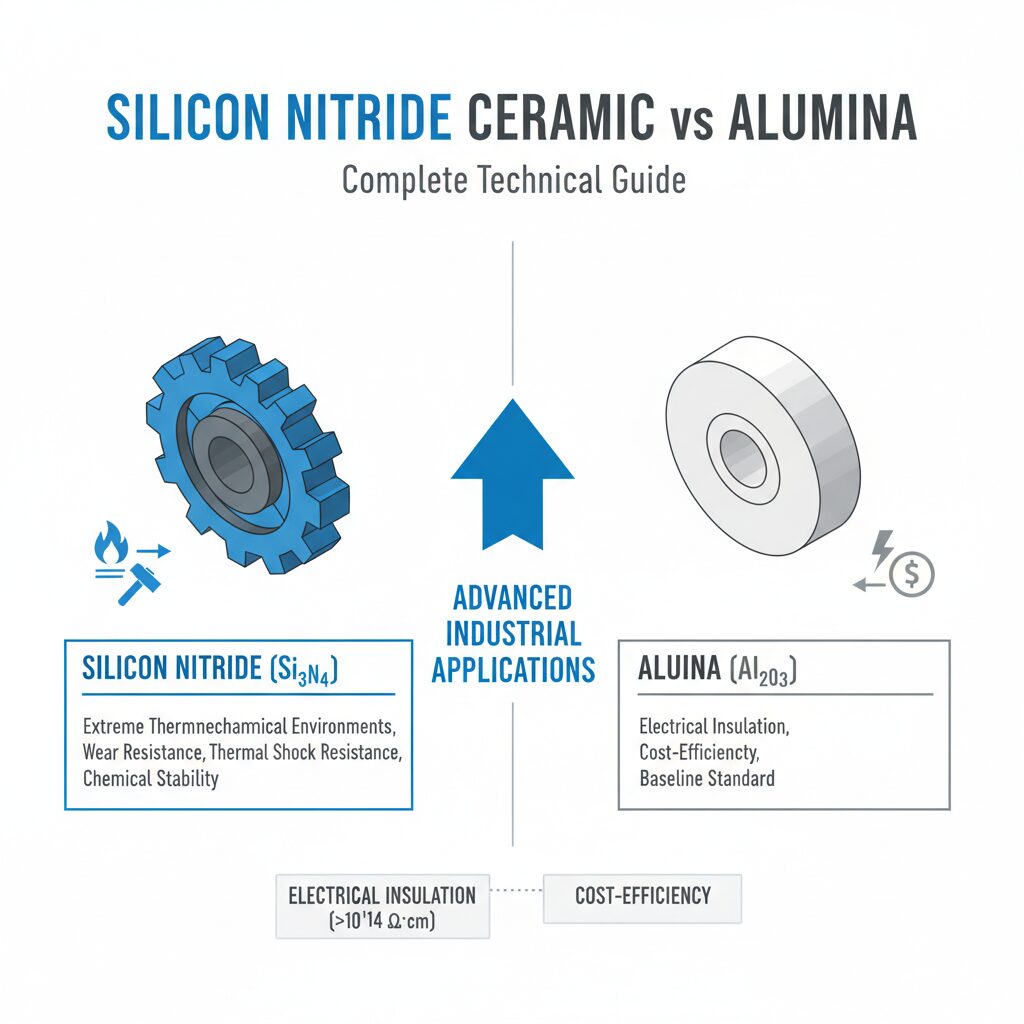
Selecting the correct technical ceramic for mechanical seal faces requires a rigorous comparative analysis of tribological properties, fracture mechanics. And thermal behavior. Engineers frequently evaluate silicon nitride alongside other advanced ceramics. For instance, tlenek glinu provides a cost-effective solution for low-stress environments but falls short in applications subjected to rapid temperature fluctuations due to its relatively high coefficient of thermal expansion (8.1 x 10^-6 /°C) and lower thermal conductivity. Conversely, cyrkonia offers the highest fracture toughness at room temperature but is highly susceptible to Low-Temperature Degradation (LTD) or hydrothermal aging when exposed to water or steam at temperatures between 150°C and 300°C—conditions ubiquitous in energy applications. The specialized silicon nitride ceramic seal ring for energy, processed with proprietary yttria and alumina sintering additives, achieves a highly optimized balance. It significantly outperforms standard commercial-grade silicon nitride by minimizing the intergranular glassy phase, thereby elevating high-temperature creep resistance and maximizing both hardness and thermal shock resistance. For applications requiring extreme thermal conductivity above 130 W/m·K, engineers might alternatively specify azotek aluminium, though it lacks the wear resistance required for dynamic seal faces.
| Nieruchomość | Silicon Nitride Ceramic Seal Ring for Energy | Tlenek glinu | Cyrkon | Azotek krzemu |
|---|---|---|---|---|
| Przewodność cieplna | 28 W/m·K | 25 W/m-K | 2,5 W/m-K | 20 W/m-K |
| Twardość | 1600 HV | 1450 HV | 1200 HV | 1500 HV |
| Wytrzymałość na złamania | 7,5 MPa-m½ | 3,5 MPa-m½ | 9,0 MPa-m½ | 6.0 MPa·m½ |
| Koszt | Wysoki | Niski | Średni | Wysoki |
Aplikacje
- Downhole Oil and Gas Drilling Tools (MWD/LWD): In Measurement While Drilling (MWD) and Logging While Drilling (LWD) pulsers, the silicon nitride ceramic seal ring for energy must endure abrasive drilling mud flowing at velocities exceeding 30 m/s under hydrostatic pressures up to 20,000 psi. Silicon nitride is selected over tungsten carbide because its specific gravity (3.2 g/cm³) is nearly one-fifth that of tungsten carbide (14.5 g/cm³), drastically reducing rotational inertia and parasitic power loss while maintaining equivalent wear resistance against highly abrasive silica particulates.
- Nuclear Reactor Coolant Pumps: Primary coolant pumps in Pressurized Water Reactors (PWRs) require absolutely zero-leakage hermetic seals operating in radioactive, borated water at 300°C and 15 MPa. Silicon nitride is chosen because it exhibits zero hydrothermal degradation (unlike yttria-stabilized zirconia) and provides a highly stable tribological running film, ensuring continuous operation for the mandatory 5-to-10-year maintenance intervals without the risk of sudden brittle fracture during emergency scram thermal transients.
- Concentrated Solar Power (CSP) Molten Salt Pumps: CSP facilities utilize molten nitrate salts at temperatures exceeding 560°C for thermal energy storage. Dynamic seals in these pumps face extreme thermal shock during startup phases and severe corrosion from the molten salt. A silicon nitride ceramic seal ring for energy is specified here because its low coefficient of thermal expansion (3.2 x 10^-6 /°C) combined with high flexural strength yields a thermal shock resistance parameter ($\Delta T$) greater than 600°C, preventing the cracking that commonly destroys alumina seals in this exact scenario.
- Wind Turbine Hydraulic Pitch Control Systems: Megawatt-class offshore wind turbines utilize high-pressure hydraulics to adjust blade pitch continuously. The mechanical seals in these rotary joints suffer from micro-fretting and dry-running conditions during periods of low wind. Silicon nitride is selected for its exceptionally low unlubricated coefficient of friction (typically 0.15 – 0.25 against carbon-graphite or silicon carbide), preventing excessive frictional heating and adhesive wear during boundary lubrication regimes.
- Geothermal Power Generation Turbines: The multi-phase fluids extracted from geothermal wells contain a destructive mixture of steam, abrasive rock particles, dissolved chlorides. And hydrogen sulfide. Metallic seals corrode rapidly, while softer ceramics wear prematurely. The high hardness (1600 HV) and supreme chemical inertness of silicon nitride guarantee dimensional stability of the seal face flatness (maintained below 0.3 µm) despite continuous exposure to this highly erosive and corrosive multi-phase flow.
Proces produkcji
Producing a high-performance silicon nitride ceramic seal ring for energy requires rigorous control over powder metallurgy, sintering thermodynamics. And extremely precise post-sintering subtraction. Because strong covalent bonds inhibit solid-state diffusion, pure silicon nitride powder cannot be sintered to full theoretical density without the assistance of specific oxide additives. Manufacturers typically blend sub-micron alpha-phase $Si_3N_4$ powder with 4-8 wt% Yttrium Oxide ($Y_2O_3$) and 2-5 wt% Aluminum Oxide ($Al_2O_3$). These additives react with the thin layer of silica ($SiO_2$) naturally present on the powder surface to form a liquid silicate phase at temperatures around 1400°C. This liquid phase facilitates particle rearrangement and the dissolution-reprecipitation process, driving the critical alpha-to-beta phase transformation and densification. Great Ceramic ensures that this intergranular glassy phase is minimized and optimized for high-temperature stability, delivering seal rings with maximum reliability for energy-sector deployment.
Metody formowania
- Prasowanie izostatyczne na zimno (CIP): For high-integrity seal rings, the blended powder is loaded into flexible polyurethane molds and subjected to multi-directional hydrostatic pressure ranging from 200 to 300 MPa. This method ensures a highly uniform green body density (typically 55-60% of theoretical density). This is absolutely critical to prevent anisotropic shrinkage and warping during the high-temperature sintering phase.
- Uniaxial Die Pressing: For thinner, high-volume seal faces, automated uniaxial pressing at pressures of 50-100 MPa is utilized. While faster, carefully engineered binders (such as PVA or PEG) and lubricants must be precisely controlled to minimize density gradients along the axial pressing direction.
Spiekanie
The green bodies undergo a precise thermal debinding profile between 400°C and 600°C to burn off polymeric binders. Subsequently, Gas Pressure Sintering (GPS) is employed to achieve >99.5% theoretical density. The azotek krzemu components are heated to 1750°C – 1850°C inside a specialized graphite furnace. Crucially, a high-pressure nitrogen atmosphere (between 10 to 100 bar) is applied. This elevated overpressure of nitrogen chemically suppresses the high-temperature dissociation of $Si_3N_4$ into liquid silicon and nitrogen gas, a reaction that would otherwise degrade the material’s structural integrity. This precise thermodynamic control ensures a fully dense, void-free microstructure.
Obróbka końcowa
Post-sintering, the silicon nitride blanks possess an extreme hardness of up to 1600 HV, rendering traditional metal-cutting tools useless. The manufacturing transitions strictly to diamond-abrasive operations. The seal rings undergo sequential cylindrical grinding, flat lapping. And final face polishing using progressively finer synthetic diamond slurries. Achieving the required seal face flatness of 1-2 light bands (0.29 µm – 0.58 µm) and a surface roughness (Ra) of less than 0.05 µm dictates strict kinematic control over the lapping plates. For the highest tier of precyzyjna obróbka ceramiki, Great Ceramic leverages multi-axis CNC grinding centers equipped with in-situ metrology to ensure tight geometric dimensioning and tolerancing (GD&T).
Zalety i ograniczenia
Zalety
- Wyjątkowa odporność na pękanie: With values between 6.5 and 8.0 MPa·m½, silicon nitride significantly resists crack propagation compared to alumina. This prevents catastrophic shattering during hydraulic shock or foreign object debris (FOD) ingestion in energy pipeline systems.
- Doskonała odporność na szok termiczny: A low thermal expansion coefficient combined with high mechanical strength allows the silicon nitride ceramic seal ring for energy to survive rapid temperature drops (ΔT > 600°C) without the thermal stress fracturing that plagues other ceramic materials.
- Extreme Chemical Inertness: The material is highly stable in corrosive environments, showing virtually zero weight loss or dimensional change when exposed to concentrated acids, aggressive drilling fluids, or molten salts utilized in renewable energy systems.
- Low Friction and Wear: When operating against mating surfaces like węglik krzemu, silicon nitride develops a favorable tribological interface with extremely low coefficients of friction, thereby extending the Mean Time Between Failures (MTBF) for mechanical seals under boundary lubrication regimes.
Ograniczenia
- Wysokie koszty produkcji: The requirement for ultra-high purity sub-micron powders, energy-intensive Gas Pressure Sintering. And slow, diamond-based final machining renders silicon nitride significantly more expensive to produce than standard alumina or steatite components.
- Izolacja elektryczna: While advantageous in many scenarios, the high electrical resistivity (>10^14 Ω·cm) means that silicon nitride cannot dissipate static charge build-up in high-velocity hydrocarbon flow lines without specialized conductive surface coatings or dopants.
Rozważania dotyczące obróbki
The very properties that make the silicon nitride ceramic seal ring for energy invaluable—its immense hardness and interlocking fibrous microstructure—create severe challenges during the material removal process. Unlike metals that deform plastically during machining, advanced ceramics undergo brittle fracture. Machining forces must be strictly controlled to maintain the stress at the cutting zone strictly below the material’s critical fracture threshold. If the feed rate or depth of cut exceeds specific micro-mechanical limits, subsurface micro-cracks will propagate, compromising the structural integrity of the final mechanical seal and drastically reducing its fatigue life under dynamic pressure loads.
| Parametr obróbki | Recommended Value | Tolerance Capability (Great Ceramic) |
|---|---|---|
| Diamond Grit Size (Roughing) | D91 – D126 (120-170 Mesh) | ± 0,050 mm |
| Diamond Grit Size (Finishing) | D15 – D25 (600-1000 Mesh) | ± 0,005 mm |
| Grinding Wheel Surface Speed | 25 - 35 m/s | NIE DOTYCZY |
| Ciśnienie płynu chłodzącego | > 10 Bar (High-volume flood) | NIE DOTYCZY |
| Seal Face Flatness | 1 Light Band | 0.29 µm (Helium Light) |
| Chropowatość powierzchni (Ra) | Polishing Phase | < 0.02 µm |
To overcome these challenges, grinding parameters must be meticulously optimized. Wheel speeds typically operate between 25 to 35 meters per second to ensure adequate diamond exposure and clearance, while preventing thermal damage. Unlike machining softer materials like azotek boru, cutting silicon nitride generates intense friction and heat. High-pressure, water-based synthetic coolants (>10 Bar) must be precisely targeted at the wheel-workpiece interface to flush away ceramic swarf and prevent thermal micro-cracking of the seal face. Edge chipping is another primary concern during ID/OD turning and chamfering. utilizing resin-bonded diamond wheels with high concentration and careful toolpath programming (climb grinding vs. conventional grinding) minimizes this risk. Great Ceramic specializes in overcoming these exact machining challenges. With state-of-the-art CNC internal and external cylindrical grinders, Great Ceramic routinely achieves tight dimensional tolerances of ±0.005mm and concentricity below 0.01mm, ensuring that every silicon nitride ceramic seal ring for energy meets the stringent hermetic sealing requirements of the power generation and oil extraction industries.
FAQ
What is a silicon nitride ceramic seal ring for energy?
A silicon nitride ceramic seal ring for energy is a highly engineered, precision-machined tribological component used as the primary mating face in mechanical seals. Manufactured from advanced $Si_3N_4$ ceramics, it is designed specifically for power generation, nuclear. And oil & gas applications where equipment faces extreme hydrostatic pressures, corrosive multi-phase fluids, high abrasive particulate loads. And intense thermal shock. It provides the necessary leak-proof, dynamic seal between a rotating shaft and a stationary pump housing.
What are the main applications of a silicon nitride ceramic seal ring for energy?
The main applications are centralized in harsh-environment rotating machinery. This includes Measurement While Drilling (MWD) tools in the oil and gas sector, primary coolant pumps in pressurized water nuclear reactors, hydraulic pitch adjusters in offshore wind turbines. And molten salt transfer pumps in Concentrated Solar Power (CSP) plants. In all these applications, the seal ring prevents the escape of high-pressure process fluids, ensuring operational safety, regulatory compliance. And maximum equipment uptime.
How does a silicon nitride ceramic seal ring for energy compare to other ceramics?
When compared to alumina, a silicon nitride ceramic seal ring for energy possesses nearly triple the thermal shock resistance and more than double the fracture toughness (up to 8.0 MPa·m½ compared to alumina’s 3.5 MPa·m½). When compared to zirconia, silicon nitride offers superior high-temperature stability and total immunity to Low-Temperature Degradation (hydrothermal aging) in high-pressure steam/water environments. While silicon carbide offers superior thermal conductivity, silicon nitride’s toughness makes it far less prone to brittle fracture during mechanical shock or dry-running events.
What are the advantages of a silicon nitride ceramic seal ring for energy?
The primary advantages include unmatched fracture toughness derived from its interlocking beta-phase grain structure. This prevents catastrophic sudden failure. It also offers exceptional thermal shock resistance capable of surviving rapid >600°C temperature fluctuations. Additionally, it has a highly favorable, low-friction tribological profile when mated against carbon or silicon carbide seal faces, extreme resistance to chemical corrosion in both acidic and alkaline environments. And high wear resistance against abrasive slurries.
How is a silicon nitride ceramic seal ring for energy machined?
Machining a silicon nitride ceramic seal ring for energy is an extremely complex subtractive process strictly requiring synthetic diamond abrasives due to the material’s 1600 HV hardness. The process involves CNC cylindrical grinding for outer/inner diameters, followed by multi-stage flat lapping and diamond polishing to achieve sub-micron face flatness (1 light band) and ultra-low surface roughness (Ra < 0.05 µm). To prevent sub-surface micro-cracking, manufacturers must rigorously control grinding feeds, speeds. And coolant application. Great Ceramic leverages cutting-edge, multi-axis CNC grinding technology and strict statistical process control to offer industry-leading machining capabilities, consistently delivering complex ceramic seal profiles with ultra-tight tolerances of ±0.005mm to energy sector clients globally.
Need custom silicon nitride ceramic seal ring for energy parts? Kontakt Great Ceramic w przypadku usług precyzyjnej obróbki skrawaniem o wąskich tolerancjach lub wyślij wiadomość e-mail na adres [email protected].
Dowiedz się więcej o Silicon Nitride Ceramic Seal Ring For Energy i nasze usługi precyzyjnej obróbki ceramiki.