









Aluminum Nitride Ceramic Plate for Aerospace: Complete Technical Guide
The aerospace industry faces an escalating thermal management crisis. As modern avionics, advanced radar arrays. And satellite payloads become increasingly miniaturized and powerful, they generate unprecedented heat loads. In the vacuum of space or at high altitudes, convective cooling is non-existent or highly inefficient, demanding conductive heat transfer solutions that do not compromise electrical isolation. The azotek aluminium ceramic plate for aerospace applications has emerged as the definitive engineering solution to this pain point. Offering a rare combination of exceptionally high thermal conductivity (170–230 W/m·K) and robust dielectric strength (15 kV/mm), azotek aluminium provides a reliable pathway for dissipating extreme thermal energy away from sensitive semiconductor junctions. At Great Ceramic, we specialize in transforming raw advanced ceramic materials into mission-critical components, delivering precision-machined aluminum nitride substrates with industry-leading tolerances of ±0.005mm to guarantee flawless integration into extreme aerospace environments. If your thermal management project requires absolute precision, our engineering team is ready to assist with custom fabrication.
Właściwości materiałów
To understand why an aluminum nitride ceramic plate for aerospace is specified over traditional dielectric materials, engineers must evaluate its fundamental thermomechanical and electrical properties. AlN exhibits a hexagonal wurtzite crystal structure. This fundamentally dictates its behavior under thermal stress and electrical load. The theoretical thermal conductivity of a perfect AlN single crystal approaches 320 W/m·K. however, commercial polycrystalline aerospace-grade plates typically achieve between 170 W/m·K and 200 W/m·K due to phonon scattering caused by oxygen impurities and grain boundaries. Below is a comprehensive breakdown of the standard material properties engineers can expect from high-purity AlN plates.
| Nieruchomość | Wartość | Jednostka |
|---|---|---|
| Gęstość | 3.26 – 3.30 | g/cm³ |
| Twardość | 1100 - 1200 | HV |
| Wytrzymałość na zginanie | 300 – 350 | MPa |
| Wytrzymałość na złamania | 2.6 – 3.0 | MPa-m½ |
| Przewodność cieplna | 170 - 200 | W/m-K |
| Rezystywność elektryczna | > 10^14 | Ω-cm |
| Maksymalna temperatura robocza | 1000 (Powietrze) / 1900 (Obojętny) | °C |
For aerospace design, the density of 3.26 g/cm³ is highly advantageous, keeping payload weights strictly controlled compared to heavier metallic heat sinks like copper (8.96 g/cm³). Furthermore, the coefficient of thermal expansion (CTE) of AlN sits precisely at 4.5 x 10^-6 /°C (from 20°C to 400°C). This is a critical metric for avionics, as it closely matches the CTE of silicon semiconductor chips (4.1 x 10^-6 /°C). This matching minimizes the thermal stress at the solder or epoxy interface during the aggressive thermal cycling (-65°C to +125°C) commonly experienced in low earth orbit (LEO) satellites or high-altitude aircraft, drastically reducing the risk of fatigue-induced delamination.
Porównanie z innymi materiałami ceramicznymi
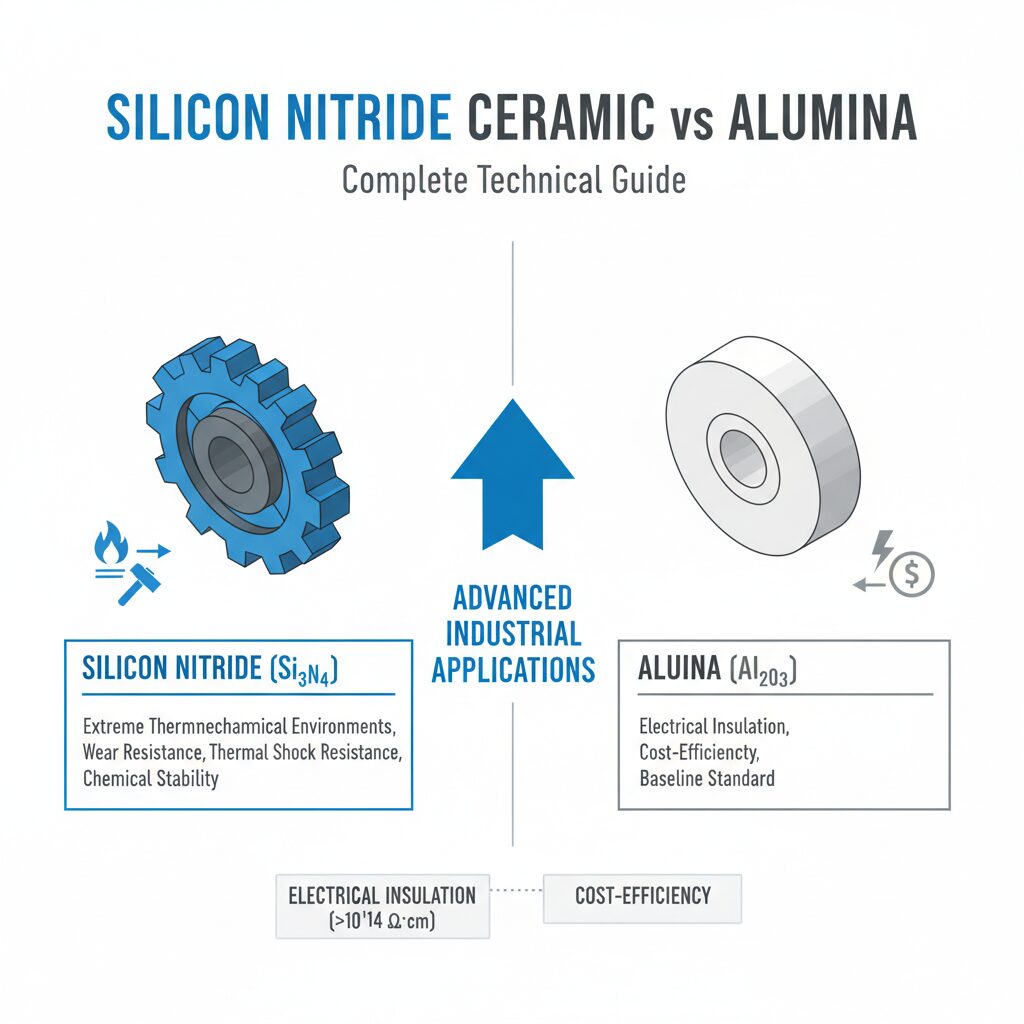
Aerospace procurement managers and R&D engineers frequently evaluate multiple advanced ceramic candidates during the design phase. While tlenek glinu/”>aluminium remains the industry standard for low-cost electronic substrates. And cyrkonia excels in structural toughness, neither can meet the extreme thermal dissipation requirements of modern high-power density electronics. In contrast, azotek krzemu offers superior mechanical resilience but falls short of AlN in pure thermal transfer. The table below provides a data-driven cross-comparison of these materials.
| Nieruchomość | Azotek glinu | Alumina (96%) | Tlenek cyrkonu (Y-TZP) | Azotek krzemu |
|---|---|---|---|---|
| Przewodność cieplna | 170 - 200 | 24–35 | 2.2 – 3.0 | 30 - 90 |
| Twardość (HV) | 1100 | 1500 | 1250 | 1500 |
| Wytrzymałość na złamanie (MPa-m½) | 2.6 | 3.5 - 4.5 | 8.0 - 10.0 | 6.0 - 7.0 |
| Koszt | Wysoki | Niski | Średni | Bardzo wysoka |
When analyzing the thermal conductivity metric, aluminum nitride outperforms 96% alumina by an order of magnitude (roughly 7x to 8x higher). For an aerospace engineer designing a localized heat sink for an Insulated-Gate Bipolar Transistor (IGBT) module, replacing an alumina plate with an aluminum nitride ceramic plate for aerospace can drop the junction temperature by over 30°C. This temperature reduction exponentially increases the mean time between failures (MTBF) for the module. Zirconia, while boasting an impressive fracture toughness of up to 10 MPa·m½, acts as a thermal insulator (2.2 W/m·K), disqualifying it from active thermal management roles. Silicon nitride strikes a balance, offering excellent fracture toughness (6.0 – 7.0 MPa·m½) and moderate thermal conductivity, making it ideal for structural engine components, but AlN remains the undisputed choice for purely electronic, high-heat flux applications.
Aplikacje
The deployment of the aluminum nitride ceramic plate for aerospace is strictly reserved for environments where thermal failure equates to mission failure. The material’s unique combination of high thermal conductivity, low CTE. And high dielectric strength makes it indispensable in the following critical systems:
- High-Power Avionics Thermal Management: Modern flight control systems utilize high-power IGBTs and MOSFETs that generate massive localized heat (flux exceeding 100 W/cm²). AlN plates act as Direct Bonded Copper (DBC) or Active Metal Brazed (AMB) substrates, instantly wicking heat away from the silicon die while preventing electrical shorting to the chassis.
- T/R Modules for AESA Radar Systems: Active Electronically Scanned Array (AESA) radars on military aircraft contain thousands of Transmit/Receive (T/R) modules. Each module contains Gallium Nitride (GaN) or Gallium Arsenide (GaAs) amplifiers that run extremely hot. AlN plates are used as baseplates to dissipate this heat efficiently, maintaining phase and frequency stability.
- Satellite Communication Systems (RF Windows): In orbital communication satellites, RF components must operate in a hard vacuum where convection cooling is impossible. AlN plates provide both the necessary RF transparency (low dielectric loss tangent of 0.0003 at 1MHz) and the conductive thermal pathway to the spacecraft’s radiator panels.
- Laser and Electro-Optic Targeting Systems: Airborne laser targeting pods generate immense thermal loads in a compact footprint. AlN plates are utilized to mount laser diodes, ensuring the semiconductor junctions remain below their critical operating temperatures. This is vital for maintaining the exact emission wavelength and optical alignment.
- Aerospace Sensor Substrates: High-altitude and orbital sensors operate in environments subject to severe temperature gradients and ionizing radiation. An aluminum nitride ceramic plate for aerospace provides a hermetic, radiation-resistant. And thermally stable mounting platform that prevents the sensor logic from drifting out of calibration during intense thermal shock events.
Proces produkcji
Creating an aerospace-grade aluminum nitride ceramic plate requires rigorous control over atmospheric conditions and powder purity. Because AlN is highly susceptible to oxidation at elevated temperatures, the entire manufacturing pipeline must be optimized to prevent oxygen from integrating into the crystal lattice. This would severely degrade the final thermal conductivity.
Metody formowania
- Odlewanie taśmy: For thin avionics substrates (ranging from 0.25mm to 1.5mm thick), a slurry of AlN powder, organic binders. And plasticizers is cast onto a moving carrier belt. The thickness is precisely controlled by a doctor blade. Once dried, the flexible “green” tape is cut, punched with via holes. And stacked. This method is crucial for mass-producing flat, uniform electronic substrates.
- Prasowanie izostatyczne na zimno (CIP): For thicker plates, structural components, or heat sinks exceeding 5mm in thickness, the AlN powder is encapsulated in a flexible mold and subjected to uniform fluid pressure from all directions (typically up to 300 MPa). This results in a highly uniform green body with excellent density gradients, minimizing warping during the subsequent firing process.
Spiekanie
The sintering process is the most critical stage in defining the thermal properties of the aluminum nitride ceramic plate for aerospace. AlN is notoriously difficult to sinter due to its high covalent bond strength. To achieve full densification without excessive grain growth, manufacturers utilize liquid-phase sintering by adding precisely calculated yttrium oxide (Y2O3) or calcium oxide (CaO) sintering aids (typically 2-5% by weight). The sintering occurs in high-temperature furnaces ranging from 1700°C to 1900°C under a strictly controlled, continuous nitrogen gas atmosphere. During this phase, the Y2O3 reacts with the oxygen impurities on the surface of the AlN particles to form yttrium aluminate liquid phases. This liquid phase not only promotes densification by capillary action but also effectively “scavenges” the oxygen out of the AlN crystal lattice, drastically improving the final phonon-based thermal conductivity.
Obróbka końcowa
Post-sintering, the AlN plates exhibit surface roughness and dimensional warping that fall far outside aerospace tolerances. The final stage requires advanced precyzyjna obróbka ceramiki using specialized diamond tooling. The plates are subjected to double-sided planetary lapping to achieve parallelism within microns, followed by diamond slurry polishing to reach sub-micron surface finishes (Ra < 0.1 µm). Edge profiling, micro-hole drilling for vias. And exact contouring are performed using multi-axis CNC grinding centers to meet the strict geometric dimensioning and tolerancing (GD&T) specifications required for aerospace assembly.
Zalety i ograniczenia
Zalety
- Wyjątkowe zarządzanie temperaturą: With a thermal conductivity of up to 200 W/m·K, AlN prevents thermal bottlenecks in densely packed aerospace electronics, allowing for higher power densities and more compact avionics designs.
- CTE Compatibility: A CTE of 4.5 ppm/K perfectly matches Silicon (Si) and closely matches Gallium Arsenide (GaAs) and Gallium Nitride (GaN). This eliminates thermal mechanical stress, preventing solder fatigue and die cracking during thousands of high-altitude thermal cycles.
- Superior Electrical Isolation: Featuring a dielectric strength of 15 kV/mm and electrical resistivity exceeding 10^14 Ω·cm, an aluminum nitride ceramic plate for aerospace ensures complete isolation between high-voltage power components and the aircraft chassis, even in low-pressure environments where corona discharge is a risk.
- Non-Toxic Alternative to Beryllia (BeO): Historically, aerospace engineers utilized Beryllium Oxide for high-thermal applications. However, BeO dust is highly toxic and causes berylliosis. AlN offers comparable thermal performance but is completely non-toxic and environmentally safe, drastically simplifying manufacturing, assembly. And end-of-life disposal.
Ograniczenia
- Podatność na hydrolizę w postaci proszku: Unprocessed AlN powder reacts with moisture in the air to form aluminum hydroxide and ammonia gas. While fully sintered plates are stable, this reactivity requires expensive, humidity-controlled environments during the powder synthesis and green forming stages, driving up manufacturing costs.
- Lower Fracture Toughness: With a fracture toughness of ~2.6 MPa·m½, AlN is relatively brittle compared to materials like structural zirconia or silicon nitride. It is highly sensitive to edge chipping and impact shock, requiring careful handling during aerospace assembly and precise torque-limiting when bolted to metallic chassis components.
Rozważania dotyczące obróbki
Machining an aluminum nitride ceramic plate for aerospace presents profound engineering challenges that only specialized facilities can overcome. Due to its inherent brittleness and high hardness (1100 HV), traditional cutting tools cannot be used. Instead, material removal occurs entirely through kinematic grinding and brittle fracture mechanics using electroplated or resin-bonded diamond abrasive wheels. The primary machining challenge lies in minimizing sub-surface micro-cracking during aggressive stock removal, as micro-cracks will act as stress concentrators that propagate under flight vibration, leading to catastrophic plate failure.
To achieve the strict specifications required by tier-one aerospace contractors, cutting feeds, speeds. And coolant delivery must be precisely calibrated. For instance, spindle speeds often exceed 30,000 RPM while maintaining minimal feed rates of less than 10 mm/min to limit the cutting force per individual diamond grit. At Great Ceramic, our proprietary machining protocols manage these exact variables, utilizing continuous, high-pressure water-based coolant flooded directly at the tool-workpiece interface to prevent localized thermal shock from friction.
When avionics engineers demand zero-defect substrates, dimensional accuracy is paramount. Great Ceramic surpasses standard industry limits, providing tight-tolerance ceramic machining capable of holding ±0.005mm accuracy. To illustrate our technical capability, the table below highlights our extreme precision machining capabilities compared to standard industry tolerances for AlN plates.
| Parametr obróbki | Standard Industry Tolerance | Great Ceramic Precision |
|---|---|---|
| Thickness Accuracy | ±0.050 mm | ±0.005 mm |
| Flatness (100x100mm plate) | ±0.020 mm | ±0.005 mm |
| Równoległość | ±0.020 mm | ±0.005 mm |
| Surface Roughness (Polished) | Ra 0.8 µm | Ra 0.1 µm |
| Hole Positional Accuracy | ±0.050 mm | ±0.010 mm |
Whether your aerospace design requires ultra-flat baseplates for DBC processing, intricate stepped geometries for satellite packaging, or micro-drilled vias for multi-layer routing, Great Ceramic’s metrology and CNC grinding centers ensure that every aluminum nitride plate meets aerospace standards for reliability and mechanical perfection. By partnering with us, you mitigate the risk of machining-induced defects that plague lower-tier suppliers.
FAQ
What is aluminum nitride ceramic plate for aerospace?
An aluminum nitride ceramic plate for aerospace is an advanced technical ceramic component designed primarily for thermal management in extreme environments. It is manufactured from highly purified AlN powder, sintered with yttria additives. And precision-machined into substrates or baseplates. Its primary function is to draw massive amounts of heat away from high-power avionics, radar modules. And satellite electronics while simultaneously providing high-voltage electrical insulation. Because it is non-toxic, lightweight. And perfectly matches the thermal expansion rate of silicon chips, it is the premier choice for mission-critical aerospace electronics.
What are the main applications of aluminum nitride ceramic plate for aerospace?
The primary applications revolve around power electronics and RF communications where high heat loads occur in confined spaces or vacuums. Key uses include acting as Direct Bonded Copper (DBC) substrates for Insulated-Gate Bipolar Transistors (IGBTs) in flight control systems, baseplates for Gallium Nitride (GaN) Transmit/Receive modules in military AESA radar, laser diode mounts in electro-optical targeting pods. And RF-transparent thermal windows in orbital satellite communication arrays.
How does aluminum nitride ceramic plate for aerospace compare to other ceramics?
When compared to alumina (Al2O3), an aluminum nitride plate offers up to 8 times higher thermal conductivity (170-200 W/m·K vs 24 W/m·K) and a significantly better CTE match to silicon, drastically reducing thermal stress. Compared to silicon nitride (Si3N4), AlN has superior thermal conductivity but lower fracture toughness (2.6 vs 6.5 MPa·m½). Compared to zirconia, AlN is much less tough but serves as a thermal conductor rather than a thermal insulator. AlN is also preferred over Beryllium Oxide (BeO) because, while possessing similar thermal capabilities, AlN is completely non-toxic.
What are the advantages of aluminum nitride ceramic plate for aerospace?
The core advantages are its exceptional thermal conductivity (up to 200 W/m·K), excellent electrical isolation (dielectric strength of 15 kV/mm). And a Coefficient of Thermal Expansion (CTE of 4.5 ppm/K) that matches semiconductor materials. This unique trifecta allows engineers to design smaller, lighter. And more powerful avionics modules without the risk of thermal runaway or mechanical failure caused by unmatched thermal expansion during altitude-induced temperature cycling. Additionally, its relatively low density (3.26 g/cm³) aids in reducing the overall payload weight of the aircraft or spacecraft.
How is aluminum nitride ceramic plate for aerospace machined?
Because of its brittleness and high hardness, the plate must be machined using specialized multi-axis CNC grinding equipment fitted with resin-bonded and electroplated diamond tooling. The process requires precise control of spindle speeds, ultra-low feed rates. And continuous flood coolant to prevent subsurface micro-cracking and chipping. To achieve the rigorous demands of the aerospace sector, Great Ceramic provides precision ceramic machining services capable of executing double-sided lapping, contour grinding. And micro-hole drilling to maintain tolerances as tight as ±0.005mm and surface finishes down to Ra 0.1 µm.
Need custom aluminum nitride ceramic plate for aerospace parts? Kontakt Great Ceramic w przypadku usług precyzyjnej obróbki skrawaniem o wąskich tolerancjach lub wyślij wiadomość e-mail na adres [email protected].
Dowiedz się więcej o Aluminum Nitride Ceramic Plate For Aerospace i nasze usługi precyzyjnej obróbki ceramiki.