








ZTA ceramic thermal expansion: Complete Technical Guide
Understanding ZTA ceramic thermal expansion is a highly critical engineering requirement for designing high-performance components subjected to severe thermal gradients and mechanical stress. Zirconia Toughened Alumina (ZTA) is an advanced composite material typically comprising 80% to 90% aluminum oxide matrix reinforced with 10% to 20% zirconium oxide particles. A major industrial pain point for mechanical engineers and procurement managers is premature catastrophic failure in pure アルミナ components due to thermal shock when exposed to rapid temperature fluctuations exceeding 400°C per minute. By leveraging the specific ZTA ceramic thermal expansion coefficient—which averages 7.8 to 8.2 × 10⁻⁶ /°C between 20°C and 1,000°C—engineers can bridge the thermodynamic performance gap between pure alumina and pure zirconia. This precise thermal expansion behavior, coupled with stress-induced phase transformation toughening, prevents micro-crack propagation under intense mechanical loads up to 800 MPa. Great Ceramic specializes in mitigating high-temperature component failures by providing precision-engineered ZTA parts, utilizing state-of-the-art grinding technology to guarantee ultra-tight dimensional tolerances of ±0.005mm. If you are experiencing structural failures due to thermal shock or wear, contact our engineering team for a precise material consultation.
材料特性
The thermomechanical profile of ZTA is governed by its unique microstructure, where tetragonal zirconia particles (typically 0.5 to 1.5 micrometers in diameter) are uniformly dispersed within an alpha-alumina matrix (grain sizes ranging from 1.0 to 3.0 micrometers). The intrinsic ZTA ceramic thermal expansion behavior is dictated by the rule of mixtures, combining alumina’s Coefficient of Thermal Expansion (CTE) of 8.1 × 10⁻⁶ /°C with zirconia’s CTE of 10.5 × 10⁻⁶ /°C. The resulting composite typically exhibits a CTE of 7.9 × 10⁻⁶ /°C at 500°C. When a propagating crack encounters a zirconia particle, the localized stress field triggers a martensitic transformation from the metastable tetragonal phase to the stable monoclinic phase. This phase shift induces a 3% to 5% volumetric expansion and a corresponding shear strain of approximately 0.16, effectively exerting compressive stress on the crack tip and halting its progression. This mechanism yields a fracture toughness of 5.0 to 7.0 MPa·m½, representing a 100% to 150% improvement over standard commercial アルミナ. Furthermore, the material maintains a rigorous Vickers hardness of up to 1,800 HV0.5, ensuring superior tribological performance under contact pressures exceeding 2.5 GPa.
| プロパティ | 価値 | 単位 |
|---|---|---|
| 密度 | 4.10 – 4.30 | g/cm³ |
| 硬度 | 1,600 – 1,800 | HV |
| 曲げ強度 | 600 – 800 | MPa |
| 破壊靭性 | 5.0 – 7.0 | MPa-m½ |
| 熱伝導率 | 20 – 24 | W/m-K |
| 電気抵抗率 | > 10¹⁴ | Ω・cm |
| 最高使用温度 | 1,400 – 1,500 | °C |
他のセラミックとの比較
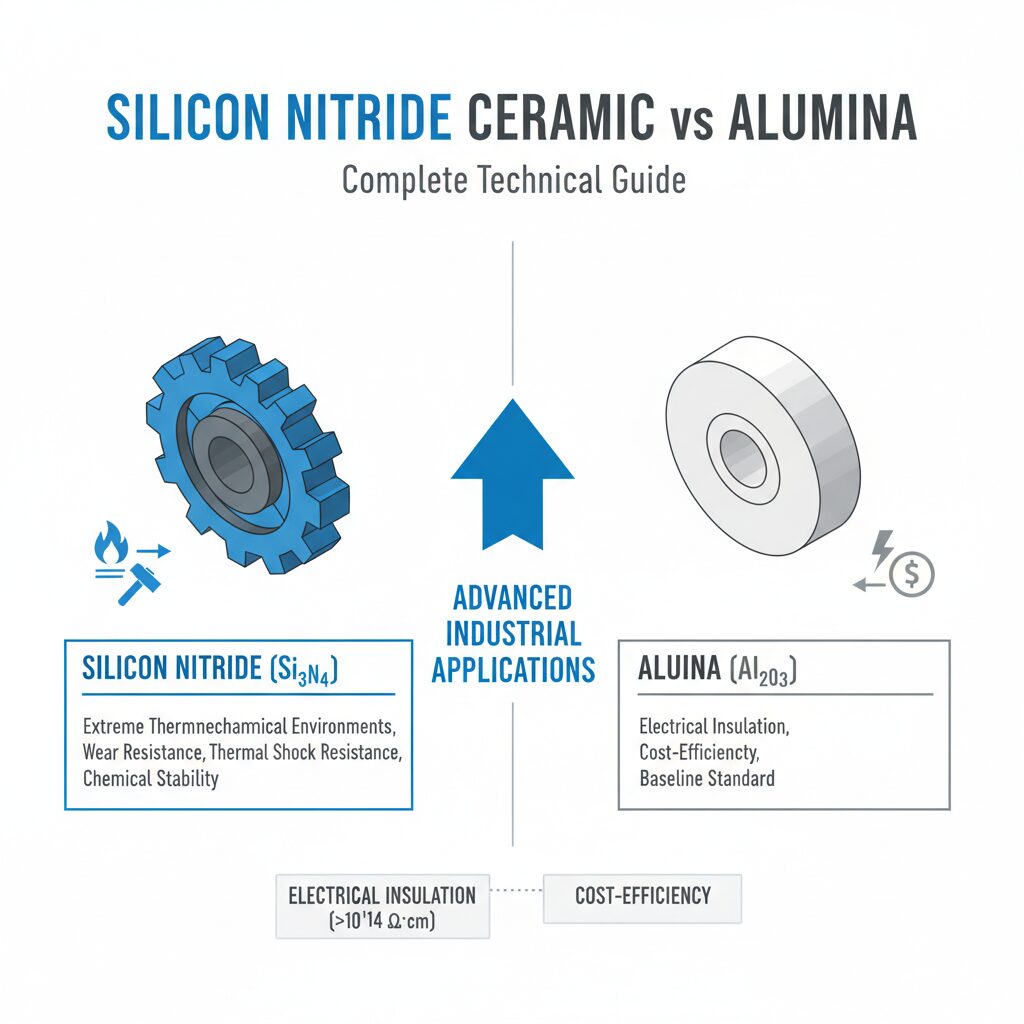
To accurately specify a material for high-temperature and high-wear applications, engineers must analyze how ZTA ceramic thermal expansion and associated properties compare against single-phase advanced ceramics. Pure ジルコニア offers exceptional fracture toughness (up to 10.0 MPa·m½) but suffers from low thermal conductivity (approximately 2.0 to 3.0 W/m·K) and a high CTE (10.5 × 10⁻⁶ /°C), making it highly susceptible to thermal shock at temperature differentials ($\Delta$T) greater than 250°C. Conversely, ZTA possesses a thermal conductivity of 20 to 24 W/m·K, effectively dissipating localized heat generated by friction at speeds of up to 3,000 RPM. When compared to 窒化ケイ素. This has an exceptionally low CTE of 3.2 × 10⁻⁶ /°C and a thermal shock resistance ($\Delta$T) exceeding 800°C, ZTA demonstrates a higher density (4.10 g/cm³ vs 3.20 g/cm³) but provides a more cost-effective solution for environments that do not experience instantaneous quenching. By balancing the ZTA ceramic thermal expansion rate with moderate thermal conductivity and high flexural strength (up to 800 MPa), this composite material fills a critical performance void for applications requiring both high wear resistance and moderate thermal shock resilience.
| プロパティ | ZTA ceramic thermal expansion | アルミナ | ジルコニア | 窒化ケイ素 |
|---|---|---|---|---|
| 熱伝導率 (W/m-K) | 20.0 – 24.0 | 25.0 – 35.0 | 2.0 – 3.0 | 25.0 – 30.0 |
| 硬度(HV) | 1,600 – 1,800 | 1,500 – 1,650 | 1,200 – 1,300 | 1,400 – 1,600 |
| 破壊靭性 (MPa-m½) | 5.0 – 7.0 | 3.5 – 4.5 | 8.0 - 10.0 | 6.0 – 8.0 |
| コスト | 中程度 | 低い | 高い | 非常に高い |
アプリケーション
The synergistic balance of ZTA ceramic thermal expansion, phase-transformation toughening. And extreme surface hardness makes this material indispensable across various rigorous industrial environments. Components manufactured from ZTA routinely outperform traditional metallic alloys and single-phase ceramics in applications subjected to aggressive mechanical wear, corrosive chemicals. And fluctuating temperatures between 200°C and 1,200°C.
- Fluid Handling Pump Seals: Operating at speeds exceeding 3,600 RPM and pressures up to 150 bar, mechanical seals face extreme frictional heating. ZTA is selected because its thermal conductivity of 24 W/m·K dissipates heat efficiently, while the specific ZTA ceramic thermal expansion minimizes dimensional distortion, maintaining seal face flatness within 2 Helium light bands (0.6 micrometers).
- Metal Forming Cutting Tools: In high-speed continuous turning of cast iron at cutting speeds of 400 to 600 meters per minute, localized temperatures at the cutting edge can reach 1,000°C. The matched ZTA ceramic thermal expansion limits thermal stress cracking. And its 7.0 MPa·m½ fracture toughness resists chipping under intermittent loads of 500 N.
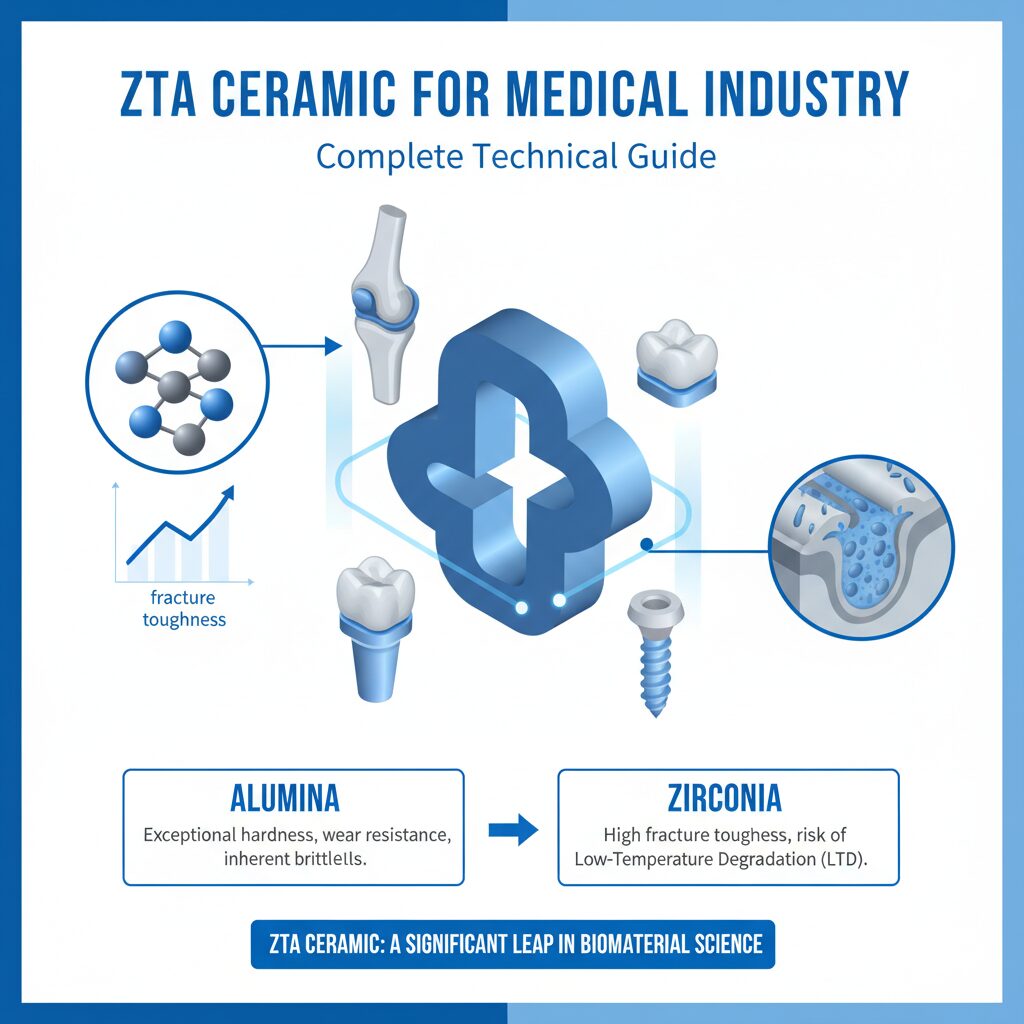
- Orthopedic Medical Implants: Used for femoral heads in total hip arthroplasty (typically 28mm to 36mm in diameter). ZTA is chosen because it exhibits a wear rate of less than 0.01 mm³/million cycles. The material’s phase stability prevents low-temperature degradation (LTD) within the 37°C aqueous human body environment.
- Industrial Wear Liners: Deployed in mining chutes and hydrocyclones handling abrasive slurries at flow rates of 50 liters per second. ZTA replaces pure alumina here because its 800 MPa flexural strength and tailored thermal expansion withstand the severe micro-impacts of quartz and ore particles without propagating macroscopic fractures.
- Semiconductor Handling End Effectors: Utilized in rapid thermal processing (RTP) chambers where silicon wafers are heated to 1,100°C in under 30 seconds. The linear ZTA ceramic thermal expansion profile closely matches that of the supporting substrate hardware, preventing thermal mismatch stresses while maintaining positional accuracy within ±0.010mm.
製造工程
The fabrication of ZTA components requires absolute metallurgical control to ensure the homogeneous dispersion of the 10-20 wt% zirconia phase within the alumina matrix. Any agglomeration of zirconia particles larger than 5.0 micrometers will prematurely trigger the tetragonal-to-monoclinic phase transformation during cooling, creating internal residual stresses that compromise the theoretical ZTA ceramic thermal expansion limits. The process begins with ultra-high purity (>99.9%) powders with a specific surface area (BET) of 10 to 15 m²/g and an average particle size (d50) strictly controlled below 0.5 micrometers.
成形方法
- 冷間静水圧プレス(CIP): For complex geometries, spray-dried ZTA powder containing 1.5% to 2.5% organic binders is subjected to uniform hydrostatic pressure ranging from 200 to 300 MPa. This produces green bodies with highly uniform density distributions (typically 2.10 to 2.25 g/cm³), minimizing differential shrinkage during subsequent thermal processing.
- Injection Molding (CIM): For high-volume production of intricate parts (under 50 grams), powders are compounded with 15% to 20% thermoplastic binders. The feedstock is injected at pressures of 80 to 120 MPa at 160°C. This method achieves near-net shapes with dimensional tolerances of ±0.5% prior to final hard machining.
焼結
The sintering cycle is the most critical thermodynamic step, dictating the final ZTA ceramic thermal expansion properties and phase retention. Green bodies undergo binder burnout at 400°C to 600°C at a slow ramp rate of 0.5°C/minute to prevent outgassing micro-cracks. Sintering is conducted in an oxidizing atmosphere at peak temperatures between 1,500°C and 1,600°C with a dwell time of 2.0 to 4.0 hours. The cooling rate must be stringently controlled (typically 2°C to 5°C/minute) to maintain the yttria-stabilized zirconia particles in their metastable tetragonal crystalline state. During this phase, the material undergoes a volumetric shrinkage of 15% to 20%, achieving a final theoretical density greater than 99.5% (approx. 4.25 g/cm³).
最終加工
Because sintered ZTA achieves a hardness of 1,800 HV, final dimensional shaping can only be accomplished using specialized diamond abrasives. Utilizing 5-axis CNC grinding centers, Great Ceramic employs resin-bonded and metal-bonded diamond wheels (grit sizes D46 to D126) operating at peripheral speeds of 25 to 35 meters per second. This 精密セラミック加工 process utilizes high-pressure coolant (up to 70 bar) to extract the 800°C localized grinding heat, preventing surface phase transformation. Through rigorous metrology and thermal management, Great Ceramic consistently achieves geometrical tolerances of ±0.005mm and surface roughness (Ra) values as low as 0.1 micrometers.
利点と限界
メリット
- Exceptional Fracture Toughness: By absorbing crack-propagation energy through a 4% volume expansion during phase transformation, ZTA achieves a toughness of 7.0 MPa·m½, significantly outperforming standard alumina which maxes out at 4.5 MPa·m½.
- Optimized Thermal Expansion: The engineered ZTA ceramic thermal expansion coefficient (7.8 to 8.2 × 10⁻⁶ /°C) allows it to be mated mechanically with various steel alloys (such as 400 series stainless) with minimal interfacial thermal shear stress at temperatures up to 600°C.
- 高い機械的強度: Featuring a flexural strength of 600 to 800 MPa, ZTA components can sustain severe mechanical loading profiles, making them suitable for high-pressure fluid valves operating above 200 bar.
- Cost-to-Performance Ratio: ZTA provides a highly economical alternative to pure zirconia or 炭化ケイ素, delivering 80% of zirconia’s toughness at approximately 40% to 50% of the raw material cost.
制限事項
- Higher Specific Gravity: With a density approaching 4.30 g/cm³, ZTA is nearly 10% heavier than pure alumina and over 30% heavier than 窒化アルミニウム (3.26 g/cm³). This can increase rotational inertia in ultra-high-speed kinetic applications.
- 低温劣化(LTD): Though highly resistant compared to pure Y-TZP, prolonged exposure (exceeding 1,000 hours) to superheated steam or hydrothermal conditions at 200°C to 300°C can initiate spontaneous phase transformations on the component surface, leading to micro-roughening.
加工に関する考慮事項
The very mechanisms that make ZTA structurally superior—specifically its transformation toughening and high Vickers hardness (up to 1,800 HV)—render it exceptionally difficult to machine. Traditional cutting tools, including solid carbide and standard ceramics, undergo catastrophic abrasive wear within seconds of engagement due to the extreme hardness of the alumina matrix. Machining ZTA requires electroplated or vitrified diamond tooling. When a diamond grit engages the ZTA surface at cutting speeds of 30,000 RPM and feed rates of 0.01 to 0.05 mm/rev, the instantaneous cutting force can spike to 400 N. This force triggers localized phase transformation toughening directly beneath the cutting zone, artificially hardening the material being removed and increasing diamond grit wear rates by 25% compared to machining pure alumina.
To overcome these thermomechanical hurdles, high-volume flood cooling (exceeding 50 liters per minute) must be directed precisely at the tool-workpiece interface to extract the friction-induced heat, ensuring the ZTA ceramic thermal expansion does not cause dimensional deviation during the grinding cycle. Great Ceramic engineers mitigate these challenges through proprietary feed-rate algorithms and advanced spindle vibration damping techniques. Discover our advanced machining capabilities to see how we maintain strict geometric tolerances of ±0.005mm on even the most complex ZTA geometries, guaranteeing that your high-performance components assemble perfectly and operate flawlessly under extreme mechanical and thermal loads.
FAQ
What is ZTA ceramic thermal expansion?
ZTA ceramic thermal expansion refers to the predictable volumetric and linear dimensional changes that Zirconia Toughened Alumina undergoes when subjected to thermal variations. Measured as the Coefficient of Thermal Expansion (CTE), this value typically ranges from 7.8 to 8.2 × 10⁻⁶ /°C across a temperature spectrum of 20°C to 1,000°C. This specific expansion rate is governed by the rule of mixtures, combining the atomic lattice vibration characteristics of the 80% alpha-alumina matrix (CTE ~8.1) and the 20% tetragonal zirconia dispersion (CTE ~10.5). Understanding this exact thermal expansion profile is absolutely critical for engineers designing interference fits, high-temperature dynamic seals. And structural components that interface directly with metal alloys, ensuring that thermally induced shear stresses remain below the material’s 800 MPa flexural yield limit during thermal cycling.
What are the main applications of ZTA ceramic thermal expansion?
Applications that rely on the specific ZTA ceramic thermal expansion behavior are those involving high mechanical stress combined with cyclic thermal loading. In industrial manufacturing, ZTA is widely utilized for heavy-duty fluid handling pump seals where frictional temperatures can rapidly escalate to 400°C. the stable CTE prevents the seal faces from warping beyond 0.6 micrometers of flatness. It is also highly prevalent in the medical industry for orthopedic femoral heads, where its extreme wear resistance (<0.01 mm³/million cycles) and phase stability outlast standard materials. Furthermore, ZTA is a primary material for wire-drawing dies, metal-cutting inserts. And semiconductor processing end-effectors operating at 1,100°C, where matching the thermal expansion of adjacent refractory metals is mandatory to prevent catastrophic substrate cracking.
How does ZTA ceramic thermal expansion compare to other ceramics?
When evaluated against standard advanced ceramics, ZTA ceramic thermal expansion occupies a highly strategic middle ground. Its CTE of approximately 7.9 × 10⁻⁶ /°C is slightly lower than pure alumina (8.1 × 10⁻⁶ /°C) and significantly lower than pure yttria-stabilized zirconia. This exhibits a highly expansive CTE of 10.5 × 10⁻⁶ /°C. This makes ZTA far less prone to thermal shock failures than pure zirconia when subjected to temperature differentials ($\Delta$T) exceeding 250°C. However, when compared to non-oxide ceramics like silicon nitride (CTE of 3.2 × 10⁻⁶ /°C) or 炭化ケイ素 (CTE of 4.0 × 10⁻⁶ /°C), ZTA has a considerably higher thermal expansion rate. Therefore, ZTA is optimally selected for environments where superior fracture toughness (up to 7.0 MPa·m½) is required. And the thermal gradients are moderate rather than instantaneous.
What are the advantages of ZTA ceramic thermal expansion?
The primary advantage of ZTA ceramic thermal expansion is its highly tunable nature. This allows it to closely match the expansion coefficients of various structural steels and cast irons (which generally sit between 10.0 and 12.0 × 10⁻⁶ /°C) much better than low-CTE ceramics like silicon nitride. This compatibility reduces interfacial thermal shear stress in shrink-fit assemblies operating up to 600°C. Additionally, the thermal expansion mechanisms work symbiotically with its stress-induced phase transformation. when mechanical stress or thermal shock initiates a micro-crack, the zirconia particles expand volumetrically by 3% to 5%, clamping the crack shut. This combination yields an exceptional fracture toughness of 5.0 to 7.0 MPa·m½, providing a massive safety factor against the brittle catastrophic failure modes typically associated with single-phase aluminum oxide components.
How is ZTA ceramic thermal expansion machined?
Machining ZTA requires overcoming its extreme 1,800 HV hardness and its inherent tendency to work-harden via phase transformation during the cutting process. Due to the exact ZTA ceramic thermal expansion characteristics, precise thermal management is required during machining. excessive grinding heat (exceeding 800°C at the cutting tip) can cause the material to expand, leading to significant dimensional inaccuracies once the part cools. Consequently, it must be machined using diamond abrasive wheels (grits ranging from D46 for roughing to D126 for finishing) on rigid 5-axis CNC platforms with spindle speeds exceeding 20,000 RPM. High-pressure coolant systems (operating at 50 to 70 bar) are mandatory to stabilize the material’s temperature. Great Ceramic utilizes these advanced 精密セラミック加工 techniques to overcome these thermodynamic hurdles, routinely delivering custom ZTA components with uncompromising dimensional tolerances of ±0.005mm and optical-grade surface finishes of Ra 0.1 micrometers.
Need custom ZTA ceramic thermal expansion parts? グレート・セラミックへのお問い合わせ 公差の厳しい精密機械加工サービスについては、Eメールでお問い合わせください。 [email protected].
詳細はこちら Zta Ceramic Thermal Expansion および当社の精密セラミック加工サービス。.