








Engineering material selection
Silicon Nitride vs Alumina Ceramic: Which Material Should Engineers Choose?
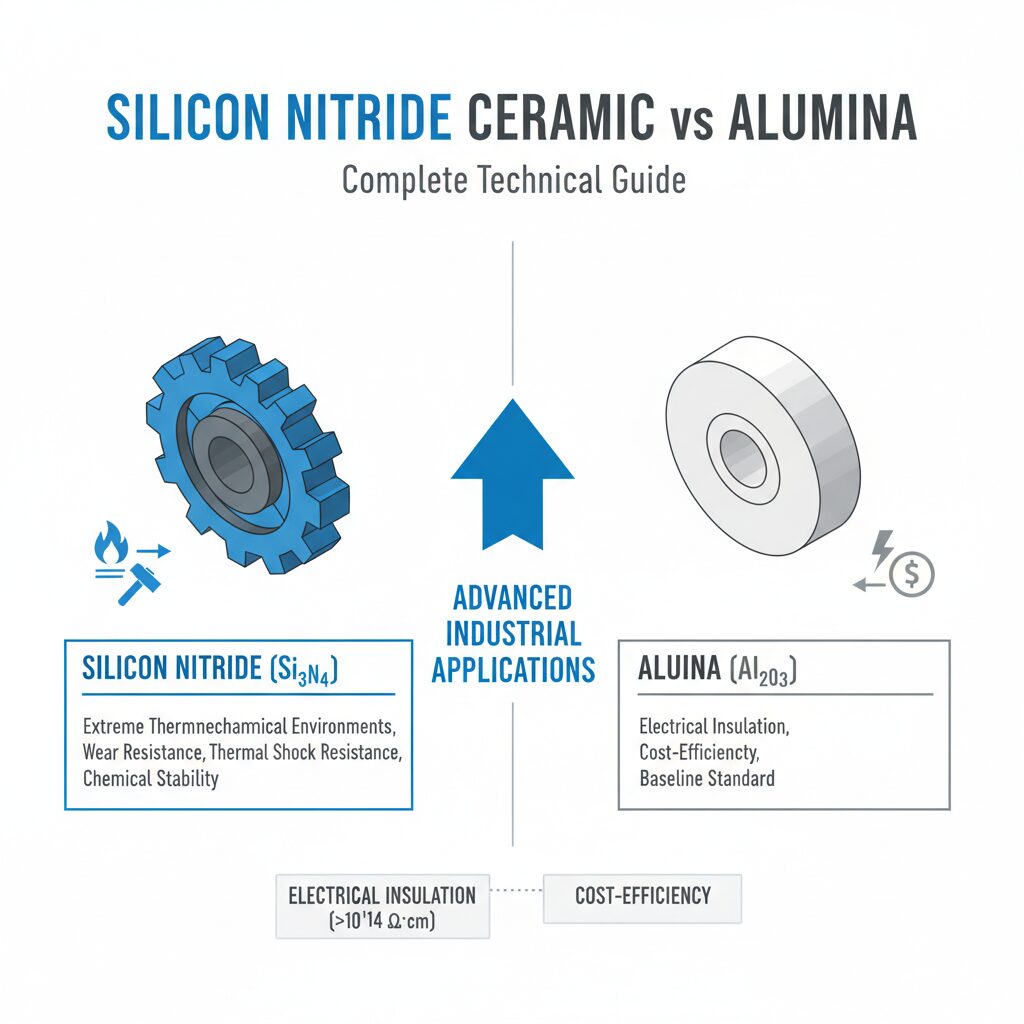
Silicon nitride vs alumina is not a simple “which is better” question. The right choice depends on load, thermal shock, electrical insulation, temperature, wear pair, machining risk and budget.
Ask for Material Selection SupportView Silicon Nitride Material Page

Quick Answer: Choose by Load, Thermal Shock, Electrical Need, and Budget
Choose silicon nitride when…
You need high fracture toughness, thermal shock resistance, low density, high-speed rolling behavior or electrical insulation combined with mechanical load.
Choose alumina when…
You need a cost-effective insulating ceramic, general wear resistance, mature availability, simple shapes or high-temperature electrical insulation without severe impact.
Do not choose by one property
Maximum temperature, hardness or price alone can lead to wrong selection. Combine load mode, cycling, medium, geometry and cost target.
This guide links to silicon nitride ceramic material, alumina ceramic material, the advanced ceramic material selection guide and the ceramic properties comparison table.
Material Overview: Si3N4 vs Al2O3
Silicon nitride, Si3N4, is a non-oxide advanced ceramic known for toughness, thermal shock resistance and low density. Alumina, Al2O3, is an oxide ceramic used across insulation, wear, substrates, tubes, bushings and structural parts. Alumina is usually more economical and broadly available.
Alumina is often the first material to evaluate because it balances cost, hardness, electrical insulation and manufacturability. Silicon nitride enters the discussion when alumina may crack, spall, overload, suffer from thermal shock or add too much rotating mass.

Mechanical, Thermal, Electrical, and Chemical Comparison
| ファクター | 窒化ケイ素 | アルミナ | Design implication |
|---|---|---|---|
| 破壊靭性 | Typically higher | Lower in common grades | Si3N4 is safer under impact or rolling contact. |
| Hardness and wear | High hardness and good wear behavior | High hardness and good general wear resistance | Both can work; counterface and lubrication decide. |
| 密度 | Lower, around 3.2 g/cm3 typical | Around 3.8-3.9 g/cm3 typical | Si3N4 helps in high-speed rotation. |
| Thermal shock | Generally stronger | Weaker under fast cycling | Do not choose only by maximum temperature. |
| 電気絶縁 | Good insulation plus mechanical strength | Excellent general insulation | Alumina often wins for simple insulators. |
| コスト | より高い | より低い | Use Si3N4 when performance risk justifies cost. |
Avoid wrong selection: A part may fail from thermal shock, edge stress, unsupported length, wrong surface finish, chemical attack or unrealistic tolerance before it reaches the theoretical temperature limit.

Application-by-Application Selection Table
| 申し込み | Better first candidate | Why | Check before RFQ |
|---|---|---|---|
| Bearing balls / hybrid bearings | 窒化ケイ素 | Low density, insulation, rolling contact | Diameter, grade, race material, lubrication, speed, load |
| General electrical insulators | アルミナ | Cost-effective and mature | Voltage, creepage, temperature, geometry |
| Welding nozzles | Often silicon nitride | Thermal shock and wear | Contact material and tip geometry |
| Wear sleeves | Depends | Alumina for cost; Si3N4 for impact | Counterface and abrasive particles |
| Substrates | Depends | Alumina for common insulation; Si3N4 for toughness | Flatness, metallization, thermal cycling |
| High-temp fixtures | Depends | Alumina for stable cost; Si3N4 for rapid cycling | Atmosphere, ramp rate, load |
| Medical / precision parts | Depends | Function and regulatory needs decide | Do not assume certification. |
| Pump / valve wear parts | Depends | Si3N4 for toughness; alumina for economical wear | Chemical media and sealing. |

When Alumina Is Better / When Silicon Nitride Is Worth the Higher Cost
When alumina is better
- Budget is the main driver.
- The part is a general electrical insulator.
- Geometry is simple and availability matters.
- High-speed rolling contact is not involved.
When Si3N4 is worth it
- High-speed rotation or bearing contact is involved.
- Rapid heating and cooling create thermal shock risk.
- Crack resistance is more important than lowest cost.
- Insulation must combine with mechanical load.

RFQ Checklist for Material Selection
If you are unsure whether Si3N4 or alumina is more suitable, send temperature ramp, continuous temperature, load mode, impact risk, wear pair, electrical requirement, chemical medium, target quantity, tolerance and surface finish. For custom machining, see precision ceramic machining for custom parts. For bearing applications, review silicon nitride ceramic balls.
Practical Decision Tree for Engineers
Start with the failure mode. If the part is cracking during rapid heating or cooling, silicon nitride deserves serious review because thermal shock resistance is one of its strongest advantages. If the part is a stable electrical insulator with limited mechanical stress, alumina is usually the more economical and proven first choice. If the part is rotating at high speed, density and rolling contact behavior become important, which often moves the decision toward Si3N4.
Next, check the load mode. Static compression, sliding wear, impact, bending and rolling contact create different risks. Alumina can handle many static insulating and wear tasks very well. Silicon nitride is more attractive where crack growth, shock, vibration or rolling fatigue are expected. A simple hardness comparison does not show this difference clearly, which is why many weak comparison pages on the search results do not fully answer engineering intent.
Then review temperature profile, not only maximum temperature. A furnace fixture held at stable temperature may be suitable for alumina, while a welding or thermal cycling component may require silicon nitride. If the temperature changes quickly across the part, low expansion and toughness matter. If the part is only exposed to steady heat and needs insulation at a controlled cost, alumina may remain the better material.
Electrical requirements should be separated into two cases. In a simple insulator, alumina is often preferred because it is mature, cost-effective and available in many shapes. In a rotating motor bearing, the insulating function is combined with mechanical speed and load; this is where silicon nitride bearing balls can add value. The same word “insulation” therefore leads to different material choices depending on mechanical function.
Common Selection Mistakes
The first mistake is assuming that the strongest or most expensive ceramic is automatically the best. A high-performance ceramic that is difficult to machine may create unnecessary cost for a simple spacer or bushing. If alumina meets the electrical, thermal and wear requirements with adequate safety margin, it is often the more practical choice.
The second mistake is selecting by maximum service temperature alone. Published temperature numbers do not describe thermal gradients, ramp rate, mechanical stress or atmosphere. A material can survive a high steady temperature and still fail under thermal shock. For parts such as nozzles, tubes and fixtures, the heating and cooling pattern is as important as the peak temperature.
The third mistake is ignoring geometry. Thin walls, sharp corners, unsupported lengths and deep holes can turn a suitable material into a risky design. This applies to both alumina and silicon nitride. Material selection and ceramic design should be reviewed together, especially when the part will be ground after sintering.
The fourth mistake is overlooking total cost. Silicon nitride may reduce failure risk, downtime or bearing damage, but the purchase price is higher. Alumina may be less expensive, but if it cracks repeatedly in service, the true cost becomes higher. The right comparison is not only unit price; it is material cost plus machining cost plus failure risk plus assembly consequences.
How to Use This Guide in an RFQ
When sending an RFQ, describe the current problem in plain engineering terms. For example: “alumina part cracks during quenching,” “steel bearing suffers electrical pitting,” “wear sleeve chips at the edge,” or “fixture needs better thermal shock resistance.” This helps the supplier understand why silicon nitride is being considered and whether another ceramic may also fit.
Attach drawings with functional surfaces marked. If you do not know the required ceramic grade, say that the material is open for recommendation. Include temperature, ramp rate, load, contact material, chemical medium, speed, lubrication, quantity and inspection requirement. These details allow Great Ceramic to compare Si3N4 and alumina in the context of your actual part instead of giving a generic material answer.
Finally, separate prototype goals from production goals. A prototype may prioritize speed and design validation, while production may prioritize repeatable cost, inspection and packaging. The material choice may remain the same, but the manufacturing route and tolerance strategy can change.
Scenario Examples for Faster Material Screening
High-speed motor bearing: If the target is to reduce electrical pitting and support high-speed rotation, silicon nitride is normally more relevant than alumina because the requirement combines insulation, low density and rolling contact. The designer still needs to confirm bearing type, lubrication, speed and race material.
Electrical spacer or insulating washer: If the part is a static insulator with moderate mechanical load, alumina is usually the first material to quote. It is mature, economical and available in many shapes. Silicon nitride may be unnecessary unless shock, thermal cycling or strength risk appears.
Thermal cycling nozzle: If a component is heated and cooled repeatedly, silicon nitride may offer better reliability than alumina because thermal shock resistance and fracture toughness become important. The exact geometry, wall thickness and edge condition should be reviewed before assuming success.
General wear guide: If the wear load is steady and cost-sensitive, alumina may be suitable. If the wear part chips, sees impact or works at changing temperature, silicon nitride becomes a stronger candidate. If abrasion is severe and impact is limited, silicon carbide should also be compared.
Precision fixture: Both materials can be precision ground, but the cost drivers are different. Alumina may be preferable for stable, simple fixtures. Silicon nitride is useful when a fixture needs better toughness, lower weight or stronger resistance to fast temperature changes. In either case, functional tolerances and surface finish should be specified carefully.
Bottom Line for Buyers
Choose alumina when the application needs reliable insulation, general wear resistance and controlled cost. Choose silicon nitride when failure risk is driven by thermal shock, high-speed rotation, impact, rolling contact or the combination of electrical insulation and mechanical load. When the drawing is not final, ask for manufacturability feedback before locking tolerances. A small design change can matter more than switching materials.
How to Present the Decision Internally
For internal approval, frame the choice as a risk-control decision. Alumina should be presented as the economical baseline for insulation and general wear. Silicon nitride should be presented as the upgrade for thermal shock, high-speed rotation, impact and combined mechanical-electrical requirements. This language is clearer for purchasing teams than simply saying one material is stronger.
If the project is cost-sensitive, request quotations for both materials using the same drawing and functional requirements. Then compare not only unit price, but also machining risk, expected failure mode, replacement cost and downtime risk. In many projects alumina will be the right answer. In demanding rotating or thermal cycling systems, silicon nitride may be the more economical decision over the life of the equipment.
Recommended Next Step
If the application is still uncertain, send one drawing and ask for a material review rather than requesting separate blind quotations. Great Ceramic can compare silicon nitride and alumina against the same geometry, temperature, load, wear, insulation and budget conditions. This creates a clearer technical recommendation and prevents the purchasing process from focusing only on the lowest unit price.
Use this guide as a practical material screening step before final quotation. Link the drawing, application conditions and target budget together so Great Ceramic can compare both materials against the same engineering requirement.
When in doubt, ask which failure mode is most expensive: cracking, electrical damage, wear, downtime, machining cost or purchase price. The answer usually points to either alumina as the practical baseline or silicon nitride as the justified upgrade.
Silicon Nitride vs Alumina Decision Matrices
The comparison is strongest when the buyer can see how each material behaves under mechanical, thermal, electrical and purchasing constraints.
| Decision factor | Alumina ceramic direction | Silicon nitride ceramic direction | Buyer action |
|---|---|---|---|
| 電気絶縁 |
Insulation-first partsFrequently shortlisted for insulating spacers, sleeves, plates and tubes. |
Mechanical-first partsUsually chosen when insulation must combine with load or shock resistance. |
Define voltage, creepage, clearance and thermal environment. |
| Impact and edge chipping |
Control geometry carefullyUse chamfers, radii and supported contact to reduce brittle-edge risk. |
Review for tougher serviceOften considered when shock, load or rolling contact dominates. |
Share assembly load, impact risk and mating material. |
| Thermal cycling |
Good when cycling is controlledCommon in many high-temperature parts with proper support. |
Stronger thermal shock candidateOften reviewed when rapid temperature change is the main failure mode. |
Provide ramp rate, support spacing, wall thickness and atmosphere. |
| Machining and cost |
Practical baselineOften more economical for standard insulating and wear components. |
Higher-value selectionMaterial and machining cost should be justified by performance need. |
Mark critical dimensions and avoid over-tight nonfunctional tolerances. |
Choose alumina when
The part mainly needs electrical insulation, hardness, chemical stability and a practical cost profile with controlled shock and bending loads.
Choose silicon nitride when
The part faces thermal shock, higher mechanical load, rolling contact, impact risk or a failure mode where alumina may be too brittle.
Check geometry before deciding
Thin walls, holes, threads, long spans and sharp corners can make either material risky if the design is not adapted for ceramic processing.
Compare total risk
Use purchase cost, machining risk, downtime cost and expected failure mode together instead of selecting by unit price alone.
FAQ
Is silicon nitride stronger than alumina?
Silicon nitride typically has higher fracture toughness and better impact or thermal shock resistance than alumina, while alumina remains hard, wear resistant and cost-effective.
Is alumina cheaper than silicon nitride?
In most custom ceramic projects, alumina is generally more economical and more widely available than silicon nitride.
Which ceramic has better thermal shock resistance?
Silicon nitride normally offers better thermal shock resistance because of low thermal expansion, useful thermal conductivity and toughness.
Which material is better for electrical insulation?
Both can be electrically insulating. Alumina is often preferred for general insulation; silicon nitride is useful when insulation must combine with load or speed.
Should I choose silicon nitride or alumina for bearing balls?
For high-speed or electrically insulating bearing balls, silicon nitride is usually the stronger candidate. Alumina may suit lower-cost, lower-load or chemical applications.
Can both silicon nitride and alumina be custom machined?
Yes. Both can be machined and ground as technical ceramics, but fully sintered ceramics require diamond tooling and careful design review.
Buyer engineering notes
Decision Path: Silicon Nitride, Alumina or Engineering Review
Choose silicon nitride when mechanical reliability, thermal shock or rolling contact is the main driver. Choose alumina when insulation, chemical stability and cost-effective custom parts are stronger priorities. If the part combines risks, send the drawing for review.
Functional requirements
- Define the property that drives the purchase: insulation, wear, heat, corrosion, load, sliding contact or dimensional stability.
- Separate must-have requirements from preferences so the material and process route stay realistic.
Drawing and inspection details
- Mark critical dimensions, datum surfaces, thread or bore features, surface finish zones, edge breaks and allowed radii.
- Explain how the ceramic part will be installed, supported and checked after delivery.
Quotation information
- Share material preference, operating environment, quantity, mating parts, packaging needs and any failed metal or polymer part being replaced.
- Use the contact form to send drawings for engineering review before final pricing.
Related paths: 先端セラミック材料, precision ceramic CNC machining, 先端セラミック加工そして drawing review RFQ.