








Silicon Nitride Ceramic Seal Ring for Aerospace: Complete Technical Guide
The aerospace industry operates within the most unforgiving mechanical and thermal environments, demanding materials that can withstand simultaneous extremes of temperature, pressure. And rotational velocity. The 窒化ケイ素 ceramic seal ring for aerospace has emerged as the definitive solution for mission-critical fluid and gas containment, directly addressing the catastrophic failure modes associated with traditional metallic or carbon-graphite seals. Operating turbine engines routinely exceed internal temperatures of 1000°C with shaft speeds surpassing 40,000 RPM, creating severe tribological conditions that induce rapid wear and thermal degradation in inferior materials. By leveraging advanced 窒化ケイ素 (Si3N4), engineers can achieve remarkable fracture toughness (up to 8.0 MPa·m½) alongside exceptional thermal shock resistance (ΔT > 700°C). Great Ceramic specializes in engineering these critical components, delivering 精密セラミック加工 with ultra-tight dimensional tolerances of ±0.005mm and surface finishes down to Ra 0.02 µm. This guide provides an exhaustive engineering analysis of Si3N4 seal rings, covering material science, complex tribological applications. And advanced manufacturing protocols required for aerospace qualification. Need to secure reliable containment for high-velocity turbine applications? Contact Great Ceramic’s engineering team to discuss your specific RFQ requirements.
材料特性
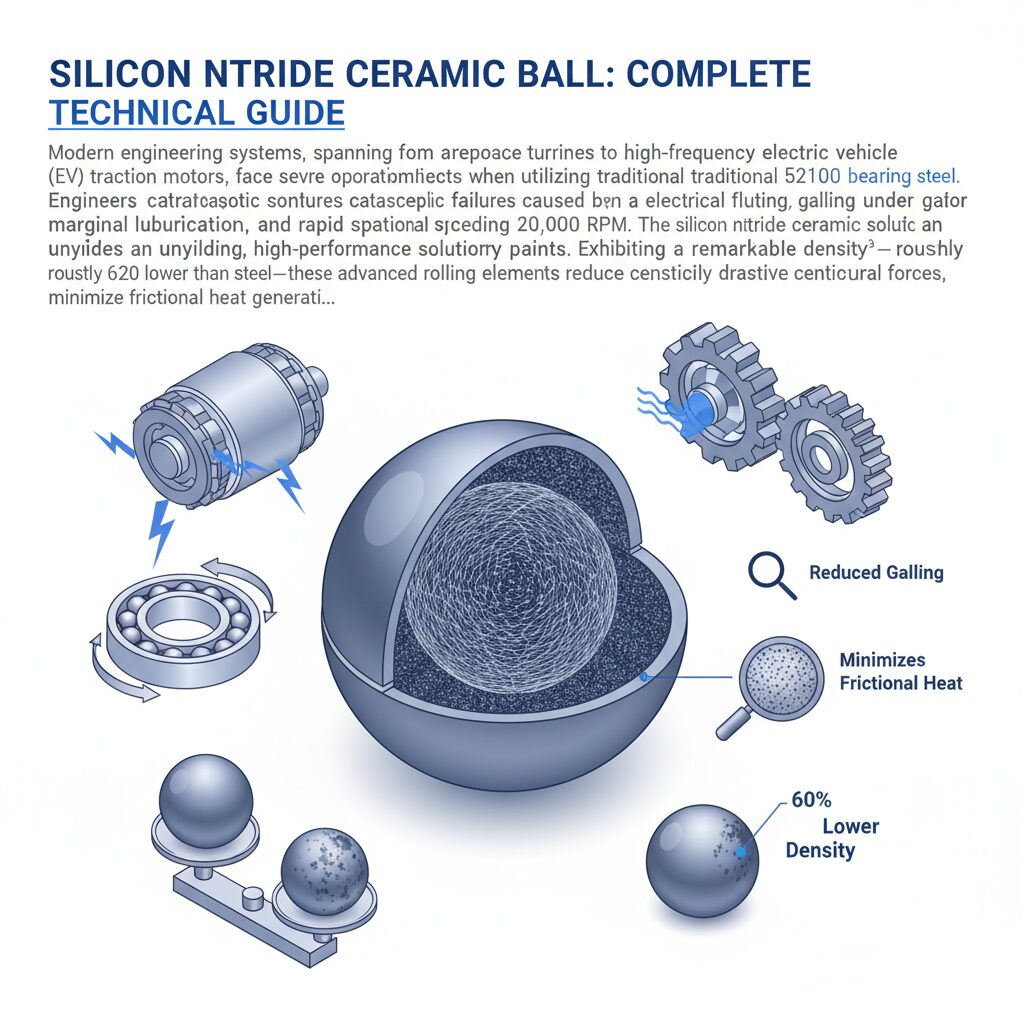
The fundamental performance of a silicon nitride ceramic seal ring for aerospace is dictated by its unique microstructural composition. Silicon nitride exhibits a complex interlocking hexagonal crystal structure (β-Si3N4). This is primarily responsible for its high mechanical strength at elevated temperatures. Unlike traditional alloys that suffer from creep above 600°C, Si3N4 maintains its structural integrity and flexural strength exceeding 800 MPa even at continuous operating temperatures of 1000°C. Furthermore, its exceptionally low theoretical density of 3.20 g/cm³ offers a massive 60% weight reduction compared to nickel-based superalloys (typically 8.2 to 8.9 g/cm³). This weight reduction translates to significantly lower centrifugal forces at angular velocities exceeding 50,000 RPM, thereby reducing parasitic loads on the engine’s primary shaft bearings. The tribological performance is augmented by a highly favorable coefficient of friction (typically 0.1 to 0.2 in dry conditions) and unparalleled wear resistance, recording specific wear rates as low as 10⁻⁶ mm³/N·m under high-load contact sliding. Below is the comprehensive quantitative property matrix for aerospace-grade gas-pressure sintered (GPS) silicon nitride.
| プロパティ | 価値 | 単位 |
|---|---|---|
| 密度 | 3.20 – 3.25 | g/cm³ |
| 硬度 | 1500 – 1800 | HV |
| 曲げ強度 | 800 – 1000 | MPa |
| 破壊靭性 | 6.5 – 8.0 | MPa-m½ |
| 熱伝導率 | 20 – 30 | W/m-K |
| 電気抵抗率 | > 10¹⁴ | Ω・cm |
| 最高使用温度 | 1200 – 1400 | °C |
他のセラミックとの比較
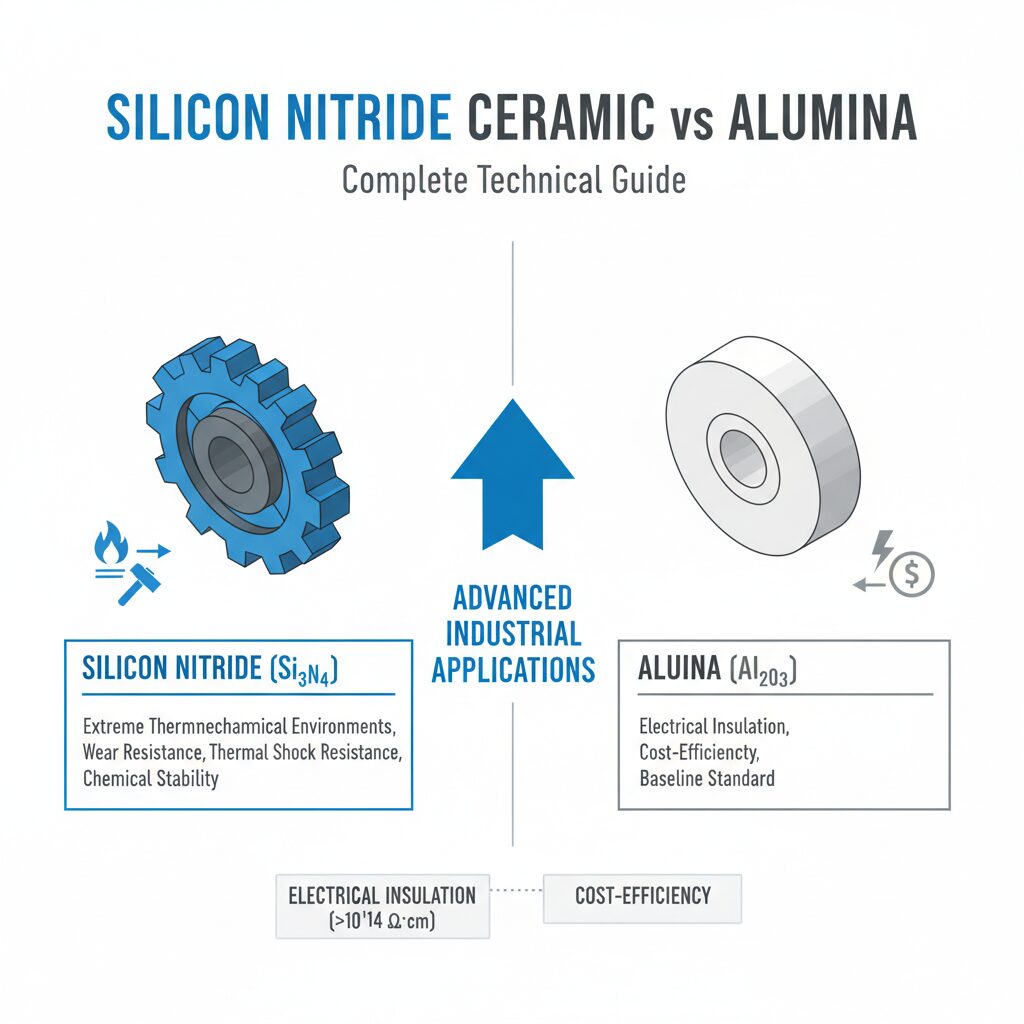
When selecting advanced structural ceramics for rotary or mechanical face seals, engineers must balance thermal conductivity, fracture toughness. And total lifecycle costs. While アルミナ/アルミナ (Al2O3) provides a highly cost-effective solution for benign chemical environments, its low thermal conductivity (20-30 W/m·K) and poor thermal shock resistance (ΔT ~ 200°C) make it completely unsuitable for the rapid thermal gradients experienced in aerospace turbines. Conversely, ジルコニア (ZrO2) offers superior fracture toughness (up to 10 MPa·m½) but suffers from severe thermal degradation and phase transformation (monoclinic to tetragonal) at continuous temperatures exceeding 500°C. The silicon nitride ceramic seal ring for aerospace stands in a unique optimal quadrant: it combines high fracture toughness (7.5 MPa·m½) with excellent thermal shock resistance, allowing it to survive sudden temperature drops from 1000°C to ambient without catastrophic crack propagation. While 炭化ケイ素 (SiC) offers superior thermal conductivity (120 W/m·K), Si3N4 outperforms SiC in fracture toughness, making it far more reliable against dynamic impact loads and vibration frequencies (up to 2000 Hz) typical in aviation applications.
| プロパティ | silicon nitride ceramic seal ring for aerospace | アルミナ | ジルコニア | 窒化ケイ素 |
|---|---|---|---|---|
| 熱伝導率 | 25 W/m-K | 20 W/m·K | 2.5 W/m-K | 25 W/m-K |
| 硬度 | 1600 HV | 1500 HV | 1200 HV | 1600 HV |
| 破壊靭性 | 7.5 MPa·m½ | 3.5 MPa-m½ | 9.0 MPa-m½ | 7.5 MPa·m½ |
| コスト | 高い | 低い | ミディアム | 高い |
アプリケーション
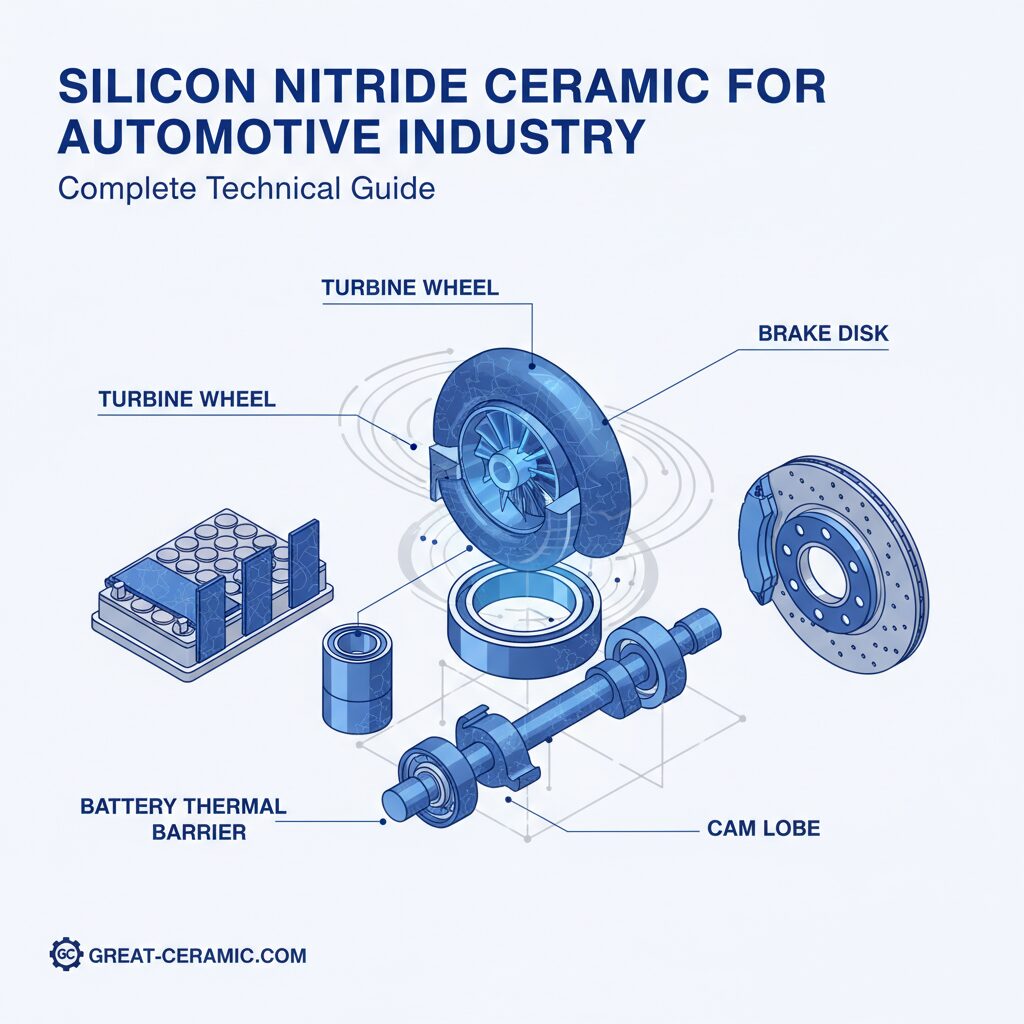
The deployment of the silicon nitride ceramic seal ring for aerospace spans multiple critical subsystems within modern commercial and military aircraft. Each application leverages specific numerical advantages of the Si3N4 matrix, ranging from cryogenic survival to extreme high-temperature oxidation resistance. The ability to machine these rings to a flatness of 1-2 helium light bands (0.3 µm) ensures near-zero leakage rates in dynamic pressurized environments.
- Main Engine Shaft Mechanical Seals: Utilized in the primary turbofan engine core, where rotational speeds reach 30,000 to 50,000 RPM. The silicon nitride ceramic seal ring for aerospace is selected here because its low density (3.2 g/cm³) significantly minimizes centrifugal radial expansion, maintaining a constant seal gap of less than 0.002 mm, preventing hot gas bypass at temperatures exceeding 850°C.
- Jet Fuel Pump Rotary Seals: Located in the high-pressure fuel delivery systems operating at up to 3,000 PSI (20.6 MPa). Silicon nitride is completely inert to aggressive aviation fuels (Jet-A, JP-8) and resists the microscopic cavitation erosion that destroys standard carbon-graphite seals within 5,000 flight hours. Its superior wear coefficient ensures an MTBF (Mean Time Between Failures) exceeding 25,000 hours.
- Auxiliary Power Unit (APU) Compressor Seals: Applied in the tailcone APUs where frequent start-stop thermal cycling occurs. The material is chosen for its exceptional thermal shock resistance (ΔT = 800°C), preventing the spalling and micro-cracking that typically afflicts alumina seals during rapid turbine ignition sequences from ambient -50°C at high altitudes to 700°C operating temps.
- Environmental Control System (ECS) Air Bearings & Seals: Used in the cabin pressurization and cooling turbines operating at 80,000 RPM under dry-running conditions. The specific selection of Si3N4 is due to its low dry sliding coefficient of friction (0.15) and ability to survive temporary loss of hydrodynamic lift without seizing or galling against mating metallic components.
- Cryogenic Rocket Turbopump Seals: Employed in aerospace launch vehicles handling liquid oxygen (LOX) at -183°C and liquid hydrogen (LH2) at -253°C. The silicon nitride ceramic seal ring for aerospace maintains absolute dimensional stability (thermal expansion coefficient of just 3.2 × 10⁻⁶ /°C) and does not become embrittled at cryogenic extremes, ensuring a 0.000 mm leakage rate during the critical 8-minute launch sequence.
製造工程
The fabrication of a high-performance silicon nitride ceramic seal ring for aerospace is a highly controlled metallurgical and chemical process. Achieving the theoretical maximum density (>99.5%) and desired microstructural phase distribution (predominantly elongated β-Si3N4 grains) requires strict adherence to temperature and pressure profiles. Because the material undergoes approximately 15% to 20% volumetric shrinkage during densification, the precursor stages must be engineered with absolute precision to minimize the final diamond machining requirements. Great Ceramic employs fully documented, AS9100-compliant manufacturing routers for every batch, tracking particle size distribution, binder burn-off rates. And exact sintering dwell times to ensure zero porosity in the final aerospace component. If you are developing next-generation aerospace systems, submit your blueprint to Great Ceramic for a comprehensive DFM (Design for Manufacturing) analysis.
成形方法
- 冷間静水圧プレス(CIP): High-purity α-Si3N4 powder (average particle size 0.5 µm), blended with yttria (Y2O3) and alumina (Al2O3) sintering aids, is placed into elastomeric molds and subjected to uniform multi-directional hydraulic pressure ranging from 200 to 300 MPa. This method eliminates density gradients, yielding green bodies with a uniform green density of roughly 60%, critical for ensuring symmetrical shrinkage of large-diameter turbine seal rings.
- Uniaxial Dry Pressing: For high-volume production of smaller-diameter secondary seal rings, precision tool-steel dies apply uniaxial pressures between 100 and 150 MPa. Advanced organic binders (typically 2-4% by weight) are utilized to provide adequate green strength (around 15 MPa flexural strength) for pre-sintering handling and near-net-shape green machining.
焼結
The sintering of silicon nitride is complex because the material tends to decompose into liquid silicon and nitrogen gas at temperatures above 1850°C before it can fully densify. To counter this thermodynamic limitation, Gas Pressure Sintering (GPS) is primarily employed. The green seal rings are placed in a controlled-atmosphere furnace under a high-pressure nitrogen environment (typically 1 MPa to 10 MPa) and heated to temperatures between 1750°C and 1850°C. During this process, the Y2O3/Al2O3 additives react with the silica (SiO2) naturally present on the surface of the Si3N4 powder to form a liquid silicate phase. This liquid phase promotes rapid densification through solution-precipitation, transforming the equiaxed α-phase grains into tough, interlocking, needle-like β-phase grains. For ultra-critical aerospace applications demanding zero internal defects, a secondary Hot Isostatic Pressing (HIP) cycle is applied at 1900°C under 200 MPa of argon gas, completely collapsing any residual closed porosity and maximizing the fracture toughness to a guaranteed minimum of 7.0 MPa·m½.
最終加工
Because the fully sintered silicon nitride ceramic seal ring for aerospace registers a Vickers hardness exceeding 1600 HV, traditional high-speed steel or carbide tooling is completely useless. Final machining requires advanced kinematics and custom-bonded diamond abrasive tooling. 精密セラミック加工 at Great Ceramic utilizes rigid 5-axis CNC grinding centers equipped with resin-bonded and metal-bonded diamond wheels ranging from D151 (coarse roughing) to D15 (ultra-fine finishing) grit sizes. The seal faces undergo rigorous double-sided planetary lapping using boron carbide (B4C) or diamond slurries (1-3 µm particle size) to achieve a critical flatness requirement of 1-2 helium light bands (approximately 0.0003 mm to 0.0006 mm variance) and a surface roughness (Ra) strictly controlled to 0.05 µm or better, ensuring perfect hydrodynamic film generation in operation.
利点と限界
メリット
- Exceptional Fracture Toughness: With values ranging from 6.5 to 8.0 MPa·m½, the silicon nitride ceramic seal ring for aerospace is up to 100% tougher than standard alumina. This interlocking grain structure prevents catastrophic brittle failure and sudden seal rupture during high-impact vibratory events (up to 50g shock loads) common in aircraft hard landings or extreme turbulence.
- Superior Thermal Shock Resistance: Silicon nitride boasts a remarkably low coefficient of thermal expansion (3.2 x 10⁻⁶ /°C) combined with moderate thermal conductivity (25 W/m·K). This yields a thermal shock parameter (ΔT) exceeding 700°C, meaning the seal can operate steadily at 900°C and be instantly quenched by cold aviation fuel without developing micro-cracks.
- Ultra-Low Density & Centrifugal Stress: At just 3.20 g/cm³, it is less than half the weight of 400-series stainless steel (7.8 g/cm³) and a fraction of tungsten carbide (14.5 g/cm³). In main engine shafts spinning at 40,000 RPM, this mass reduction exponentially decreases hoop stress and dynamic runout, significantly extending the lifespan of adjacent metallic bearings.
- High-Temperature Tribological Stability: The material demonstrates an inherently low coefficient of friction (0.1 to 0.2) against metallic counter-faces. Unlike polymer seals (PTFE or PEEK) that melt or deform above 250°C, Si3N4 maintains its exact geometric profile and self-lubricating surface characteristics even when localized frictional heat at the seal interface surpasses 800°C during dry-running fault conditions.
制限事項
- High Manufacturing and Material Cost: The synthesis of ultra-pure α-Si3N4 powder, combined with energy-intensive Gas Pressure Sintering (1850°C at 10 MPa) and the necessity of diamond-based precision grinding, results in a component cost that can be 5 to 10 times higher than standard alumina or baseline stainless steel alternatives. This restricts its use exclusively to mission-critical aerospace and defense sectors where failure is not an option.
- Electrical Insulation Properties: With an electrical resistivity exceeding 10¹⁴ Ω·cm, silicon nitride is a strong dielectric. In highly dynamic rotary applications, high-speed friction can generate substantial static electricity. Because the ceramic seal cannot dissipate this electrical charge, adjacent metallic assemblies must be engineered with dedicated grounding paths to prevent high-voltage arcing within explosive jet fuel environments.
加工に関する考慮事項
The manufacturing physics involved in shaping a silicon nitride ceramic seal ring for aerospace present formidable engineering challenges, primarily due to the material’s extreme hardness (1600 HV) and distinct lack of plastic deformation. Unlike machining ductile aerospace alloys (such as Inconel 718 or Titanium Ti-6Al-4V) which shear to form chips, machining silicon nitride relies entirely on controlled micro-fracture mechanisms. If the grinding parameters—specifically the depth of cut (ap), feed rate (vf). And wheel surface speed (vs)—are not perfectly optimized, the specific grinding energy will exceed the material’s critical threshold, inducing severe sub-surface damage (SSD) and micro-cracking up to 50 µm deep into the seal face. This SSD drastically reduces the dynamic fatigue strength of the ring, virtually guaranteeing catastrophic failure at 30,000 RPM.
Great Ceramic overcomes these extreme machining limitations through highly advanced deterministic micro-grinding protocols. To consistently achieve the aerospace tolerance standard of ±0.005 mm on critical diameters and an exacting concentricity of 0.002 mm, our facilities deploy ultra-stiff CNC grinding platforms characterized by dynamic stiffness exceeding 100 N/µm. Grinding spindle speeds are tightly regulated up to 40,000 RPM using vitrified-bond diamond wheels (grit sizes from 46 µm down to 10 µm) operating at optimal surface speeds of 25 to 35 m/s. Thermal management is equally critical. localized frictional temperatures at the diamond-ceramic interface can flash up to 1000°C within milliseconds. We counteract this by flooding the cutting zone with specialized water-soluble synthetic coolants delivered precisely at high pressures (up to 70 bar) directly into the grinding nip. Furthermore, our acoustic emission (AE) monitoring systems detect wheel wear and contact anomalies in real-time, allowing micro-adjustments down to 0.1 µm. Whether you require standard cylindrical grinding, complex internal diameter (ID) profiling, or multi-stage lapping for a 精密セラミック加工 project, Great Ceramic maintains the environmental controls (Class 10,000 cleanrooms for final inspection) and rigorous AS9100 metrology required to guarantee zero-defect aerospace components.
FAQ
What is a silicon nitride ceramic seal ring for aerospace?
A silicon nitride ceramic seal ring for aerospace is an advanced, mission-critical containment device utilized in aircraft engines, fuel pumps. And environmental control systems. Manufactured from high-purity Si3N4 powder and densified via gas pressure sintering at 1850°C, it serves as a rotary or static mechanical face seal. It is specifically engineered to prevent the leakage of high-pressure gases (up to 3000 PSI) and aggressive aviation fluids while operating in extreme environments characterized by high rotational velocities (up to 50,000 RPM) and severe temperature gradients (from cryogenic -253°C to combustion environments over 1000°C). Its primary function is to replace traditional metallic and carbon-graphite seals that rapidly degrade or thermally distort under aerospace conditions.
What are the main applications of a silicon nitride ceramic seal ring for aerospace?
The primary applications encompass the most severe fluid and gas containment zones within modern aviation. They are predominantly installed as main shaft labyrinth and mechanical face seals inside turbofan and turboshaft engines, managing differential pressures up to 50 bar at 850°C. Additionally, they are highly specified in high-pressure Jet-A fuel delivery pumps to resist cavitation erosion, Auxiliary Power Units (APUs) that experience rapid 800°C thermal shocks. And cabin Environmental Control System (ECS) compressors. They are also highly critical in military applications, including cryogenic turbopump bearing seals for liquid-propellant rocket engines and high-speed helicopter gearbox transmissions where absolute reliability is mandated.
How does a silicon nitride ceramic seal ring for aerospace compare to other ceramics?
Compared to other technical ceramics, the silicon nitride seal ring offers the most optimal balance of toughness and thermal shock resistance for rotary applications. While an alumina seal ring is cost-effective, its low fracture toughness (3.5 MPa·m½) and poor thermal shock resistance (ΔT = 200°C) cause it to shatter under aerospace thermal cycling. A zirconia seal ring offers higher toughness (up to 9.0 MPa·m½) but loses its mechanical strength and undergoes phase destabilization above 500°C. 炭化ケイ素 is much harder and offers better thermal conductivity (120 W/m·K vs Si3N4’s 25 W/m·K), making SiC great for heat dissipation, but Si3N4 surpasses SiC with double the fracture toughness (7.5 MPa·m½ vs 3.5 MPa·m½). This specific toughness makes Si3N4 vastly superior at surviving dynamic engine vibrations, impact loads. And sudden high-torque start-ups.
What are the advantages of a silicon nitride ceramic seal ring for aerospace?
The principal advantages lie in its exceptional thermo-mechanical survivability and tribological efficiency. Quantitatively, it boasts a very low density (3.2 g/cm³) which cuts rotational mass and centrifugal bearing loads by up to 60% compared to superalloys. It maintains a high flexural strength of 800 MPa even at 1000°C, ensuring zero creep or dimensional distortion. Its thermal shock resistance allows it to survive instantaneous temperature fluctuations of up to 700°C without cracking. Furthermore, its inherent self-lubricating properties yield a low coefficient of dry friction (0.15) and a remarkable wear rate (10⁻⁶ mm³/N·m), providing an MTBF (Mean Time Between Failures) of over 25,000 operating hours, virtually eliminating the need for unscheduled seal maintenance.
How is a silicon nitride ceramic seal ring for aerospace machined?
Because of its extreme hardness (1600 HV), machining cannot be performed with standard cutting tools. It must be shaped using deterministic micro-grinding techniques utilizing industrial diamond abrasives. The process involves high-stiffness 5-axis CNC grinding machines running diamond-impregnated wheels (grit sizes D46 to D15) at spindle speeds of up to 40,000 RPM. High-pressure coolant (70 bar) is essential to remove localized frictional heat that can reach 1000°C and cause sub-surface micro-cracking. For aerospace applications, final finishing involves multi-stage double-sided planetary lapping to achieve surface finishes of Ra 0.02 µm and flatness controlled to 0.3 µm (1-2 helium light bands). Great Ceramic specializes in these exact 精密セラミック加工 protocols, consistently delivering complex Si3N4 geometries with ultra-tight geometric tolerances of ±0.005mm.
Need custom silicon nitride ceramic seal ring for aerospace parts? グレート・セラミックへのお問い合わせ 公差の厳しい精密機械加工サービスについては、Eメールでお問い合わせください。 [email protected].
詳細はこちら 航空宇宙用窒化ケイ素セラミックシールリング および当社の精密セラミック加工サービス。.