







Aluminum Nitride Ceramic for Electronics Industry: Complete Technical Guide
The relentless miniaturization and power density escalation in modern semiconductors have created critical thermal management bottlenecks. In high-power modules where power dissipation routinely exceeds 150 W/cm², traditional substrate materials fail to prevent catastrophic thermal runaway. Aluminum nitride ceramic for electronics industry applications provides the definitive engineering solution, combining an exceptional thermal conductivity of up to 200 W/m·K with a dielectric strength surpassing 15 kV/mm. Furthermore, its coefficient of thermal expansion (CTE) of 4.5 ppm/K perfectly matches silicon semiconductor dies, eliminating thermomechanical stress fractures during aggressive power cycling. For procurement managers and R&D engineers, sourcing these materials requires a partner capable of executing flawless geometries. Great Ceramic specializes in 精密セラミック加工, delivering 窒化アルミニウム components with ultra-tight tolerances of ±0.005mm. If your thermal management project requires immediate technical intervention, contact our engineering team today to review your CAD specifications and secure a rapid RFQ.
材料特性
Aluminum Nitride (AlN) is a covalently bonded ceramic featuring a hexagonal wurtzite crystal structure. The material’s theoretical maximum thermal conductivity approaches 320 W/m·K, though commercially available, sintered grades typically achieve between 170 and 200 W/m·K due to trace oxygen impurities causing phonon scattering. Unlike metals, AlN conducts heat via lattice vibrations (phonons) rather than electron transport, allowing it to maintain an extremely high electrical resistivity of >10¹⁴ Ω·cm. This unique dual-characteristic—thermally conductive yet electrically insulating—makes it indispensable for advanced microelectronics. Below are the precise mechanical, thermal. And electrical property values for commercial-grade AlN.
| プロパティ | 価値 | 単位 |
|---|---|---|
| 密度 | 3.26 – 3.30 | g/cm³ |
| 硬度 | 1100 – 1200 | HV |
| 曲げ強度 | 300 – 340 | MPa |
| 破壊靭性 | 2.6 – 3.0 | MPa-m½ |
| 熱伝導率 | 170 – 200 | W/m-K |
| 電気抵抗率 | >10¹⁴ | Ω・cm |
| 最高使用温度 | 1000 (Oxidizing) / 1900 (Inert) | °C |
| Coefficient of Thermal Expansion (20-400°C) | 4.3 – 4.6 | 10-⁶/K |
| 誘電率 (1 MHz) | 8.8 – 9.0 | – |
| 絶縁耐力 | 15 – 17 | kV/mm |
他のセラミックとの比較
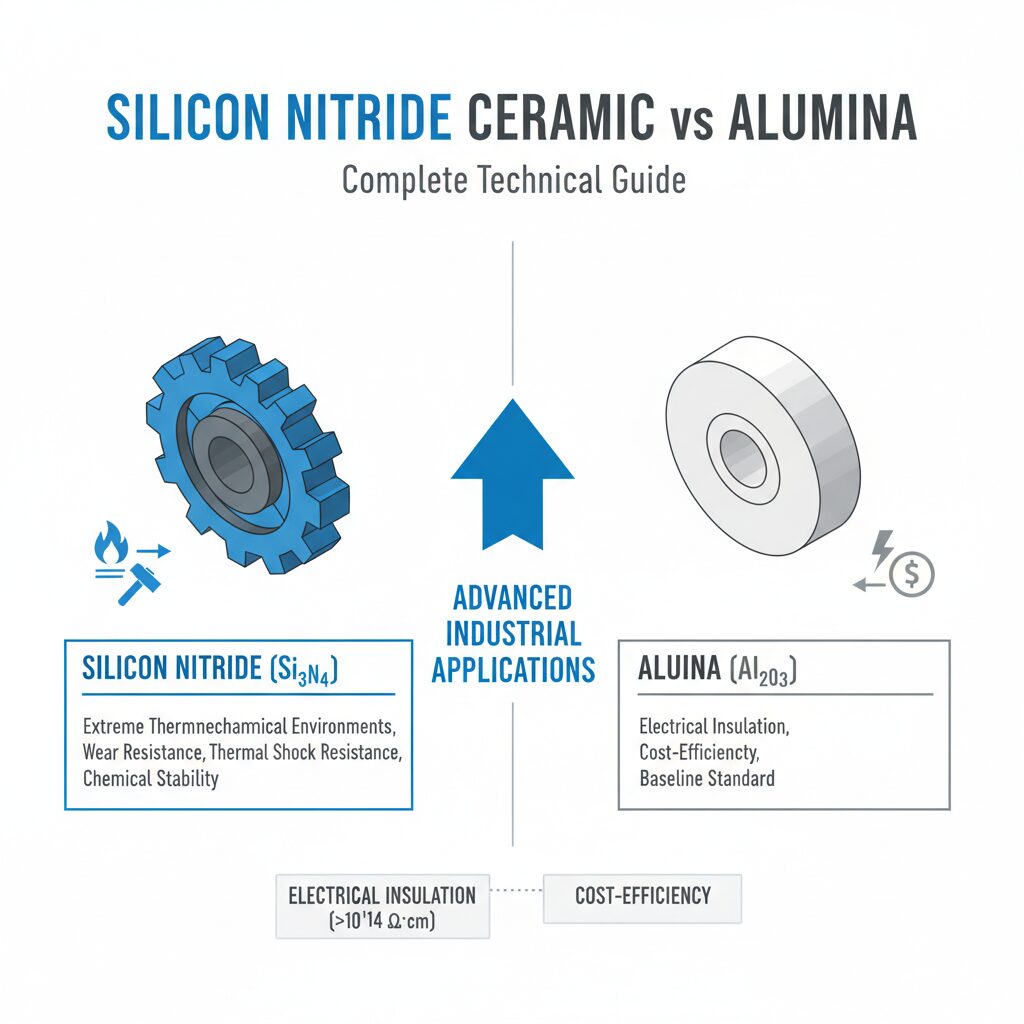
When selecting a ceramic substrate or structural component for electronic applications, engineers must balance thermal conductivity, mechanical toughness. And manufacturing costs. While アルミナ/アルミナ remains the industry standard for low-cost electronic substrates, its thermal conductivity (24 W/m·K) is approximately 1/7th that of aluminum nitride. Conversely, ジルコニア offers unparalleled fracture toughness (up to 10.0 MPa·m½), making it highly resistant to mechanical impact, but it acts as a thermal insulator at just 2.5 W/m·K. 窒化ケイ素 offers a middle ground, providing superior mechanical strength (800 MPa flexural strength) and high fracture toughness, with modern grades achieving thermal conductivities up to 90 W/m·K, though it remains significantly more expensive to sinter and machine than standard ceramics.
| プロパティ | 窒化アルミニウム | Alumina (99.5%) | ジルコニア(Y-TZP) | 窒化ケイ素 |
|---|---|---|---|---|
| 熱伝導率 (W/m-K) | 170 – 200 | 24 – 30 | 2.0 – 3.0 | 30 – 90 |
| 硬度(HV) | 1100 | 1500 | 1200 | 1500 – 1600 |
| 破壊靭性 (MPa-m½) | 2.8 | 4.0 – 5.0 | 9.0 – 10.0 | 6.0 – 7.0 |
| 曲げ強さ (MPa) | 320 | 380 | 1000 | 800 |
| CTE (ppm/K) | 4.5 | 7.2 | 10.3 | 3.2 |
| コスト | 高い | 低い | ミディアム | 非常に高い |
アプリケーション
The integration of aluminum nitride ceramic for electronics industry applications has revolutionized how thermal architectures are designed in multi-chip modules and power conversion systems. Its specific combination of a 4.5 ppm/K CTE and high thermal diffusivity allows for direct bonding of semiconductor crystals without the need for thick, thermally resistive compliant layers.
- IGBT and Power Semiconductor Modules: Used extensively as Direct Copper Bonded (DCB) or Active Metal Brazed (AMB) substrates. In traction inverters for electric vehicles operating at >800V and >300A, AlN substrates dissipate heat directly to the liquid cooling plate, maintaining junction temperatures below the critical 150°C threshold. The high isolation voltage prevents dielectric breakdown during power surges.
- High-Power UV-C LED Packaging: UV-C LEDs operate with an exceptionally low wall-plug efficiency (often under 10%), meaning over 90% of the input power is converted to heat. AlN submounts provide a thermal resistance of less than 0.5 K/W, rapidly extracting heat from the active region to prevent degradation of the epitaxial layers and prolonging the operational lifespan from hundreds to thousands of hours.
- 半導体ウェハー処理装置 Utilized in electrostatic chucks (ESCs), heater plates. And clamping rings within CVD and etch chambers. AlN’s plasma resistance to fluorine chemistries, combined with its ability to distribute heat uniformly across a 300mm wafer with less than a ±1.0°C variance, ensures high-yield photolithography and deposition. Great Ceramic routinely machines these components to flatness tolerances of <0.002mm.
- RF and Microwave Packages: In 5G telecom infrastructure and aerospace radar arrays, high-frequency signal attenuation is a major concern. AlN possesses a low dielectric constant of 8.9 and a dissipation factor (loss tangent) of <0.0003 at 1 MHz. This allows high-power RF amplifiers (GaN on SiC) to operate efficiently without signal distortion while dumping massive thermal loads into the AlN package base.
- Optoelectronics and Laser Diode Submounts: High-power laser diodes require exact alignment. Because AlN’s thermal expansion coefficient closely matches Gallium Arsenide (GaAs) and Indium Phosphide (InP), the submount does not warp or induce stress onto the fragile laser chip during thermal cycling from 20°C to 80°C, ensuring the optical beam remains perfectly targeted within a ±0.1 micrometer tolerance.
製造工程
Producing high-purity aluminum nitride requires rigorous control over atmospheric conditions, particulate contamination. And high-temperature thermodynamics. The presence of even 0.1 weight percent (wt%) of unreacted oxygen in the final crystal lattice can drastically reduce the thermal conductivity from 200 W/m·K down to 120 W/m·K. Therefore, the manufacturing process is highly specialized and requires inert gas environments.
成形方法
The raw AlN powder is typically synthesized via carbothermal reduction of alumina in a nitrogen atmosphere at 1600°C. Once the high-purity powder is acquired, it is mixed with organic binders, plasticizers. And sintering aids (typically Yttrium Oxide, Y₂O₃, at 3-5 wt%). Depending on the final geometry required, different forming methods are utilized:
- Tape Casting: The primary method for creating thin, flat substrates for electronic circuits. A slurry of AlN is cast onto a moving carrier belt using a doctor blade, creating green sheets with precise thicknesses ranging from 0.25mm to 1.5mm. These sheets are then cut, punched with vias. And stacked.
- Dry Pressing and Isostatic Pressing: For three-dimensional components like semiconductor chucks or structural heat sinks, the granulated powder is compacted in a rigid steel die at pressures exceeding 150 MPa (Dry Pressing) or enclosed in a flexible mold and submerged in fluid pressurized to 200 MPa (Cold Isostatic Pressing – CIP). This ensures a uniform green density of roughly 60% of theoretical mass.
焼結
The sintering of AlN is complex due to its strong covalent bonds. This resist natural densification. The green bodies undergo binder burnout in an inert atmosphere at 600°C to 800°C to completely remove organics. The parts are then transferred to a high-temperature furnace and sintered at temperatures between 1750°C and 1900°C under a continuous flow of nitrogen gas. The Y₂O₃ sintering aids react with the unavoidable surface alumina (Al₂O₃) present on the AlN particles, forming a liquid yttrium aluminate phase (such as Y₃Al₅O₁₂) that promotes liquid-phase sintering. This mechanism not only densifies the ceramic to >99% of its theoretical density but also traps oxygen atoms at the grain boundaries, purifying the AlN lattice and maximizing thermal conductivity.
最終加工
Because sintered AlN shrinks by approximately 15% to 20% during the firing process, achieving critical dimensional tolerances requires post-sintering machining. Given its hardness of 1100 HV, traditional high-speed steel or carbide tooling is completely ineffective. Final machining relies exclusively on precision diamond grinding, lapping. And ultrasonic machining. For complex geometries, such as micro-cooling channels or precision mounting holes, 5-axis CNC machines equipped with diamond-impregnated tools operating at spindle speeds exceeding 30,000 RPM are utilized. Substrate surfaces are often chemically-mechanically polished (CMP) to achieve surface roughness (Ra) values below 0.05 µm. This is essential for subsequent thin-film metallization.
利点と限界
メリット
- Exceptional Thermal Management: At 170-200 W/m·K, it provides thermal conductivity matching metallic aluminum, effectively eliminating heat buildup in compact electronic assemblies.
- Thermomechanical Stability: The CTE of 4.5 x 10⁻⁶/K prevents solder joint fatigue and chip delamination during thermal cycling, bridging the gap between silicon (4.2 ppm/K) and surrounding metals.
- Electrical Isolation: With a dielectric strength of 15 kV/mm, it prevents arcing in high-voltage power conversion circuits, making it superior to metal-core printed circuit boards (MCPCBs).
- Non-Toxicity: Unlike Beryllium Oxide (BeO). This offers similar thermal properties but poses severe respiratory health hazards (berylliosis) during machining, AlN is completely non-toxic and compliant with RoHS and REACH regulations.
制限事項
- Moisture Sensitivity (Hydrolysis): Bare, unmetallized AlN powder and exposed substrates can react with atmospheric moisture or liquid water at elevated temperatures to form aluminum hydroxide and ammonia gas, degrading the surface. It often requires protective coatings or metallization layers.
- High Manufacturing Cost: The requirement for high-purity raw powders, rare-earth sintering aids (Yttria). And extremely high sintering temperatures (1900°C in pure Nitrogen) results in components that cost 3 to 5 times more than standard alumina.
- 本質的な脆さ: With a fracture toughness of ~2.8 MPa·m½, AlN is highly susceptible to chipping during machining and assembly, demanding specialized handling protocols compared to 炭化ケイ素 or zirconia.
加工に関する考慮事項
The process of precision machining aluminum nitride ceramic for electronics industry applications is fraught with mechanical challenges. The material’s low fracture toughness means that excessive tool pressure or incorrect feed rates will immediately induce micro-cracking, edge chipping. And catastrophic failure of the workpiece. To prevent subsurface damage, material removal rates must be kept exceedingly low. Typical grinding operations utilize a depth of cut (DOC) no greater than 0.005mm to 0.010mm per pass.
At Great Ceramic, our engineering team mitigates these challenges through the application of specialized diamond tooling and strict kinematic control. We utilize resin-bonded diamond grinding wheels with precise grit sizes (D46 to D126) tailored specifically for AlN’s grain structure. High-volume, high-pressure synthetic coolants are continuously directed at the cutting zone to flush away abrasive swarf and prevent localized thermal shock. This could propagate cracks. For features like micro-vias in substrates, we employ ultrasonic core drilling, reducing the mechanical stress on the ceramic lattice by superimposing a high-frequency (20 kHz) oscillation over the tool rotation.
Our commitment to tight tolerance metrology allows us to consistently outperform standard industry capabilities. Below is a detailed breakdown of Great Ceramic’s advanced machining capabilities compared to industry standards.
| Machined Feature | Standard Industry Tolerance | Great Ceramic Precision Tolerance |
|---|---|---|
| Linear Dimensions | ± 0.050 mm | ± 0.005 mm |
| Surface Flatness (per 100mm) | 0.020 mm | < 0.002 mm |
| Cylindricity / Roundness | 0.010 mm | 0.002 mm |
| Surface Finish (Lapped/Polished) | Ra 0.4 µm | Ra 0.05 µm |
| Hole Diameter (Micro-vias) | ± 0.020 mm | ± 0.005 mm |
By leveraging advanced CMM (Coordinate Measuring Machine) verification and laser interferometry, Great Ceramic guarantees that every component meets rigorous aerospace and semiconductor specifications. Whether you need intricately machined heat sinks or ultra-flat electrostatic chucks, our 精密セラミック加工 infrastructure is built to handle the unique brittleness of AlN while maintaining absolute geometric fidelity. Contact our engineering team to discuss how we can reduce your component rejection rates.
FAQ
What is aluminum nitride ceramic for electronics industry?
Aluminum nitride (AlN) ceramic is an advanced, synthetically manufactured technical ceramic composed of aluminum and nitrogen. In the electronics industry, it is primarily used as a structural substrate and heat sink. It is uniquely valued for its ability to conduct heat nearly as efficiently as metallic aluminum (up to 200 W/m·K) while simultaneously acting as a powerful electrical insulator (dielectric strength >15 kV/mm). This rare combination solves severe thermal bottlenecks in densely packed electronic circuits, ensuring high-power chips do not overheat.
What are the main applications of aluminum nitride?
The primary applications revolve around high-power, high-heat electronic environments. It is heavily utilized in Insulated-Gate Bipolar Transistor (IGBT) power modules for electric vehicles, solar inverters. And high-speed rail. It serves as submounts for high-power UV-C LEDs and laser diodes, preventing thermal degradation of the optical elements. Additionally, in semiconductor fabrication, AlN is machined into large-format electrostatic chucks, heater plates. And plasma-resistant clamping rings that hold silicon wafers during critical chemical vapor deposition (CVD) and etching processes.
How does aluminum nitride compare to other ceramics?
Compared to alumina. This is cheap and widely used, AlN provides roughly 7 times the thermal conductivity, making it vastly superior for thermal management. Compared to beryllium oxide (BeO), AlN offers similar thermal performance but without the deadly toxicity risks associated with beryllium dust. When compared to structural ceramics like zirconia or 窒化ケイ素, AlN has lower fracture toughness (is more brittle) and lower mechanical strength, meaning it is not preferred for heavy mechanical wear applications. However, for electronics where heat dissipation and CTE matching with silicon are paramount, AlN remains unmatched.
What are the advantages of aluminum nitride?
The core advantages include its massive thermal conductivity (170-200 W/m·K), outstanding electrical insulation. And a Coefficient of Thermal Expansion (4.5 ppm/K) that almost perfectly matches silicon (4.2 ppm/K). This CTE match means that when a silicon chip heats up and expands, the AlN substrate expands at the exact same rate, preventing the solder joints from tearing apart due to mechanical stress. Furthermore, it is non-toxic, chemically stable in most non-aqueous environments. And features a low dielectric constant that minimizes signal loss in high-frequency 5G and radar RF applications.
How is aluminum nitride machined?
Due to its high hardness (1100 HV) and brittle nature, sintered AlN cannot be machined using conventional metal-cutting tools. It must be shaped using precision diamond grinding, ultrasonic machining. And lapping processes under heavy coolant flooding to prevent thermal micro-cracking. Because the material is prone to edge chipping, exact feed rates, spindle speeds. And diamond grit selection are critical. Great Ceramic offers state-of-the-art 精密セラミック加工 services specifically tuned for brittle materials like AlN, 窒化ホウ素. And silicon carbide. We routinely achieve ultra-tight tolerances of ±0.005mm and optical-grade surface finishes, ensuring your semiconductor components function flawlessly in the field.
Need custom aluminum nitride ceramic for electronics industry parts? グレート・セラミックへのお問い合わせ 公差の厳しい精密機械加工サービスについては、Eメールでお問い合わせください。 [email protected].
aluminum nitride ceramic for electronics industry is widely used in advanced ceramic applications.
詳細はこちら Aluminum Nitride Ceramic For Electronics Industry および当社の精密セラミック加工サービス。.