








アルミナ ceramic vs steel: Complete Technical Guide
When engineers and procurement managers evaluate materials for high-stress industrial applications, the debate of alumina ceramic vs steel is a critical engineering junction. Traditional metal alloys, specifically stainless and tool steels, have long been the default choice due to their high fracture toughness, ductility. And ease of fabrication. However, as modern industrial applications push the boundaries of operational environments—demanding higher speeds, extreme temperatures. And corrosive chemical exposures—steel components often suffer from rapid abrasive wear, thermal deformation. And galvanic corrosion. This leads to frequent maintenance downtime and compromised system reliability. Upgrading to advanced technical ceramics provides a highly effective solution. Specifically, alumina (aluminum oxide) offers exceptional hardness, thermal stability up to 1700°C. And chemical inertness, extending component lifespan by up to 10 times in abrasive environments compared to standard 316 stainless steel. Navigating the transition from metals to ceramics requires a deep understanding of mechanical properties, design constraints. And machining capabilities. In this comprehensive guide, we analyze the critical differences between these materials and explore how Great Ceramic’s expertise in tight-tolerance precision machining (±0.005mm) translates raw ceramic materials into high-performance industrial solutions. If you are currently facing wear or thermal issues with steel components, contact our engineering team for a material consultation.
材料特性
To truly understand the performance differences between アルミナ and steel, one must examine their fundamental mechanical, thermal. And electrical properties. Steel relies on metallic bonding. This provides a “sea of electrons” that allows atoms to slide past one another, resulting in high ductility and electrical conductivity. In contrast, alumina (99.5% purity) features a rigid ionic and covalent crystalline lattice. This crystalline structure prevents plastic deformation, yielding a material that is exceptionally hard and wear-resistant, but inherently brittle. The density of alumina (3.90 g/cm³) is less than half that of stainless steel (8.00 g/cm³), allowing engineers to significantly reduce the weight of dynamic rotating components, thereby lowering centrifugal forces and motor loads. Furthermore, alumina’s immense hardness (1500 HV) drastically outperforms standard stainless steel (200 HV), making it virtually immune to galling and particulate abrasion. Below is a detailed technical comparison of their core properties.
| プロパティ | Alumina (99.5%) | Stainless Steel (316) | 単位 |
|---|---|---|---|
| 密度 | 3.90 | 8.00 | g/cm³ |
| 硬度 | 1500 | 200 | HV |
| 曲げ強度 | 350 | 515 (Ultimate) | MPa |
| 破壊靭性 | 4.5 | 100+ | MPa-m½ |
| 熱伝導率 | 30.0 | 16.0 | W/m-K |
| 電気抵抗率 | >10¹⁴ | 7.4 x 10⁻⁵ | Ω・cm |
| 最高使用温度 | 1700 | 870 | °C |
他のセラミックとの比較
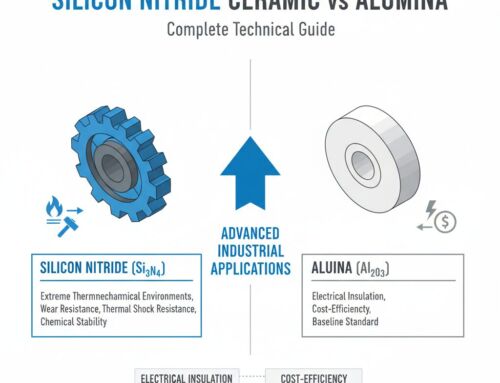
While the transition from steel to advanced ceramics is often driven by the need for superior wear resistance and thermal stability, alumina is not the only option available. Depending on the specific operational stresses—such as severe impact loads or extreme thermal shock—engineers may need to evaluate other technical ceramics alongside the baseline performance of steel. ジルコニア (Y-TZP) is frequently selected when higher fracture toughness (up to 10.0 MPa·m½) is required, acting as the “ceramic steel” due to its phase-transformation toughening mechanism. 窒化ケイ素 offers unparalleled thermal shock resistance and high-temperature strength, making it ideal for aerospace and molten metal applications. Another critical material, 炭化ケイ素, is utilized for its extreme hardness (up to 2800 HV) and extraordinary thermal conductivity (up to 150 W/m·K). Understanding how stainless steel compares directly to this family of advanced materials is essential for optimizing both system performance and manufacturing costs.
| プロパティ | Stainless Steel 316 | Alumina (99.5%) | ジルコニア(Y-TZP) | 窒化ケイ素 |
|---|---|---|---|---|
| 熱伝導率 | 16.0 | 30.0 | 2.5 | 25.0 – 30.0 |
| 硬度(HV) | 200 | 1500 | 1200 | 1600 |
| 破壊靭性 (MPa-m½) | 100+ | 4.5 | 9.0 | 7.0 |
| コスト | 低い | ミディアム | 高い | 非常に高い |
アプリケーション
- Industrial Pump Shafts and Mechanical Seals: In high-pressure slurry pumps operating at over 3000 RPM, stainless steel seals suffer from rapid abrasive wear and galling due to particulate matter. Alumina is selected for these components because its extreme hardness (1500 HV) resists scoring from abrasive slurries, while its low coefficient of friction minimizes heat generation, extending the MTBF (Mean Time Between Failures) from weeks to years.
- 半導体ウェハー処理装置 Plasma etching and chemical vapor deposition (CVD) chambers utilize highly aggressive halogen gases (like fluorine) that rapidly degrade metallic components, introducing catastrophic particulate contamination to silicon wafers. Alumina is chosen because of its exceptional chemical inertness and high dielectric strength (>15 kV/mm), ensuring zero electrical interference and absolute purity in ultra-high vacuum (UHV) environments.
- High-Temperature Furnace Components: Structural supports, thermocouple protection tubes. And kiln furniture operating at temperatures exceeding 1200°C will cause steel to oxidize, warp. And ultimately melt. Alumina is the superior choice because it maintains its structural integrity and flexural strength up to 1700°C, remaining completely stable in both oxidizing and reducing atmospheres without outgassing.
- Medical and Surgical Instruments: Reusable surgical instruments and implantable devices require repeated sterilization in autoclaves at 134°C with high-pressure steam. This can induce galvanic corrosion and pitting in lower-grade steels. Alumina is utilized because it is 100% biocompatible, non-porous. And impervious to chemical sterilization agents, ensuring zero degradation and eliminating the risk of metallosis in patients.
- Textile and Wire Drawing Guides: When manufacturing fine copper wire or synthetic technical fibers running at speeds exceeding 50 meters per second, the friction generated quickly cuts deep grooves into hardened steel guides. Alumina is implemented in these scenarios because its micro-fine surface finish (machinable to Ra 0.1 µm) and high abrasion resistance prevent thread breakage and maintain dimensional accuracy of the wire over millions of cycles.
製造工程
The manufacturing paradigms for metals and technical ceramics are fundamentally different. While steel is typically smelted, cast, forged. And then machined in its hardened or annealed state using carbide cutting tools, technical ceramics require a complex powder metallurgy approach. The production of high-purity alumina parts begins with sub-micron alumina powders mixed with organic binders. Because the material cannot be melted and cast like metal, it must be formed into a “green” (unfired) state, thermally processed at extreme temperatures to achieve density. And then subjected to rigorous and specialized machining processes to achieve tight tolerances.
成形方法
- 冷間静水圧プレス(CIP): This method applies uniform hydraulic pressure (often exceeding 200 MPa) from all directions to a flexible mold filled with ceramic powder. It ensures a highly uniform density distribution throughout the billet. This is critical for minimizing warpage during sintering and is ideal for large or complex cylindrical components.
- Dry Pressing: Uniaxial pressing utilizes rigid steel dies to compress spray-dried ceramic powder. This highly automated process is utilized for high-volume production of simple, flat geometries like seal rings and electrical insulators, ensuring rapid cycle times and excellent dimensional repeatability in the green state.
焼結
Once the alumina component is formed, it undergoes a careful debinding process to burn off organic additives, followed by high-temperature sintering. The parts are fired in specialized kilns at temperatures ranging from 1600°C to 1700°C for up to 24 hours. During this phase, the ceramic particles undergo solid-state diffusion, fusing together to eliminate porosity and form a dense crystalline structure. A critical engineering challenge during sintering is managing volumetric shrinkage. This typically ranges from 15% to 20%. Accurately predicting this shrinkage is vital, but inherently limits the dimensional accuracy of as-fired parts to roughly ±1-2%, necessitating post-sintering machining for precision applications.
最終加工
Unlike steel. This can be aggressively milled and turned using standard CNC equipment, fully sintered alumina has a hardness approaching that of diamonds. Final machining cannot utilize conventional metal-cutting tools. instead, it requires precision grinding using resin or metal-bonded diamond abrasives. Utilizing 5-axis CNC grinding centers, Great Ceramic performs internal/external cylindrical grinding, surface grinding. And ultrasonic machining to bring as-fired ceramics to exact engineering specifications. If you require specialized component fabrication, explore our 精密セラミック加工 services to see how we achieve tight tolerances down to ±0.005mm.
利点と限界
メリット
- Unmatched Wear Resistance: With a Vickers hardness rating of 1500 HV compared to stainless steel’s 200 HV, alumina components outlast metals by an order of magnitude in abrasive applications, significantly reducing replacement costs and maintenance downtime.
- Extreme Thermal Stability: Alumina retains its mechanical properties at operational temperatures up to 1700°C and exhibits a lower coefficient of thermal expansion (8.1 µm/m·K) than steel (16.0 µm/m·K), ensuring dimensional stability in high-heat environments.
- 電気絶縁: Unlike metallic steel, alumina is a potent dielectric material with an electrical resistivity exceeding 10¹⁴ Ω·cm and a dielectric strength of 15 kV/mm, making it an essential substrate for high-voltage and high-frequency electronic applications.
- Complete Chemical Inertness: Alumina is virtually unaffected by strong acids (such as HCl and H₂SO₄), potent alkalis. And organic solvents that would rapidly corrode or pit stainless and tool steels, making it ideal for chemical processing and fluid handling.
制限事項
- 本質的な脆さ: The primary drawback of alumina compared to steel is its low fracture toughness (4.5 MPa·m½ vs >100 MPa·m½ for steel). It lacks ductility, meaning it cannot absorb high-velocity impact loads or bending stresses without catastrophic brittle fracture.
- Thermal Shock Susceptibility: Due to its relatively high coefficient of thermal expansion for a ceramic and moderate thermal conductivity, rapid and extreme temperature fluctuations (ΔT > 200°C) can induce internal tensile stresses, leading to micro-cracking and part failure.
加工に関する考慮事項
Transitioning from metal to advanced ceramics introduces significant machining challenges that most standard machine shops cannot handle. When cutting steel, the material undergoes plastic deformation, creating a chip that carries heat away from the cutting zone. Alumina, possessing zero ductility, is removed entirely through brittle micro-fracture. Machining fully sintered alumina requires heavy-duty, ultra-rigid CNC grinding machines equipped with continuous high-pressure, water-based coolant systems to prevent thermal damage to both the part and the tool. The abrasive nature of ceramic dust easily destroys standard machine slideways, requiring specialized sealed equipment.
Tool selection is equally critical. only electroplated or vitrified diamond grinding wheels (typically ranging from D46 to D126 grit sizes) can effectively penetrate the alumina lattice. Engineers must carefully program minimal depths of cut (often as shallow as 0.002 mm per pass) and control spindle speeds exceeding 10,000 RPM to prevent inducing subsurface micro-cracks that could compromise the component’s structural integrity. Great Ceramic overcomes these extensive machining challenges through decades of specialized experience. Our advanced temperature-controlled grinding facilities allow us to maintain dimensional tolerances of ±0.005mm, achieve geometric concentricity of 0.01mm. And polish surfaces to an ultra-smooth Ra 0.1 µm finish, ensuring your custom ceramic parts fit perfectly into demanding assemblies.
FAQ
What is alumina ceramic vs steel?
The comparison of alumina ceramic vs steel evaluates two fundamentally different classes of industrial materials. Steel is a metallic alloy primarily composed of iron and carbon, characterized by its high tensile strength, excellent fracture toughness, ductility. And electrical conductivity. It is highly machinable and cost-effective for general structural applications. Alumina (aluminum oxide) is an advanced technical ceramic characterized by ionic and covalent bonding. It completely lacks ductility but offers extraordinary hardness (1500 HV), exceptional wear resistance, thermal stability up to 1700°C. And complete chemical inertness. Engineers analyze these two materials when a standard metal part fails prematurely due to high friction, abrasive wear, extreme heat, or corrosive environments, pivoting to alumina as a high-performance upgrade.
What are the main applications of alumina ceramic vs steel components?
The main applications where engineers replace steel with alumina ceramic revolve around environments that destroy metals. Common applications include mechanical seal faces and shafts in industrial slurry pumps, where steel suffers from rapid abrasive wear. In the semiconductor industry, alumina is used for wafer handling arms and plasma chamber liners because steel would release metallic ions and contaminate silicon wafers. High-temperature applications include furnace tubes and thermocouple insulators, where temperatures exceeding 1000°C would cause steel to oxidize and warp. Additionally, alumina is heavily utilized in analytical instrumentation and high-voltage electronics where electrical insulation is required—a property impossible to achieve with conductive steel alloys.
How does alumina compare to other ceramics and steel?
When comparing alumina to steel and other advanced ceramics, it serves as an excellent middle ground in terms of cost and performance. Steel offers the highest impact resistance and lowest cost but fails in extreme heat and abrasive environments. Alumina significantly outperforms steel in hardness and maximum working temperature (1700°C), making it a highly cost-effective ceramic upgrade. However, if an application requires higher fracture toughness than alumina can provide, engineers may choose zirconia. This offers up to 10 MPa·m½ of toughness—often referred to as “ceramic steel.” If the application involves extreme thermal shock (rapid heating and cooling), 窒化ケイ素 is preferred over both alumina and steel due to its low coefficient of thermal expansion and high thermal conductivity.
What are the advantages of alumina over steel?
The primary advantages of alumina over steel include its massive increase in hardness and wear resistance. an alumina part can operate in high-friction, abrasive environments up to 10 times longer than a hardened steel equivalent. Thermally, alumina can operate continuously at 1700°C, far beyond the melting or oxidizing points of most steel alloys. Chemically, alumina is inert and will not rust or degrade when exposed to harsh acids, alkalis, or saltwater, eliminating the galvanic corrosion issues associated with stainless steel. Finally, alumina is significantly lighter than steel (3.9 g/cm³ vs 8.0 g/cm³). This drastically reduces rotational mass and inertia in dynamic motor assemblies. And it functions as a perfect electrical insulator.
How is alumina machined compared to steel?
Machining alumina is vastly more complex, time-consuming. And expensive than machining steel. Steel can be milled, turned. And drilled using standard high-speed steel (HSS) or tungsten carbide cutting tools on conventional CNC machines. Because fully sintered alumina is nearly as hard as diamond, it cannot be cut with metal tools. It must be meticulously ground using diamond-impregnated grinding wheels on ultra-rigid, specialized CNC grinding centers. This process requires precise control of feed rates and high-pressure coolant to prevent micro-cracking the brittle ceramic structure. Great Ceramic possesses the specialized equipment and proprietary tooling knowledge required to machine advanced ceramics safely, routinely achieving tight engineering tolerances of ±0.005mm and mirror-like surface finishes.
Need custom alumina components? グレート・セラミックへのお問い合わせ 公差の厳しい精密機械加工サービスについては、Eメールでお問い合わせください。 [email protected].
alumina ceramic vs steel is widely used in advanced ceramic applications.
詳細はこちら アルミナ・セラミック対スチール および当社の精密セラミック加工サービス。.