








アルミナ ceramic ceramic components: Complete Technical Guide
When engineering advanced industrial systems, material selection directly dictates component lifecycle and system reliability. For applications demanding high dielectric strength, extreme hardness. And robust chemical resistance, precision-machined alumina ceramic ceramic components offer an unparalleled combination of performance and cost-efficiency. However, achieving tight dimensional tolerances in a material boasting a Vickers hardness of 1500 HV presents severe tribological and manufacturing challenges. This technical guide delivers comprehensive engineering data, microstructural analysis. And machining parameters for aluminum oxide (Al₂O₃) parts. By examining density optimization up to 3.9 g/cm³, thermal conductivity parameters ranging from 25 to 35 W/m·K. And complex fabrication methodologies, engineers can accurately specify these components for their demanding environments. If your current project requires tolerances as tight as ±0.005mm, contact Great Ceramic’s engineering team for a detailed feasibility analysis and rapid RFQ processing.
材料特性
The macroscopic performance of alumina ceramic ceramic components is fundamentally governed by their microstructure, specifically grain size distribution (typically refined to 1.5–5.0 µm for 99.5% purity) and residual porosity (maintained below 0.5 volume percent). Achieving optimal mechanical integrity requires careful control over the sintering profile to maximize bulk density. This approaches the theoretical maximum of 3.98 g/cm³. At a standard industrial purity of 99.5%, aluminum oxide exhibits exceptional compressive strength exceeding 2000 MPa, allowing it to withstand extreme localized loading. Furthermore, its dielectric breakdown strength of 15 to 20 kV/mm makes it highly suitable for high-voltage isolation applications operating in excess of 10,000 volts. The material’s Young’s Modulus of 370 GPa indicates high stiffness, resulting in an elastic deformation of less than 0.1% under 300 MPa loads. Understanding these specific numerical limits is critical for accurate Finite Element Analysis (FEA) during the component design phase.
| プロパティ | 価値 | 単位 |
|---|---|---|
| Density (99.5% Purity) | 3.85 – 3.92 | g/cm³ |
| 硬度(ビッカース) | 1450 – 1600 | HV |
| 曲げ強さ(室温) | 320 – 380 | MPa |
| Fracture Toughness (K_Ic) | 4.0 – 5.0 | MPa-m½ |
| Thermal Conductivity (20°C) | 25 – 35 | W/m-K |
| Electrical Resistivity (20°C) | > 10¹⁴ | Ω・cm |
| 最高使用温度 | 1650 – 1700 | °C |
他のセラミックとの比較
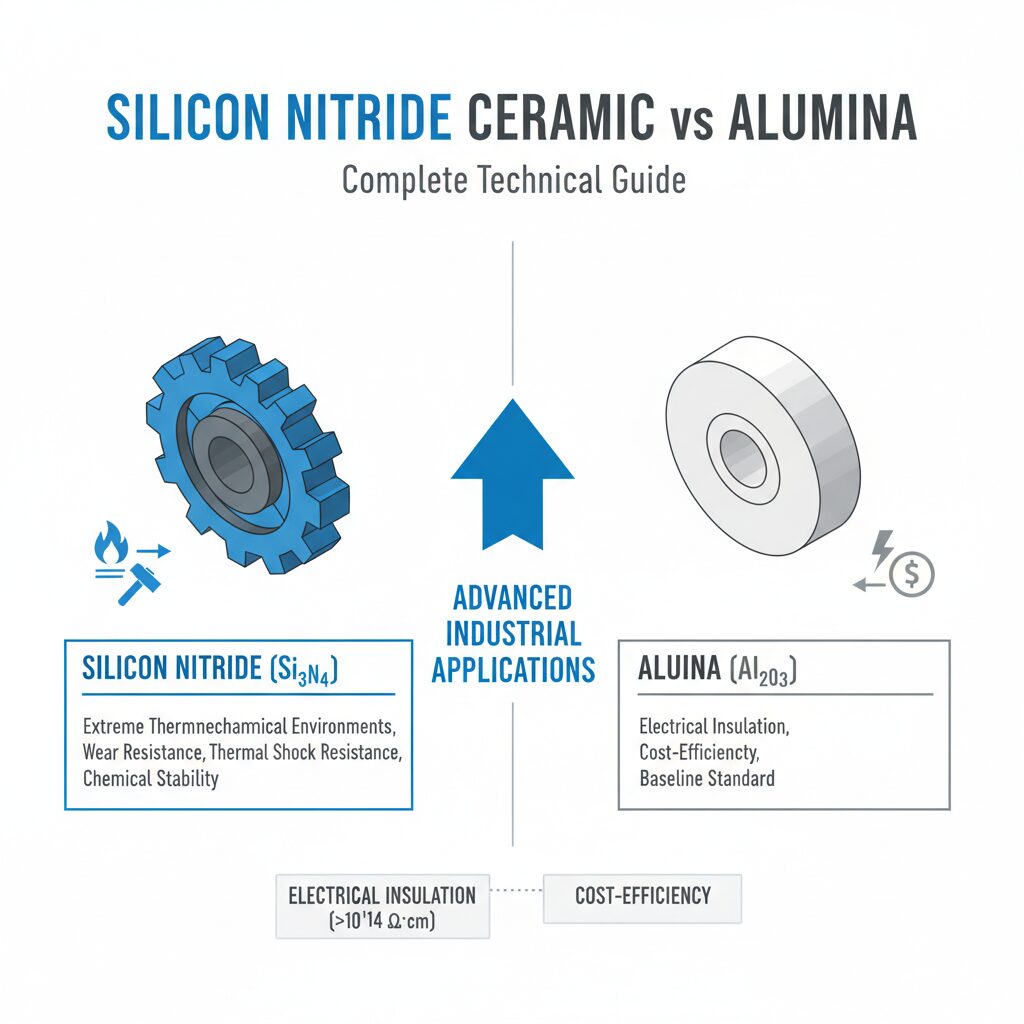
Material selection often requires evaluating trade-offs between thermal performance, fracture toughness. And procurement costs. While alumina ceramic ceramic components provide an excellent baseline with a thermal conductivity of roughly 30 W/m·K and a flexural strength of 350 MPa, demanding applications might necessitate alternatives. For instance, systems subjected to severe thermal shocks with temperature gradients exceeding 200°C/sec often fail when utilizing standard アルミナ. In such high-stress thermal environments, 窒化ケイ素 becomes preferential due to its low coefficient of thermal expansion (3.2 x 10⁻⁶/°C compared to alumina’s 8.1 x 10⁻⁶/°C) and higher fracture toughness of 6.0-8.0 MPa·m½. Conversely, when maximum impact resistance is required, yttria-stabilized ジルコニア offers unparalleled fracture toughness up to 10.0 MPa·m½, absorbing impact energy through phase transformation toughening at stress concentration points. Standard 95% Alumina acts as a cost-effective alternative for structural components where slight reductions in dielectric strength (down to 10 kV/mm) and hardness (down to 1300 HV) are acceptable engineering compromises.
| プロパティ | alumina ceramic ceramic components (99.5%) | Alumina (95%) | ジルコニア(Y-TZP) | 窒化ケイ素 (Si₃N₄) |
|---|---|---|---|---|
| 熱伝導率 | 30 W/m·K | 24 W/m·K | 2.5 W/m-K | 80 W/m·K |
| 硬度 | 1500 HV | 1350 HV | 1250 HV | 1500 HV |
| 破壊靭性 | 4.5 MPa-m½ | 3.5 MPa-m½ | 9.5 MPa·m½ | 7.0 MPa-m½ |
| コスト | 中程度 | 低い | 高い | 非常に高い |
アプリケーション
- Semiconductor Plasma Processing Chambers: In dry etching environments utilizing aggressive fluorine or chlorine plasmas, conventional metals degrade rapidly. Alumina components with 99.5% or greater purity withstand plasma bombardment at chamber temperatures reaching 400°C. The ultra-low porosity (<0.5%) prevents particle shedding, ensuring wafer defect rates remain below 0.1 particles/cm².
- High-Voltage Electrical Insulators: For power transmission and RF engineering, alumina’s electrical resistivity of >10¹⁴ Ω·cm and dielectric strength of 15 kV/mm suppress electrical arcing. Insulators machined from this material can actively isolate potential differences exceeding 100 kV while maintaining structural integrity under wind-induced lateral loads of up to 500 N.
- Mechanical Seal Faces for Fluid Handling: In centrifugal pumps handling abrasive slurries or corrosive acids at pressures up to 150 bar, alumina rings offer superior wear resistance. The sealing surfaces are typically lapped to a flatness of 1-2 helium light bands (0.3 to 0.6 µm) and a surface roughness (Ra) of less than 0.1 µm, achieving zero-leakage performance over a 10,000-hour continuous operational lifecycle.
- Medical and Analytical Instrumentation: High-performance liquid chromatography (HPLC) pumps rely on alumina pistons to dose highly corrosive solvents at system pressures of 400 to 600 bar. The dimensional stability of the ceramic prevents volumetric drift, ensuring dosing accuracy of ±0.5 microliters over millions of cyclic strokes.
- Laser Guidance and Reflector Assemblies: High-power industrial CO₂ and Nd:YAG lasers generating optical outputs exceeding 5 kW utilize alumina components for structural mounts and cooling channel guides. Alumina’s ability to maintain dimensional stability—expanding only 0.008 mm per meter per degree Celsius—ensures beam alignment remains within ±0.01 milliradians even as surrounding temperatures fluctuate between 20°C and 150°C.
製造工程
The fabrication of high-purity alumina ceramic ceramic components is a highly controlled, multi-stage metallurgical process. It begins with raw powder preparation, where alpha-alumina powders with an average particle size of 0.5 to 2.0 µm are ball-milled with organic binders, plasticizers. And distilled water to form a uniform slurry. This slurry undergoes spray drying at temperatures between 200°C and 250°C to produce flowable, spherical agglomerates measuring 50 to 100 µm in diameter. These agglomerates ensure a uniform fill density in subsequent forming stages. This is critical for minimizing anisotropic shrinkage during the firing process. Every variable, from pressing pressure to atmospheric control during burnout, requires stringent digital monitoring to prevent internal micro-fissures and guarantee a final material density exceeding 98% of the theoretical limit.
成形方法
- Dry Pressing: Ideal for high-volume, axially symmetric geometries. The spray-dried powder is compacted in carbide dies under pressures ranging from 50 to 150 MPa. This method yields a “green” (unfired) density of approximately 50-55%, maintaining green tolerances of ±0.1 mm before sintering.
- 冷間静水圧プレス(CIP): For complex or large components, powder is sealed in an elastomeric mold and subjected to uniform fluid pressure between 150 and 300 MPa. CIP eliminates pressure gradients present in uniaxial pressing, ensuring homogeneous density and reducing differential shrinkage rates to below 1.5% across varying cross-sections.
焼結
The green components are first subjected to a thermal debinding cycle at 400°C to 600°C, utilizing a slow ramp rate of 0.5°C to 1.0°C per minute to safely vaporize organic binders without inducing internal gas-pressure fracturing. Following debinding, the temperature is elevated to the sintering range of 1600°C to 1650°C. During a holding period of 2 to 6 hours, solid-state diffusion occurs, eliminating pore volume and causing a volumetric shrinkage of 15% to 20%. The cooling rate is strictly controlled at 2°C to 3°C per minute to prevent the initiation of thermal shock micro-cracks in the newly densified matrix.
最終加工
Due to the substantial and occasionally asymmetrical shrinkage during sintering, “as-fired” tolerances rarely exceed ±1% of the nominal dimension. To achieve engineering-grade specifications, hard-state 精密セラミック加工 is required. Because the fired alumina possesses a hardness of 1500 HV, traditional carbide or high-speed steel cutting tools are completely ineffective. Instead, final shaping is accomplished utilizing resin-bonded or metal-bonded diamond grinding wheels. Coordinate CNC grinding centers operate with spindle speeds of 10,000 to 20,000 RPM, utilizing continuous flood coolant at 50-70 bar to evacuate microscopic ceramic swarf and control localized heat buildup, ultimately achieving dimensional tolerances down to ±0.005mm.
利点と限界
メリット
- Exceptional Wear Resistance: With a hardness approaching 9 on the Mohs scale (1500 HV), alumina exhibits an abrasive wear rate up to 15 times lower than that of hardened 316 stainless steel under identical dry-sliding tribological tests under a 50 N load.
- Chemical Inertness: Alumina is virtually impervious to strong acids (such as 30% HCl or 98% H₂SO₄) and alkaline solutions (NaOH) even at elevated temperatures of 100°C, displaying an annual corrosion penetration rate of less than 0.001 mm/year.
- High Compressive Strength: Engineered to withstand massive mechanical forces, its compressive strength safely exceeds 2000 MPa, making it structurally capable of bearing heavy static loads in heavy machinery and deep-sea pressure housings operating at 600 bar.
- Cost-to-Performance Ratio: Compared to advanced nitrides or carbides, the raw material abundance and established processing routes make alumina a highly economical choice, often costing 40% to 60% less per cubic centimeter than 炭化ケイ素 または 窒化アルミニウム.
制限事項
- Low Fracture Toughness: With a K_Ic value of 4.0-5.0 MPa·m½, alumina is intrinsically brittle. It cannot undergo plastic deformation to relieve stress concentrations, meaning point-loading impacts exceeding 5 Joules can result in catastrophic brittle failure.
- Poor Thermal Shock Resistance: Due to a relatively high thermal expansion coefficient (8.1 x 10⁻⁶/°C) coupled with moderate thermal conductivity (30 W/m·K), alumina cannot withstand rapid thermal cycling. A sudden temperature quench (ΔT) of greater than 200°C will typically induce critical tensile surface stresses, leading to immediate fracture.
加工に関する考慮事項
Transitioning an as-fired alumina blank into tight-tolerance alumina ceramic ceramic components requires overcoming significant tribological and mechanical barriers. The primary machining challenge lies in preventing sub-surface micro-cracking during material removal. Because alumina undergoes brittle fracture rather than plastic shear during cutting, aggressive feed rates lead to edge chipping and deep structural flaws that degrade the component’s flexural strength by up to 40%. Standard machining parameters dictate maximum depths of cut (DOC) between 0.005 mm and 0.020 mm per pass, using diamond grit sizes ranging from D151 for roughing down to D15 for final finishing.
Machining Challenges & Optimization Data
| 加工パラメーター | Rough Grinding Specification | Precision Finishing Specification |
|---|---|---|
| Diamond Grit Size (FEPA) | D107 – D151 (100-150 µm) | D15 – D46 (15-45 µm) |
| Wheel Peripheral Speed | 25 – 35 m/s | 15 – 25 m/s |
| Depth of Cut (per pass) | 0.015 – 0.025 mm | 0.002 – 0.005 mm |
| Workpiece Feed Rate | 100 – 200 mm/min | 20 – 50 mm/min |
To overcome these challenges, Great Ceramic employs state-of-the-art 5-axis ultrasonic-assisted CNC machining centers. By superimposing ultrasonic vibrations (typically at frequencies of 20 to 40 kHz with amplitudes of 2 to 5 µm) onto the rotating diamond tool, the continuous cutting force is converted into a micro-pulsed impact. This reduces tool friction by up to 30%, lowers localized thermal spikes below 150°C. And minimizes the risk of micro-crack propagation. Through strict control of coolant chemistry and precise tool-path generation, Great Ceramic reliably achieves stringent geometric dimensioning and tolerancing (GD&T). For engineers requiring exact specifications, we deliver components with diametric tolerances of ±0.005mm, cylindricity within 0.003mm. And surface finishes down to Ra 0.05 µm. Submit your CAD files to our engineering team today for a comprehensive manufacturability review and RFQ generation.
FAQ
What is alumina ceramic ceramic components?
Alumina ceramic ceramic components are precision-engineered industrial parts manufactured primarily from aluminum oxide (Al₂O₃) powder. In engineering contexts, these components usually feature high purity levels ranging from 95% to 99.8%. They are consolidated through high-pressure pressing or casting and then sintered at temperatures exceeding 1600°C to form a highly dense (up to 3.9 g/cm³) crystalline matrix. These components are specified by engineers worldwide to resolve complex wear, electrical insulation. And high-temperature degradation problems where traditional metals or polymers fail.
What are the main applications of alumina ceramic ceramic components?
Due to a unique combination of high dielectric strength (15 kV/mm), massive compressive strength (>2000 MPa). And absolute chemical inertness, they are heavily deployed across multiple high-tech sectors. Key applications include semiconductor wafer processing equipment (such as plasma focus rings operating at 400°C), ultra-high-vacuum (UHV) electrical feedthroughs, precision fluid metering pump pistons dispensing at 500 bar, mechanical seal rings rotating at 3600 RPM. And industrial laser waveguides. Their high hardness (1500 HV) also makes them ideal for heavy-duty textile yarn guides and wire-drawing capstans.
How does alumina ceramic ceramic components compare to other ceramics?
Alumina stands as the industry standard, offering the best balance of performance and cost. When compared to 窒化ホウ素, alumina offers vastly superior hardness (1500 HV vs. a highly machinable, soft state for BN) and mechanical strength, though it lacks BN’s exceptional lubricity and thermal shock resistance. Compared to zirconia, alumina has lower fracture toughness (4.5 vs. 9.5 MPa·m½) making it more brittle, but it is lighter (3.9 vs. 6.0 g/cm³) and significantly more cost-effective. Against silicon carbide, alumina possesses lower thermal conductivity (30 vs. 120 W/m·K) and less extreme hardness, but offers vastly superior electrical insulation, whereas silicon carbide behaves as a semiconductor.
What are the advantages of alumina ceramic ceramic components?
The primary advantage is its exceptional wear resistance derived from its 1500 HV hardness, translating to component lifespans that are often 10 to 20 times longer than hardened steel in abrasive environments. Secondarily, its high dielectric constant (approx. 9.8 at 1 MHz) and electrical resistivity (>10¹⁴ Ω·cm) make it an ultimate insulator. Furthermore, it maintains its structural integrity and resists oxidation in air at continuous operating temperatures up to 1650°C. Finally, its high purity (>99.5%) variants prevent chemical contamination, making it highly desirable for medical device manufacturing and semiconductor fabrication.
How is alumina ceramic ceramic components machined?
Machining an alumina component after it has been fully sintered (hard machining) requires specialized equipment due to its extreme hardness and brittle nature. Material removal is strictly limited to abrasive grinding rather than traditional cutting. Engineers utilize diamond-impregnated grinding wheels, core drills. And micro-mills rotating at high speeds (up to 40,000 RPM) while taking exceptionally shallow depths of cut (0.002 to 0.010 mm) to prevent catastrophic edge chipping. Copious amounts of high-pressure coolant are applied to flush away ceramic swarf and control frictional heat. Great Ceramic specializes in this complex 精密セラミック加工 process. By utilizing advanced 5-axis CNC grinding centers, we routinely navigate these strict machining parameters to deliver components with ultra-precise tolerances of ±0.005mm and pristine surface finishes (Ra 0.1 µm), tailored precisely to your engineering blueprints.
Need custom alumina ceramic ceramic components parts? グレート・セラミックへのお問い合わせ 公差の厳しい精密機械加工サービスについては、Eメールでお問い合わせください。 [email protected].
alumina ceramic ceramic components is widely used in advanced ceramic applications.
詳細はこちら Alumina Ceramic Ceramic Components および当社の精密セラミック加工サービス。.