








Alumina Ceramic Ceramic Components for Medical: Complete Technical Guide
Designing implantable devices, diagnostic equipment. And surgical instruments requires materials that can survive the harsh, highly corrosive physiological environment of the human body without triggering an immune response. This is precisely where high-purity アルミナ ceramic ceramic components for medical applications become essential. Historically, medical manufacturers relied on metals like titanium alloys (Ti-6Al-4V) or cobalt-chromium (Co-Cr), but these materials face critical pain points regarding long-term wear debris, metal ion release. And radiopacity during MRI diagnostics. Advanced technical ceramics solve these issues, but they introduce severe manufacturing challenges due to their extreme hardness and brittleness.
At Great Ceramic, we engineer solutions for these exact challenges. By leveraging state-of-the-art 精密セラミック加工, we deliver medical-grade ceramic components with ultra-tight tolerances down to ±0.005mm. This comprehensive technical guide explores the material science, comparative properties. And precision manufacturing processes required to successfully deploy medical-grade alumina (Al2O3) in life-critical applications.
材料特性
Medical-grade アルミナ is strictly governed by international standards, most notably ISO 6474-1 (high-purity alumina for surgical implants). To meet these stringent criteria, the material must possess a minimum purity of 99.5% Al2O3, though 99.9% is often specified for critical load-bearing applications like orthopedics. The microscopic grain size is typically controlled to remain below 3.0 µm to prevent micro-fracture propagation, ensuring long-term mechanical reliability.
The inherent physical and mechanical properties of medical-grade alumina are derived from its strong ionic and covalent interatomic bonds. This unique crystalline structure yields an exceptionally high density and extraordinary hardness, translating into wear rates that are magnitudes lower than traditional medical polymers (like UHMWPE) or surgical metals.
| プロパティ | 価値 | 単位 |
|---|---|---|
| 密度 | 3.98 | g/cm³ |
| 硬度 | 2000 | HV |
| 曲げ強度 | 450 – 580 | MPa |
| 破壊靭性 | 4.5 - 5.0 | MPa-m½ |
| 熱伝導率 | 30 – 35 | W/m-K |
| 電気抵抗率 | >10¹⁴ | Ω・cm |
| 最高使用温度 | 1700 | °C |
他のセラミックとの比較
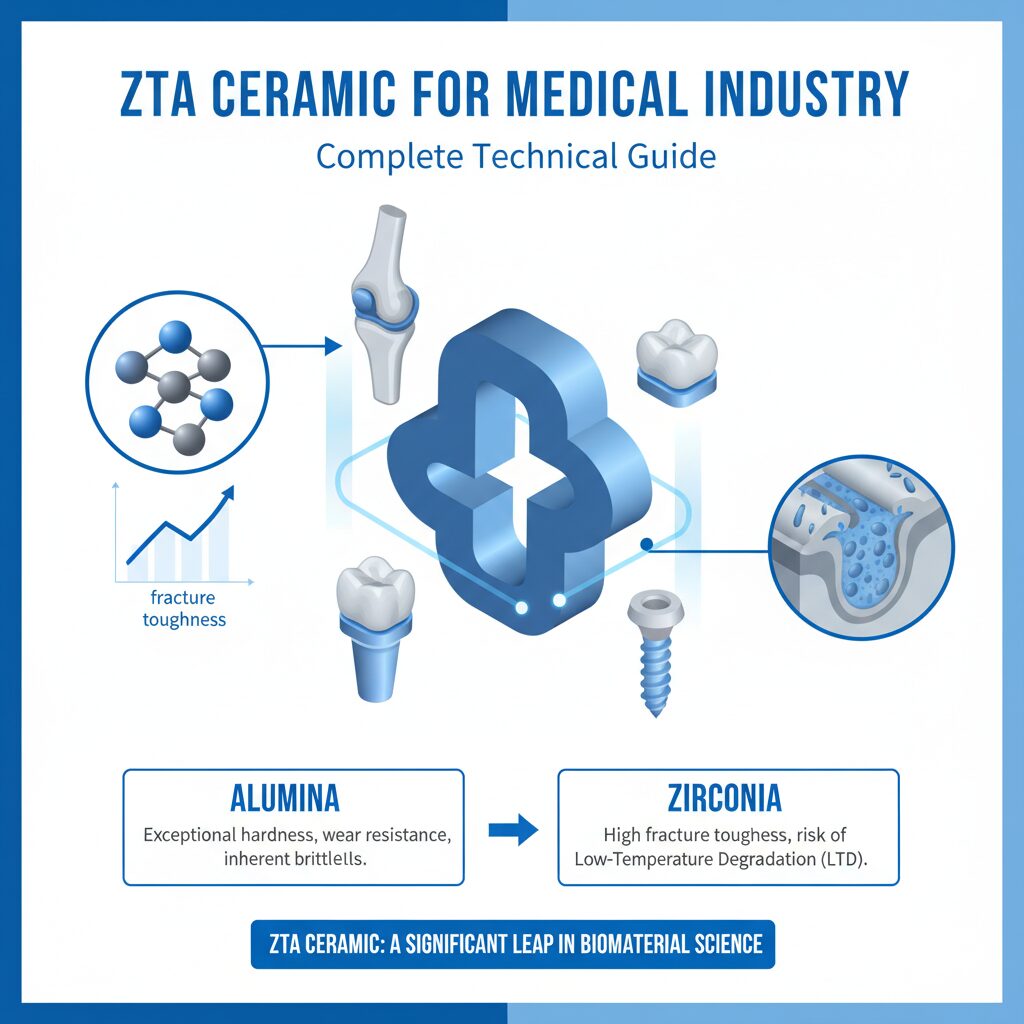
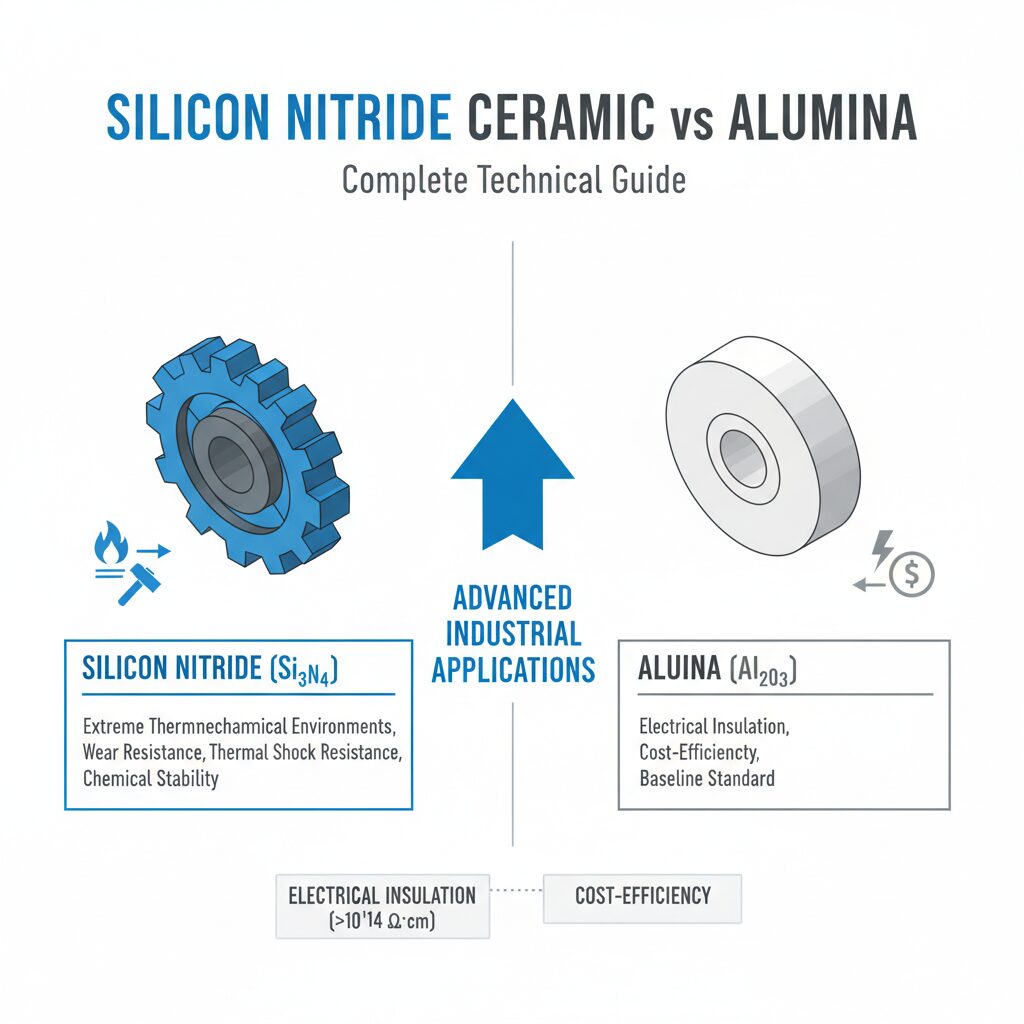
When engineering medical devices, material selection is paramount. Engineers frequently evaluate various advanced technical ceramics to match the specific physiological and mechanical demands of the implant or instrument. While alumina is the most established biomaterial, it is often evaluated alongside other advanced structural materials such as yttria-stabilized tetragonal zirconia polycrystal (Y-TZP) and medical-grade 窒化ケイ素.
In the comparative table below, the targeted medical components are evaluated against standard industrial grades to highlight the critical differences in thermal, mechanical. And economic metrics. Medical applications prioritize chemical inertness and phase stability, whereas industrial counterparts might prioritize high thermal shock resistance or extreme operating temperatures.
| プロパティ | Alumina Ceramic Ceramic Components for Medical (>99.9%) | Industrial Alumina (95%) | ジルコニア(Y-TZP) | 窒化ケイ素 (Si3N4) |
|---|---|---|---|---|
| 熱伝導率 | 35 W/m·K | 24 W/m·K | 2.5 W/m-K | 30 – 90 W/m·K |
| 硬度 | 2000 HV | 1500 HV | 1200 HV | 1500 – 1800 HV |
| 破壊靭性 | 4.8 MPa·m½ | 3.5 MPa-m½ | 8.0 – 10.0 MPa·m½ | 6.0 – 7.0 MPa·m½ |
| コスト | 中程度 | 低い | 高い | 非常に高い |
As the data indicates, while ジルコニア offers superior fracture toughness (up to 10.0 MPa·m½) making it highly resistant to crack propagation, high-purity medical alumina retains a distinct advantage in absolute hardness (2000 HV vs 1200 HV). This extreme hardness makes alumina the superior choice for minimizing particulate wear debris in articulating joints. Conversely, structural 窒化ケイ素 provides an excellent balance of toughness and natural osteointegration, but at a significantly higher raw material and machining cost.
アプリケーション
The intersection of extreme hardness, complete biocompatibility. And electrical insulation allows medical-grade alumina to dominate specific sectors of the medical device industry. Below are the primary applications where engineers specify these components.
- Orthopedic Joint Replacements (Hip and Knee): In total hip arthroplasty (THA), femoral heads and acetabular cup inserts are manufactured from high-purity alumina. Why chosen: The material achieves a polished surface finish of Ra < 0.02 µm. This ultra-smooth, hydrophilic surface provides extreme wear resistance, reducing the generation of sub-micron wear debris to less than 0.1 mm³/year, significantly lowering the risk of aseptic loosening and osteolysis compared to metal-on-polyethylene joints.
- Implantable Electronic Feedthroughs: Used in pacemakers, cochlear implants. And neurostimulators. Why chosen: These devices require hermetic sealing to protect sensitive microelectronics from highly conductive bodily fluids. Alumina provides exceptional electrical insulation (dielectric strength >15 kV/mm and volume resistivity >10¹⁴ Ω·cm) and can be brazed with biocompatible metals like titanium or platinum to create leak-tight seals with helium leak rates < 1×10⁻⁹ atm·cc/sec.
- Dental Prosthetics and Abutments: Employed in dental implant systems and crowns. Why chosen: Alumina offers excellent aesthetics due to its ivory-white color and translucency. This mimics natural dentin. Additionally, its high compressive strength (up to 4000 MPa) ensures it can withstand dynamic masticatory (chewing) forces ranging from 100 N to 500 N without structural failure, while its inertness prevents gum tissue inflammation.
- Electrosurgical Instrument Blades: Utilized in cutting and coagulation tools for minimally invasive surgery. Why chosen: Electrosurgical tools operate using high-frequency alternating current (typically 300 kHz to 5 MHz). Alumina acts as a precise thermal and electrical insulator, directing the 200V-10,000V surgical current precisely to the cutting edge without thermally damaging surrounding healthy tissue. It also easily survives multiple autoclave sterilization cycles at 134°C.
- Medical Imaging X-ray Tube Enclosures: Used as high-voltage insulators in diagnostic X-ray and CT scanning equipment. Why chosen: X-ray tubes operate under hard vacuum conditions (10⁻⁷ Torr) and massive voltage potentials (70 kV to 150 kV). Alumina’s high dielectric strength prevents electrical arcing, while its high thermal conductivity (35 W/m·K) assists in dissipating the extreme heat generated by electron bombardment on the tungsten anode.
製造工程
The transition from raw aluminum oxide powder to a finished, life-saving medical implant is a highly controlled metallurgical and mechanical process. To achieve the rigorous ±0.005mm tolerances required by modern medical assemblies, manufacturers must execute precision control over particle size, binder burnout, thermal profiles. And abrasive machining kinematics.
成形方法
The initial shaping of the ceramic component—known as “green body” forming—dictates the isotropic shrinkage and final density of the part. Medical components rely on high-pressure compaction techniques to eliminate internal voids.
- 冷間静水圧プレス(CIP): High-purity alumina powder (typically with an average particle size of 0.5 to 1.5 µm) is enclosed in an elastomeric mold and subjected to uniform fluid pressure ranging from 200 to 300 MPa. This method ensures uniform powder compaction, crucial for manufacturing large, highly symmetrical components like acetabular cups, yielding a green density of roughly 55-60%.
- Ceramic Injection Molding (CIM): For intricate geometries like dental abutments or pacemaker feedthroughs, alumina powder is compounded with organic thermoplastic binders. The feedstock is injected into hardened steel molds at pressures between 50 and 100 MPa. CIM allows for near-net-shape manufacturing of complex medical micro-components with exceptional repeatability.
焼結
Following forming and the complete thermal debinding of organic additives (conducted at 200°C to 500°C), the green bodies are subjected to high-temperature sintering. For medical-grade alumina, sintering occurs in oxygen-rich or ambient atmospheres at temperatures ranging from 1600°C to 1700°C. During this process, solid-state diffusion occurs, causing the material to shrink by 15% to 20% linearly. The thermal profile must be strictly monitored to achieve >99.5% theoretical density (3.98 g/cm³) while preventing abnormal grain growth, keeping the final grain size strictly below 3.0 µm to maximize fracture toughness (4.5 MPa·m½).
最終加工
Because sintering induces volumetric shrinkage and minor distortions, the as-sintered component rarely meets strict medical dimensional tolerances. Final machining—or “hard machining”—is required. This involves using diamond-impregnated abrasive tools in 4-axis or 5-axis CNC grinding centers. Due to the material’s 2000 HV hardness, traditional carbide or HSS tools cannot be used. Machining operations include surface grinding, cylindrical grinding, ultrasonic machining. And final lapping/polishing to achieve surgical-grade surface finishes of Ra 0.02 µm.
Ready to optimize your medical device manufacturing? グレート・セラミックへのお問い合わせ for advanced design-for-manufacturability (DFM) support on high-purity medical ceramic components.
利点と限界
Implementing alumina ceramic ceramic components for medical devices offers transformative benefits for patient outcomes and device longevity, but the material physics also impose strict engineering constraints.
メリット
- Absolute Biocompatibility and Hemocompatibility: Alumina is completely bioinert. Unlike cobalt-chromium or nickel-titanium alloys, it does not release toxic or allergenic metallic ions (such as Co²⁺ or Cr³⁺) into the bloodstream, eliminating the risk of metallosis or adverse local tissue reactions (ALTR).
- Exceptional Wear Resistance: With a Vickers hardness approaching 2000 HV, alumina is highly resistant to third-body abrasive wear. In orthopedic applications, alumina-on-alumina bearings demonstrate a volumetric wear rate of roughly 0.01 to 0.1 mm³ per million cycles, ensuring implants can last 20 to 30 years in vivo.
- Superior Sterilization Stability: Medical instruments and reusable device housings must withstand repeated sterilization. Alumina remains structurally and dimensionally stable under steam autoclaving (134°C, 0.2 MPa), gamma irradiation (typically 25-50 kGy). And ethylene oxide (EtO) gas exposure without degradation.
- Radio-Translucency: Unlike metal implants that cause severe artifact scattering in Magnetic Resonance Imaging (MRI) and Computed Tomography (CT) scans, high-purity alumina is largely radiolucent and non-magnetic, allowing for clear, unobstructed post-operative diagnostic imaging.
制限事項
- 本質的な脆さ: With a relatively low fracture toughness (4.0 to 5.0 MPa·m½) and a Weibull modulus typically between 10 and 15, alumina is sensitive to point-loading, tensile stress. And impact forces. Engineers must design components with generous radii and avoid sharp internal corners to prevent catastrophic brittle fracture.
- High Manufacturing and Machining Costs: The extreme hardness that makes alumina beneficial in vivo also makes it notoriously difficult to machine. Hard-grinding requires expensive diamond tooling, slow feed rates (often less than 0.01 mm per pass). And extended cycle times. This drives up the cost of complex, tight-tolerance components.
加工に関する考慮事項
The greatest hurdle in the deployment of alumina ceramic ceramic components for medical technology lies in post-sintering precision machining. Medical devices are characterized by unforgiving dimensional requirements. a deviation of just 10 microns in a pacemaker feedthrough can compromise hermeticity, leading to catastrophic device failure in vivo.
When machining alumina (2000 HV), operators face severe challenges including rapid diamond tool wear, thermally induced micro-cracking. And sub-surface damage. Because alumina removes material via brittle fracture rather than plastic deformation, improper feed rates or inadequate coolant delivery will introduce microscopic surface flaws. These micro-flaws act as stress concentrators that drastically reduce the mechanical strength of the implant.
At Great Ceramic, we overcome these machining challenges through optimized “ductile-regime grinding.” By utilizing ultra-stiff 5-axis CNC machine platforms and dynamically balanced diamond grinding wheels (operating at spindle speeds exceeding 30,000 RPM), we maintain a depth of cut so minute (sub-micron levels) that the ceramic is removed plastically, leaving a flawless, crack-free surface. We also employ advanced flood cooling techniques using highly lubricious synthetic coolants to immediately evacuate abrasive swarf and dissipate friction-induced heat away from the workpiece.
Precision Tolerances at Great Ceramic
| Machining Feature | Standard Capability | Minimum Tolerance Achieved |
|---|---|---|
| Outer Diameter (OD) Turning/Grinding | ± 0.010 mm | ± 0.002 mm |
| Inner Diameter (ID) Boring/Grinding | ± 0.015 mm | ± 0.005 mm |
| Surface Flatness | 0.010 mm | 0.002 mm |
| Concentricity / Runout | 0.015 mm | 0.005 mm |
| Surface Finish (Polished) | Ra 0.4 µm | Ra 0.02 µm |
For applications requiring entirely different thermal or conductive profiles, our precision machining expertise extends to harder materials like 炭化ケイ素 and specialized thermal substrates like 窒化アルミニウム または 窒化ホウ素. However, for sheer biocompatibility matched with exceptional wear resistance, high-purity alumina remains the industry gold standard.
FAQ
What is alumina ceramic ceramic components for medical?
Alumina ceramic ceramic components for medical refer to high-purity (typically >99.5% to 99.9%) aluminum oxide (Al2O3) parts engineered specifically for healthcare and surgical applications. These components adhere to strict international standards such as ISO 6474. Because of their exceptional hardness (2000 HV), total chemical inertness. And superior biocompatibility, these components are utilized inside the human body where traditional metals or plastics would fail due to corrosion, wear, or adverse biological reactions.
What are the main applications of alumina ceramic ceramic components for medical?
The primary applications revolve around orthopedics, dentistry. And active implantable medical devices. In orthopedics, it is used to manufacture femoral heads and acetabular cups for hip replacements due to its ultra-low wear rate (10¹⁴ Ω·cm) makes it the material of choice for hermetic feedthroughs in implantable pacemakers, cochlear implants. And neurostimulators, as well as for high-voltage insulators in X-ray tubes and electrosurgical instruments.
How does alumina ceramic ceramic components for medical compare to other ceramics?
When compared to other advanced medical ceramics, alumina stands out for its supreme hardness and high wear resistance. For instance, while medical-grade zirconia (Y-TZP) boasts a higher fracture toughness (up to 10.0 MPa·m½) making it highly resistant to cracking, it is softer (1200 HV) than alumina (2000 HV). Silicon nitride provides a great middle-ground of toughness and osteointegration but is significantly more expensive to manufacture. Alumina remains the most cost-effective, time-tested solution for extreme wear resistance and electrical insulation in the medical field.
What are the advantages of alumina ceramic ceramic components for medical?
The defining advantages include absolute biocompatibility (triggering zero immune or allergic responses), extreme resistance to abrasive wear. And total chemical stability against harsh bodily fluids (resisting pH levels from 2 to 12). Furthermore, these components do not interfere with MRI or CT imaging, as they are non-magnetic and radiolucent. They also easily survive all modern sterilization methods, including repeated steam autoclaving at 134°C, high-dose gamma irradiation. And ethylene oxide gas processing without any loss of mechanical integrity.
How is alumina ceramic ceramic components for medical machined?
Because fully sintered alumina possesses extreme hardness (approaching that of diamond), it cannot be machined using standard high-speed steel or carbide tooling. It must be processed using advanced CNC grinding centers equipped with specialized diamond abrasive wheels. The process involves high spindle speeds, incredibly shallow depths of cut (often < 0.01 mm per pass). And copious amounts of coolant to prevent thermally induced micro-cracking. At Great Ceramic, our specialized 5-axis 精密セラミック加工 capabilities allow us to machine these complex medical components to exact, ultra-tight tolerances as low as ±0.005mm, ensuring perfect assembly fits and flawless surface finishes down to Ra 0.02 µm.
Need custom alumina ceramic ceramic components for medical parts? グレート・セラミックへのお問い合わせ 公差の厳しい精密機械加工サービスについては、Eメールでお問い合わせください。 [email protected].
alumina ceramic ceramic components for medical is widely used in advanced ceramic applications.
詳細はこちら Alumina Ceramic Ceramic Components For Medical および当社の精密セラミック加工サービス。.