








Alumina Ceramic Ceramic Block for Vacuum: Complete Technical Guide
Operating critical equipment in High Vacuum (HV), Ultra-High Vacuum (UHV). And Extreme High Vacuum (XHV) environments (ranging from 10⁻⁶ Torr down to 10⁻¹² Torr) presents extreme engineering challenges. Components must exhibit zero porosity to prevent virtual leaks, maintain exceptionally low outgassing rates (< 10⁻¹⁰ Torr·L/s·cm²). And provide structural and electrical integrity under high-temperature bake-outs. An アルミナ ceramic ceramic block for vacuum engineered to precise tolerances is the definitive solution for these extreme conditions. Unlike standard plastics that outgas heavily or metals that offer no electrical isolation, high-purity alumina (typically 99.5% to 99.8% Al₂O₃) delivers an unparalleled combination of dielectric strength, dimensional stability. And vacuum compatibility. This technical guide explores the material science, manufacturing protocols. And advanced machining strategies required to deploy these critical components. If your application demands zero-defect structural insulators with dimensional tolerances tight to ±0.005mm, Great Ceramic provides the advanced engineering and precision machining necessary to transition your designs from prototype to production.
材料特性
The performance of an alumina ceramic ceramic block for vacuum is dictated by its physical, thermal. And electrical properties. For UHV applications, a high-purity formulation (99.8%) is utilized to eliminate silicate glass binders found in lower-grade ceramics. This can trap gases and compromise vacuum integrity. The following data represents the typical engineering values for vacuum-grade alumina, serving as a baseline for mechanical design and thermal modeling.
| プロパティ | 価値 | 単位 |
|---|---|---|
| 密度 | 3.92 | g/cm³ |
| 硬度 | 1500 | HV |
| 曲げ強度 | 380 | MPa |
| 破壊靭性 | 4.2 | MPa-m½ |
| 熱伝導率 | 30 | W/m-K |
| 電気抵抗率 | >10¹⁴ | Ω・cm |
| 最高使用温度 | 1700 | °C |
In vacuum systems, the density of 3.92 g/cm³ is particularly critical. This value approaches the theoretical maximum for aluminum oxide, indicating a fully densified microstructure with near-zero open porosity. Open porosity is the primary cause of "virtual leaks"—trapped atmospheric gases that slowly escape into the chamber, making it impossible to achieve UHV pressure levels. Furthermore, the exceptional electrical resistivity (>10¹⁴ Ω·cm) ensures that the block acts as a perfect isolator for high-voltage feedthroughs and ion optics, even when subjected to the elevated temperatures (up to 400°C) routinely used during vacuum chamber bake-out cycles.
他のセラミックとの比較
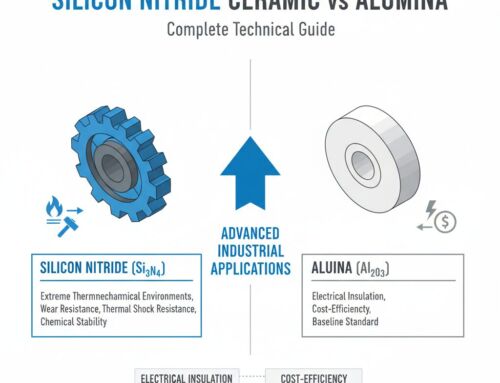
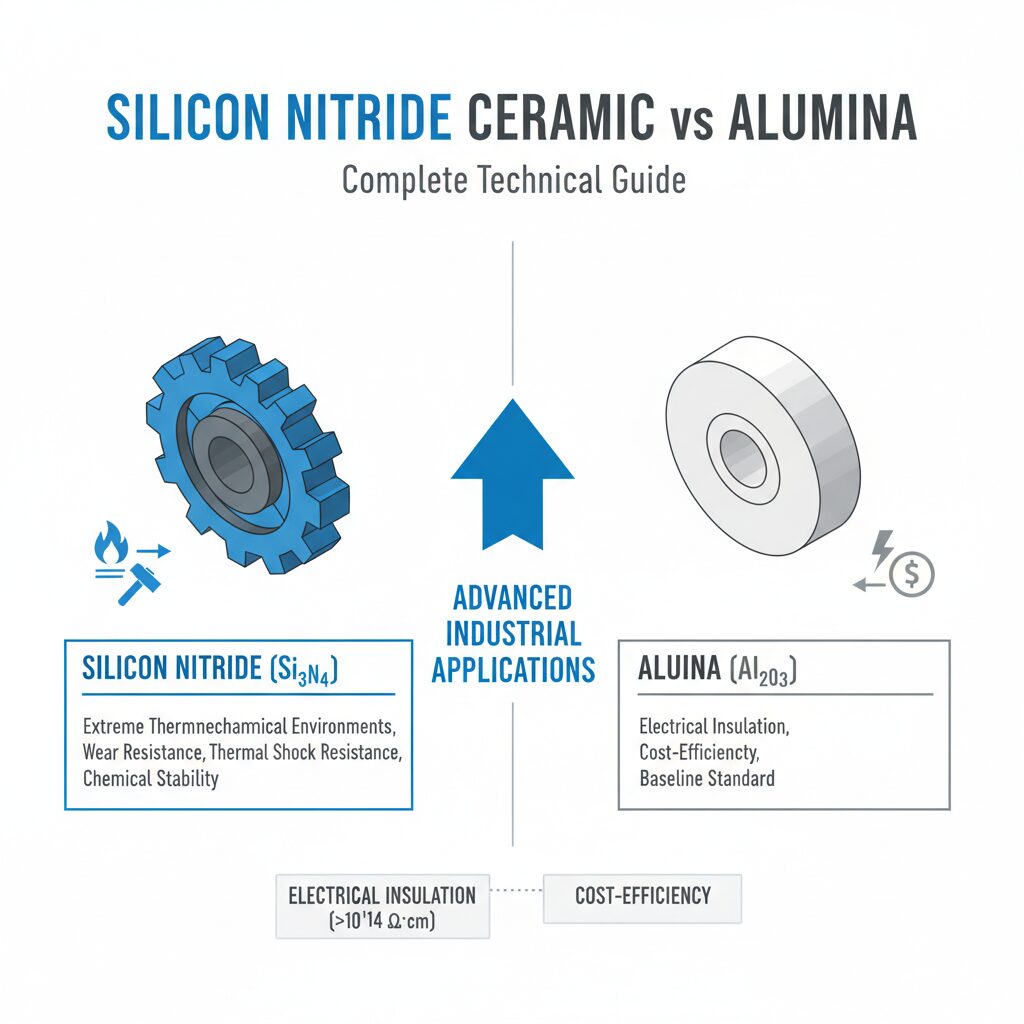
Selecting the correct technical ceramic for vacuum applications requires balancing thermal management, mechanical toughness. And outgassing characteristics. While an alumina ceramic ceramic block for vacuum is the industry standard due to its excellent all-around performance and cost-effectiveness, engineers must understand how it compares to alternative materials such as ジルコニア または 窒化ケイ素. The table below illustrates these comparative metrics under standard environmental conditions.
| プロパティ | Alumina Ceramic Ceramic Block for Vacuum (99.8%) | Standard Alumina (95%) | Zirconia (YTZP) | 窒化ケイ素 (Si3N4) |
|---|---|---|---|---|
| 熱伝導率 | 30 W/m·K | 18 W/m·K | 2.5 W/m-K | 30 – 90 W/m·K |
| 硬度 | 1500 HV | 1100 HV | 1200 HV | 1600 HV |
| 破壊靭性 | 4.2 MPa·m½ | 3.5 MPa-m½ | 8.0 MPa·m½ | 6.5 MPa·m½ |
| Vacuum Outgassing Rate | < 10⁻¹⁰ Torr·L/s·cm² | ~ 10⁻⁸ Torr·L/s·cm² | < 10⁻⁹ Torr·L/s·cm² | < 10⁻¹⁰ Torr·L/s·cm² |
| コスト | 中程度 | 低い | 高い | 非常に高い |
As the data indicates, the high-purity alumina ceramic ceramic block for vacuum vastly outperforms standard 95% alumina in outgassing rates. The 95% grade contains glass fluxing agents (SiO₂, CaO, MgO) that not only decrease thermal conductivity but also introduce micro-porosity that traps water vapor. While Zirconia offers double the fracture toughness (8.0 MPa·m½), making it less prone to chipping during mechanical assembly, its extremely low thermal conductivity (2.5 W/m·K) makes it unsuitable for vacuum applications where heat dissipation is required, as vacuum environments lack convective cooling. Silicon Nitride presents excellent mechanical and thermal properties but comes at a significantly higher cost and poses greater challenges when metallizing and brazing to stainless steel vacuum flanges.
アプリケーション
The unique combination of zero porosity, high dielectric breakdown strength. And extreme dimensional stability makes the high-purity alumina ceramic ceramic block for vacuum indispensable across several high-technology sectors. Below are the primary applications where these components are deployed.
- Mass Spectrometry Isolation Platforms: Deployed as the foundational mounting block for quadrupole and time-of-flight (TOF) mass analyzers. The material is chosen because its non-magnetic nature does not interfere with ion trajectories. And its near-zero outgassing ensures background signal noise is eliminated in the $10^$ Torr operating environment.
- Semiconductor Ion Implantation Systems: Utilized as high-voltage standoff blocks and extraction optic insulators. These environments feature extreme electrical potentials (often exceeding 200 kV). The alumina ceramic ceramic block for vacuum prevents catastrophic arcing while resisting degradation from stray ion beam strikes and high-energy plasma exposure.
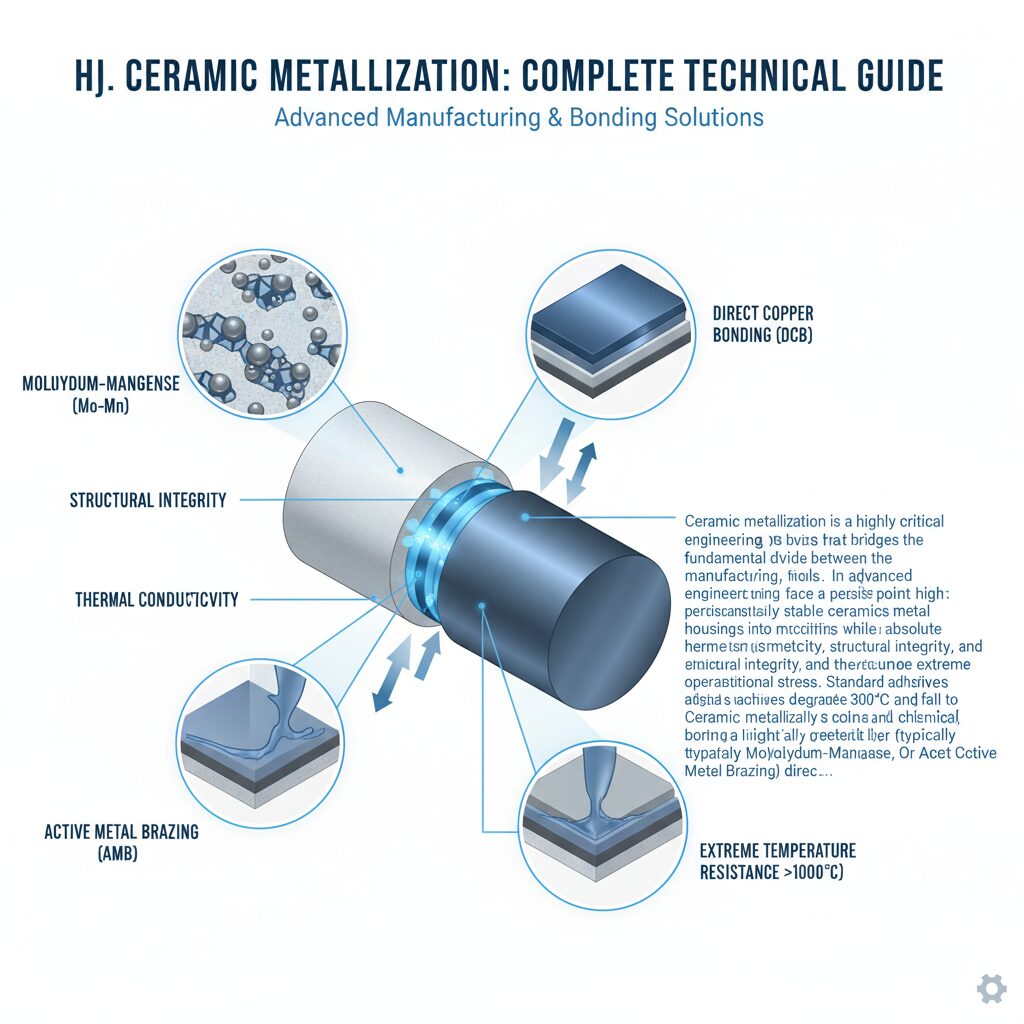
- Ultra-High Vacuum (UHV) Feedthrough Connectors: Implemented as the core insulating structure between conductive pins and the external CF (ConFlat) stainless steel flange. The high-purity alumina can be metallized (using moly-manganese processes) and hermetically brazed, maintaining a leak-tight seal capable of surviving repeated 400°C bake-out cycles without thermal stress failure.
- Electron Beam Lithography (EBL) Reference Stages: Used as the mechanical support base for wafer chucks. EBL systems require nanometer-level precision. The high stiffness (Young's Modulus of 370 GPa) and low coefficient of thermal expansion (8.0 x 10⁻⁶/K) of the alumina block ensure the stage remains dimensionally stable under the localized heat generated by electron beam targeting.
- PVD and CVD Chamber Shielding: Positioned as thermal and electrical standoffs within physical and chemical vapor deposition vacuum chambers. The material is selected because it withstands corrosive precursor gases, aggressive halogen plasma cleaning cycles. And extreme temperature fluctuations without shedding particles that could contaminate semiconductor wafers.
製造工程
Producing an alumina ceramic ceramic block for vacuum that meets UHV specifications requires stringent control over powder chemistry, forming dynamics. And thermal processing. Even microscopic deviations during manufacturing can result in sub-surface voids, localized density variations, or structural defects that compromise the final vacuum integrity and mechanical strength. The manufacturing lifecycle is a multi-stage engineering process designed to maximize bulk density and structural homogeneity.
成形方法
- 冷間静水圧プレス(CIP): The optimal method for producing large, dense vacuum blocks. High-purity alumina powder (particle size 1-5 μm) is encapsulated in a flexible mold and subjected to uniform hydraulic pressure (typically 200 to 300 MPa) from all directions. This creates a "green" (unsintered) block with highly uniform density, completely eliminating the directional stress gradients and compaction voids commonly associated with standard pressing.
- Dry Pressing (Uniaxial Pressing): Utilized for smaller, standardized block geometries. Powder is compressed in a rigid steel die at pressures up to 150 MPa. While highly efficient for volume production, advanced binder systems and carefully controlled pressing speeds are required to ensure trapped air is expelled, preventing laminations that could become virtual leaks in a vacuum chamber.
焼結
The sintering phase transforms the compacted powder into a dense crystalline structure. For a vacuum-grade alumina block, the green body is slowly heated in high-temperature kilns to roughly 1650°C – 1700°C. The temperature profile must be precisely controlled to allow organic binders to burn out completely (between 300°C and 600°C) before the outer pores seal. If the heating rate is too rapid, carbon residue becomes trapped inside the block, severely degrading its dielectric properties and outgassing performance. During peak sintering, the block undergoes a volumetric shrinkage of 15% to 20%. Managing this shrinkage to prevent warping or internal stress fractures is a critical competency of Great Ceramic's metallurgical team.
最終加工
Because sintered high-purity alumina achieves a hardness of 1500 HV, it cannot be processed using traditional metal-cutting tools. Final shaping, hole drilling. And surfacing require 精密セラミック加工 utilizing diamond-impregnated tooling. This phase dictates the final geometrical tolerances (up to ±0.005mm) and surface finish (Ra < 0.1 μm) essential for high-end vacuum mating surfaces. Need a custom prototype manufactured to strict UHV standards? Reach out to Great Ceramic's engineering team to discuss your specific tolerancing and surface finish requirements.
Advantages & Limitations
メリット
- Zero Virtual Leaks: The near 100% theoretical density of the 99.8% alumina ceramic ceramic block for vacuum ensures there is no interconnected porosity, guaranteeing outgassing rates suitable for $10^$ Torr environments.
- Extreme High-Temperature Bake-out Compatibility: Unlike polymers (e.g., PEEK or PTFE) which melt or deform, alumina safely withstands routine vacuum system bake-outs at 400°C to 600°C, accelerating the desorption of water vapor from chamber walls.
- 高い絶縁耐力: Capable of providing electrical isolation exceeding 15 kV/mm, making it the premier choice for protecting sensitive instrumentation from high-voltage arcing in ionized environments.
- Plasma and Chemical Inertness: Highly resistant to sputtering, halogen gases. And reactive plasma, ensuring zero particulate generation that could contaminate silicon wafers or sensitive optical components.
制限事項
- 本質的な脆さ: With a relatively low fracture toughness (4.2 MPa·m½) compared to metals, the blocks are susceptible to chipping or catastrophic failure if subjected to mechanical shock, over-torqued bolts, or uneven clamping forces on vacuum flanges.
- 熱衝撃感受性: Due to a moderate thermal conductivity and high elastic modulus, subjecting an alumina block to sudden temperature changes (ΔT > 200°C) can induce thermal gradients that result in immediate cracking.
加工に関する考慮事項
Transforming a sintered blank into a precise alumina ceramic ceramic block for vacuum is one of the most mechanically demanding processes in industrial manufacturing. Sintered high-purity alumina is vastly harder than steel and highly abrasive. Therefore, CNC grinding, lapping. And polishing with diamond superabrasives are mandatory.
A primary machining challenge for vacuum applications is the prevention of Sub-Surface Damage (SSD). Aggressive machining feeds or using dull diamond wheels can introduce microscopic sub-surface cracks. In a UHV environment, these micro-cracks act as capillary traps for water vapor and cleaning solvents, completely ruining the system's pump-down time and ultimate base pressure. To prevent this, Great Ceramic employs multi-stage CNC grinding protocols. We initiate roughing with coarse-grit diamond wheels (e.g., D126) at high spindle speeds (>10,000 RPM) to remove bulk material, followed by sequential passes using progressively finer grits (down to D15 or finer) at very low feed rates (e.g., 10-20 mm/min). This meticulous step-down approach actively machines away any SSD introduced by the previous roughing passes.
Furthermore, the surface finish of the vacuum block is critical. A rough surface drastically increases the actual surface area compared to the geometric surface area, providing more bonding sites for gas molecules. Great Ceramic routinely achieves surface finishes of Ra 0.1 μm or better through advanced planetary lapping and chemical-mechanical polishing (CMP) techniques, effectively sealing the surface on a microscopic level.
| Machining Feature | Standard Industry Tolerance | Great Ceramic UHV Tolerance Capability |
|---|---|---|
| Dimensional Tolerance | ± 0.05 mm | ± 0.005 mm |
| Surface Finish (Ra) | 0.8 μm | < 0.1 μm |
| Flatness (per 100mm) | 0.02 mm | 0.003 mm |
| Parallelism | 0.02 mm | 0.005 mm |
| Concentricity | 0.05 mm | 0.01 mm |
Another major challenge specific to vacuum-grade ceramics is coolant contamination. Traditional machining requires heavy lubrication to cool the diamond tools and flush away ceramic swarf. However, standard oil-based or sulfur-heavy coolants will impregnate the microscopic surface structure of the alumina. Once in a vacuum, these hydrocarbons outgas indefinitely, destroying the UHV environment. Great Ceramic explicitly utilizes strictly controlled, water-based synthetic coolants for all vacuum block machining. Post-machining, parts undergo rigorous multi-stage ultrasonic cleaning using 18 Megohm deionized (DI) water and isopropyl alcohol at 40kHz, followed by a high-temperature vacuum bake-out process. This ensures every alumina ceramic ceramic block for vacuum arrives in a pristine, installation-ready state, devoid of any hydrocarbon contamination.
If your design requires advanced thermal management exceeding the capabilities of alumina, Great Ceramic also offers precision machining for 炭化ケイ素 components. This offer thermal conductivities above 120 W/m·K while maintaining high vacuum compatibility.
FAQ
What is an alumina ceramic ceramic block for vacuum?
An alumina ceramic ceramic block for vacuum is a high-purity (typically 99.5% to 99.8%) aluminum oxide structural component specifically engineered for High Vacuum (HV) and Ultra-High Vacuum (UHV) environments. Unlike standard ceramics, these blocks are manufactured to achieve near 100% theoretical density, meaning they possess zero interconnected open porosity. This eliminates "virtual leaks" caused by trapped gases. They are utilized to provide rigid structural support, precision alignment. And high-voltage electrical isolation inside vacuum chambers without contributing to system outgassing or particle contamination.
What are the main applications of an alumina ceramic ceramic block for vacuum?
These blocks are primarily deployed in ultra-clean, high-stress environments. Main applications include electrical standoff insulators for semiconductor ion implanters (withstanding >100kV potentials), structural mounting bases for mass spectrometer quadrupole assemblies, dielectric windows for RF energy transmission, reference stages for electron-beam lithography equipment. And insulating collars for hermetic vacuum feedthroughs. In each case, the block provides dimensional stability under thermal stress and prevents arcing in ionized vacuum atmospheres.
How does an alumina ceramic ceramic block for vacuum compare to other ceramics?
While standard 95% アルミナ contains silicate glass binders that trap moisture and increase outgassing, the 99.8% vacuum grade eliminates these impurities, resulting in an outgassing rate lower than $10^$ Torr·L/s·cm². Compared to Zirconia, high-purity alumina offers significantly better thermal conductivity (30 W/m·K vs 2.5 W/m·K), allowing it to dissipate heat in a vacuum where convective cooling does not exist. Compared to Silicon Nitride, alumina is much more cost-effective and easier to metallize and braze to metal vacuum flanges, making it the most balanced engineering choice for structural vacuum components.
What are the advantages of an alumina ceramic ceramic block for vacuum?
The primary advantage is its exceptional vacuum compatibility, characterized by ultra-low outgassing and zero porosity. Furthermore, it boasts immense compressive strength (over 2000 MPa), exceptional dielectric strength (15 kV/mm). And high thermal stability. The material can easily survive the aggressive 400°C to 600°C bake-out cycles required to drive moisture off the walls of UHV chambers. Additionally, alumina is chemically inert, meaning it will not degrade or shed particulates when exposed to reactive halogen plasmas in semiconductor processing chambers.
How is an alumina ceramic ceramic block for vacuum machined?
Because fully sintered alumina has a hardness of 1500 HV, it must be machined using specialized CNC grinding equipment fitted with diamond-bonded abrasives. Standard metal tooling cannot cut it. The process involves high spindle speeds, low feed rates. And rigorous coolant management to prevent micro-cracking and sub-surface damage that could trap gases. Great Ceramic specializes in this exact process, utilizing proprietary diamond grinding kinematics and pure, water-based synthetic coolants to prevent hydrocarbon contamination. We routinely achieve dimensional tolerances of ±0.005mm and optical-grade surface finishes of Ra 0.05 μm, ensuring superior UHV performance directly out of the box.
Need custom alumina ceramic ceramic block for vacuum parts? グレート・セラミックへのお問い合わせ 公差の厳しい精密機械加工サービスについては、Eメールでお問い合わせください。 [email protected] to discuss your UHV engineering requirements with our technical specialists.
詳細はこちら 真空のためのアルミナの陶磁器のブロック および当社の精密セラミック加工サービス。.