








Alumina Ceramic Ball: Complete Technical Guide
In highly demanding industrial environments, standard metallic components frequently fail due to severe abrasive wear, aggressive chemical corrosion. And extreme thermal degradation. The アルミナ ceramic ball has emerged as an indispensable engineering solution for mitigating these catastrophic failures in high-performance fluid handling and rotational motion systems. Manufactured from high-purity aluminum oxide (typically 99.5% to 99.9% purity), an alumina ceramic ball offers a near-perfect microstructural matrix that guarantees exceptional dimensional stability at temperatures exceeding 1,600°C. For engineers designing next-generation check valves, precision metrology instruments. And hybrid angular contact bearings, transitioning to technical ceramics is no longer optional—it is a baseline requirement for extending Mean Time Between Failures (MTBF). By drastically reducing centrifugal dynamic loads and eliminating galling, these components optimize system kinematics. If your project demands unparalleled accuracy, contact Great Ceramic for custom ceramic solutions engineered to tight tolerances of ±0.005mm.
材料特性
The mechanical and thermophysical properties of an alumina ceramic ball dictate its operational envelope in severe service applications. Advanced engineering アルミナ utilized in high-grade spheres features a densely sintered microstructure with an average grain size strictly controlled between 2.0 µm and 5.0 µm. This fine-grained architecture minimizes internal porosity to less than 0.2%, directly translating to optimized macro-mechanical capabilities. The following table delineates the empirical values for high-purity (99.5%) alumina utilized in precision ball manufacturing.
| プロパティ | 価値 | 単位 |
|---|---|---|
| 密度 | 3.90 – 3.92 | g/cm³ |
| 硬度 | 1,500 – 1,650 | HV |
| 曲げ強さ(4点) | 350 – 380 | MPa |
| Fracture Toughness (K_Ic) | 4.5 - 5.0 | MPa-m½ |
| Thermal Conductivity (at 20°C) | 25.0 – 30.0 | W/m-K |
| Electrical Resistivity (at 20°C) | > 10¹⁴ | Ω・cm |
| Max Working Temperature (No Load) | 1,700 | °C |
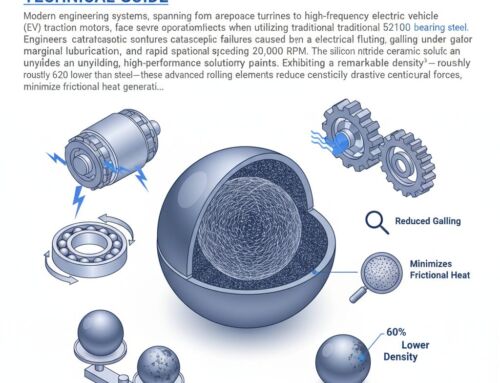
Analyzing these metrics reveals why this material excels in tribological applications. The density of 3.90 g/cm³ is approximately 50% lower than that of bearing steel (7.8 g/cm³). In high-speed rotational applications operating at 25,000 RPM, this lower mass proportionally reduces the centrifugal force exerted on the outer bearing race, thereby minimizing frictional heat generation and extending fatigue life. Furthermore, the extreme Vickers hardness of 1,500 HV ensures that volumetric wear rates remain well below 10⁻⁶ mm³/Nm, even when subjected to abrasive particulate contamination. The material’s dielectric strength, characterized by a volume resistivity exceeding 10¹⁴ Ω·cm, completely eradicates the risk of electrical arcing and galvanic corrosion. This frequently destroy traditional metallic bearing elements in electric vehicle (EV) drivetrains and high-voltage industrial motors.
他のセラミックとの比較
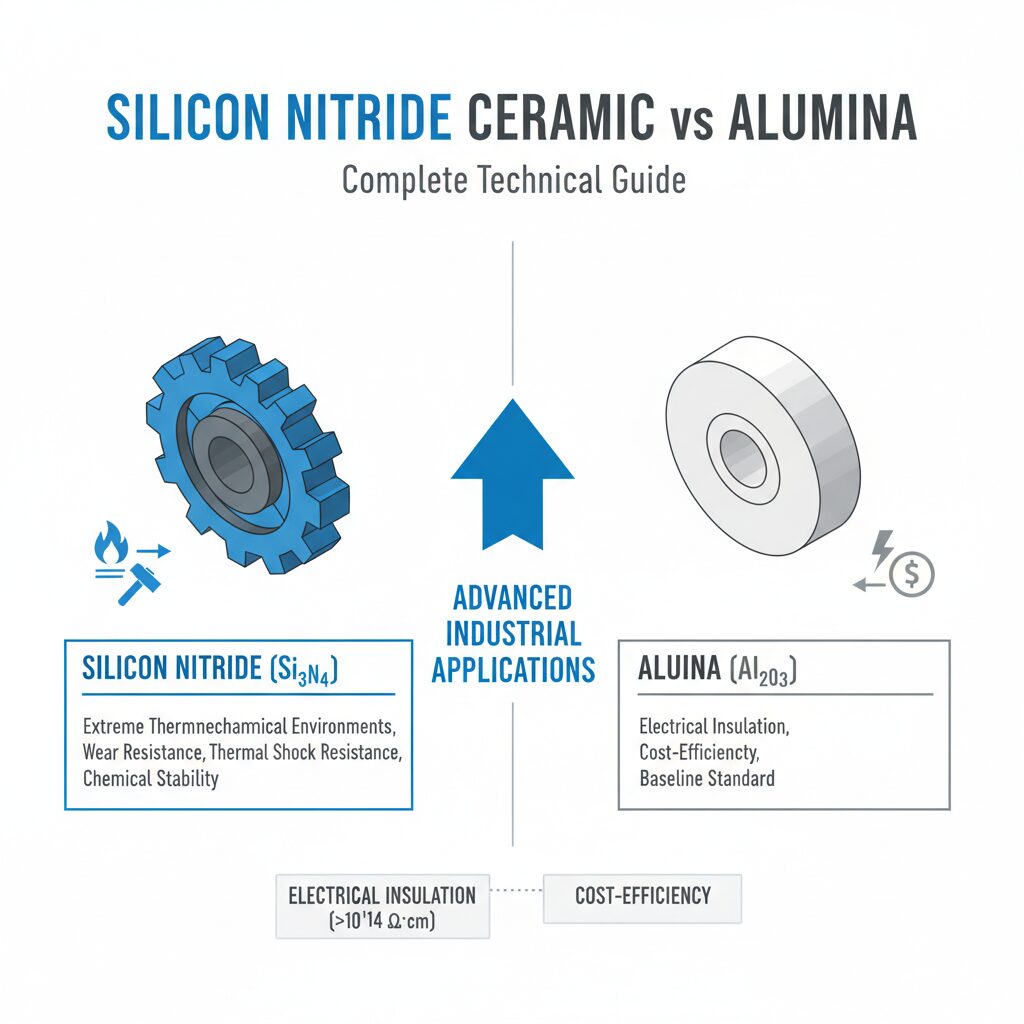
Selecting the correct advanced ceramic requires a rigorous evaluation of opposing material behaviors. While an alumina ceramic ball provides an excellent baseline of hardness, chemical inertness. And cost-efficiency, materials like ジルコニア (Y-TZP) and 窒化ケイ素 (Si3N4) offer alternative performance profiles for highly specialized parameters. The following data compares a precision alumina ceramic ball against other standard industrial ceramic materials.
| プロパティ | Alumina Ceramic Ball | Alumina (95% Bulk) | ジルコニア(Y-TZP) | 窒化ケイ素 (Si3N4) |
|---|---|---|---|---|
| 熱伝導率 (W/m-K) | 30.0 | 20.0 | 2.5 | 25.0 – 30.0 |
| 硬度(HV) | 1,600 | 1,350 | 1,250 | 1,500 – 1,600 |
| 破壊靭性 (MPa-m½) | 4.5 | 3.5 | 9.0 – 10.0 | 6.0 – 8.0 |
| コスト | 中程度 | 低い | 高い | 非常に高い |
The comparative data highlights several critical engineering trade-offs. While an alumina ceramic ball outperforms standard 95% industrial alumina across all mechanical metrics due to its higher purity and superior densification, it presents lower fracture toughness (4.5 MPa·m½) when compared to Yttria-Stabilized Tetragonal Zirconia Polycrystal (Y-TZP). This achieves 9.0 to 10.0 MPa·m½ through stress-induced transformation toughening. However, zirconia suffers from low-temperature degradation (LTD) in hydrothermal environments above 250°C, a condition where alumina remains completely inert. Compared to silicon nitride. This is the gold standard for ultra-high-speed spindle bearings due to its lower density (3.2 g/cm³) and superior thermal shock resistance (ΔT > 600°C), alumina provides a highly competitive alternative at a significantly lower volumetric cost, making it the preferred choice for applications where extreme impact is not the primary failure mode but severe chemical and abrasive resistance is mandatory.
アプリケーション
- High-Speed Precision Bearings: Utilized in hybrid angular contact bearings where the shaft rotates at speeds up to 40,000 RPM. Engineers select the alumina ceramic ball for these environments because its low density (3.90 g/cm³) drastically reduces centrifugal loading and gyroscopic spin moments on the outer race. The material’s innate electrical insulation prevents electrical pitting (fluting) caused by parasitic stray currents in variable frequency drive (VFD) electric motors.
- Check Valves in Chemical Processing Pumps: Deployed as sealing elements in diaphragm and metering pumps handling aggressive media, including concentrated sulfuric acid (H2SO4), sodium hydroxide (NaOH). And abrasive slurries. The material is selected because its absolute chemical inertness (across pH levels 1 through 14) prevents degradation of the spherical geometry, ensuring a continuous, leak-tight seal against the valve seat under hydrostatic pressures exceeding 150 bar.
- Ultra-Fine Grinding and Milling Media: Employed in high-energy attrition mills, planetary ball mills. And stirred media mills for processing pharmaceutical powders, battery materials (lithium-ion cathode compounds). And advanced pigments. An alumina ceramic ball is chosen because its extreme hardness (1,600 HV) maximizes kinetic energy transfer to the particle, yielding sub-micron particle distributions while ensuring zero metallic contamination—a critical requirement for high-purity chemical processing.
- Metrology and Coordinate Measuring Machine (CMM) Probes: Used as the contact stylus tip in highly sensitive dimensional inspection equipment. Engineers specify high-sphericity alumina because of its exceptionally low coefficient of thermal expansion (8.1 × 10⁻⁶/K) and extreme wear resistance. This ensures the probe tip maintains a perfect spherical radius (typically controlled within a tolerance of 0.00013 mm) over thousands of measurement cycles, preventing data drift and calibration errors in multi-axis metrology.
- Flow Control in High-Temperature Fluidics: Integrated into flow meters and rotary joints operating in extreme thermal environments up to 1,600°C, such as aerospace turbine testing rigs and metallurgical gas injection systems. The material is preferred over hardened stainless steel or tungsten carbide because it does not undergo metallurgical phase changes, retains its full mechanical strength at elevated temperatures. And completely resists high-temperature oxidation.
製造工程
The fabrication of a high-precision alumina ceramic ball is a complex, multi-stage metallurgical process that demands absolute environmental control. The sequence begins with the synthesis of ultra-pure Bayer-process alumina powder. To ensure homogeneity, the powder is milled down to sub-micron particle sizes and mixed with organic binders, plasticizers. And deflocculants in a highly controlled aqueous slurry. This rheologically optimized slurry is then pumped into a spray dryer under pressures of 15 to 20 MPa, atomizing the mixture into highly flowable, spherical granules measuring between 50 µm and 150 µm. These granules form the critical precursor architecture required for high-density compaction.
成形方法
- 冷間静水圧プレス(CIP): For high-grade bearing balls, the granulated powder is sealed in flexible elastomer molds and subjected to uniform hydrostatic fluid pressures ranging from 200 to 300 MPa. This isotropic compaction creates a highly uniform “green” compact with gradient-free density, minimizing internal stresses and preventing asymmetrical shrinkage during the subsequent thermal processing phases.
- Roll Forming / Die Pressing: For smaller diameter balls (typically under 10mm) and high-volume commercial runs, automated uniaxial dry pressing or roll forming is utilized. The pre-calculated mass of spray-dried powder is compressed between hard-metal punches. While faster, this method requires rigorous tooling design to accommodate the inherent density gradients along the pressing axis.
焼結
Following a precise thermal debinding profile (ramping at 1°C to 2°C per minute up to 600°C to volatilize organic binders without inducing micro-cracking), the green spheres undergo solid-state sintering. The components are heated in highly oxidizing atmospheric kilns to peak temperatures between 1,600°C and 1,650°C. During this isothermal soak (lasting 2 to 6 hours depending on cross-sectional mass), atomic diffusion eliminates internal porosity, causing the spheres to undergo a volumetric shrinkage of 15% to 20%. Advanced thermal management is crucial here to restrict grain growth to under 5 µm. excessive grain growth exponentially degrades the material’s fracture toughness and surface finish potential.
最終加工
The sintered blanks emerge with rough surface topographies and diametric variations up to 2-3%. Achieving exact geometric perfection requires multi-axis 精密セラミック加工. The process relies on sequential grinding and lapping utilizing progressively finer diamond abrasives. The balls are captured between heavily loaded cast iron or composite plates. Complex kinematic planetary motion ensures random polishing trajectories, systematically erasing geometric lobing and high spots. To illustrate the extreme precision achieved during this stage, refer to the standard ISO 3290 bearing grades below, representing the rigorous tolerances Great Ceramic meets for advanced applications.
| ISO 3290 Grade | Ball Diameter Variation (VDws) | Deviation from Spherical Form (ΔRws) | 表面粗さ(Ra) |
|---|---|---|---|
| Grade 5 (G5) | 0.00013 mm (0.13 µm) | 0.00013 mm (0.13 µm) | 0.014 µm |
| Grade 10 (G10) | 0.00025 mm (0.25 µm) | 0.00025 mm (0.25 µm) | 0.020 µm |
| Grade 16 (G16) | 0.00040 mm (0.40 µm) | 0.00040 mm (0.40 µm) | 0.025 µm |
| Grade 24 (G24) | 0.00060 mm (0.60 µm) | 0.00060 mm (0.60 µm) | 0.050 µm |
利点と限界
メリット
- Exceptional Tribological Performance: With a coefficient of friction (µ) as low as 0.1 to 0.2 against steel when dry. And extreme surface hardness, an alumina ceramic ball drastically reduces galling and adhesive wear, operating seamlessly in boundary lubrication or completely dry conditions where standard metals would instantly cold-weld.
- Absolute Chemical Immuno-Stability: Demonstrates zero oxidation, swelling, or dissolution when exposed to halogen gases, concentrated acids (such as 98% H2SO4). And aggressive alkalis. This allows continuous service in petrochemical refining and semiconductor wafer processing fluid circuits.
- High-Temperature Dimensional Integrity: Unlike martensitic stainless steels (e.g., 440C) that begin to lose their temper and anneal at temperatures above 150°C, alumina retains its extreme hardness and structural rigidity at temperatures exceeding 1,200°C without plastic deformation or creep.
- Non-Magnetic and Electrically Insulating: The complete absence of ferromagnetic domains and high volume resistivity (>10¹⁴ Ω·cm) ensures the material neither disrupts sensitive magnetic fields in MRI equipment nor permits electrical tracking in high-voltage switchgear environments.
制限事項
- Low Fracture Toughness: With a K_Ic of 4.5 MPa·m½, the material is brittle. It is susceptible to catastrophic brittle fracture when subjected to severe point-impact loads, high-velocity ballistics, or heavy shock vibrations. It lacks the plastic deformation zone of metals to absorb extreme kinetic impact.
- 熱衝撃の脆弱性: Due to a relatively high coefficient of thermal expansion combined with a moderate thermal conductivity (30 W/m·K), alumina cannot dissipate rapid localized heating efficiently. A sudden temperature fluctuation (ΔT > 200°C) can induce severe internal tensile stresses, resulting in immediate thermal shock cracking.
加工に関する考慮事項
Transforming a fired blank into a perfectly spherical alumina ceramic ball requires overcoming substantial manufacturing challenges. Because the material’s hardness (1,600 HV) surpasses almost all conventional cutting tools, standard turning, milling, or drilling are impossible. All material removal must occur through stochastic abrasive grinding mechanics utilizing synthetic industrial diamond (ranging from D46 grit for heavy stock removal down to D1 or sub-micron pastes for ultra-fine polishing).
The primary machining challenge lies in preventing Sub-Surface Damage (SSD). If the normal force applied during the lapping process exceeds the critical load threshold of the specific alumina grain structure, the diamond abrasive transitions from a ductile plowing regime to brittle fracture. This creates microscopic lateral and median cracks up to 50 µm beneath the surface. While the surface may appear highly polished, these hidden flaws drastically reduce the Weibull modulus of the ball, leading to premature spalling and fatigue failure under cyclic contact stresses. Controlling lapping pressure (typically maintained between 5 and 15 kPa), optimizing the kinematic sliding velocity. And ensuring a continuous hydrodynamic film of highly concentrated diamond suspension fluid are critical to mitigating SSD.
At Great Ceramic, we leverage proprietary lapping kinematics and multi-stage interferometric metrology to control sphericity down to ISO Grade 5 (0.00013 mm deviation). We specialize in managing the rigorous variables of 精密セラミック加工, guaranteeing components that meet demanding dimensional tolerances of ±0.005mm without sacrificing microstructural integrity. If you are experiencing premature bearing wear or valve failure, contact our engineering team today to upgrade your critical systems with custom-machined advanced ceramics.
FAQ
What is an alumina ceramic ball?
An alumina ceramic ball is a highly engineered spherical component manufactured from densely sintered aluminum oxide (Al2O3), generally exceeding 99.5% purity. It is designed to replace traditional steel or tungsten carbide spheres in industrial applications that experience extreme abrasive wear, corrosive chemical attacks, high temperatures, or strong electrical currents. By leveraging a high-density microcrystalline structure, these balls provide a Vickers hardness exceeding 1,500 HV, excellent compressive strength. And complete chemical inertness, making them ideal for high-stress rotary and fluidic mechanisms.
What are the main applications of an alumina ceramic ball?
The primary applications encompass high-performance engineering sectors requiring extreme durability. They are extensively used as rolling elements in hybrid precision angular contact bearings capable of operating at 40,000 RPM. Additionally, they serve as critical sealing check valves in high-pressure diaphragm pumps handling hazardous chemicals, such as concentrated acids and caustic sodas. Other critical uses include sub-micron grinding media in pharmaceutical attrition mills, highly stable metrology probe tips for Coordinate Measuring Machines (CMMs). And flow control components in high-temperature aerospace fluidics operating above 1,000°C.
How does an alumina ceramic ball compare to other ceramics?
An alumina ceramic ball offers an optimal balance of hardness, chemical resistance. And cost-efficiency. Compared to 炭化ケイ素, it provides superior electrical insulation but possesses lower thermal conductivity. When evaluated against zirconia, alumina demonstrates lower fracture toughness (4.5 vs. 9.5 MPa·m½) but excels in high-temperature hydrothermal environments where zirconia would suffer from phase-degradation (LTD). Unlike silicon nitride. This is lighter and highly resistant to thermal shock, alumina is more economical to produce in high volumes while maintaining the requisite compressive strength and wear profiles needed for intense chemical and tribological applications.
What are the advantages of an alumina ceramic ball?
The core advantages lie in its exceptional survivability in severe environments. The extreme hardness significantly lowers volumetric wear rates, ensuring that the ball maintains its precise spherical geometry millions of cycles longer than metal equivalents. Its low density (3.90 g/cm³) reduces centrifugal forces in high-speed bearings, mitigating heat generation and extending lubricant life. Furthermore, its complete resistance to oxidation, immunity to galvanic corrosion, ability to withstand continuous operational temperatures up to 1,700°C. And absolute electrical insulation make it an irreplaceable component in advanced electromechanical and chemical engineering systems.
How is an alumina ceramic ball machined?
Machining these components from a fired, rough blank to a mirror-finish sphere requires advanced abrasive processing, as the material is too hard for traditional cutting tools. The blanks are processed in specialized lapping machines where they are rolled between heavy cast-iron or composite plates under precisely controlled pressures (5-15 kPa). An abrasive slurry loaded with progressive grades of synthetic diamond (from coarse grits down to 1-micron paste) is introduced, utilizing random planetary kinematics to slowly abrade high spots. Great Ceramic provides exceptional 精密セラミック加工 services, executing stringent process controls to eliminate sub-surface damage and achieve ultra-tight geometric tolerances of ±0.005mm and sphericity up to ISO Grade 5.
Need custom alumina ceramic ball parts? グレート・セラミックへのお問い合わせ 公差の厳しい精密機械加工サービスについては、Eメールでお問い合わせください。 [email protected].
詳細はこちら Alumina Ceramic Ball および当社の精密セラミック加工サービス。.